Class 9 SST Chapter 4 Early Humans and Beginning of Civilisation Question Answer
The Big Questions (Page No. 61)
Question 1.
How did humans live on Earth before the beginning of civilisation?
Answer:
Humans were hunter-gatherers before civilisation came into existence. They used to move from one place to another to find food and other things they needed. Humans killed animals for meat. They picked fruits and nuts to eat. They also collected roots and seeds to survive.
Over time, humans learned how to farm and take care of animals. This led to humans living in settled communities, where they could stay in one place and grow their food and take care of their own animals.
Question 2.
How did humans communicate before writing was invented?
Answer:
Before people could write, they talked to each other using hand gestures and drew pictures in caves and on rocks.
- They also used signs and symbols to share their thoughts.
- People passed on their knowledge, stories and customs to their children and grandchildren by telling them.
- This way, important information was kept alive through generations.
- Humans used spoken language and oral traditions played a role in sharing knowledge.
- People also used cave paintings and rock art to communicate. These helped to pass down stories.
- The customs were also shared through these methods from one generation to the next.
- Knowledge was shared through language.
Question 3.
How is archaeology helpful in understanding our past?
Answer:
Archaeology helps us understand the past by studying material remains such as tools, pottery, buildings, bones, coins and artefacts. These findings provide evidence about how people lived, worked, ate and organised their societies before written records existed.
Question 4.
How did early civilisations interact with each other?
Answer: Early civilisations interacted through trade, migration, cultural exchanges and the sharing of ideas and technologies. Trade routes connected regions such as the Indus Valley, Mesopotamia and Egypt, allowing people to exchange goods, knowledge and cultural practices.
Let’s Explore (Page-62)
Question 1.
You have studied the Harappan script in your previous grades. Observe this seal carefully and discuss why the script has not yet been deciphered. Also, find out what efforts have been made to decipher it. You can use your textbook, consult your teacher or refer to online sources.
Answer:
The Harappan script is still not understood because:
- The writings on seals are very short, usually having a few signs.
- No inscription written in both Harappan and a known language has been discovered to help experts understand the script.
- We do not know what language the Harappan people spoke.
- There are no remaining records that explain what the symbols mean.
Attempts to Understand the Harappan Script
- Archaeologists and linguists have examined thousands of Harappan writings on seals, pottery and other items.
- Researchers have looked at the symbols, compared them with old scripts from other places like Mesopotamia and Egypt.
- Computer analysis has been used to find patterns in the symbols.
- Some scholars think the script might be a form of the Dravidian language or another old language, but nobody agrees on this.
- The Harappan script remains a mystery.
Think About It (Page-65)
Question 1.
Why do you think early humans left Africa to migrate to other regions?
Answer:
Early humans may have migrated out of Africa to other parts of the world in search of food, water and better living conditions. In some regions, shifts in climate (droughts or cooling periods) may have caused a reduction in resource availability. With the increase in the human population, people moved to new areas to find animals to hunt, plants to gather and suitable places to live.
Let’s Explore (Page-66 )
Let us observe the images given above and answer the following questions.
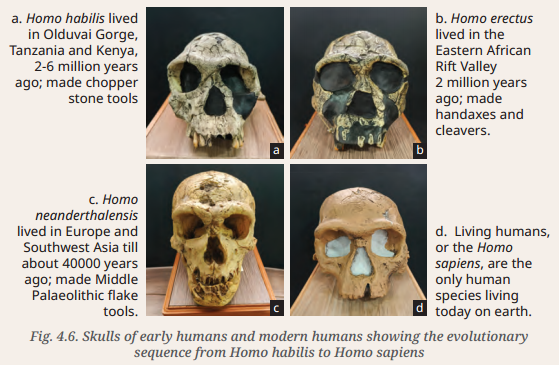
Question 1.
Do you notice any changes in the shape or features of the skulls across different ancestors?
Answer:
Yes, as we move from Homo habilis to Homo sapiens, the skull gets bigger and rounder, indicating an increase in brain size. The forehead rises, and the jaws, teeth and brow ridges become smaller and less prominent.
Question 2.
Can you observe a gradual straightening of the face?
Answer:
Yes. There is a gradual straightening of the face through the evolutionary sequence. In earlier humans, such as Homo habilis, the face projects forward. Over time, the face becomes flatter and more vertical, reaching its most developed form in Homo sapiens.
Think About It (Page-67)
Question 1.
Why do you think the shift to farming during the Neolithic period is called a revolution rather than a simple change? Discuss with your classmates.
Answer:
The shift to farming is called a revolution because it completely changed human life. People began to grow food, settle in villages, domesticate animals and develop organised societies, leading to the rise of civilisations.
Think About It (Page-71)
Question 1.
Observe the chart (Fig. 4.4) and identify the animals that were domesticated. Also, try to identify the types of human habitats and objects that were used. Are any of these still used in present times?
Answer:
Dogs, sheep, goats, cattle and pigs were domestic animals. Neolithic people lived in permanent village settlements and used polished stone tools, grinding stones and earthenware pottery. Many of these animals, tools and settlements are still in use today, but in a better form.
Think About It (Page-76)
Question 1.
Harappans had their own standard systems of weight and measurement. This is evident from the meticulously planned settlements and efficient interregional trade practices of the Harappans. They followed a binary multiple (1, 2, 4, 8, 16, etc.) system for weighing smaller units and used multiples of ten for larger denominations. Such cubical stone weights have been reported from several sites. Can you imagine how long-distance trade would have been affected had the Harappans not followed a standard system of weights?
Answer:
Without a standard system of weights, long-distance trade would have been full of confusion, cheating and disputes over quantities. Standard weights assured fair trade, accuracy and smooth commercial transactions throughout the Harappan civilisation.
Think About It (Page-77)
Question 1.
Why were rivers important in the growth of early civilisations?
Answer:
Rivers were really important for civilisations. They gave people a supply of water for drinking, farming and homes.
- The rivers also left behind soil.
- This helped farmers grow crops and have food.
- Rivers were also like roads for moving people and goods between towns and areas.
- They helped connect places.
- Many early civilisations started in river valleys.
- For example, the Sindhu-Sarasvati Civilisation, also known as the Harappan Civilisation, began in a river valley.
- Rivers played a role in their growth.
- They supported the people living there.
Let’s Explore (Page-79)
Question 1.
Can you find out which countries constitute West Asia in the present times?
Answer:
West Asia today includes countries such as Saudi Arabia, Iraq, Iran, Syria, Jordan, Lebanon, Israel, Palestine, Turkey, Yemen, Oman, the UAE, Qatar, Bahrain and Kuwait. It is also commonly referred to as the Middle East.
Let’s Explore (Page-80)
Question 1
Do you find any similarities between the temples in India and those of the Sumerian civilisation as centres of socio-cultural and economic activity?
Answer:
Yes. Like many temples in India, Sumerian temples were not only places of worship but also centres of social, cultural and economic activities. They helped organise community life, managed resources and supported trade and other economic functions.
Let’s Explore (Page-81)
Question 1.
The cuneiform writing system was contemporary to the Harappan script, but while cuneiform has been deciphered, the Harappan script has not yet been deciphered. Do you think our understanding of a civilisation changes when its script is deciphered compared to when it is not?
Answer:
Yes. Deciphering a script allows historians to understand a civilisation directly through its written records. Since the Harappanscript remains undeciphered, our knowledge of the Harappan civilisation is more limited and depends mainly on archaeological evidence.
Let’s Explore (Page-82)
Question 1.
The Epic of Gilgamesh, written during the Mesopotamian civilisation, is one of the earliest stories written. Try to find out more such stories and share therh in class.
Answer:
Besides the Epic of Gilgamesh, some of the earliest’, known stories from ancient civilisations are:
- Enuma Elish – A Mesopotamian story explaining the creation of the world and the rise of the god Marduk.
- The Tale of Sinuhe – An Egyptian story about an official who flees Egypt and later returns home.
- The Story of Wenamun – An account of a journey undertaken by an Egyptian priest.
- Rig Veda – Contains hymns, legends and stories from early Indian civilisation.
- The Iliad and the Odyssey – Early Greek epics traditionally attributed to Homer.
Think About It (Page-85)
Question 1.
Why do you think there is a scale with a heart on one side and a feather on the other (Refer NCERT for Fig. 4.29)? What can this papyrus tell us about early Egyptian beliefs?
Answer:
The scale represents the Egyptian concept that an individual’s activities were evaluated after death by weighing their heart against a feather. It demonstrates Egyptians’ belief in morality, divine judgement and an afterlife.
Let’s Map (Page-86)
Question 1.
Can you locate the River Nile on the given map? “Why do you think the northern part is called Lower Egypt and the southern part Upper Egypt”?
Answer:
Yes, the River Nile can be located in north-eastern Africa. It flows from south to north and empties into the Mediterranean Sea.
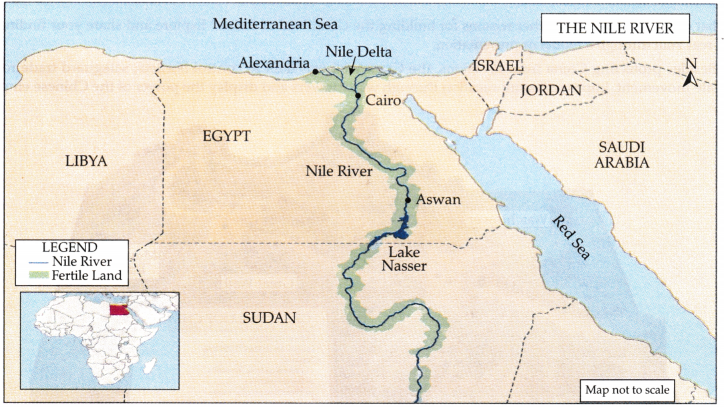
The northern part of ancient Egypt is called Lower Egypt and the southern part is called Upper Egypt because these names are based on the flow of the Nile River, not on their position on the map.
- Upper Egypt is in the south because it is upstream, closer to the source of the Nile.
- Lower Egypt is in the north because it is downstream, near the Nile Delta, where the river flows into the Mediterranean Sea.
Let’s Explore (Page-87)
Question 1.
Look at the social hierarchy pyramid in the image. What were the social classes of early Egypt? What were the different kinds of occupations? What could have been a typical daily routine of the people from each class?
Answer:
The social classes of early Egypt were Pharaoh, Government Officials, Nobles and Priests, Free Landholders, Artisans and Merchants and Serfs and Slaves.
Their occupations ranged from ruling, administration and religious duties to farming, trading, craftwork and labour. Each class had different daily responsibilities based on its role in Egyptian society.
Think About It (Page-88)
Question 1.
Observe the images given above. What do they tell you about Egyptian fashion?
Answer:
The images suggest that Egyptians preferred simple, practical and well-crafted items made from natural materials. The sandals show that footwear was used, especially in hot and dry conditions. The decorated pottery also indicates an appreciation for art and design.
Question 2.
Which social classes do you think used these items?
Answer:
The sandals may have been used by wealthier people such as nobles, officials, merchants and priests, although simpler; versions could have been used by common people.
The basket/container was likely used by ordinary households, farmers, traders and artisans for storage. The pottery vessel may have been used by various social classes for storing food, water, oils or other goods.
Question 3.
What clues in the images help you to make this guess?
Answer:
The sandals are neatly woven and carefully made, suggesting skilled craftsmanship.
The basket is made from plant fibres, showing the use of locally available natural materials.
The pottery vessel has decorative designs, indicating artistic skill and cultural interest in decoration.
None of the objects appears to be made of gold or precious stones, so they were likely everyday items rather than luxury goods reserved only for the Pharaoh and nobles.
Try to explain your reasoning based on the materials, designs or accessories shown in the pictures.
Let’s Explore (Page-90)
Question 1.
The Chinese script is logographic, with characters Representing entire words or morphemes (the smallest meaningful units of language) rather than sounds. Person A Tree 木 Explore more examples of Chinese characters that resemble the objects or ideas they represent. Note down at least two such characters and explain how their shapes are connected to their meanings.
Answer:
Two Chinese characters that resemble the objects they represent are 木 (tree) and 山 (mountain). The character 木 looks like a tree with branches and a trunk, while ill resembles mountain peaks. Similarly, 日 represents the sun and 人 resembles a standing person. These examples show how early Chinese writing used visual symbols to represent real objects and ideas.
Think About It (Page-92)
Question 1.
What could have been the other reasons for building the Great Wall of China? Explore and share your findings on the Great Wall through a model or presentation.
Answer:
Besides protecting China from invasions, the Great Wall was built to control borders, safeguard trade routes, regulate movement, improve communication through watchtowers and display the power of the Chinese empire.
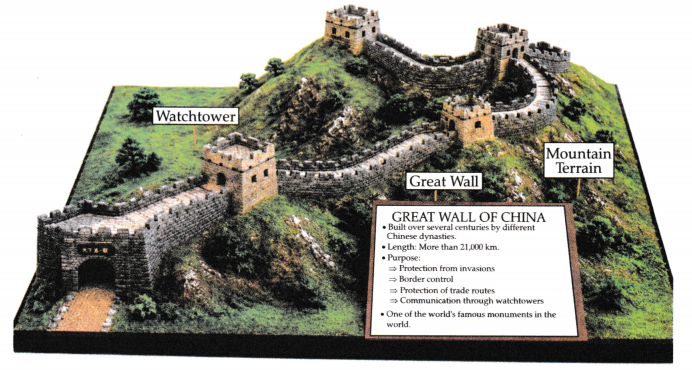
Let’s Recall (Page-92)
Question 1.
Do you remember studying about the Silk Route in Grade 7? How was India connected with it? Can you recollect China’s contact with India with reference to Buddhism that you studied in Grade 7?
Answer:
India was connected to the Silk Route through trade with China and other regions. India and China were also linked through Buddhism, as Buddhist monks, scholars and pilgrims travelled between the two countries, spreading religious and cultural ideas.
Questions and Activities (Page No. 93-94)
Question 1.
Do you think life became easier or more challenging after humans started farming? Give two reasons for your answer.
Answer:
Life became easier in some ways after humans started farming, although it also brought new challenges.
Two reasons:
Regular food supply: Farming enabled people to grow their own food instead of depending entirely on hunting and gathering. This made food more reliable and helped populations grow.
Permanent settlements: People could settle in one place, build homes and villages and develop crafts, trade and other occupations, leading to more organised societies.
Question 2.
The environment offers human societies both opportunities and challenges. Explain with reference to early farming communities and river-valley civilisations.
Answer:
The environment offered both opportunities and challenges to early farming communities and river- valley civilisations.
Opportunities:
Rivers provided water for drinking, irrigation and agriculture.
- Fertile soil deposited by rivers helped grow crops and produce food surpluses.
- Rivers served as routes for transport and trade, encouraging the growth of settlements and cities.
Challenges:
- Floods could destroy crops, homes and settlements.
- Droughts or changes in river courses could lead to water shortages and crop failures.
- People had to develop methods to manage water and protect their settlements from natural disasters.
Thus, while the environment supported the growth of farming and civilisations by providing fertile land and water, it also posed challenges such as floods and droughts that people had to overcome.
Question 3.
Why do historians divide early human history into different ages, such as the Stone Age, the Bronze Age and the Iron Age? What does this classification tell us about human progress?
Answer:
Historians break down the history of humans into the Stone Age, the Bronze Age and the Iron Age. They do this based on the materials people used to make tools and weapons. The materials people used say a lot about how far they had come with technology and how they lived at different times.
This way of looking at history tells us how humans got better and better at things. It shows how humans slowly got better at making things and coming up with ideas. People used stone tools to hunt and gather food and to farm in the Stone Age.
In the Bronze Age, people figured out how to make tools and weapons out of bronze. This led to new ways of farming, trading and living in cities.
In the Iron Age, people made tools and weapons out of iron. These tools and weapons were stronger. They helped people farm better and make things. They also helped societies and kingdoms grow.
Question 4.
Imagine you are a Neolithic farmer. Describe one day of your life. What challenges would you face that a hunter- gatherer would not?
Answer:
If I were a farmer, I would get up really early and go to my fields to see how my crops are doing. My crops would need water, so I would water them. I would also pull out the weeds that are growing with my crops. ‘ I would have to keep animals from eating my crops. I > would take care of my Neolithic farmer animals like \cattle, sheep and goats.
Later in the day, I might help make food from grain, make pottery or fix tools that are broken or store food so we can eat it later. When the day is over,
I would go back to my village and hang out with my family.
Being a farmer is different from being a hunter-gatherer. As a farmer, I would have some new problems to deal with.
- My crops might not grow because of too little rain, too much rain, pests or sickness. This could mean my family does not have food to eat.
- I would have to work hard and stay in one place to take care of my crops and my Neolithic farmer animals. Hunter-gatherers can just move to another place whenever they want to find more food.
As a farmer, farming is good because it means we have food to eat all the time and a home that does not move. Being a Neolithic farmer also means I have a lot of work to do and some big risks, like my crops not growing, that hunter-gatherers do not have to worry about.
Question 5.
Imagine that the Harappan script gets deciphered tomorrow. What new types of information do you think historians might learn?
Answer:
If the Harappan script were deciphered tomorrow, historians could learn many new details about the Harappan (Sindhu-Sarasvati) Civilisation.
They might discover:
- The language spoken by the Harappan people.
- Their system of government and administration.
- Details about trade, business and economic activities.
- Their religious beliefs, customs and rituals.
- Information about daily life, occupations and social organisation.
- Names of rulers, cities and important individuals.
- Records of laws, agreements and historical events. Deciphering the script would provide direct evidence from the Harappans themselves rather than relying only on archaeological remains such as seals, pottery and buildings.
Question 6.
Prepare a table with three columns—Palaeolithic, Mesolithic, and Neolithic—and fill in their distinctive features: tools, settlements, art, and subsistence.
Answer:
Palaeolithic, Mesolithic, and Neolithic Ages – Comparison Table
| Features | Palaeolithic Age (Old Stone Age) | Mesolithic Age (Middle Stone Age) | Neolithic Age (New Stone Age) |
| Time Period | The earliest phase of human history | The transitional phase between the Palaeolithic and the Neolithic | Period of settled farming communities |
| Tools | Large, rough stone tools such as hand axes and choppers | Small stone tools called micro- liths | Polished stone tools, axes, sickles and grinding stones |
| Settlements | Nomadic life; lived in caves and rock shelters | Temporary camps near rivers and lakef | Permanent village settlements and houses |
| Art | Cave paintings and rock art depicting animals and hunting scenes | Continued rock paintings with more detailed human activities | Pottery, weaving, decorative objects and some rock art |
| Subsistence (Food) | Hunting wild animals and gathering fruits, roots and nuts | Hunting, fishing, gathering and the beginning of animal domestication | Farming, animal husbandry, food production and storage |
| Lifestyle | Hunter-gatherers, constantly moving | Semi-settled life | Settled agricultural life |
| Animals | Wild animals hunted for food | Early domestication of dogs | Domestication of cattle, sheep, goats, pigs, etc. |
Question 7.
“Bronze Age civilisations developed independently but shared common features.” Examine this statement with reference to the civilisations given in the chapter.
Answer:
Bronze Age civilisations developed independently but shared common features:
The Bronze Age civilisations discussed in the chapter— Harappan Civilisation, Mesopotamian Civilisation, Egyptian Civilisation and Chinese Civilisation — developed independently in different regions of the world. However, they shared several common features.
| Independent Developments | Common Features |
| They arose in different geographical regions and river valleys. | All developed near rivers that provided water and fertile soil. |
| Each civilisation had its own language, script, culture and religious beliefs. | Agriculture formed the basis of their economy. |
| They developed distinct forms of architecture, art and administration. | They had organised governments and social hierarchies. |
| Their writing systems were different, such as the Harappan script, cuneiform, hieroglyphics and Chinese characters. | Trade and exchange of goods were important economic activities. |
| They evolved according to local environmental conditions and resources. | They used bronze tools and developed specialised occupations such as artisans, merchants and priests. |
Question 8.
Although the Bronze Age civilisations emerged independently in different parts of the world, they shared common characteristics such as agriculture, urban centres, trade networks, social organisation and technological advancements. These similarities show how human societies responded in comparable ways to the opportunities and challenges of settled life and civilisation.
Answer:
Although rivers gave benefits, they also made life hard for early societies. Let’s talk about them. Advantages:
- Rivers gave people water to drink and to help grow- food.
- The soil near rivers was good for growing crops.
- Rivers helped people trade and move goods around.
Disadvantages:
- Rivers could destroy crops and homes.
- When there wasn’t enough rain, rivers could dry up and people wouldn’t have enough water.
- Sometimes rivers changed direction. That could cause problems for people living nearby.
- Rivers helped early societies grow and get bigger. People had to deal with floods, droughts and other problems. Rivers were important for people’s lives. They also brought many challenges that people had to face.
Question 9.
With the help of your teacher, find out more about the Code of Hammurabi. Why was it important? Do you think it was fair to all sections of society? Give reasons for your answer.
Answer:
The Code of Hammurabi was an old set of laws. King Hammurabi of Babylon made the Code of Hammurabi around 1750 BCE. The Code of Hammurabi had laws about buying and selling things, owning property, family issues and crimes.
Why was the Code of Hammurabi important?
- It made sure everyone knew what was allowed and what was not.
- The Code of Hammurabi helped keep people safe and in line.
- It made sure people knew what would happen if they broke the Code of Hammurabi laws.
Was the Code of Hammurabi fair to everyone?
- No, it was not. The punishments were often based on who you were.
- If you were rich and powerful, you might get treated differently.
- The Code of Hammurabi laws were not the same for everyone
- The Code of Hammurabi was important because it gave people a set of rules to follow.
- The Code of Hammurabi helped people know what, and to expect.
However, the Code of Hammurabi was not perfect be cause it did not treat everyone the same.
Question 10.
If you had to choose one major innovation from early civilisations that changed the world permanently, what would it be and why?
Answer:
The development of writing was one of the most important innovations because it helped people record and share knowledge, making the growth of civilisation possible.
Question 11.
Compare the social hierarchy and daily life of people in the Egyptian civilisation with those in Mesopotamia or China. What similarities and differences do you notice?
Answer:
Comparison of the Social Hierarchy and Daily Life of People in the Egyptian Civilisation and Mesopotamia Civilisation
| Aspect | Egyptian Civilisation | Mesopotamian Civilisation |
| Social Hierarchy | Pharaoh at the top, followed by officials, nobles, priests, artisans, merchants, farmers and slaves. | King at the top, followed by priests, officials, merchants, artisans, farmers and slaves. |
| Role of Religion | Pharaoh was considered divine and closely linked to the gods. | Priests and temples played a major role in society and administration. |
| Daily Life | Most people were farmers dependent on the Nile River. | Most people were farmers dependent on the Tigris and Euphrates Rivers. |
| Occupations | Farming, trade, crafts, administration and religious duties. | Farming, trade, crafts, record-keeping and temple service. |
| Writing | Hieroglyphic script. | Cuneiform script. |
Similarities
- Both had a hierarchical society with rulers, officials, priests, farmers, artisans and slaves.
- Agriculture was the main occupation.
- Religion played an important role in daily life.
- Trade and crafts were important economic activities.
Differences
- In Egypt, the Pharaoh was regarded as a divine ruler, while Mesopotamian kings were powerful but not usually considered gods.
- Egyptian civilisation was centred on the Nile River, whereas Mesopotamia developed between the Tigris and Euphrates Rivers.
- They used different writing systems and had distinct cultural traditions.
Thus, both civilisations had organised social structures and agricultural economies, but they differed in their political systems, religious beliefs and cultural practices.
Question 12.
Activity: Using maps, locate the major rivers and civilisations of Mesopotamia, Egypt, China, and the Sindhu–Sarasvatī Valley. Mark the trade links between them.
Answer:
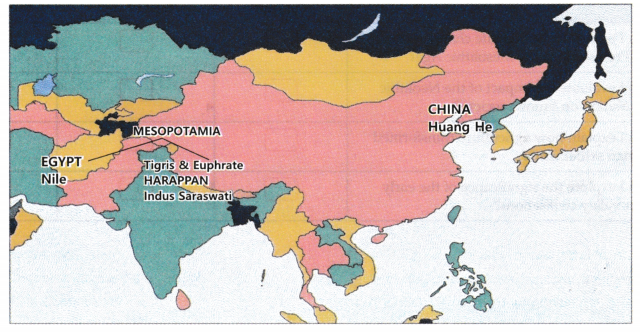
Question 13.
Activity: Choose one early civilisation (Mesopotamia, Egypt or China) and prepare a mini scrapbook or a presentation showing its innovations in tools, writing, art and architecture. Include pictures, brief descriptions and explain their significance.
Answer:
Idea to make – Mini Scrapbook: Mesopotamian Civilisation
(Land between the Tigris and Euphrates Rivers)
We are going to explore the Mesopotamian Civilisation. It existed between the Tigris and Euphrates Rivers.
1. Tools and Technology Innovations:
- People used bronze to make tools like hoes and sickles. They also made weapons from bronze.
- The wheel was an important invention.
- It was used in carts and for making pottery.
- Farmers built irrigation canals to grow crops. Significance:
- With these tools, people produced more food.
- Trade and transport became easier.
- Cities started to grow and become more powerful. The Mesopotamian Civilisation grew because of these tools.
2. Writing System Innovation:
- The Mesopotamians created a writing system called cuneiform.
- They wrote on clay tablets.
Significance:
- Cuneiform was one of the earliest writing systems in the world.
- People used it to keep records, write laws and tell stories.
- It helped with administration and education.
- The writing system was crucial for the Mesopotamian Civilisation.
3. Art and Culture Innovations:
- They used cylinder seals to mark property.
- Artists made carvings and sculptures of kings and gods.
- Potters created painted pottery and decorative objects. ‘ Significance:
Art showed a person’s status and identity.
- It preserved their beliefs and royal power.
- Mesopotamian art helped develop artistic traditions. The art and culture of Mesopotamia are still studied today.
4. Architecture
Innovations:
- They built ziggurats, which were step temples.
- Cities like Babylon had planned walls and gates.
- Builders used bricks.
Significance:
- Ziggurats were the centre of community life.
- They showed the power of kings and gods.
- They were examples of organised urban architecture. Mesopotamian architecture was impressive.
Overall Importance
Mesopotamia is often called the “Cradle of Civilisation”. It introduced important things, including:
- Writing systems, which helped keep records.
- Urban cities, where people lived together.
- Laws, like Hammurabi’s Code, which kept order.
- Advanced agriculture and trade systems, which helped them grow.
The Mesopotamian Civilisation was very important.
It helped shape the world we live in today. Mesopotamia was truly the cradle of civilisation.
Early Humans and Beginning of Civilisation Class 9 Extra Questions and Answers
Early Humans and Beginning of Civilisation Class 9 Very Short Question Answer
Question 1.
Define ‘prehistory’ and name the primary source of information about prehistoric humans.
Answer:
- Prehistory refers to the period of human existence before the invention of writing — spanning approximately 2 million years.
- Primary sources: Stone tools, fossils, skeletal remains, cave paintings and other material remains studied through archaeology and anthropology.
Question 2.
What are microliths? Why were they technologically superior to Palaeolithic tools?
Answer:
- Microliths are tiny, sharp stone blades characteristic of the Mesolithic Age (~10,000-8,000 BCE),
- They were superior because they could be hafted (fixed) to wooden or bone handles, creating composite tools like bows, arrows and harpoons — far more precise, lighter and efficient than heavy Palaeolithic hand-axes.
Question 3.
How did the discovery of fire transform human life in the Palaeolithic Age?
Answer:
- Fire (~1.5 mya) provided warmth in cold climates and protection against predators — extending habitable regions for Homo erectus.
- Cooking food made it safer, more digestible and more nutritious — enabling brain development. Fire also extended social activity beyond daylight, encouraging group bonding, communication and culture.
Question 4.
Name two Mesolithic sites in India and mention the key feature of each.
Answer:
- Bagor (Rajasthan): One of India’s largest Mesolithic sites; shows microliths and earliest evidence of animal herding.
- Bhimbetka (M-P ): Famous rock shelter complex with cave paintings spanning Mesolithic to the historic period (UNESCO World Heritage Site).
Question 5.
What is the ‘Neolithic Revolution? Why is it called a ‘revolution?
Answer:
- The Neolithic Revolution refers to the transition from food collection (hunting-gathering) to food production (settled agriculture), beginning —10,000 BCE — coined by V. Gordon Childe (1936).
- It is called a ‘revolution’ because its effects were sweeping and irreversible: surplus food paved the way for permanent villages and population growth. This enabled specialised crafts, which created a social hierarchy and eventually culminated in civilisation.
Question 6.
Define ‘domestication’. Give one example each of a domesticated plant and animal with the region of origin.
Answer:
- Domestication: selective breeding of wild species over generations to develop traits useful to humans (size, yield, tameness).
- Plant: Wheat — domesticated in the Fertile Crescent (~10,000 BCE). Animal: Dog — domesticated from wolves globally (~15,000 BCE).
Question 7.
How did agriculture change the food habits of early humans?
Answer:
- Before agriculture, food was seasonal and unpredictable — entirely dependent on wild game and plants, varying by season and location.
- After agriculture, humans grew specific crops (wheat, barley, millets, rice in India) and raised animals for milk and meat — food became predictable, storable and more varied. Surplus food was possible for the first time and different regions developed distinct food traditions based on local crops (e.g., wheat-based flatbreads in India and Mesopotamia, rice in China).
Question 8.
What was significant about the Harappan drainage system? What does it tell us about Harappan society?
Answer:
(i) The Harappan civilisation had an advanced underground covered drainage network connecting every house one of the world’s earliest municipal sanitation systems.
(ii) It tells us:
- centralised civic planning and administration were present to design and maintain such infrastructure;
- Harappan society prioritised public health and sanitation at a level unmatched by contemporary civilisations like Mesopotamia or Egypt.
Question 9.
Name any two contributions of Mesopotamian civilisation to world history and explain their significance.
Answer:
- Cuneiform writing (∼3500 BCE): World’s first writing system; enabled record-keeping, law (Hammurabi’s Code) and literature (Epic of Gilgamesh) the basis of all written civilisation.
- Sexagesimal (base-60) math: Gave us 60 seconds per minute, 60 minutes per hour and 360-degree geometry used globally today in every clock, map and GPS system. This makes Mesopotamia’s mathematical legacy the most pervasive ancient contribution to everyday modern life.
Question 10.
What do the Pashupati Seal and Mother Goddess figurines reveal about Harappan religion?
Answer:
- Pashupati Seal: A horned deity in yoga posture, surrounded by animals suggests proto-Shiva worship and reverence for a lord of animals, indicating deep connections to later Hindu religious traditions.
- Mother Goddess figurines: Numerous terracotta female figures indicate fertility worship possibly pointing to a matriarchal religious tradition. Together, they suggest a polytheistic tradition rooted in nature, fertility and animal worship, with possible ceremonial use of the Great Bath.
Question 11.
Explain the social and political structure of ancient Egypt.
Answer:
- Political: Pharaoh absolute divine ruler, considered the son of Ra (sun god) and embodiment of Horus; commanded the army, owned all land and directed all religious life. No written code Pharaoh’s decree was law, guided by the principle of Ma’at (truth and justice).
- Social hierarchy: The structure consisted of the Pharaoh at the top, followed by nobles and high priests, scribes and officials, craftsmen and traders, and finally farmers and slaves. Religion and state were inseparable priests held enormous power and temples owned vast estates, making religious authority a form of political power.
Early Humans and Beginning of Civilisation Class 9 Short Question Answer
Question 1.
Describe the life of Palaeolithic hunter-gatherers. How did they meet their basic needs?
Answer:
- Food: Hunted wild game with stone weapons; gathered wild fruits, berries, tubers; fished in rivers — entirely dependent on nature’s seasonal availability.
- Shelter: Lived in caves, rock shelters and temporary open-air camps of branches and animal skins; moved seasonally following herds and plant cycles.
- Tools and Technology: Chipped stone hand-axes and scrapers; fire (∼1.5 mya) transformed cooking, warmth and protection. (Specific industry names removed as per syllabus scope.)
- Social life: Small nomadic bands of 20-50; cooperative hunting; symbolic culture evidenced by cave paintings at Bhimbetka (India) showing cognitive sophistication.
Question 2.
Explain the significance of the Mesolithic Age as a transitional phase. Give examples from India.
Answer:
- Technological transition: Microliths replaced Palaeolithic hand-axes — enabling composite tools (arrows, harpoons) for more efficient hunting and fishing.
- Environmental catalyst: End of the Ice Age (∼10,000 BCE) expanded forests and rivers in India, compelling new lifestyle adaptations at sites like Bagor (Rajasthan) and Adamgarh (M.P.).
- Social shift: Semi-permanent settlements appeared near water bodies — Adamgarh (M.P.) provides India’s earliest animal domestication evidence; Bhimbetka paintings confirm composite weapons in use.
Question 3.
How were prehistoric time divisions organised? Compare the Palaeolithic and Mesolithic Ages.
Answer:
(i) Prehistoric time is classified primarily by the type of tools used and the corresponding lifestyle — forming the archaeological ‘Ages’ system proposed by Thomsen (1836).
Comparison:
| Aspect | Palaeolithic | Mesolithic |
| Tools | Chipped stone— hand- axe, chopper | Microliths—composite blades |
| Food | Hunting and gathering wild sources | Hunting + early herding + wild grains |
| Shelter | Caves and rock shelters; fully nomadic | Semi-permanent huts near rivers |
| India | Bhimbetka, Attira mpakkam | Bagor, Adamgarh, Langhnaj |
Question 4.
Explain how agriculture and domestication contributed to the establishment of a ‘prosperous economy’ in early civilisations.
Answer:
- Agriculture produced food surplus — freeing some people from farming to become potters, weavers, carpenters and traders; this division of labour was the economic engine of early civilisations.
- Domesticated animals provided food (milk, meat), labour (ploughing) and goods (wool, leather) — multiplying economic productivity well beyond what was possible through hunting alone.
- Craft specialisation created trade goods — pottery, textiles, metalwork. Pottery enabled grain storage across seasons. This surplus-and-specialisation cycle was the foundation of Harappan, Mesopotamian and Egyptian urban economies.
Question 5.
Explain the factors that led to the Neolithic Revolution and how it gave rise to settled life.
Answer:
- End of Ice Age (~10,000 BCE) stabilised climate, enabling consistent crop cultivation in river valleys — the foundational geographic precondition.
- Accidental observation of discarded seeds sprouting near camps led to intentional cultivation over generations; population pressure made hunting alone insufficient — farming was a necessity.
- Settled life followed automatically: crops required regular tending, harvests needed storage and houses were built near fields — creating the first permanent villages at sites like Mehrgarh (~7,000 BCE) in South Asia.
Question 6.
Compare the social structures of Mesopotamia and Egypt. What similarities and differences do you notice?
Answer:
- Similarity Hierarchical pyramid: Both had a supreme ruler at the top (King/Lugal in Mesopotamia; \Pharaoh in Egypt), followed by priests, officials, artisans, farmers and slaves at the bottom a strict social stratification in both cases.
- Similarity Divine authority: Mesopotamian kings were divinely chosen by gods; the Egyptian Pharaoh was literally a living god both used religion as the foundation of political legitimacy.
- Difference Degree of divinity: The Pharaoh was a god incarnate (son of Ra, embodiment of Horus); the Mesopotamian king was human but divinely appointed. Additionally, Mesopotamia had Hammurabi’s written Code of 282 laws; Egypt had no comparable codified law Pharaoh’s decree was law itself.
Question 7.
Explain how trade and crafts contributed to the economic prosperity of early civilisations.
Answer:
- Agricultural surplus was the foundation: freeing workers for specialised crafts: pottery, metalwork, weaving and jewellery. Harappan seals and weights found in Mesopotamia confirm long-distance maritime trade; Harappan exports included cotton, beads and pottery.
- Craft diversity drove inter-regional demand: Harappan beadwork, Mesopotamian bronze, Egyptian linen each civilisation had unique products others wanted, creating sustained trade networks.
- Standard weights: Harappan cuboid stone weights (binary system) across the entire cultural zone indicate regulated, institutionalised commerce the hallmark of a prosperous organised economy.
Question 8.
How did the religious beliefs of Mesopotamia shape its political and cultural life?
Answer:
- Patron deity-city bond: Each city worshipped a specific god (Ur – Nanna; Babylon – Marduk) religion was inseparable from civic identity; the city existed to serve its patron god.
- Ziggurats were the gods’ earthly homes and economic redistribution centres: priests managed grain storage and tax collection, making religious authority structurally identical to economic power.
- Divine law: Hammurabi claimed Shamash (The sun/ justice god) gave him the Code making 282 laws divinely authorised and politically unquestionable; literature (Epic of Gilgamesh) explored mortality and divine favour, showing religion as the lens for all Mesopotamian cultural expression.
Early Humans and Beginning of Civilisation Class 9 Long Question Answer
Question 1.
How were prehistoric time divisions organised? Describe the classification of the Stone Age with reference to tools, lifestyle and important sites in India.
Answer:
- Prehistoric time is classified by the tools used and the nature of human life — the Three-Age System (Stone→Bronze→Iron) was proposed by Christian Jiirgensen Thomsen (1836) and remains the basis of prehistoric classification.
- Palaeolithic Age (2.6 mya-10,000 BCE): Oldest period; rough chipped stone tools. Nomadic hunters. Fire discovered (∼1.5 mya). Cave art at Bhimbetka (M.P.) — UNESCO site; Attirampakkam (T.N.) tools date to 1.5 mya, the oldest in South Asia.
- Mesolithic Age (10,000-8,000 BCE): Post-Ice Age transition. Microliths replaced heavy tools. Semi-permanent settlements near rivers. Key Indian sites: Bagor (Rajasthan), Adamgarh (M.P.), Langhnaj (Gujarat).
- Neolithic Age (8,000-4,000 BCE): ‘New Stone Age’ — polished stone tools. Farming and animal domestication began. Pottery appeared. Indian sites: Mehrgarh
(Balochistan, -7000 BCE), Burzahom (Kashmir), Chirand (Bihar). - Chalcolithic Age (4,000-2,500 BCE): Copper tools introduced alongside stone, marking the transition frbm the Stone Age to metal use. Early towns and organised trade networks emerged — a brief but important bridge to the Bronze Age. (Content kept minimal as per syllabus scope.)
Question 2.
‘The Mesolithic Age was a period of significant transition in human history.’ Substantiate with specific examples from India.
Answer:
- The Mesolithic Age (10,000-8,000 BCE) bridges the nomadic Palaeolithic world and the settled Neolithic world — making it a highly significant transitional period in prehistoric development.
- Technological transition: Microliths replaced heavy stone tools; composite weapons (arrow tips, harpoons) made hunting significantly more efficient — a major technological leap reflected at Bagor and Bhimbetka sites.
- Environmental catalyst: End of the Last Ice Age (~10,000 BCE) transformed India’s landscapes — forests expanded, new river systems formed, compelling communities at Adamgarh (M.P.) and Langhnaj (Gujarat) to adapt tools and diet.
- Social/settlement shift: Semi-permanent settlements appeared near water bodies — Bagor (Rajasthan) shows sedentary tendencies alongside microliths and Adamgarh gives India’s earliest animal domestication evidence.
- Cultural evidence: Bhimbetka (M.P.) contains Mesolithic paintings showing bows and dynamic hunt scenes — confirming both composite tool use and sophisticated symbolic culture.
- The Mesolithic was the transitional bridge connecting the nomadic prehistoric world with the settled agricultural world of the Neolithic — without it, the agricultural and urban revolutions that followed would not have been possible.
Question 3.
Describe the Neolithic Revolution and explain how it transformed human society. Refer to specific examples from India. CB1 3
Answer:
- The Neolithic Revolution (V. Gordon Childe, 1936) — the shift from nomadic food-gathering to settled agriculture — marks a landmark prehistoric transition that fundamentally changed how humans lived organised society and interacted with the environment.
- Origins and multi-region spread: Agriculture
began in the Fertile Crescent (~10,000 BCE). Emerged independently in South Asia (wheat and cotton at Mehrgarh, —7000 BCE), China (rice) and the Americas (maize, potato) proving this was a global human response to similar environmental pressures. - Technology: Polished stone tools (axes, sickles, grinding stones) replaced chipped Palaeolithic tools. Pottery was invented storing surplus grain for the first time. Mud-brick architecture replaced caves.
- Social transformation: Permanent villages emerged. Population grew. Division of labour created potters, weavers and traders. Social stratification appeared as surplus created wealth differences the roots of class- based society.
- Food habits transformed: Hunter-gatherers depended on wild, seasonal food. Neolithic farmers at sites like Mehrgarh grew their own crops and raised animals — creating predictable, surplus food and diversified regional diets based on cultivated grains and domesticated animals.
- Long-term legacy: This chain of surplus leading to specialisation, which caused social stratification and ultimately the formation of the state, laid the foundation for all subsequent civilisations i.e., Harappan, Mesopotamian and Egyptian.
Question 4.
Trace the evolution of human dietary habits from the Palaeolithic Age to the era of early civilisations. How did the domestication of plants and animals act as a turning point in this journey?
Answer:
- Hunter-Gatherer Diet (Palaeolithic and Mesolithic): Early humans were entirely dependent on wild, unpredictable food sources. They hunted game, caught fish, and gathered seasonal berries, roots, tubers, and honey, requiring them to constantly move to follow food availability.
- The Turning Point (Domestication): The Neolithic transition to food production changed everything. Cultivated grains like wheat, barley, millets, and rice formed a stable dietary base, while domesticated animals provided consistent sources of milk, meat, and eggs.
- Food Security and Storage: With the invention of pottery in the Neolithic age, surplus grain could be stored for the first time. The human diet transformed from being seasonal and uncertain to being varied, predictable, and reliable.
- Civilisation-Era Diets: By the time of the river valley civilisations, complex diets emerged based entirely on agricultural surplus.
- Regional Variations: Diets adapted to local geography. Harappans consumed wheat, barley, fish, and meat; Mesopotamians relied on barley bread, beer, and dates; while Egyptians depended heavily on Nile-grown wheat, barley, onions, and lentils.
Question 5.
Describe the social, political and religious structures of Mesopotamia and Egypt. What similarities can you draw between these two civilisations?
Answer:
(i) Mesopotamia Political: City-states ruled by kings (lugal) with both secular and religious authority; evolved from Sumerian city-states to Akkadian Empire (Sargon, —2350 BCE) to Babylonian Empire (Hammurabi);
Hammurabi’s Code of 282 laws codified governance publicly.
(ii) Egypt Political: Unified —3100 BCE under Pharaoh Narmer. The Pharaoh was absolute and divine a living god; centralised administration with viziers, scribes and regional governors (nomarchs); no written law code Pharaoh’s decree guided by Ma’at was law.
(iii) Mesopotamia Religious: Polytheistic Anu, Enlil, Inanna and Marduk. Each city had a patron god. Ziggurats were earthly homes of gods. Priests managed religious and economic affairs. Humans existed to serve gods (creation myth).
(iv) Egypt Religious: Polytheistic Ra, Osiris, Isis, Horus. Pharaoh was divine (son of Ra, embodiment of Horus). Afterlife belief was central mummification, Book of the Dead, pyramid construction. Temples at Karnak and Luxor were religious and economic centres.
(v) Similarities: Both had stratified hierarchies ranging from the ruler, followed by priests, scribes, farmers, and slaves. Both fused religion and political power completely. Both produced monumental architecture (Ziggurats vs Pyramids). Both used specialised scribes for record-keeping (cuneiform vs hieroglyphics). Both demonstrate that organised religion, defined governance and social hierarchy were universal features of early complex societies.
Question 6.
Evaluate the contributions of the Harappan civilisation to urban development. How do its features reflect a well- planned society?
Answer:
(i) The Harappan or Indus Valley Civilisation (~3000-1500 BCE) stands apart from its ancient contemporaries for its remarkable level of civic planning a sophistication that was not matched globally until the modern era.
(ii) Grid-pattern streets: Roads at right angles; major streets and lanes forming a disciplined urban grid indicates pre-planned, centralised urban design rather than organic growth; this required a governing authority with planning power.
(iii) Standardised bricks: The 1:2:4 ratio brick used uniformly across all Harappan sites from Balochistan to Gujarat indicates either a centralised governing authority enforcing standards or a deep shared technical tradition spanning a vast area.
(iv) Covered drainage: Underground brick-lined drains connecting every house an extraordinary municipal sanitation achievement; no contemporary civilisation not Egypt, not Mesopotamia had an equivalent system.
(v) Trade infrastructure: Standardised cuboid weights (binary: 1,2,4,8…) across all sites Lothal dockyard (Gujarat) evidence of regulated, institutionalised commerce spanning thousands of kilometres. Harappan seals found in Mesopotamia confirm international maritime trade.
(vi) Absence of war/monarchy monuments: Unlike Egypt and Mesopotamia, no royal tombs or war scenes exist suggesting civic welfare was prioritised over royal glorification. Relatively uniform residential architecture hints at a less extreme social hierarchy. These inferences (based on material evidence) point to a form of governance unique among ancient civilisations.
Early Humans and Beginning of Civilisation Class 9 Competency Based Questions
Question 1.
Define ‘Neolithic Revolution’. Identify the region where agriculture FIRST began and name any two crops cultivated there.
Answer:
- The Neolithic Revolution refers to the transition from nomadic hunting-gathering to settled agriculture, coined by V. Gordon Childe (1936). It began —10,000 BCE.
- Agriculture first began in the Fertile Crescent (modern Iraq/Syria/Palestine). Two crops cultivated there: emmer wheat and barley the staple crops of all early Mesopotamian and Egyptian civilisations.
Question 2.
Explain how prehistoric time is divided into archaeological ages. Name the ages and state the key feature of each.
Answer:
- Prehistoric time is classified by tools and lifestyle: the Three-Age System (Stone Bronze Iron) was proposed by Christian Jiirgensen Thomsen (1836) and remains the framework for prehistoric classification.
- Palaeolithic (2.6 mya-10,000 BCE): chipped stone tools, nomadic hunters; Mesolithic (10,000-8,000 BCE) microliths, semi-nomadic transition; Neolithic (8,000-4,000 BCE) polished stone, farming, pottery; Chalcolithic (4,000-2,500 BCE) copper stone, early towns.
Question 3.
Who was Hammurabi? What is the significance of his law code for the history of governance?
Answer:
- Hammurabi was the Babylonian king (~1792-1750 BCE) who created the world’s earliest comprehensive written law code (~1754 BCE), comprising 282 laws covering trade, property, family and crime.
- Significance: (a) publicly displayed on a stone stele for all citizens to see; (b) introduced ‘an eye for an eye’ proportional justice; (c) demonstrated that stable, just states require formal written law a principle foundational to Roman law, Islamic jurisprudence and all modern legal constitutions.
Question 4.
Describe the main features of Harappan town planning that make it unique among ancient civilisations.
Answer:
(i) The main features of Harappan town planning are:
(a) Grid-plan streets roads crossed at right angles;
(b) Standardised bricks in uniform 1:2:4 ratio across all sites;
(c) Advanced covered drainage from every house unprecedented sanitation; (d) Two-zoned cities citadel (Great Bath, granaries) and lower residential town.
(ii) What makes Harappan planning unique: No contemporary civilisation not Egypt, not Mesopotamia had an equivalent municipal drainage system. The standardised bricks across a 1,500 km cultural zone imply centralised engineering standards that were not seen again until the modern era.
Question 5.
A village has just begun farming wheat. Explain how this SINGLE change would affect (a) food security, (b) social structure and (c) trade.
Answer:
- Food security: Farming creates a predictable, storable supply surplus grain eliminates seasonal starvation. Population grows as the risk of food shortage declines and the village can withstand poor hunting seasons.
- Social structure: Not all villagers need to farm some specialise as potters, weavers, traders. Division of labour creates hierarchy as those controlling grain stores gain political power, laying the foundation for social stratification.
- Trade: Surplus grain and craft goods (pottery, textiles) can be exchanged with neighbouring settlements for materials the village lacks (metals, obsidian, timber). Trade routes form, spreading technology, culture and creating the economic basis for towns.
Question 6.
Herodotus called Egypt ‘the gift of the Nile’. Apply your understanding to explain how the Nile shaped Egyptian society in (a) agriculture, (b) trade and (c) religion. Answer:
(a) Agriculture: Annual Nile floods deposited rich black silt extremely fertile soil without irrigation; enabled reliable cultivation of wheat, barley and flax. Predictable floods made Egypt one of the ancient world’s most stable agricultural economies the foundation of its wealth.
(b) Trade: The Nile was Egypt’s main highway boats transported grain, building stone and trade goods between Upper Egypt and the Mediterranean delta. Egypt traded gold, papyrus and grain for timber (Levant) and ivory and gold (Nubia) making the Nile a commercial artery as much as a water source.
(c) Religion: The Nile’s annual cycle (drought followed by flood) shaped Egyptian cosmology Osiris (god of afterlife and agriculture) was associated with the river’s renewal. The flood’s death-and-rebirth cycle mirrored Egyptian beliefs about the afterlife, making the Nile central to both physical survival and spiritual understanding.
Question 7.
Study the following data table carefully and answer the questions that follow:
Table: Comparison of Prehistoric Ages Tools, Food and Settlement Patterns
| Feature | Palaeolithic Age | Mesolithic Age | Neolithic Age |
| Time Period | 2.6 mya – 10,000 BCE | 10,000 – 8,000 BCE | 8,000 – 4,000 BCE |
| Tools | Chipped stone tools | Microliths (composite) | Polished stone tools |
| Food Source | Wild game, berries, roots | Hunting + early herding + wild grains | Cultivated crops + domesticated animals |
| Settlement | Caves and rock shelters | Semi-permanent huts near rivers | Permanent villages |
| Key India Site | Attirampakkam(T.N.) | Bagor (Rajasthan) and Bhimbetka (M.P.) | Mehrgarh (Balochistan) |
(i) According to Table, which age saw the FIRST use of composite tools?
(A) Palaeolithic
(B) Mesolithic
(C) Neolithic
(D) Chalcolithic
Answer:
Option (B) is correct.
Explanation: The table clearly shows ‘Microliths (com¬posite)’ under the Mesolithic Age column. Palaeolithic tools were simply chipped stone with no composite element; Neolithic used polished tools; Chalcolithic introduced copper all postdate the Mesolithic composite microlith.
(ii) Based on Table, what was the MOST significant change in food habits between the Palaeolithic and Neolithic Ages?
(A) People began eating cooked meat only in the Neolithic
(B) Food shifted from wild, unpredictable sources to culti¬vated crops and domesticated animals
(C) Wild game was completely abandoned in the Neolith¬ic
(D) Food habits did not change significantly across the ages
Answer:
Option (B) is correct.
Explanation: The table shows the transition from “Wild game, berries, roots’ (Palaeolithic) to ‘Hunting + early herding + wild grains’ (Mesolithic) and finally to ‘Cultivated crops + domesticated animals’ (Neolithic). This progression from entirely wild sources to deliberately cultivated food represents the single most transformative dietary change in prehistory.
(iii) Table 1 shows that Bhimbetka is a Palaeolithic site but also mentioned in the chapter as having Mesolithic paintings. What does this tell us about Bhimbetka?
(A) The dates in the table are incorrect
(B) Bhimbetka was occupied and used across multiple prehistoric ages, not just one
(C) Bhimbetka belongs only to the Mesolithic Age
(D) Only Palaeolithic humans were capable of cave art
Answer:
Option (B) is correct.
Explanation: Bhimbetka is a UNESCO World Heritage Site precisely because its cave paintings and rock shelters span from the Palaeolithic through to the historical period multiple ages. The table uses it as a Palaeolithic ‘key site’ but that doesn’t exclude its Mesolithic significance. It is one of the richest multi-period archaeological sites in India.
(iv) Based on the settlement data in Table, what was the MAIN reason humans moved from caves to semi-permanent huts in the Mesolithic?
(A) Caves were destroyed by floods
(B) Environmental changes and the need to be near new food sources like rivers after the Ice Age
(C) Humans forgot how to live in caves
(D) Government policies relocated people
Answer:
Option (B) is correct.
Explanation: The Mesolithic Age began with the end of the Ice Age (~10,000 BCE), which changed India’s climate dramatically forests expanded and river systems developed. New food sources (fish, riverine plants, water animals) made riverside locations highly attractive. Semi-permanent huts near rivers allowed humans to exploit these new resources while adapting to changed conditions.
Question 8.
Analyse why all four major early civilisations developed along river valleys. Do you think geography was the MOST important factor in the rise of civilisation? Justify.
Answer:
- Why rivers: Annual floods deposited rich silt (natural fertiliser), enabling high yields without soil exhaustion. Rivers were transport arteries for trade, provided fish as food supplements and supplied clay/ reeds as building materials all concentrated benefits of a single geographic feature.
- Water management → state formation: Irrigation required large-scale cooperation between communities → incentivised centralised governance. This ‘hydraulic hypothesis’ (Karl Wittfogel) links river management directly to the formation of the state.
- Geography was necessary but not sufficient: Without river-fed agriculture, no surplus, no cities — geography provided the opportunity. But human ingenuity, technology (pottery, wheel), religion (community cohesion) and trade (access to diverse resources) were equally essential in converting that opportunity into civilisation.
- Geography explains WHERE civilisations arose; human factors explain WHY they succeeded and lasted. River valleys were the stage; human society provided the actors and the script.
Question 9.
Compare the contributions of Mesopotamia and Egypt under: writing, law, architecture and religion. Which civilisation made a GREATER IMPACT on later world history? Give reasons.
Answer:
| Aspect | Mesopotamia | Egypt |
| Writing | Cuneiform (∼3500 BCE) world’s first; enabled law, trade, epic literature | Hieroglyphics (∼3200 BCE) decoded via Rosetta Stone; papyrus writing |
| Law | Hammurabi’s Code (∼1754 BCE) 282 public written laws; ‘eye for an eye’ | Pharaoh’s decree as law; guided by Ma’at less codified |
| Architec
ture |
Ziggurats stepped temples; Hanging Gardens (legendary) | Pyramids, Sphinx, Karnak/Luxor most enduring ancient monuments |
| Religion | Polytheistic; flood myth parallels Biblical Noah; Gilgamesh Epic | Afterlife/mummification; solar theology; Ra, Osiris worship |
- Mesopotamia arguably made the greater global impact because: Cuneiform influenced all Middle Eastern writing systems;
- Hammurabi’s Code established the written legal tradition foundational to Roman, Islamic and modern law;
- Base-60 math is embedded in every clock, GPS and geometry textbook used globally today;
- The Epic of Gilgamesh contains a flood narrative that shares similarities with later Biblical accounts.
Question 10.
“In 1799, during Napoleon’s Egyptian campaign, French soldiers discovered a large stone slab near the town of Rosetta. The slab contained the same decree written in three scripts ancient Egyptian hieroglyphics (the formal priestly script), Demotic (the everyday Egyptian script) and ancient Greek. Since Greek was well understood by scholars, the stone provided the KEY to decode hieroglyphics. In 1822, the French scholar Jean-Frangois Champollion succeeded in fully deciphering the script, unlocking over 3,000 years of Egyptian written history including religious texts, royal decrees, historical records and literary works.”
(i) Why was the Rosetta Stone particularly significant for deciphering hieroglyphics?
(A) It was the largest stone found in Egypt
(B) It contained the same text in hieroglyphics, Demotic and Greek enabling cross-referencing
(C) It was written by Champollion himself
(D) It showed hieroglyphics were the same as cuneiform
Answer:
Option (B) is correct.
Explanation: The Rosetta Stone’s significance lay entirely in its trilingual nature the same decree in three scripts. Scholars knew Greek, so they could cross-reference the Greek text to identify and match hieroglyphic signs for the same content. Without this bilingual key, hieroglyphics might have remained a mystery for centuries more, as the Indus script has.
(ii) The decipherment of hieroglyphics in 1822 allowed historians to ‘unlock 3,000 years of Egyptian history’. This is BEST described as:
(A) Archaeological excavation
(B) Primary source analysis enabling historical reconstruc¬tion
(C) Oral historical tradition
(D) Carbon dating of ancient remains
Answer:
Option (B) is correct.
Explanation: Deciphering hieroglyphics is textbook primary source analysis written inscriptions, royal decrees, religious texts and literary works are primary historical sources. Their decipherment gave historians direct, unmediated access to what ancient Egyptians themselves recorded, enabling historical reconstruction far beyond what archaeology (material evidence) alone could achieve.
(iii) The Indus script remains undeciphered. Comparing Egypt and Harappa, what is the MAIN consequence of this difference for our understanding of these civilisations?
(A) We know less about Egyptian history because hiero-glyphics are complex
(B) We can reconstruct Egyptian history from texts but Harappan history relies mainly on material evidence
(C) Both civilisations are equally well understood
(D) Harappan history is better understood because of its urban remains
Answer:
Option (B) is correct.
Explanation: Hieroglyphic decipherment gives direct textual access to Egyptian governance, law, religion and social life through royal decrees, religious texts and historical inscriptions. The undeciphered Indus script means Harappan history depends entirely on archaeological material giving us information about physical infrastructure and trade but leaving governance, law, belief systems and literature largely unknown.
(iv) ‘The discovery of the Rosetta Stone was as significant for Egyptology as the Neolithic Revolution was for human society.’ Evaluate this analogy.
(A) Both opened entirely new possibilities one for agricul¬ture/civilisation, the other for historical knowledge
(B) The analogy is false because the Rosetta Stone had no real impact
(C) The Neolithic Revolution was less important than the Rosetta Stone
(D) The Rosetta Stone was purely a military discovery with no historical value
Answer:
Option (A) is correct.
Explanation: The analogy is apt at the structural level: both were transformative ‘keys’ that opened previously inaccessible worlds. The Neolithic Revolution unlocked human civilisation itself making agriculture, surplus, specialisation and states possible. The Rosetta Stone unlocked 3,000 years of Egyptian written history—making direct textual understanding of that civilisation possible. Both are foundational enabling events in their respective domains.
Question 11.
Analyse the different phases of the Stone Age, specifying their characteristic features and prominent sites related to each.
Answer:
Phases of the Stone Age:
Palaeolithic Age (2.6 mya – 10,000 BCE): Early humans were nomadic hunter-gatherers who relied entirely on nature and used rough, chipped stone tools such as handaxes. They lived in caves or rock shelters and mastered the use of fire for warmth and protection. Prominent Indian sites include Attirampakkam in Tamil Nadu, which features 1.5 million-year-old Acheulian tools, and Bhimbetka in Madhya Pradesh, famous for its early cave paintings.
Mesolithic Age (10,000 – 8,000 BCE): This was a transitional phase triggered by a warming climate at the end of the Ice Age. Humans began moving into semi-permanent settlements near expanding river systems and started early animal herding. Technologically, they invented “microliths”—tiny, sharp stone blades that could be attached to wood or bone to create composite weapons like bows and arrows. Prominent sites include Bagor iri Rajasthan and Adamgarh in Madhya Pradesh.
Neolithic Age (8,000 – 4,000 BCE): Known as the “New Stone Age,” this phase is defined by the use of polished stone tools and the dawn of deliberate farming. Humans built permanent villages and invented pottery. Prominent sites include Mehrgarh for early wheat and cotton cultivation, and Burzahom in Kashmir for its unique pit dwellings.
Question 12.
Why does the Neolithic Age hold a unique place in the evolution of mankind? Elaborate with specific examples.
Answer:
Unique Place of the Neolithic Age in Human Evolution: The Neolithic Age holds a unique place in history because it marks the “Neolithic Revolution” the monumental transition from a nomadic, food-gathering lifestyle to settled food production. This fundamentally altered human society in several ways:
- Creation of Permanent Settlements: Because farming requires staying in one place to tend to crops, humans stopped wandering and built the first permanent villages, such as Mehrgarh.
- Food Surplus and Division of Labour: For the first time, humans produced more food than they immediately needed. This surplus allowed some individuals to stop farming and specialise in other skills, becoming potters, weavers, carpenters, and traders.
- Social Stratification: The accumulation of surplus food and specialised trade goods created wealth differences. This led to the emergence of elites, priests, and rulers, establishing the complex social hierarchies that eventually evolved into the first urban civilisations.