Believe in Yourself Class 9 Question Answer
Reflect and Respond
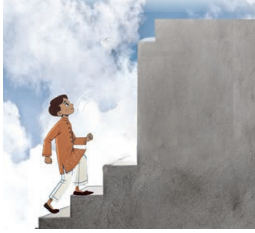
I. Imagine that you are the person in the image.
Question 1.
What emotions do you feel standing at the base of a difficult task?
Answer:
Standing at the base of a difficult task, I feel a mixture of emotions all at once. There is excitement at the possibility of what lies ahead, but alongside it sits a quiet nervousness about whether I am truly capable of what is being asked of me. I feel the weight of uncertainty pressing down, and somewhere beneath all of that, there is also a small but steady flicker of determination reminding me that I have come this far already and that, in itself, is an achievement.
Question 2.
What might make you take the first step?
Answer:
Several factors can motivate me to take the first step. Remembering the purpose behind my goal gives me clarity and direction. The thought of looking back with regret is far more unsettling than the fear I feel in the present. In addition, a few encouraging words from someone who believes in me can boost my confidence. Sometimes, simply realising that waiting will not make things easier is enough to push me forward and begin.
II. Think about a time when you had to face a challenge.
Question 1.
What was it, and how did you feel at the start of the journey?
Answer:
One challenge I faced was speaking in front of the entire school during an assembly presentation. At the start, I felt terrified. My hands were cold, my thoughts were scattered, and I genuinely considered asking someone else to take my place. The fear of forgetting my words or being judged felt enormous, and I seriously doubted whether I was ready for something like that.
Question 2.
How did you feel once you made the decision to move forward?
Answer:
The moment I decided to go ahead and not back down, something shifted inside me. The fear did not disappear entirely, but it became smaller and more manageable. Once I began speaking, I found my rhythm and the words came more naturally than I had expected. When it was over, what I felt was not just relief but a genuine sense of pride. It was the kind that only comes from doing something that frightened you and discovering that you were more capable than you had believed.
III. What does the phrase ‘believe in yourself’ mean to you? Write some words or phrases you associate with believing in yourself.
Answer:
To me, ‘believe in yourself’ means trusting my own abilities even when the outcome is uncertain and others may doubt me. It means choosing to move forward not because the path is clear but because I know I have what it takes to figure it out as I go.
Words and phrases I associate with believing in yourself:
Courage, Self-trust, Inner strength, Resilience, Confidence, Determination, Taking the first step, Trusting the process, Knowing your own worth, Moving forward despite fear, Not waiting for permission and Being your own greatest supporter.
IV. Select the correct meaning of ‘status quo’ based on the given sentence.
Even though some kids wanted to try new activities, most of them were happy with the status quo and didn’t want any changes.
1. A plan to make things more exciting.
2. A situation to keep things the same.
3. A decision where everything is completely different.
4. A choice to change things quickly without thinking.
Answer:
2. A situation to keep things the same.
Hint
The sentence shows that the children were comfortable with how things already were and did not want anything to change.
Class 9 English Believe in Yourself Poem Question Answer
Check Your Understanding
I. Based on your understanding of the poem, select the correct central idea for each stanza from the options given.
Stanza 1
i) Facing challenges requires personal responsibility and a clear focus on one’s future.
ii) Facing challenges is a journey best taken with support and guidance from others.
Answer:
i)
Hint
The stanza emphasises that there is no crowd watching and no one else to rely on. The challenge is entirely personal, and the focus must remain on where the individual wants to be.
Stanza 2
i) Fear and uncertainty make it difficult to make choices as the future approaches.
ii) Facing the future with confidence makes choices easier and more straightforward.
Answer:
i)
Stanza 3
i) Personal growth involves finding balance between comfort and change.
ii) Personal growth requires leaving behind comfort and embracing change.
Answer:
ii)
Stanza 4
i) The first step towards change may feel easy if you place your trust in others to guide you and provide support.
ii) The first step towards change is difficult, but having self-belief and confidence helps you stay on track.
Answer:
ii)
II. Rhyme Scheme
Fill in the blank to complete the following sentence.
The poem follows a simple, yet effective rhyme scheme _______ that flows steadily through each stanza.
Answer:
The poem follows a simple, yet effective rhyme scheme ABCB that flows steadily through each stanza.
III. Tone
State whether the following statements are true or false.
1. The overall tone of the poem is motivational and encouraging.
2. The tone shifts from thoughtful in the beginning to one of determination by True the end of the poem.
Answer:
1. True
2. True
IV. Speaker
Fill in the blanks with the correct options from those given in the brackets in textbook.
Answer:
The speaker in this poem is not distant; rather, he/ she comes across as a guide who understands the struggle and is encouraging the reader to take control of his/her own future.
The use of direct address ‘You’ creates a close connection, as though the speaker is talking directly to the reader.
V. Imagery
Match the phrases from the poem in Column 1 with the imagery they represent in Column 2. An extra representation is given.
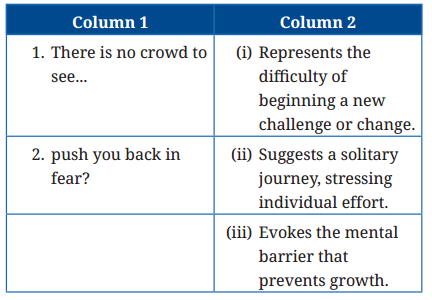
[Note: Option (i) is extra.]
Answer:
(1 – ii), (2 – iii)
VI. Symbolism
Select the words/phrases from the box below to complete the given sentences.
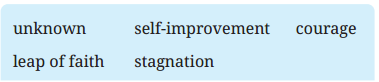
1. Comfort and the status quo represent _______ and fear of change, symbolising the comfort zone that holds one back.
2. The future symbolises the _______, the potential for change and success that lies ahead but requires _______ to step into.
3. The first step symbolises the initial ________ required to begin the journey of ________ or personal development.
Answer:
1. stagnation
2. unknown, courage
3. leap of faith, self-improvement
VII. Metaphor
The poet uses a metaphor in the line, ‘The first step is the hardest’. Explain why this is metaphorical.
Answer:
The line ‘The first step is the hardest’ is metaphorical because it does not refer literally to a physical step taken by a foot. Rather, ‘the first step’ is used figuratively to represent any initial act of courage — the decision to begin something new, difficult, or uncertain. The word ‘hardest’ extends this metaphor by suggesting that the greatest obstacle in any journey of personal growth is not the journey itself but the moment of beginning it. The poet compares the entire complex experience of overcoming fear, self-doubt, and inertia to the simple, familiar physical act of taking a step, making an abstract emotional experience feel immediate, relatable, and deeply human.
VIII. The poem uses antithesis in a couple of lines.
Antithesis is a rhetorical device that pairs contrasting or opposite ideas in a parallel grammatical structure to highlight differences or create emphasis. It simplifies complex ideas through contrast, making them easier for readers or listeners to understand.
Consider the famous quote from Neil Armstrong when he stepped onto the moon:
“Setting foot on the moon may be a small step for a man, but a giant leap for mankind.”
Here, the antithesis lies in contrasting the ‘small step’ for an individual with the ‘giant leap’ for all humanity. The parallel structure of the two phrases highlights the incredible signifiance of this event, presenting it as both a personal and massive achievement.
Other examples:
- Speech is silver, but silence is gold.
- Patience is bitter, but it has a sweet fruit.
- Man proposes, God disposes.
Identify the lines from the poem that show antithesis and explain why it is so.
Answer:
Line 1: “Will it pull you forward/Or push you hack in fear?”
Explanation: This is a clear example of antithesis. The poet places two directly opposing ideas – ‘pull you forward’ and ‘push you back’ – in a parallel grammatical structure within the same question. ‘Pull you forward’ represents progress, ambition, and the positive embrace of the future, while ‘push you back in fear’ represents retreat, self-doubt, and the negative power of anxiety. The contrast between moving forward and moving backward, and between motivation and fear, highlights the central choice every individual must make when standing before an uncertain future. The parallel structure makes both possibilities feel equally real and equally powerful, forcing the reader to recognise that the outcome depends entirely on their own response to what lies ahead.
Line 2: “There is such ease in comfort/To maintain the status quo,/But this isn’t what we are made for/This isn ‘t how we grow.”
Explanation: This is a sustained antithesis built across four lines. The first two lines present the appealing ease and familiarity of comfort and the status quo, while the final two lines firmly oppose this with the truth that comfort is incompatible with growth and human purpose. The contrast between ‘ease in comfort’ and ‘how we grow’ is the heart of the antithesis — ease suggests effortlessness and passivity, while growth demands effort, challenge, and change. The conjunction ‘but’ signals the turn and makes the opposition structurally clear. By placing these two opposing ideas side by side, the poet creates maximum emphasis, making the rejection of comfort feel not harsh but logical, inevitable, and deeply honest.
Critical Reflection
I. Read the extract given below and answer the questions that follow.
Question 1.
Step up to the challenge
There is no crowd to see,
It’s just you and the future
And where you want to be.
i) What does the line, ‘There is no crowd to see’ suggest about facing challenges?
Answer:
The line suggests that facing challenges is a personal journey with no audience, or external validation.
ii) Complete the following suitably.
The line ‘It’s just you and the future’ suggests that ________.
Answer:
achieving one’s goals is a personal journey where individuals must make their own choices and take responsibility for shaping their future
iii) Fill in the blank with the appropriate word/phrase from the extract.
Latha will _______ her efforts to improve her vocal performance by practicing harder each day.
Answer:
step up
iv) Select the most suitable title for the extract.
(A) The Struggles of Change
(B) Facing the Future Alone
(C) A Journey of Growth
(D) The Power of Fear
Answer:
(C) A Journey of Growth
Hint
The extract encourages one to take personal responsibility for future by stepping up to the challenges and doing it for oneself and one’s dreams. All these ideas together capture the essence of growth (or the journey of growth).
v) Complete the analogy by using a word from the extract.
achieve: goal:: face : _______
Answer:
challenge
II. Answer the following questions.
Question 1.
What is the significance of the metaphor, ‘The first step is the hardest’ in the context of personal growth?
Answer:
This metaphor highlights that beginning is the most difficult part of growth. By representing abstract fear as a physical step, it makes the struggle relatable. It suggests that overcoming initial hesitation builds the momentum necessary to make further progress easier.
Question 2.
What message does the antithesis in the poem convey about the nature of personal development?
Answer:
The antithesis reflects the tension between growth and fear. By juxtaposing “pulling forward” with “pushing back,” the poet shows that progress requires choosing change over comfort. It emphasises that confronting internal conflict is an essential condition for true personal development.
Question 3.
Do you think the poet’s message is realistic in the context of real-world struggles? (Clue: Evaluate whether simply ‘believing in yourself’ is enough to overcome obstacles or other factors are also necessary.)
Answer:
The poet’s message is inspiring and largely true, but only partially realistic when applied to real-world struggles. Self-belief is undeniably a powerful and essential foundation. However, believing in oneself alone is rarely sufficient to overcome the complex obstacles that people face in real life. Systemic challenges such as poverty, lack of access to education, social inequality and discrimination cannot be resolved through self-belief alone. Personal growth also requires sustained effort, access to opportunities, support from others, the willingness to learn from failure, and sometimes, a degree of external guidance and encouragement. The poem is most valuable as a starting point — a reminder that the inner decision to believe and begin is necessary, but it is the first step of many, not the only one required.
Question 4.
Consider a situation where you or someone you know had to take a difficult first step towards a goal. How does the poem’s message about the importance of self-belief apply to this situation?
Answer:
I experienced this situation when I was afraid to join my sister’s karate class because the teacher seemed very strict and often scolded her. I refused at first, convinced I would not be able to cope. However, with my sister’s encouragement, I agreed to attend one class. Though I was nervous, the teacher turned out to be patient and supportive. Gradually, my confidence grew. Now I was practicing regularly. Even w,hen it got hard, I believed that I would be able to master this. Before I knew it, i earned my first belt! The poem’s message about the importance of self-belief applies deeply to my experience; J took that ‘first step’ with courage and faith in my own abilities.
Vocabulary in Context
I. The phrase ‘status quo’ is a Latin expression that translates to ‘the state in which’ or ‘the existing state of affairs.’ Over time, it has become a popular term used in English to refer to the current situation or condition, especially when things remain unchanged.
Fill in the blanks in the given sentences, with the Latin expressions used in English from the table given in textbook.
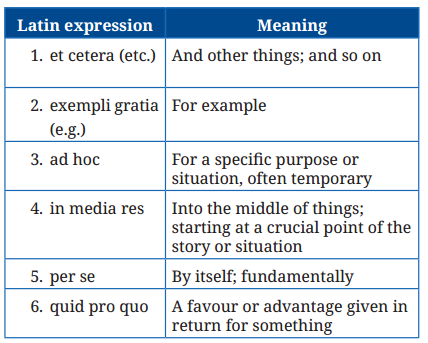
(i) I enjoy reading fantasy books, _________ Harry Potter and Magical Paint Brush.
(ii) After helping Tanya with the homework, Ritu asked for a _________ to borrow her notes next time.
(iii) I love all kinds of outdoor activities, such as trekking, hiking, biking, _________.
(iv) The park is not very special _________; it becomes more fun when you visit with friends.
(v) We created an _________ team to organise the school festival.
(vi) The movie started _________, with the hero already fighting the villain in a huge battle.
Answer:
i) I enjoy reading fantasy books, e.g., Harry Potter and Magical Paint Brush.
ii) After helping Tanya with the homework, Ritu asked for a quid pro quo to borrow her notes next time.
iii) I love all kinds of outdoor activities, such as trekking, hiking, biking, etc
iv) The park is not very special per se; it becomes more fun when you visit with friends.
v) We created an ad hoc team to organise the school festival.
vi) The movie started in media res, with the hero already fighting the villain in a huge’ battle.
II. Read the following rhetorical questions and state what they intend to achieve.
i) Isn’t it obvious that we must act now? Don’t we all have a responsibility to make a change?
ii) Will we let fear control us, or will we rise above it?
Answer:
i) These rhetorical questions intend to create a sense of urgency and shared moral responsibility in the reader.
ii) This rhetorical question intends to inspire courage and challenge the rader to make a deliberate choice between two clearly contrasting paths.
III. Match the situations in Column 1 to the rhetorical questions in Column 2.
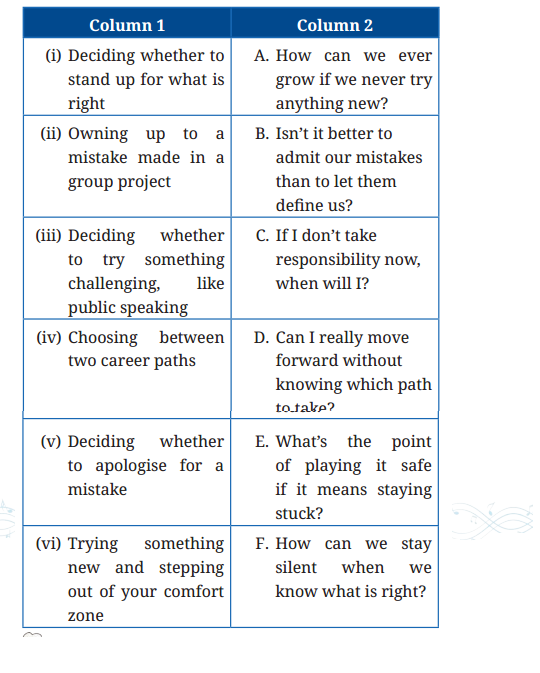
Answer:
(i – F), (ii – B), (iii – A), (iv – D), (v – C), (vi-E)
Listen and Respond
I. You will listen to a conversation between two friends. As you listen, answer the following questions in one to three exact words that you hear. (Transcript for teacher on page 275)
Question 1.
How did the boy feeF before the play?
Answer:
The boy felt so nervous.
Question 2.
According to the girl, where does confidence come from?
Answer:
According to the girl, confidence comes from taking action.
Question 3.
What was the girl finally sure about regarding the boy?
Answer:
The girl was finally sure that the boy would shine.
II. You will once again listen to the conversation. As you listen, select the four true statements from 1-7 given below.
1. The boy feels confident but is worried about freezing on stage.
2. The girl encourages the boy to push through his doubts by trusting in his preparation.
3. The boy thinks that the audience will be supportive regardless of his performance.
4. The girl believes that self-doubt is a normal part of preparing for a big performance.
5. The boy feels that his preparation is not enough and doubts his abilities, even though he has practiced.
6. The girl suggests that the boy should avoid feeling nervous and perform perfectly.
7. The girl believes that pushing through nervousness will help the boy grow and build confidence.
Answer:
Statements 2, 4, 5, and 7 are true.
Speaking Activity
I. Work in pairs. Read the three Sayings/Proverbs given below. For each one, think of a real-life situation where it Could apply. Do the suggested role play and use the Saying/Proverb.
Remember:
- Before diving into a real-life situation, briefly explain the meaning of the saying.
- Describe the situation in the following way—
- Introduction: Briefly explain the saying.
- Situation/Example: Share a personal story or relate the saying to something familiar.
- Conclusion: Reflect on what the saying teaches or what you learned from the experience.
- For the role-play, work in pairs to create the dialogues fist and then enact. Take turns to choose your sayings/proverbs.
Sayings/Proverbs
1. Don’t judge a book by its cover.
- Situation to consider: Have you ever misjudged someone based on their appearance or fist impression? What happened?
- Role-play: One student acts as someone who judges others based on their looks or fist impressions. The other student plays someone who shows the true personality after a deeper conversation, proving that appearances can be deceptive.
2. Actions speak louder than words.
- Situation to consider: Think of a time when someone’s actions proved more valuable than their words.
- Role-play: One student talks about how they will improve their grades, and the other shows how they actually put in the effort. Compare the impact of talking versus doing.
3. When the going gets tough, the tough get going.
- Situation to consider: Can you think of a time when you faced a difficult challenge but didn’t give up?
- Role-play: One student plays someone who is giving up on a tough school project, while the other encourages that student to keep going. Show how perseverance leads to success despite difficulties.
Refer to the instructions and proverbs.
Answer:
Saying 1: Don’t judge a book by its cover. Introduction: Simply put, this saying tells us notjto form opinions about people based on how they look. Just like a plain-looking book might turn out to be your favourite read, a person you overlook at first could become someone truly important to you.
Situation/Example: When I joined a new school, there was this quiet boy who always sat alone. Most of us assumed he was unfriendly and just left him alone. Then one day we got paired for a project and honestly, he turned out to be the-; funniest, most thoughtful person in the class. He just needed time to warm up.
Conclusion: It was a bit of an embarrassing realisation, honestly. I had completely written someone off without giving them a fair chance. Now I make it a point to actually talk to people before deciding what I think of them.
Role-play Dialogue:
A: (Whispering to a friend) Have you seen the new girl? She barely talks and just sits by herself. It doesn’t seem like she’d getting along with us.
B: Hi, are you talking about me? I’m just taking my time to warm up to this new place as I’ve lived in Netherlands.
A: I’m sorry to be speaking behind your back. But Netherlands, seriously? I had no idea.
B: Yeah, I used to have many friends there who used to sing and write like me.
A: Even I love writing! Which genre do you usually write in?
B: I’ll show you my work. Before that, shall we have a proper introduction?
A: (Laughs) Sure!
[Note: One proverb has been covered for reference. Students are expected to do this activity on their own.]
Writing Task
I. Your class is conducting the morning assembly. You have been asked to deliver a speech on the topic, ‘Turning Challenges into Opportunities’. Draft this speech by following the guidelines given below.
- Consider how challenges can lead to new learning experiences, growth, or unexpected benefits.
- Why do you think people often feel scared or anxious when faced with change?
- How can change open doors to new opportunities? Can you think of an example from your own life or someone you know?
- What are some strategies or attitudes you can adopt to approach change with a positive mindset?
- Think about how facing challenges builds skills, determination, and confidence, all of which are essential for success.
Answer:
Turning Challenges into Opportunities
The first step is the hardest, but it is where a new possibility begins.
Good morning respected Principal, teachers, and friends. I am Arjun Sharma from Class IX B. Today, I want to share why challenges are not roadblocks, but essential stepping stones to success.
We often feel anxious when faced with change because we fear the unknown. However, has anything truly great ever come from staying comfortable? I don’t think any of us have come this far without facing the things we fear or feel challenged by. For instance, when I was asked to join an inter-school debate, I was terrified and almost refused. Although I didn’t win, the challenge taught me to research and speak under pressure—skills no regular classroom lesson could provide. Don’t you agree that our greatest growth happens when we are pushed out of our comfort zone?
To approach any change or challenge with a positive mindset, we must remember that feeling scared is normal; it simply means the task matters. By focusing on learning rather than just the result, we build the determination and confidence necessary for excellence. Isn’t it true that every leader we admire once stood exactly where we are, choosing to step forward despite their fear?
Therefore, I encourage each one of us to embrace every difficulty as a chance to evolve. Let us find the courage to say “yes” to what scares us, for that is where our extraordinary journey begins. Thank you!
Learning Beyond the Text
I. Explore the stories of Indian leaders who faced significant challenges and turned them into opportunities for success given below.
For example:
1. Dr. B. R. Ambedkar
At school, Ambedkar suffered untold humiliations and discrimination but he never gave up.
It was for sheer grit, hardwork, and perseverence that he went on to study Politics and Economics. His self-motivation proved to be a life-changing event not only for him but also for the nation. He is known as a great jurist, economist, and social reformer.
He rose to become the Chairperson of the Drafting Committee of the Constitution of India.
2. Lal Bahadur Shastri
He endured many hardships throughout his life. His father passed away when he was just a year and a half old, leaving the family in financial distress. Despite the challenges, he remained committed to his education, often walking several miles barefoot to attend school, even in extreme weather. After graduating from Kashi Vidyapeeth in Varanasi, he was honoured with the title “Shastri,” meaning scholar.
Deeply involved in India’s freedom movement, Shastri was imprisoned multiple times alongside other freedom fighters for his active participation. Following India’s independence, he dedicated himself to the progress and unity of the nation. Through unwavering determination and sincere efforts, Lal Bahadur Shastri rose to become the Prime Minister of India, leaving a legacy of humility, service, and patriotism.
3. Dr. APJ Abdul Kalam
Kalam’s family faced financial difficulties, which made it hard for them to support his education fully. To help with his school expenses, Kalam took on a job delivering newspapers early in the morning. He would wake up before dawn, distribute newspapers across the town, and then head to school.
This job was more than just a way to earn money; it was a valuable learning experience for Kalam. Through this work, he learnt the importance of hard work, perseverance, and managing responsibilities. It also gave him a sense of independence and taught him the value of hard work.
He was a renowned scientist, also known as the ‘Missile Man of India’. He rose to become the 11th President of India.
Now find out about such personalities from your village, town, city, or state and present their success stories in class.
Answer:
The Mother of Orphans
Sindhutai Sapkal was bom into extreme poverty in a small village in Maharashtra. She was married off at an early age and by the time she was twenty, she had been abandoned by her husband and left on the streets with a newborn daughter. She had no money, no shelter and no one to turn to.
Instead of giving up, she began begging at railway stations to feed herself and her child. But what she saw around her broke her heart even further – hundreds of orphaned and abandoned children with nobody to care for them.
She made a decision that changed everything. She adopted every child she found on the streets, eventually becoming a mother to over 1,400 orphans across India. She gave away her own biological daughter to an orphanage so that she would never show favouritism among her children.
She received over 750 national and international awards during her lifetime and was honoured with the Padma Shri in 2021. She passed away in 2022, leaving behind thousands of children who called her Mai, meaning mother.
What her story teaches us:
She had every reason the world could offer to give up. Instead, she chose /to turn her own pain into purpose. That is the very definition of turning a challenge into an opportunity.
[Note: The above answer is given for reference. Students are expected to do this activity on their own.]
Believe in Yourself Class 9 Extra Questions and Answers
Believe in Yourself Short Question Answer
Question 1.
What does the poet suggest about the relationship between comfort and personal growth?
Answer:
The poet suggests that comfort and personal growth are fundamentally incompatible. While comfort offers a pleasant and tempting ease, it prevents the very challenges and experiences that allow human beings to develop and grow. The lines ‘this isn’t what we are made for/this isn’t how we grow’ make this incompatibility clear and direct.
Question 2.
How does the image of the future as something that either ‘pulls’ or ‘pushes’ reflect the power of an individual’s mindset?
Answer:
The image reflects that the future is not fixed or predetermined but responds to how the individual approaches it. When a person has self-belief and ambition, the future appears motivating and pulls them forward. However, when fear dominates, it seems to push them back. Thus, ,the poet highlights that attitude determines one’s direction of growth.
Question 3.
Why does the poet choose to address the reader directly as ‘you’ throughout the poem?
Answer:
By addressing the reader as you, the poet transforms general advice into a direct, personal conversation. This creates a sense of intimacy and accountability, making the emotional challenges of fear and choice feel immediate. It establishes a mentor-like connection that encourages the reader to take personal responsibility for their future.
Question 4.
How does the poem balance honesty about difficulty with encouragement and hope?
Answer:
The poet balances realism with hope by acknowledging that choices are difficult and comfort is tempting, which builds trust with the reader. This honesty ensures that the subsequent encouragement feels earned rather than empty, leaving the reader motivated by a grounded and genuine sense of empowerment to take action.
Question 5.
Cap you think of a time when someone’s encouragement helped you take a difficult first step?
Answer:
Yes, I remember a time when my parents encouraged me to take the first step of seeking help for my habit of fumbling. I used to fumble a lot in stressful situations. Though I was scared and nervous, my parents assured me that I can get over it with proper guidance from a speech specialist.
Believe in Yourself Long Question Answer
Question 1.
The poem ‘Believe in Yourself’ argues that self-belief is more powerful than any external circumstance in determining the direction of a person’s future. Discuss thisview with reference to the poem, using at least three examples of poetic devices to support your answer.
Answer:
Robert Langley’s poem ‘Believe in Yourself powerfully argues that self-belief is far more influential than external circumstances in shaping one’s future. The poet asserts that the future is not fixed but moulded by an individual’s inner conviction and courage. This idea is supported by powerful poetic devices. Personification is used when the future is described as something that can “pull you forward” or “push you back in fear,” showing that our mindset decides its direction. Antithesis appears in the contrast between the “ease in comfort” of the status quo and the fact that “this isn’t how we grow.” Additionally, the line “for your future to be on track” shows that self-belief helps one stay focused and move in the right direction. Through these devices, Langley convincingly proves that internal belief determines our path more than outside conditions.
Question 2.
Robert Langley wrote ‘Believe in Yourself’ as a poem of encouragement and motivation. How successfully does he achieve this purpose through his choice of language, structure, and poetic devices?
Answer:
Langley achieves his motivational purpose effectively through clear language, relatable ideas, and simple poetic devices. The poem acknowledges difficulty through the line ‘the first step is the hardest, making the message honest and realistic rather than idealistic. The use of direct address such as ‘you’ and ‘your’ creates a personal tone, helping the reader feel directly encouraged.
The steady rhyme scheme gives the poem a smooth and conversational flow, reinforcing its accessibility. Additionally, the concluding idea that one must believe in oneself leaves a strong and lasting impression. Together, these elements ensure that the poem motivates while remaining grounded in real experience.
Question 3.
The first step is the hardest/There is no turning back.’ These two lines are considered the emotional climax of the poem. Examine why the poet places this acknowledgement at the beginning of the final stanza and what effect it creates on the reader.
Answer:
The poet places these lines at the beginning of the final stanza to create a powerful emotional impact. By this stage, the reader has been encouraged to face challenges and move beyond comfort. The line “the first step is the hardest” acknowledges the reader’s fear, making the message feel honest and relatable. This validation builds trust, as the poet does not ignore the difficulty of beginning.
The phrase “there is no turning back” then reinforces commitment, preparing the reader for action. Together, these lines act as a turning point, where doubt is recognised but not allowed to dominate. As a result, the reader feels both understood and motivated to move forward with confidence.
Question 4.
The poem presents the comfort zone as an enemy of growth. Do you agree that remaining in one’s comfort zone is ultimately harmful, or do you think there is value in comfort and stability? Justify your answer with evidence from the poem and examples from your own life.
Answer:
The poem presents the comfort zone as a barrier to growth, especially through lines that suggest we are not meant to remain where things feel easy. I agree with this view to a large extent. Real progress often begins when we step beyond what feels safe. For example, A.P.J. Abdul Kalam overcame poverty, limited resources, and repeated failures in early projects, while Mary Kom faced financial struggles, lack of support, and the challenge of balancing motherhood with training. Their journeys show that growth requires effort and courage. However, some comfort is necessary for rest and stability, but it should be for coming back stronger.
Question 5.
How does the line “for your future to be on track” reflect the poet’s view on self-belief as a driver of destiny, and to what extent do you agree?
Answer:
The line “for your future to be on track” reflects the poet’s view that self-belief acts as the main driver of one’s destiny. The metaphor compares life’s journey to a train or vehicle that must stay on its proper track. Self-belief serves as the steering mechanism that prevents one from derailing into doubt and fear. The poet believes that when a person trusts their own abilities, they can confidently move towards their goals and shape a successful future. I largely agree with this view. Although external factors like opportunities, resources and support do matter, it is ultimately the unshakeable inner belief in oneself that gives the courage to take the first difficult step and persis through challenges, thereby creating better possibilities in life.
Question 6.
You have a close friend who is hesitant to participate in the school’s annual science exhibition due to fear of failure and lack of confidence in their project. Drawing inspiration from the poem ‘Believe in Yourself’ by Robert Langley, write a letter (120-150 words) encouraging your friend to take the first step and believe in their abilities.
Answer:
Dear Mansi,
How are you? When we last spoke, I sensed that you were feeling anxious and unsure about participating in the science exhibition. I understand your fear, but I truly believe you should give it a chance.
You have always shown a natural interest in science and technology and follow new findings with immense dedication. It is okay to feel nervous, but remember, the first step is always the hardest.
Try to trust your abilities and focus on your effort rather than the outcome. Every experience teaches you something valuable.
Have the courage to begin. I believe in you, and you should too.
Yours lovingly,
Ananya