Twin Melodies Class 9 Question Answer
Reflect and Respond
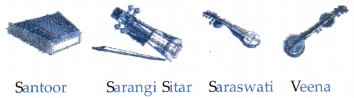
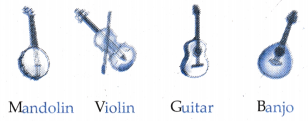
I. Given below are some stringed musical instruments. Work in pairs and identify them by first letter of the spellings of their names.
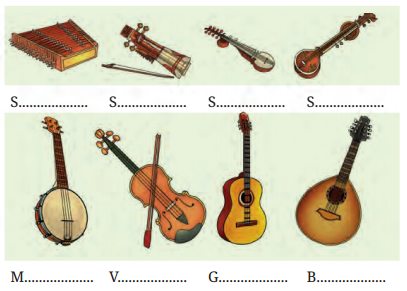
Answer:
II. Do you play a musical instrument? If given a choice, which one would you choose and why?
Answer:
Yes, I would like to learn a musical instrument. If given a choice, I would choose the violin. I find its sound very soulful and expressive. It can be used in both classical and modern music, which makes it very versatile. I also admire how it can convey deep emotions and I would love to develop that skill.
[Note: The above answer is given as reference. Students are expected to write the answer on their own.]
III. Is there any difference in the choice of music between children and elders? If yes, why? If no, why not?
Answer:
Yes, there is often a difference in the choice of music between children and elders. Children usually prefer modem, fast-paced, and experimental music, while elders tend to appreciate classical or traditional forms. This difference arises due to variations in exposure, experiences and cultural preferences across generations.
IV. Work in pairs to complete the paragraph given on the next page by choosing the correct phrases given in the box. Discuss with your teacher whether the following phrases have a literal meaning or a figurative one.
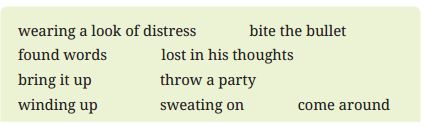
The theatre club was 1. _______________________ their practice. Anil saw Sunny was 2. _______________________ and not speaking to anyone. They had a disagreement in the morning and since then, Sunny was 3. ______________________ . Anil did not want to 4. _______________________ and disturb Sunny further but he fially decided to 5. _______________________ and speak to Sunny. He was sure if he apologised fist, his friend would 6. _______________________. With a lot of anxiety, he 7. _______________________ to apologise. And finally, Sunny smiled! Everyone clapped and asked them to 8. _______________________ to celebrate.
Answer:
The theatre club was winding up their practice. Anil saw Sunny was lost in his thoughts and not speaking to anyone. They had a disagreement in the morning and since then, Sunny was wearing a look of distress. Anil did not want to bring it up and disturb Sunny further but he finally decided to bite the bullet and speak to Sunny. He was sure if he apologised first, his friend would come around. With a lot of anxiety, he found words to apologise. And finally, Sunny smiled! Everyone clapped and asked them to throw a party to celebrate.
These phrases are used in a figurative sense.
Class 9 English Kaveri Chapter 6 Question Answer
Check Your Understanding
I. Complete the table given below based on Act I of the play. Check your answers with the teacher.
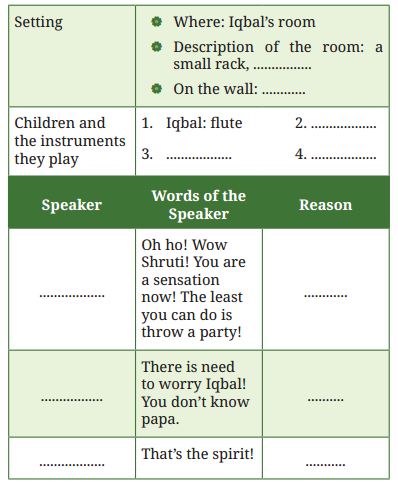
Answer:
| Setting | Where: Iqbal’s room | |
| Description of the room: a small rack, musical instruments neatly arranged, a practice space for music
On the wall:posters of famous flute players Pandit Hariprasad Chaurasia and Shashank Subramanyam |
||
| Children and the instruments they play | 1. Iqbal: flute | 2. Shruti: violin |
| 3. Avinash: tabla | 4. Peter: keyboard | |
| Speaker | Words of the Speaker | Reason |
| Anil | “Oh ho! Wow Shruti! You are a sensation now! The least you can do is throw a party!” | He is excited and impressed by Shruti’s success and is praising her playfully. |
| Shruti | “There is need to worry Iqbal! You don’t know papa.” | She is anxious about her father’s reaction. |
| Iqbal | “That’s the spirit!” | He is encouraging Shruti to be confident. |
II. Do you think Shruti will gather the courage to speak to her father? Give a reason.
Answer:
Yes, Shruti is likely to gather the courage to speak to her father because her friends encourage her to be honest with him. Her strong interest in music may also motivate her to express her feelings and share her decision confidently.
III. What might be Shruti’s father’s reaction? Why?
Answer:
Shruti’s father might initially react with anger or disapproval because he strongly believes in classical music and does not appreciate fusion. However, later he may understand her perspective and accept her choices, as he realises her talent and dedication.
Check Your Understanding
I. Complete the summary of Act II by choosing the correct words from the box given below. There are two extra words that you do not need. Check your answers with the teacher.
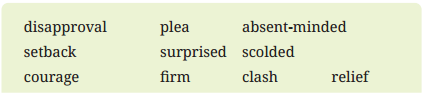
Shruti seemed 1. _______________________ during dinner. She fially gathered the 2. _______________________ to inform her father, Nabin, about her wish to participate in an upcoming Indo-Western fusion concert. Nabin reacted negatively, expressing 3. _______________________ of fusion music and dismissed the idea. Despite Shruti’s 4. _______________________ to him to attend a practice before deciding, Nabin was 5. _______________________ in his decision. Shruti’s mother, Leela, 6. _______________________ her for not seeking permission earlier. The tension highlights the 7. _______________________ between traditional and contemporary musical preferences within the family.
Despite the 8. _______________________, Shruti promises not to hide again and is urged to go to bed by her mother.
II Will Shruti’s father go for the rehearsal? Support your answer with a reason.
III Do you think Shruti and her parents would understand one another? If yes, why? If no, why not?
Answer:
Shruti seemed 1. absent-minded during dinner. She finally gathered the 2. courage to inform her father, Nabin, about her wish to participate in an upcoming Indo-Western fusion concert. Nabin reacted negatively, expressing 3. disapproval of fusion music and dismissed the idea. Despite Shruti’s 4. plea to him to attend a practice before deciding, Nabin was 5. firm in his decision. Shruti’s mother, Leela, 6. scolded her for not seeking permission earlier. The tension highlights the 7. clash between traditional and contemporary musical preferences ; within the family. Despite the 8. setback, j Shruti promises not to hide again and is ! urged to go to bed by her mother.
II. Will Shruti’s father go for the rehearsal? j Support your answer with a reason.
Answer:
Shruti’s father may initially refuse to attend the rehearsal because he strongly disapproves of fusion music. However, there is a possibility that he might go later, as parents often reconsider their decisions after reflecting on their child’s feelings and determination.
III. Do you think Shruti and her parents would understand one another? If yes, why? If no, why not?
Answer:
Yes, Shruti and her parents are likely to understand one another eventually. With open communication and patience, her I parents may begin to appreciate her passion for music, while Shruti will also respect their values. This mutual understanding can help bridge the gap between tradition and modernity.
Check Your Understanding
I. Work in pairs. Identify the true statements. Check the answers with your teacher.
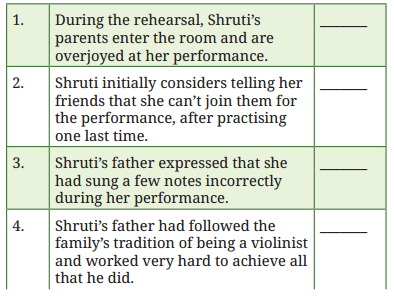
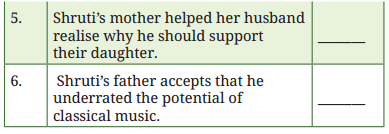
Answer:
1. During the rehearsal, Shruti’s parents enter the room and are overjoyed at her performance. — True
2. Shruti initially considers telling her friends that she can’t join them for the performance, after practising one last
time. — True
3. Shruti’s father expressed that she had sung a few notes incorrectly during her performance. — False
4. Shruti’s father had followed the family’s tradition of being a violinist and worked very hard to achieve all
that he did. — False
5. Shruti’s mother helped her husband realise why he should support their daughter. — True
6. Shruti’s father accepts that he underrated the potential of classical music Critical Reflection — False
Critical Reflection
I. Read the extracts given below and answer the questions that follow.
Shruti: There is need to worry Iqbal! You don l know papa. He is very strict about these things. He will think it a desecration of the violin to be played to Western tunes. Papa firmly believes that Classical Hindustani music, with its ragas and aalaaps, is the only kind of music that an artist of any worth shoidd play. I don want papa to feel that I don care about his opinions, because I do. It s just that I want to give this a try too. I just don know how to tell him in the right way!
Iqbal: All ways are right ways, Shruti. He is your father, he will understand.
i. Select the option that correctly identifies Shruti’s situation.
(A) confident
(B) indifferent
(C) content
(D) in a dilemma
Answer:
(D) in a dilemma
ii. What does Shruti mean by ‘the right way’, in the sentence, “I just don’t know how to tell him in the right way!”?
Answer:
By “the right way,” Shruti means a respectful and thoughtful manner of expressing her wish so that her father does not feel hurt or think she is ignoring his opinions.
iii. Complete the following with a suitable reason.
We can say that the extract reflects the generational gap in understanding art and tradition because _______ .
Answer:
Shruti is interested in Indo-Western fusion music, whereas her father strongly believes that only classical Hindustani music is’ valuable for a true artist.
iv. Explain how Iqbal’s words were meant as an assurance to Shruti.
Answer:
Iqbal reassures Shruti by encouraging her to speak honestly with her father and expressing confidence that he will
understand her perspective.
v. Fill in the blank with a phrase from the extract.
The critics argued that only films which provoke thoughtful discussion are
Answer:
of any worth
2. Read the extract given below and answer the questions that follow.
Nabin: I underestimated the power of our own music. I was afraid you would be lost to us. I realise that my fears were baseless. After all each bay, its own wind. I trust you Shruti and 1 will root for your group at the concert!
(Shruti hugs both of her parents)
i. Select the suitable option to complete the sentence.
Nabin’s breakthrough in his understanding of artistic freedom, highlights a bridge between ________.
(A) personal ambition and professional success
(B) traditional values and modern expressions
(C) strict discipline and casual learning
(D) historical techniques innovations and futuristic
Answer:
(B) traditional values and modern expressions
ii. Fill in the blank with a suitable phrase.
The extract uses the word Tost’ both in the sense of losing ________ and physical separation.
Answer:
one’s identity / sense of self
iii. In the line, ‘Shruti hugs her parents’, which word from those given below does not show what it conveys?

iv. What can be inferred about Shruti’s future in music following her father’s expression of trust and support?
Answer:
Shruti will likely pursue fusion music with greater confidence while continuing to value her classical training, supported by her father’s trust.
v. Identify the phrase that refers to the uniqueness of each artist’s journey and style.
Answer:
“each bay, its own wind”
II. Answer the following questions.
Question 1.
Justify the title ‘Twin Melodies’. How does the play explore the theme of tradition and modernity?
Answer:
The title ‘Twin Melodies’ symbolises the harmonious coexistence of two musical traditions—Hindustani classical music and Indo-Western fusion. These ‘twin melodies’ represent tradition and modernity through the contrasting perspectives of Nabin and Shruti. Nabin strongly believes that only classical music is worthy of a true artist, while Shruti wishes to explore fusion music alongside her classical training. This difference creates tension between them. However, after witnessing Shruti’s performance and recalling his own past struggle against family expectations, Nabin realises his mistake and accepts her choice. The play shows that tradition and innovation can coexist and enrich artistic expression rather than oppose each other.
Question 2.
What are the different perspectives of Peter, Iqbal and Avinash regarding confronting figures of authority? How do their attitudes towards Shruti’s dilemma with her father provide insight into their own characters and values?
Answer:
Peter, Iqbal and Avinash present distinct attitudes towards authority, revealing their personalities. Iqbal is empathetic and balanced, reassuring Shruti that ‘all ways are right ways,’ encouraging respectful dialogue. Peter appears relaxed and supportive, suggesting she simply inform her parents about the practice, which shows optimism and practicality. In contrast, Avinash takes a realistic approach, warning that avoiding the issue may make matters worse and advising her to face the situation directly. Their responses to Shruti’s dilemma highlight values of encouragement, optimism and sensible judgement. Together, they “illustrate different approaches to authority—through reassurance, optimism and careful judgment.
Question 3.
Analyse the character of Nabin Sharma. How does his attitude towards music evolve throughout the play?
Answer:
Nabin Sharma is initially portrayed as rigid and tradition-bound, firmly believing that classical Hindustani music is the only kind of music that an artist of any worth should play. He even views fusion as a desecration, reflecting his deep attachment to tradition. However, his attitude evolves significantly. After witnessing Shruti’s performance and reflecting on his own past struggle against family expectations when he chose the violin, he realises that his fears were unfounded. He acknowledges that he had ‘underestimated the power of our own music’ and begins to trust Shruti’s judgement. By the end, he becomes more open-minded and supportive, learning to balance respect for tradition with acceptance of change.
Question 4.
How does the play use Shruti’s internal conflict to explore the theme of duty towards family versus personal passion?
Answer:
Shruti’s internal conflict highlights the tension between familial duty and personal passion. She says, “I don’t want papa to feel that I don’t care about his opinions,” showing her respect and responsibility, yet also admits “I want to give this a try too,” expressing her ambition. Her uncertainty about telling him ‘in the right way’ reflects her emotional struggle. This conflict reflects the challenges many young people face while balancing family expectations with individual interests. The situation is resolved when her father understands her feelings and supports her decision, showing that personal passion and family duties can coexist through trust and open1 communication.
Question 5.
Evaluate the effectiveness of the play’s conclusion. Does it realistically address the conflicts presented?
Answer:
The play’s conclusion is effective because it resolves the central conflict in a meaningful and convincing manner. Nabin’s change in attitude—from strong disapproval of fusiort music to acceptance of Shruti’s choice – appears realistic after he witnesses her performance and reflects on his own past struggles. His statement that he had ‘underestimated the power of our own music’ shows his growth in understanding. His assurance that he will support her group removes Shruti’s fear and restores harmony in the family. The moment when “Shruti hugs both her parents” symbolises reconciliation and harmony. Although slightly idealistic, the ending realistically demonstrates how dialogue and empathy can bridge generational differences, making the resolution both meaningful and satisfying.
Question 6.
Assess how well the role of cultural diversity contributes to the storyline of the play.
Answer:
Cultural diversity plays an important role in shaping the storyline of the play. Shruti’s interest in Indo-Western fusion music reflects the blending of traditional Indian and global musical styles, which creates conflict with her father’s strong belief in the purity of Hindustani classical music. This contrast highlights the tension between preserving tradition and accepting new influences. As the play progresses, Nabin begins to understand that innovation does not weaken tradition but can enrich it. His acceptance of Shruti’s choice shows respect for changing artistic expressions. Through this development, the play presents cultural diversity as a positive force that promotes openness, mutual respect and harmony between different perspectives.
Vocabulary and Structures in Context
I. Read the highlighted word given in the brackets.
SHRUTI (Aside): Oh, how much I enjoy performing this piece. Perhaps I can practise one last time and soon after that I will “tell them that I can’t join them for the performance.
Question 1.
What is’aside’used for?
(i) enables characters to talk about the story
(ii) shows what a character thinks or feels
(iii) makes a direct link between the audience and the character
(iv) (i), (ii), and (iii)
Answer:
(iv) (i), (ii), and (iii)
II. Read the following words from the text. Ahem ahem, I… er…
Now, select the correct answer for the question given below.
Why are they used?
1. to fill gaps while speaking
2. to increase clarity
3. to provide confidence
Answer:
1. to fill gaps while speaking
Now, choose suitable non-lexical fillers:

Answer:
1. arrgh
2. ahem-ahem
3. whew
4. hmmm
III. Match the meanings of other music-related words in Column 1 with their meanings in Column 2.
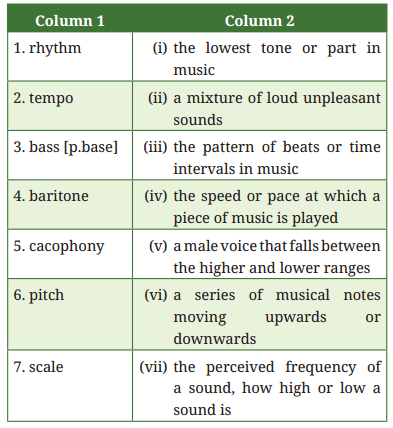
Answer:
1 – (iii), 2 – (iv), 3 -(i), 4 – (v), 5 – (ii), 6 – (vii), 7-(vi)
IV. Write the meanings of the underlined phrases based on your understanding of the usage in sentences.
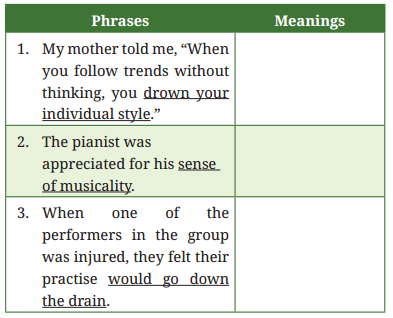
Answer:
| Phrases | Meanings | |
| 1. | My mother told me, “When you follow trends without thinking, you drown your individual style.” | lose your unique identity by blindly following trends |
| 2. | The pianist was appreciated for his sense of musicalitv. | natural understanding or appreciation of music |
| 3. | When one of the performers in the group was injured, they felt their practise would go down the drain. | be wasted or come to nothing |
V. Read the dialogues given below.
1. Oh, how much I enjoy performing this piece!
2. Wah, how soulful! You all have done a wonderful job!
Sentences 1 and 2 are _______ sentences. (declarative/interrogative/exclamatory/imperative)
Answer:
exclamatory
Now, convert the exclamatory sentences given above to declarative sentences.
Answer:
- She exclaimed with joy that she enjoyed performing that piece very much.
- He exclaimed with admiration that they all had done a wonderful job and that it was very soulful.
VI. Write the sentences given below in reported speech.
Question 1.
“What an incredible achievement! I can’t believe we pulled it off!” said Iqbal.
Answer:
Iqbal exclaimed that it was an incredible achievement and that he could not believe they had pulled it off.
Question 2.
“Bravo! Each note was executed perfectly, and the performance was flawless!” said Shruti’s mother.
Answer:
Shruti’s mother applauded that each note had been executed perfectly and that the performance was flawless.
Question 3.
Iqbal: I basically have a little bit of scolding for breakfast every day!
Answer:
Iqbal said that he basically had a little bit of scolding for breakfast every day.
Question 4.
Shruti: Sorry mummy, won’t hide from you again. I promise!
Answer:
Shruti apologised to her mother and promised that she would not hide from her again.
Question 5.
Avinash: You are a sensation now! The least you can do is throw a party!
Answer:
Avinash exclaimed that she was a sensation then and added that the least she could do was throw a party.
VII. Report the dialogue in the indirect form of speech.
Answer:
Asma exclaimed excitedly that she 1. had had a very unique experience at the art studio that day. Deepa urged her to tell her as she was eager to hear. Asma said that 2. she had accidentally spilled paint all over her canvas. Deepa pitied Asma. However, Asma replied to her not to worry as 3. the painting then looked better than her original plan. Deepa exclaimed that 4. it was incredible.
Listen and Respond
I. Look at the given stringed musical instruments and decide which one could be the yazh [yal].
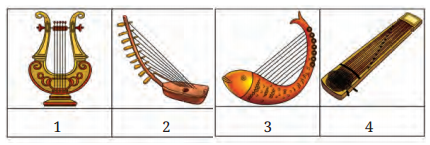
Answer:
3
II. Now, listen to a musician describing the yazh and check if your choice was correct. (Transcript for teacher on
page 270)
Answer:
Yes, the choice is correct
III. Listen to the musician’s description of the yazh once again. As you listen, complete the notes below with not
more than three words.
The Yazh
1. Type of instrument – The Indian _______
- Was used in: __________
- Earlier version of: __________
2. Design
- stem tip – shaped like _____ of mythological animal
- resonator
A. shape of a _________
B. material – _________
3. Design variety
- peacock, _________, _________, and bow string
Answer:
The Yazh
1. Type of instrument — The Indian harp
- Was used in: ancient Tamil music
- Earlier version of: modem day veena
2. Design
- stem tip — shaped like head of mythological animal
- resonator
(A) shape of a boat
(B) material – wooden, skin-covered
3. Design variety
- peacock, crocodile, fish, and bow string
Writing Task
I. Read the beginning of a story given in the textbook. In groups of four, create a play script based only on the beginning of the story. To write the script, you may refer to the play you have just read.
Answer:
Title: The Rhythm of Courage
Setting: A modest living room in Anuradha’s house; later shifts to a stage at a prestigious music event.
Characters:
- Anuradha (a talented teenage tabla player)
- Father (a strict music teacher and vocalist)
- Mother (supportive and caring)
- Brother (encouraging and cheerful)
- Host
Scene 1: Living Room
(Anuradha sits quietly, holding her tabla notebook.)
Anuradha: (softly, thinking) I wish Papa understood… tabla is my passion.
Mother: (gently) What’s troubling you, Anuradha?
Anuradha: (hesitantly) I’ve been selected to perform at the National Music Fest… but Papa may not allow me to go.
Brother: (excitedly) That’s wonderful news! You must participate!
(Father enters.)
Father: (seriously) Participate in what? Anuradha: (nervously) Papa… I’ve been invited to perform tabla at a prestigious event.
Father: (firmly) Tabla again? Ahem-ahem! You should focus on vocals. That is our tradition.
Anuradha: (pleading) But Papa… I’ve worked very hard for this opportunity.
Father: (strictly) No more discussion.
(Father exits. Silence.)
Anuradha: (aside) What should I do now…? Should I follow my dream… or obey Papa?
Mother: (placing a hand on her shoulder) Follow your heart, beta.
Brother: Don’t worry. We’re with you! (Lights fade.)
Scene 2: Backstage at the Event
(Anuradha stands near the stage entrance, nervous.)
Anuradha: (aside) Arrghh… what if Papa never forgives me? But I must try…
Host: (announcing) Please welcome our next performer—Anuradha Sharma!
(Anuradha walks slowly onto the stage.)
Scene 3: Performance Stage
(Anuradha begins playing the tabla. Rhythmic beats fill the stage. Audience listens attentively.)
Audience: (after performance) Bravo! Wonderful!
(Father appears quietly in the audience, surprised.)
Father: (softly, moved) Whew… that was extraordinary.
Scene 4: Backstage Reunion
(Father walks towards Anuradha.)
Father: (emotionally) Anuradha… I was wrong. Your performance was excellent. Anuradha: (tearfully) Papa… you came! Father: (smiling warmly) Music is music… whether vocal or instrumental. I am proud of you.
Mother: (happily) We always believed in her.
Brother: (cheerfully) I knew she would shine!
Anuradha: (gratefully) Thank you, Papa… your support means everything to me. Father: (placing his hand on her shoulder) From today onwards, I will always support your music.
(Family stands together.)
Curtain falls.
[Note: The above answer is given as reference. Students are expected to attempt the activity on their own.]
Learning Beyond the Text
Study the words given in brackets in the following dialogues taken from the text. What do you notice?
Iqbal: (a little loudly) Shruti!
Avinash: (very loudly) SHRUTI!
Nabin: (calmly but firmly) No is the answer.
Iqbal: (picking up a newspaper from his desk)… Nabin: (getting up)…
Question 1.
Why do we not use inverted commas to convey the dialogues?
Answer:
We do not use inverted commas in play scripts because the speakers name followed by a colon already indicates who is speaking. This format is the standard way of presenting dialogues in dramas.
Question 2.
Where do we use colons?
Answer:
Colons are used after the name of the speaker to introduce the dialogue spoken by that character.
Example: Iqbal: Shruti!
Question 3.
What is written within the brackets? What do these convey?
Answer:
The brackets contain stage directions. They describe how a line should be spoken (tone, manner, volume) or what actions the character performs. They help show emotions, gestures, and movements on stage. Examples: (a little loudly) (calmly but firmly) (getting up)
Question 4.
How does it help the actors?
Answer:
Stage directions help actors understand how to deliver their lines, express emotions correctly, and perform appropriate actions. This makes the performance more effective and meaningful for the audience.
Twin Melodies Class 9 Extra Questions and Answers
Twin Melodies Short Question Answer
Question 1.
What is the setting of the opening scene and who are present there?
Answer:
The opening scene is set in Iqbal’s room, lined with books and posters of renowned flute players. Shruti, Iqbal, Avinash, and Peter are present, having just finished rehearsal. Their lively conversation shows excitement about music, though Shruti’s anxiety about her father’s reaction creates tension.
Question 2.
Why does Shruti appear distressed despite a successful rehearsal?
Answer:
Despite a successful rehearsal, Shruti remains anxious about telling her father about the fusion concert. She knows he strongly believes in classical music and may not approve of her decision, which creates a conflict between her passion for music and her respect for his views.
Question 3.
How do Shruti’s friends try to support her during her moment of anxiety?
Answer:
Shruti’s friends support her by encouraging her to speak honestly with her father instead of avoiding the issue. They reassure her that his reaction may not be as serious as she fears and motivate her to “bite the bullet,” helping her gain confidence to face the situation.
Question 4.
Why does Shruti consider fusion music a ‘desecration’ in her father’s eyes?
Answer:
Shruti believes her father considers fusion music a ‘desecration’ because he strongly values the purity of Hindustani classical music based on ragas and aalaaps. She feels he may see blending it with Western styles as disrespecting tradition rather than appreciating it as experimentation.
Question 5.
What rule does Nabin mention, and what does it reveal about his personality?
Answer:
Nabin mentions his rule that an artist should give only one performance every six months. This reflects his disciplined and traditional approach to music, as he values regular practice and artistic depth over frequent performances. It also shows his strict and principled nature.
Question 6.
What does Leela’s reaction when she learns about Shruti hiding the concert reveal about her role in the family?
Answer:
When Leela learns that Shruti has hidden the concert from her father, she reacts with concern rather than anger and advises her not to hide things again. Her response shows that she understands Shruti’s situation while encouraging honesty, highlighting her role as a supportive and balanced mediator in the family.
Question 7.
What happens when Shruti’s parents enter during the practice session?
Answer:
Shruti’s parents enter quietly during the practice session and listen to the group’s performance without interrupting. As they watch, they become impressed by the music and Shruti’s playing. At the end of the rehearsal, they clap and praise the children for their successful practice.
Question 8.
Why is Shruti startled by her parents’ reaction during the practice session?
Answer:
Shruti is startled by her parents’ reaction because she had expected disapproval, especially from her father. Instead, they appreciate the performance and praise her playing. This unexpected response surprises her and shows a clear change in her father’s earlier attitude towards fusion music.
Question 9.
How does Leela help change Nabin’s perspective during the rehearsal scene?
Answer:
Leela helps change Nabin’s perspective by reminding him that he had once chosen the violin against his family’s wishes, even though they were vocalists. This makes him reflect on his own past struggle and realise that Shruti’s choice also deserves’ understanding and support.
Question 10.
Why does Nabin decide to support Shruti and her group in the end?
Answer:
After watching the rehearsal, Nabin realises that Shruti and her group perform with sincerity and discipline while respecting classical elements. He also reflects on his own past struggle when he chose the violin against family expectations. This helps him understand Shruti better and support her decision.
Question 11.
What is the significance of the phrase “each bay, its own wind” in the play?
Answer:
The phrase ‘each bay, its own wind’ suggests that every individual follows a unique path and direction in life. In the play, it reflects Nabin’s acceptance that Shruti’s musical choice, though different from his expectations, is valid and deserves respect and support.
Question 12.
What does Shruti’s aside in Act III reveal about her inner conflict?
Answer:
In her aside, Shruti reveals that she is still worried about disappointing her father and considers withdrawing from the performance despite enjoying the rehearsal. ; This shows her inner conflict between her responsibility towards her group and her desire to respect her father’s expectations.
Question 13.
What might have happened if Nabin had not witnessed the rehearsal?
Answer:
If Nabin had not witnessed the rehearsal, he might have continued to disapprove of fusion music and refused to support Shruti’s participation. The conflict might have deepened, as his judgement relied on assumption rather than experience. Without seeing her dedication and the group’s performance, the misunderstanding between them may have continued and delayed his change in attitude.
Question 14.
If you were in Shruti’s place, how would you explain your interest in fusion music to your parent while respecting their views?
Answer:
If I were in Shruti’s place, I would explain that fusion music allows me to explore creativity while still respecting classical training. I would assure my parent that learning classical music remains important to me and request them to observe my practice before forming an opinion. This approach would show respect and confidence.
Question 15.
Shruti struggles to balance her father’s expectations with her own musical interests. Describe a situation when you had to balance your interest with someone else’s expectations. What did you learn from it?
Answer:
I once wanted to participate in a school drama competition, but my parents expected me to focus more on academics. I explained that I could manage both with proper time planning. They agreed after seeing my commitment. I learned that clear communication and responsibility can help balance personal interests with others’ expectations.
Twin Melodies Long Question Answer
Question 1.
How does the beginning of the play highlight the conflict between tradition and modernity?
Answer:
The beginning of the play highlights the conflict between tradition and modernity through Shruti’s situation. Her father strongly believes in the purity of Hindustani classical music based on ragas and aalaaps, while Shruti and her friends practise Indo- Westem fusion music. This difference creates emotional tension, as Shruti respects her father’s opinions but also wishes to explore new musical forms. The newspaper report referring to her as the daughter of a famous musician further connects her identity to tradition and increases her hesitation. Thus, the play shows how young artists often struggle to balance respect for cultural heritage with their desire for experimentation and self-expression.
Question 2.
How does peer support influence Shruti’s decision-making at the beginning of the play?
Answer:
At the beginning of the play, Shruti’s friends play an important role in influencing her decision-making. She feels anxious about telling her father about the fusion concert and initially avoids the conversation. However, her friends encourage her to “bite the bullet” and speak honestly with him. Their reassurance and humour help reduce her fear and make her feel more confident about facing the situation. They also remind her that avoiding the issue may make matters worse. Their support gradually helps Shruti move from hesitation to determination. Thus, the play highlights how positive peer encouragement can help individuals make difficult decisions with greater confidence.
Question 3.
To what extent is Shruti’s fear of her father justified?
Answer:
Shruti’s fear is partly justified but somewhat exaggerated. Her father is portrayed as strict and deeply committed to classical music, making her expect strong disapproval of fusion. His authoritative personality creates genuine anxiety. However, much of her fear is based on assumption rather than actual experience. Her friends suggest that he might listen if she explains calmly. By avoiding the conversation, she increases her stress unnecessarily. Her hesitation shows how fear can distort perception. This shows that while her concern is understandable, open communication could have reduced the tension. Thus, her fear is real but somewhat exaggerated due to hesitation and uncertainty.
Question 4.
Explain the role of music in shaping relationships and emotions at the beginning of the play?
Answer:
Music plays a central role in shaping both relationships and emotions. It unites Shruti and her friends as a fusion group, reflecting shared passion and teamwork. At the same time, it creates tension between Shruti and her father, whose focus on classical traditions contrasts with her experimental approach. His expectations make Shruti anxious about telling him the truth. The newspaper reference to her father’s reputation further connects music with family identity and responsibility. It allows her creative expression but also causes inner conflict. Thus, music acts as both a bonding force among friends and a source of strain within the family.
Question 5.
Examine the father-daughter conflict in Act II and its underlying causes.
Answer:
Nabin’s response to fusion music reflects his strong commitment to tradition and disciplined artistic practice. He believes that Hindustani classical music based on ragas and aalaaps represents the true path for a serious musician and worries that fusion may weaken its purity. His immediate rejection of the idea shows his cautious1 attitude towards experimentation and change. At the same time, his views reflect a sincere desire to preserve cultural heritage and maintain high artistic standards. His reaction also highlights a generational perspective that values continuity and established practices, which creates tension with Shruti’s interest in exploring new. musical forms.
Question 6.
Evaluate how effectively Shruti handles her conversation with her father about participating in the fusion concert.
Answer:
Shruti handles her conversation with her father in a respectful and thoughtful manner, which shows maturity and responsibility. Although she feels nervous and initially delays telling him about the concert, she gathers the courage to speak honestly. Instead of arguing, she politely j requests him to attend the practice session so that he can understand her interest in fusion music better. This reflects her willingness to find common ground rather than oppose him. However, her hesitation shows her lack of confidence in facing authority. Overall, her approach is effective because it balances respect for her father’s views with her effort to express her own choice calmly and responsibly.
Question 7.
Discuss how communication contributes to the development of conflict during Shruti’s conversation with her father about the fusion concert.
Answer:
Communication plays an important role in shaping the conflict between Shruti and her father during their discussion about the fusion concert. Shruti delays informing him about the performance because she fears his disapproval, which increases her anxiety and creates emotional tension even before the conversation begins. When she finally speaks, her hesitant tone prevents her from clearly expressing her thoughts and intentions. On the other hand, Nabin responds firmly and dismisses the idea without first listening to her request that he attend a rehearsal before making a decision.
His strong attachment to classical music influences his reaction and limits open discussion. This lack of balanced communication deepens misunderstanding between them. The scene shows that when honest expression and patient listening are missing, differences of opinion can easily develop into conflict within family relationships.
Question 8.
Trace the transformation of Nabin’s character from the beginning to the end of the play.
Answer:
At the beginning of the play, Nabin is shown as strict and strongly committed to the purity and discipline of Hindustani classical music. He disapproves of fusion music and expects Shruti to follow traditional artistic values. However, his attitude gradually changes after he watches the rehearsal and recognises the sincerity and quality of the group’s performance. Leela’s reminder of his own decision to learn the violin against his family’s wishes also makes him reflect on his behaviour. As a result, he becomes more understanding and supportive of Shruti’s choice. His transformation highlights the importance of empathy, reflection, and openness to new perspectives.
Question 9.
How is the generational conflict between Shruti and her father resolved in the play?
Answer:
The generational conflict between Shruti and her father is resolved through understanding and reflection. Initially, Nabin strongly supports traditional Hindustani classical music, while Shruti wishes to explore fusion music, whigh creates tension between them, However, after watching the rehearsal, Nabin recognises the sincerity and discipline of the group’s performance. Leela’s reminder of his own decision to learn the violin against his family’s wishes also helps him relate to Shruti’s situation. This reflection changes his attitude, and he begins to support her choice. The play shows that empathy, open-mindedness, and communication can help bridge generational differences and restore harmony in relationships.
Question 10.
In what ways does Shruti’s journey reflect courage and personal growth?
Answer:
Shruti’s journey reflects courage and j personal growth as she gradually learns to express her feelings honestly despite her fear of disappointing her father. At the beginning of the play, she hesitates to tell him about the fusion concert because she respects his strong views on classical music. However, with encouragement from her friends, she decides to “bite the bullet” and speak to him. I She also respectfully requests him to attend the rehearsal so that he can understand her perspective. Her willingness to balance respect for her father with confidence in her own choices shows emotional maturity and growing self-assurance as both an individual and a young musician.
Question 11.
How do memory and past experiences influence decisions in the play?
Answer:
Memory and past experiences play an important role in shaping decisions in the play. Leela reminds Nabin that he had once chosen to learn the violin against his family’s wishes, even though they were vocalists. This reminder makes him reflect on his own struggle and realise that he is reacting to Shruti in a similar way. As a result, he becomes more understanding of her interest in fusion music. His reflection helps him change his attitude and support her decision. The play shows that recalling past experiences can lead to greater empathy and help individuals make wiser and more balanced decisions.
Question 12.
Does the play suggest compromise, independence, or a balance of both in resolving the conflict between Shruti and her father? Explain your view.
Answer:
The play suggests a balance between compromise and independence in resolving the conflict between Shruti and her father. Shruti shows independence by expressing her interest in fusion music, yet she continues to respect her father’s opinions and seeks his understanding instead of opposing him. At the same time, Nabin learns to reconsider his strict views and becomes more open to new mysical forms while still valuing classical tradition. Their conflict is resolved through mutual understanding rather than confrontation. This balanced approach shows that healthy relationships require both respect for individual choices and willingness to adapt, leading to harmony within the family.
Question 13.
How does the title ‘Twin Melodies’ symbolise both musical ideas and relationships in the play?
Answer:
The title Twin Melodies symbolises harmony between two different musical approaches as well as the evolving relationship between Shruti and her father. At the musical level, it represents the coexistence of Hindustani classical music and Indo-Western fusion, reflecting the contrast between tradition and modern experimentation. These two forms initially appear to be in conflict but later complement each other. At another level, the title reflects the emotional relationship between Shruti and Nabin, whose differing, views on music create tension at the beginning of the play. As the story progresses, Nabin begins to understand Shruti’s perspective after watching her rehearsal and recalling his own past struggles. Their relationship gradually moves towards acceptance and support, Thus, the title suggests that differences in ideas and generations can come together like twin melodies to create harmony and mutual understanding.
Question 14.
Choose any one Hindustani raga and explore its origin, mood, and usage. Listen to a short performance of it and describe how it makes you feel. What does this reveal about the expressive power of Indian classical music?
Answer:
I chose Raga Yaman, one of the most popular Hindustani ragas. It is believed to have originated from the Kalyan thaat and is traditionally performed in the evening. The mood of this raga is calm, devotional, and peaceful, often creating a sense of ; serenity and emotional depth. It is widely used in classical performances as well as in semi-classical and film music.
After listening to a short performance, I felt relaxed and thoughtful. The slow, flowing notes created a soothing atmosphere and helped me focus inward. This experience shows that Indian classical music is not just about technique but also about expressing emotions deeply. A single raga can influence mood and connect listeners to feelings beyond words, highlighting its expressive power.
| Year | Initiative | Source | Change |
| 2003 | Intangible Cultural Heritage Convention adopted | UNESCO | Recognised traditional arts like classical music as cultural heritage |
In Twin Melodies, Shruti’s training in Hindustani classical music reflects the importance of preserving cultural heritage such as ragas and aalaaps, while her interest in fusion music shows how traditions continue to grow and adapt with changing times.