A Friend Found in Music Class 9 Question Answer
Reflect and Respond
I. Read the questions given below and share your answers with your classmates and teacher.
Question 1.
What kind of music do you prefer to listen to—vocal or instrumental?
Answer:
I prefer vocal music because the lyrics and the singer’s voice create a strong emotional connection. However, I also enjoy instrumental music when I want to relax or concentrate.
Question 2.
Name your favourite musician(s).
Answer:
Some of my favourite musicians are A.R. Rahman, Arijit Singh and Lata Mangeshkar. Each of them has a unique and soulful style that makes their music timeless and deeply moving.
Question 3.
Give reasons for your choice.
Answer:
A. R. Rahman is my favourite because his music beautifully blends Indian classical and modern styles. Arijit Singh’s voice is expressive and emotional. Lata Mangeshkar’s voice is pure and timeless, and her songs are loved across generations.
[Note: The above answers are given as reference. Students are expected to write the answers on their own.]
Class 9 English A Friend Found in Music Poem Question Answer
Check Your Understanding
I. Read the poem again to complete the poet’s diary about her feelings on music. Fill in the blanks with words from the poem.
Today, I’ve been thinking about how essential music is to me. It is like an ocean that calls me to its 1. ____. Music is the 2. _____ that harmonises with my 3. _____, moving me in ways I can’t explain. When I feel sad or upset about things, music is the 4. _____ that eases the ache. It is amazing how music has the power to lift my 5. ____, and give me strength to pull through difficult times. I know that it is the effect of music whenever I feel 6. ____. Music is the much 7. _______, dependable friend when there is no one to 8. ______. Thank you, my dear music, for being my all-time comfort.
Answer:
1. shore
2. rhythm
3. core
4. therapy
5. spirits
6. cheerful
7. needed
8. care
II. Let us appreciate the poem.
Question 1.
The phrase ‘moves me’ in the line ‘That moves me to the core,’ is an example of ______.
Answer:
Personification.
Question 2.
The poet uses metaphors for music. List these metaphors and rewrite them as similes. For example, Music is as _______ as _____.
Answer:
Metaphors rewritten as similes:
Music is as vast and powerful as an ocean. Music is as healing and soothing as therapv. Music is as loval and dependable as p needed friend.
Question 3.
What is the rhyme scheme of the poem? What impact does it have?
Answer:
The rhyme scheme of the poem is ABCB (the second and fourth lines of each stanza rhyme). This creates a musical, flowing rhythm that mirrors the theme of music itself, making the poem pleasant and easy to read.
Question 4.
What is the poet’s purpose in using the word ‘music’ repetitively?
Answer:
The poet uses the word ‘music’ repetitively to emphasise its central and constant role in her life. The repetition also creates a rhythmic, almost musical effect, reinforcing
the poem’s theme.
Question 5.
What is the message the poet wishes to convey through the poem?
Answer:
The poem conveys that music is a constant and comforting companion in human life. It heals sadness, lifts our spirits, and gives strength during difficult times. The poet shows that music supports us in both happiness and loneliness, making it a dependable source of emotional comfort and inner peace.
Question 6.
Identify the mood of the poem from the options given below.
i) nostalgic
ii) thoughtful
iii) amused
iv) playful
Answer:
ii) thoughtful.
Question 7.
Give evidence from the poem to support that the speaker is the poet herself.
Answer:
The speaker is the poet herself, as she uses first-person expressions such as “pulls me,” “moues me,” “I need,” “my spirits,” and the most cheerful.” These phrases show that the poem reflects her personal feelings and experiences, revealing her deep emotional connection with music as a companion in her life.
Critical Reflection
I. Read the extract given below and answer the questions that follow.
Music is the therapy
I need when I feel blue.
Music lifts my spirits
To make sure I pull through.
i) Complete the following sentence suitably.
The phrase ‘feel blue’ indicates _______.
Answer:
a state of sadness, low mood or emotional distress.
ii) Identify the line which shows music makes the poet happy.
Answer:
‘Music lifts my spirits’ shows that music makes the poet happy.
iii) What does the last line of the extract signify?
Answer:
The last line signifies that music gives the poet the strength and hope to overcome difficult times.
iv) State whether the following sentence is true or false.
Music plays a vital role in the poet’s life.
Answer:
True
v) Select the central idea of the extract from the following options.
(A) Music brings comfort during sadness.
(B) Music is a necessity in times of happiness.
(C) Music improves our ability to pull heavy loads.
(D) Music is a source of knowledge and excitement.
Answer:
(A) Music brings comfort during sadness.
II. Answer the following questions.
Question 1.
How is music able to move the poet ‘to the core’?
Answer:
Music moves the poet ‘to the core’ because it deeply affects her emotions and inner feelings. Its rhythm creates a strong personal connection with her heart and mind. It does not merely entertain her but touches the deepest part of her being and provides emotional comfort.
Question 2.
Why does the poet compare music to a ‘needed friend’?
Answer:
The poet compares music to a ‘needed friend’ because it comforts and supports her during lonely moments when no one seems to care. Like a true friend, music stays with her in both happy and difficult times and gives her emotional strength and reassurance.
Question 3.
Explain the poet’s attitude towards music.
Answer:
The poet’s attitude towards music is one of deep love, trust and gratitude. She considers music a constant companion in her life. It comforts her during sadness, lifts her spirits in difficult times and remains with her during happy moments as a faithful source of support.
Question 4.
Support the opinion that this poem has a universal appeal.
Answer:
This poem has universal appeal because almost every person in the world has experienced sadness, loneliness, or the need for comfort. Music is a global language that transcends culture and language, and the poet’s feelings of being uplifted and comforted by music are feelings that people everywhere can relate to.
Question 5.
Compare your experience of music with the feelings expressed in the poem.
Answer:
Like the poet, I also turn to music when I feel sad or stressed. Listening to my favourite songs instantly improves my mood and helps me feel less alone. Music gives me comfort and motivation, and I can relate to the poet’s feelings about music being a supportive companion.
Vocabulary in Context
I. Read the following phrases from the poem denoting happiness and sadness.
Classify the words given in the box below as positive emotions and negative emotions.

Answer:
Positive emotions: List my spirits. most cheerful
Negative emotions: feel blue
Now, fill in the blanks by choosing the correct word from those given in the brackets.
1. The familiar tune stimulated a rush of______ transporting listeners back to cherished moments from their past. (nostalgia/elation)
2. The soulful ballad expressed the singer’s, leaving the audience moved by the intensity of their emotions. (despondence/anguish)
3. The pianist played a soulful melody on the stage, creating an ambience of ______. (melancholy/despair)
4. The festive symphony filled the air with ________ tones, lifting the spirits of everyone present on the joyous occasion, (jubilant/euphoric)
Answer:
1. nostalgia
2. anguish
3. melancholy
4. jubilant
II. Choose the correct meaning from the box given below for the underlined phrasal verbs in the following sentences.
1. He’s planning to move out of his parents’ house next month.
2. Our new neighbours moved in yesterday.
3. I’ve been in this job long enough—it’s time I moved on.
4. Can you move over a bit so I can sit down?
5. The police officer told the crowd to move along.
6. The bus moved off as soon as all the passengers were seated.
(i) to start doing or discussing something new
(ii) to begin living in a new home or place
(iii) to start moving; to leave
(iv) to go to a new position, especially in order to make room for other people
(v) to leave a place where one has been living
(vi) to shift position to make space for someone or something
Answer:
| Phrasal Verb sentences | Meanings | |
| 1. | move out | (v) to leave a place where one has been living |
| 2. | moved in | (ii) to begin living in a new home or place |
| 3. | moved on | (i) to start doing or discussing something new |
| 4. | move over | (vi) to shift position to make space for someone or something |
| 5. | move along | (iv) to go to a new position, especially in order to make room for other people |
| 6. | moved off | (iii) to start moving; to leave |
III. Create phrasal verbs from the verbs ‘put’, ‘get’, ‘look’, ‘break’. Find the meanings of the phrasal verbs you create. Make, sentences with the phrasal verbs. Discuss them with your classmates and teacher.
Answer:
| Phrasal Verb | Meaning | Sentence |
| put off | to postpone | He put off the meeting to the next day. |
| put up with | to tolerate | She could not put up with the noise any longer. |
| get over | to recover from | It took him weeks to get over his illness |
| get along | to have a good relationship | The two friends get along very well. |
| look after | to take care of | She looks after her younger siblings. |
| look forward to | to await with excitement | I look forward to the annual trip. |
| breakdown | to stop functioning | The car broke down on the highway |
| breakout | to begin suddenly | A fire broke out in the building. |
I. Before you listen, read the questions and guess the responses to the given questions.
Question 1.
How are the two speakers connected?
(i) parent-child
(ii) teacher-student
(iii) brother-sister
Answer:
(i) parent-child (mother and son)
Question 2.
Where is the conversation taking place?
(i) music centre
(ii) park
(iii) school reception area
Answer:
(i) music centre
Question 3.
Which musical instrument is the reason for the problem?
(i) sitar
(ii) santoor
(iii) sarod
Answer:
(ii) santoor
Question 4.
What is the problem being discussed?
(i) inability to play the musical instrument
(ii) irregularity of the music class
(iii) lack of choice of the musical instrument
Answer:
(ii) irregularity of the music class
Question 5.
What has been the unsuccessful solution?
(i) practising for longer hours
(ii) singing while playing the instrument
(iii) watching videos about playing the instrument
Answer:
(iii) watching videos about playing the instrument
Question 6.
What is the final decision taken?
(i) change classes
(ii) pick a simpler instrument
(iii) purchase the musical instrument
Answer:
borrow the santoor from a friend and purchase their own instrument for home practice.
II. Now, listen to the conversation between the two people. As you listen, check your answers and rectify them wherever needed. Once done, discuss your responses with your classmates and teacher. (Transcript for teacher on page 270)
[Students are expected to cross check their above answers.]
Speaking Activity
I. Work in groups of four and choose a role each. Use the cues given below to present a role play in the class. Frame your responses logically in complete sentences. You may frame appropriate questions to ensure continuity in the conversation.
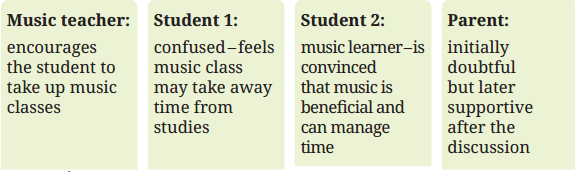
Answer:
Role-Play: Should I Join Music Classes?
Music Teacher Good morning everyone. I would like to encourage students to join music classes. Learning music improves concentration, creativity, and confidence. It also helps students relax after studies.
Student 1: I am interested in music, but i am worried it may take away time from my studies. I already have homework and exams to prepare for.
Parent: I share the same concern. I want my child to do well in academics. Will music classes affect study time?
Student 2: I have been learning music for two years. It has helped me manage stress and improve my focus. I follow a timetable and balance both studies and practice easily.
Music Teacher: That is true. Music actually improves discipline and memory. We also plan practice time carefully so it does not disturb academic work.
Student 1: That sounds reassuring. If I can manage both studies and music, I would like to try joining the class.
Parent: After listening to this discussion, I feel more confident. I now support my child joining music classes.
Music Teacher Wonderful! I am sure this decision will help in your overall development.
[Note: The above answer is given as reference. Students are expected to attempt the above activity on their own.]
Writing Task
I. Your school is organising a musical evening on 21 June, World Music Day. You are presenting a Sitar recital at the event, Draft an invitation letter requesting your grandparents to attend the event.

Follow the guidelines given to draft the invitation letter.
Format:
Sender’s address
Date
Salutation: Dear…
Body of the letter:
- Ask about their well-being.
- Mention the event and give details—date, time, and venue.
- Request them to attend.
Complimentary close: Yours affectionately,
Name of the sender
Language:
- Use fist person—‘I’ and second person ‘We’ and ‘You’.
- Write in a warm and personalised style.
Answer:
12, Shanti Nagar Colony
Sector 4, Ghaziabad
Uttar Pradesh —201001
18 June 2026
Dear Dadu and Dadi,
I hope this letter finds you both in the best of health and high spirits. I have been missing you dearly and thinking of you often these days. I am writing to share some wonderful news with you. Our school, Dethi Public School, is organisirig a grand Musical Evening on the occasion of World Music Day, 21 Jurie 2026. The event will be held in the School Auditorium and will begin at 5:30 p.m. it promises to be a beautiful and memorable evening filled with music, culture and joy.
I am especially excited to tell you that I will be presenting a Sitar recital at this event. It would mean the world to me to have you both in the audience as I perform. Your presence will give me immense confidence and make this occasion truly special and unforgettable for me.
I sincerely request you to please make it a point to attend. We have reserved seats in the front row especially for our family. Refreshments will be served after the performance and we can spend some quality time together afterwards.
I eagerly await your arrival and look forward to making you proud.
Yours affectionately,
Ananya Sharma
Learning Beyond the Text
I. Did you know, India’s rich musical heritage has a lot to offer to our wellbeing? Raga Chikitsa, one of the ancient texts, elaborates on the healing properties of music. A seventeenth century work titled Sangita Sudha gives an account of the effects of music on emotions. Find out how music is used as an alternative therapy in the present times.
Answer:
Music therapy is widely recognised today as a powerful alternative healing method. Here is how it is used:
What is Music Therapy? Music therapy is a clinical practice where trained therapists use music to address the physical, emotional, cognitive, and social needs of individuals.
How it is used today:
- Mental Health: Music therapy is used to treat depression, anxiety, stress, and PTSD. Listening to calming music reduces the levels of cortisol, the stress hormone, in the body.
- Alzheimer’s and Dementia: Patients with memory loss often respond positively to familiar music, helping them recall memories and feel emotionally grounded.
- Cancer Care: Many hospitals use music therapy to reduce pain, nausea, and emotional distress in cancer patients undergoing treatment.
- Children with Autism: Music helps children with autism improve their communication, social interaction, and emotional expression.
- Physical Rehabilitation: Rhythmic music is used to help stroke patients regain movement and coordination through a technique called Neurologic Music Therapy.
- Neonatal Care: Soft lullabies and gentle sounds are played in neonatal units to soothe premature babies and support their development.
- Yoga and Meditation: Specific ragas and sound frequencies such as 432 Hz and 528 Hz are used in meditation practices to promote healing and inner peace.
[Note: The above answer is given as reference. Students are expected to attempt the above activity on their own.]
II. Everything in nature has a rhythm or sound vibration, even our heartbeat. Speak to your music teacher and find out about the origin of the seven swaras (notes) of Indian classical music.
Answer:
| Swara | Full named | Inspired by |
| Sa | Shadja | The cry of the peacock |
| Re | Rishabha | The sound of the bull or ox |
| Ga | Gandhara | The bleat of a goat |
| Ma | Madhyama | The call of the dove or heron |
| Pa | Panchama | The call of the cuckoo (Koyal) |
| Dha | Dhaivata | The neigh of a horse or the sound of a frog’ |
| Ni | Nishada | The trumpeting of an elephant |
Origin and Significance: The seven swaras are believed to have originated from the sounds of nature and animals. Ancient Indian musicologists observed that all sound in nature could be organised into these seven fundamental notes. They are mentioned in ancient texts such as the Natya Shastra by Bharata Muni, which is considered the foundational text of Indian classical music and performing arts. The swaras form the basis of all ragas and are deeply connected to human emotions, times of the day, and seasons.
[Note: The above answer is given as reference. Students are expected to attempt the above activity on their own.]
III. You must have read or heard poems and songs about music – both in English and in your own language. Share some of them with your classmates and create a collection of these poems and songs together.
Answer:
In English:
- ‘Music’ by Longfellow – a beautiful poem describing music as art divine
- ‘I Wandered Lonely as a Cloud’ by William Wordsworth -though about nature, it captures the musical rhythm of poetry itself
- ‘A Friend Found in Music’ by Bryanna T. Perkins -the poem we have studied, celebrating music as a companion
In Hindi:
- ‘Sur Na Saje’ -a popular song reflecting the importance of music in life
- ‘Vaishnav Jan To’ -a devotional composition by Narsinh Mehta, set to music by many artists including M.S. Subbulakshmi
- ‘Man Tarpat Hari Darshan Ko Aaj’ -a classical Hindi song from the film Baiju Bawra, showcasing the healing power of music
In Other Indian Languages:
- Tamil: ‘Isaiye Thunai’ – a song about music being a companion
- Bengali: Rabindranath Tagore’s Rabindra Sangeet compositions, many of which speak of music as the language of the soul
[Note: The above answer is given as reference. Students are expected to attempt the above activity on their own.]
A Friend Found in Music Class 9 Extra Questions and Answers
A Friend Found in Music Short Question Answer
Question 1.
How does the poet use the image of the ocean to describe her relationship with music? What does this comparison reveal about the depth of her feelings?
Answer:
The poet compares music to an ocean to suggest that it is vast, powerful and strongly attractive. Just as the ocean pulls water to the shore, music draws her toward comfort and belonging. This comparison reveals that her connection with music is deep, natural, and impossible to resist.
Question 2.
What does the poet mean when she says music ‘moves her to the core’? How is this different from simply enjoying music?
Answer:
When the poet says music moves her to the core, she means it deeply affects her emotions and inner feelings. This is different from simply enjoying music because it shows a strong personal connection that influences her deeply rather than giving only temporary pleasure or entertainment.
Question 3.
Why does the poet call music her ‘therapy’? What does this word choice suggest about her emotional state?
Answer:
The poet calls music her therapy because it comforts her when she feels sad and helps her regain emotional strength. This word choice suggests that she experiences moments of loneliness and depends on music for healing, reassurance, and support during difficult situations in her life.
Question 4.
Explain the significance of the phrase ‘pull through’ in the context of the poem. What does it tell us about the poet’s struggles?
Answer:
The phrase ‘pull through’ means to successfully overcome difficult situations. In the poem, it suggests that the poet faces emotional struggles but finds strength through music. Music supports her during challenging times and helps her remain hopeful, strong, and confident despite her difficulties.
Question 5.
What does the poet reveal about the nature of human relationships through the line ‘when no one seems to care’?
Answer:
Through the line ‘when no one seems to care’, the poet suggests.. that she has experienced loneliness and a lack of emotional support from others. This highlights how human relationships may sometimes fail, while music remains a dependable companion that provides comfort and reassurance during such moments.
Question 6.
How does the repetition of the word ‘music’ throughout the poem contribute to its overall effect?
Answer:
The repetition of the word ‘music’ emphasises its importance in the poet’s life. It creates a rhythmic and musical effect that strengthens the theme of the poem and shows that music remains constantly present in her thoughts, emotions and experiences as a faithful companion.
Question 7.
In what ways is music present during both the joyful and sorrowful moments of the poet’s life? Support your answer with evidence from the poem.
Answer:
Music supports the poet during sad moments when she says, “Music is the therapy I heed when I feel blue.” It is also present during her happiest moments, as she says, ‘the times when I’m most cheerful, it’s clear, music was there.’ This shows music remains with her in all emotional situations. ‘
Question 8.
How does the poet personify music in the poem? What human qualities does she attribute to it?
Answer:
The poet personifies human qualities of presence. It lifts her spirits, heals her when she feels blue, stays with her during cheerful moments, and supports her when no one seems to care. These qualities show music as loyal, comforting, dependable, and emotionally understanding like a true friend.
Question 9.
Why is music considered a universal language across cultures?
Answer:
Music is understood and appreciated by people all over the world, regardless of language differences. It expresses emotions such as happiness, sadness, and hope. This universal quality makes music an important form of communication across societies and cultures. ”
Question 10.
Music is often shared during celebrations, travel, or family time. Describe an occasion when you shared music with your friends or family members. How did this experience strengthen your relationship with them?
Answer:
Yes, I once shared music with my family during a long car journey. We listened to our favourite old songs and sang together happily. This created a joyful atmosphere and helped us spend quality time together. The experience strengthened our bond and showed how music brings people closer emotionally.
Question 11.
Music often helps people manage stress and emotions. Have you ever listened to music when you felt sad or worried? How did it help you?
Answer:
Yes, I have listened to music when I felt sad or stressed. It helped me relax and improved my mood. Like the poet in the poem, I felt comforted and supported by music. It gave me strength and helped me think more positively during difficult situations.
A Friend Found in Music Long Question Answer
Question 1.
The poet describes music as playing j multiple roles in her life. Discuss in detail ! the various roles music plays for the poet ! as described in the poem. Do you think music can truly fulfil these roles for j everyone?
Answer:
In the poem, music plays several important roles in the poet’s life. She compares music to an ocean that draws her towards comfort and belonging. She also describes it as rhythm that touches her deeply and connects with her inner feelings. The poet calls music her therapy because it heals her sadness when she feels blue and lifts her spirits during difficult times.
She further presents music as a needed friend who stays with her when no one seems to care and shares both her joyful and lonely moments. Music can indeed fulfil these roles for many people, as it is a universal language that transcends barriers of age, culture, and language. However, the depth of its impact depends on the individual’s emotional sensitivity and personal relationship with music.
Question 2.
The poem uses several metaphors to describe music. Analyse how these metaphors collectively build the central theme of the poem.
Answer:
The poet uses several meaningful metaphors to present music as an essential companion in her life. She compares music to an Ocean to show its vast and powerful influence that draws her towards comfort and belonging. The metaphor rhythm suggests that music deeply affects her inner emotions. By calling music therapy, she presents it as a source of healing during sadness.
The most personal metaphor describes music as a needed friend who supports her when no one seems to care. Together, these metaphors develop the central theme that music provides comfort, strength, and companionship. They show that music is not just entertainment but a dependable presence throughout the poet’s life.
Question 3.
What is the message of the poem and how effectively does the poet convey it through her choice of language and poetic devices?
Answer:
The central message of the poem is that music is a powerful and reliable source of emotional comfort, healing, and companionship in human life. The poet conveys this message effectively through simple language and meaningful poetic devices. Her use of metaphors such as ocean, rhythm, therapy, and needed friend clearly shows the deep influence of music on her emotions.
The repetition of the word “music” at the beginning of several lines emphasises its importance and creates a rhythmic quality in the poem. The ABCB, rhyme scheme gives the poem a smooth and musical flow that reflects its theme. Through her honest expression of loneliness as well as happiness, the poet successfully highlights the constant and comforting presence of music in her life.
Question 4.
‘A Friend Found in Music’ presents music as more reliable than human companionship. Do you agree with this view? Justify your answer with reference to the poem and your own experience.
Answer:
The poem suggests that music can sometimes be more reliable than human companionship. The poet calls music her “needed friend” when no one seems to care, showing that it supports hr during lonely moments. She also says that music was present during her cheerful times, which proves that it remains a constant companion in both happiness and sorrow.
Unlike people, music is always available and never judges or leaves her alone. From my experience, listening to music often brings comfort and relief during stressful situations. However, it is important to recognise that human connection remains irreplaceable in ways that music cannot fully substitute. The ideal lies in embracing both music as a constant companion and people as sources of love and understanding.