Bharat Our Land Class 9 Question Answer
Reflect and Respond
I. Recall the lines of the National Anthem and complete the table given below with the names of the states, mountain ranges, and rivers mentioned in it.
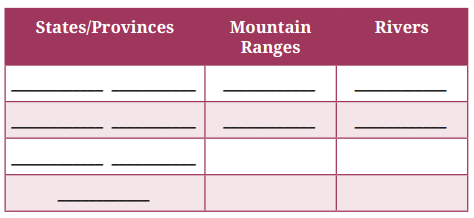
Answer:
| States/Provinces | Mountain Ranges | Rivers |
| Punjab, Sindh, Gujarat, Maratha, Dravida (Southern region), Utkala (Odisha region), Banga (Bengal region) | Vindhya, Himachal (Himalayas) | Yamuna, Ganga |
II. Work in pairs. Discuss what the words जये हे (Jaya he) in the last two lines of the National Anthem convey. Share your answer with your classmates and teacher.
Answer:
The words ‘जये हे’ (Jaya he) express victory{ glory and praise. They convey a feeling of respect, pride and celebration for the nation. Through these words, the singer offers salutations to the spirit and unity of India. They are repeated as a resounding cheer to India’s glory.
[Note: The above answers are given for reference. Students are expected to write these answers on their own.] .
III. Read the underlined words in the given lines of the poem. Choose the odd one out j that does not correspond with the meaning I of the underlined word.
1. She’s peerless, let’s praise her!
valuable, incomparable, unmatched
2. Many a sage has sanctified this land.
blessed, purified, applauded
3. And here all auspicious things are found.
fortunate, fantastic, favourable
4. Of hoary antiquity is Bharat,
ancient times, recent past, time immemorial
Answer:
1. valuable
2. applauded
3. fantastic
4. recent past
Class 9 English Bharat Our Land Poem Question Answer
Check Your Understanding
I. Fill in the blanks by choosing appropriate words from the box given below to complete the summary of the poem.
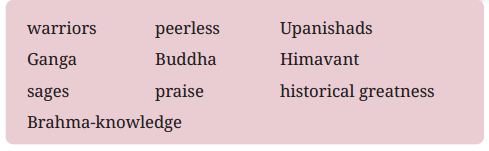
The poem is a tribute to India, celebrating its natural beauty, spiritual heritage, and 1. _______. The poet praises the 2. _______, describing it as mighty and unparalleled. The 3. _______ is depicted as generous and graceful, while the 4. _______ are honoured as sacred and unmatched. The poem highlights the contributions of 5. _______ and 6. _______ who have enriched the land with their bravery and wisdom. It also acknowledges the presence of 7. _______ and the teachings of 8. _______, highlighting India’s deep-rooted spiritual and philosophical traditions. The poet repeatedly asserts that India is 9. _______, urging everyone to 10. ________ her.
Answer:
The poem is a tribute to India, celebrating its natural beauty, . spiritual heritage, and 1. historical greatness. The poet praises the 2. Himavant, describing it as mighty and unparalleled. The 3. Ganga is depicted as generous and graceful, while the 4. Upanishads are honoured as sacred and unmatched. The poem highlights the contributions of 5. warriors and 6. sages who have enriched the land with their bravery and wisdom. It also acknowledges the presence of 7. Brahma-knowledge and the teachings of 8. Buddha, highlighting India’s deep-rooted spiritual and philosophical traditions. The poet repeatedly asserts that India is 9. peerless, urging everyone to 10. praise her.
II. Complete the following features about the poem.
1. The impact on the readers (mood): __________
2. The poet’s attitude (tone): __________
3. The rhyme scheme: ___________
4. Examples of personifiation: ________
Answer:
1. The impact on the readers (mood): Bride, admiration and inspiration
2. The poet’s attitude (tone): Patriotic and reverential
3. The rhyme scheme: Irregular / Free verse (no fixed rhyme scheme)
4. Examples of personification: “The generous Ganga”, “This sunny golden land is ours – she’s peerless” (India and the river are given human qualities)
III. What is the impact of the refrain, ‘she’s peerless, let’s praise her!’?
Answer:
The refrain emphasises India’s unparalleled greatness, fostering a sense of national pride and collective admiration in the reader.
IV. Complete the following sentence appropriately.
India is metaphorically described as ‘this sunny golden land,’ suggesting that it is ________.
Answer:
rich and prosperous
V. The poet uses symbolism. Match the symbols in Column 1 to what they suggest in Column 2.
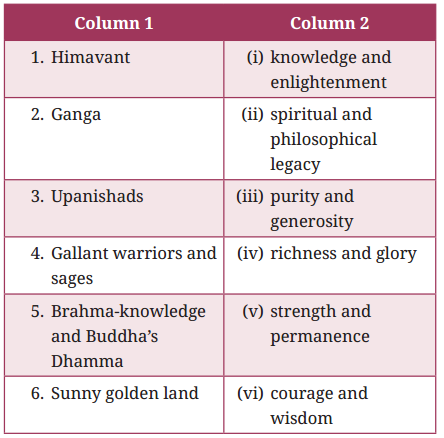
Answer:
(1 – v), (2 – iii), (3 – ii), (4 – vi), (5 – i), (6 – iv)
VI. The poet uses imagery (descriptive language to create vivid mental pictures that appeal to the senses). Give any two examples from the poem.
Answer:
mighty Himavant, sunny golden land
[Note: Other answers include: generous Ganga and many a sage has sanctified this land]
VII. What is the impact of the use of hyphens in the first stanza? Select the options that are true.
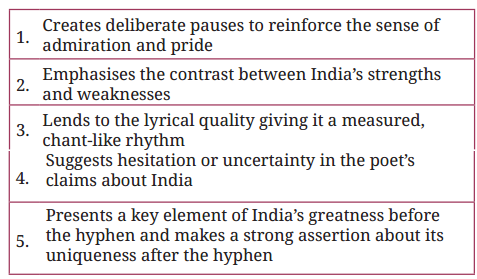
Answer:
1, 3, 5
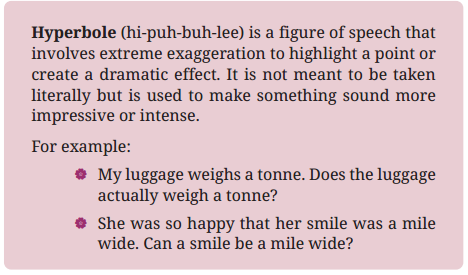
VIII. The poem is an ode. Identify examples from the poem that correspond to it being anode.
Answer:
“The mighty Himavant is ours – there’s no equal anywhere on earth. “The generous Ganga is ours”; “This sunny golden land is ! ours – she’s peerless, let’s praise her!”; “Gallant warriors have lived here…”
IX. Read the explanations and identify the matching allusions from the poem for the following.
1. An allusion to the ancient Indian scriptures that form the philosophical core and symbolise deep wisdom and enlightenment.
2. An allusion to the concept of spiritual knowledge associated with self-realisation and ultimate truth.
3. An allusion to Gautama Buddha’s teachings, which include compassion, non-violence, and enlightenment. This highlights India’s role in shaping major religious and philosophical traditions.
Answer:
1. Upanishads,
2. Brahma-knowledge,
3. Buddha/Buddha’s dhamma
Critical Reflection
I. Read the extract given below and answer the questions that follow.
The mighty Himavant is ours-
there’s no equal anywhere on earth.
The generous Ganga is ours-
which other river can match her grace?
The sacred Upanishads are ours-
what scriptures else to name with them?
Question 1.
Complete the sentence.
The word ‘mighty’ refers to the ________ of the Himavant.
Answer:
strength
Question 2.
Choose the correct option to complete the sentence given below.
The question mark at the end of the fourth and sixth line of the extract is used to _____.
i) show doubt and uncertainty
ii) emphasise a point
iii) highlight confusion and hesitation
iv) reveal inquiry and curiosity
Answer:
ii) emphasise a point
Question 3.
The poet uses the word ‘generous’ to describe the Ganga. Why?
Answer:
The poet uses the word ‘generous’ to describe the Ganga because of her life-giving and nurturing traits,
Question 4.
Why has the movement of the river been described as graceful?
Answer:
The movement of the river has been described as graceful because it flows smoothly and beautifully.
Question 5.
Fill in the blank with the correct option from the words given in the brackets.
The poet is implying that the Upanishads are _______ (unmatched/abundant) in their wisdom and spiritual depth.
Answer:
unmatched
II. Answer the following questions.
Question 1.
How does the poem reflect a strong connection to cultural identity and’ heritage?
Answer:
The poem reflects a strong connection to cultural identity and. heritage by highlighting India’s natural features, sacred texts, and spiritual traditions. References to the Upanishads, sages, and Gautama Buddha show the country’s rich philosophical legacy, which shapes its, identity and values.
Question 2.
What can you infer about the poet’s attitude towards India from the repeated phrase ‘she’s peerless, let’s praise her!’?
Answer:
The poet expresses deep pride, admiration, and reverence for India. By repeating the phrase, he emphasises the nation’s unmatched greatness and highlights all that it symbolises—its natural beauty, cultural richness, and spiritual heritage. The repetition also encourages readers to appreciate and take pride in the country.
Question 3.
What does the line ‘many a sage has sanctified this land’ suggest about India’s spiritual heritage?
Answer:
The line ‘many a sage has sanctified this land’ suggests India is a spiritual landscape and hallowed ground, purified by the wisdom and penance of ancient thinkers(sages). This sanctified heritage formed a deep foundation for universal truths like Brahma-knowledge to take root, defining BFarat as a peerless nation of hoary antiquity and ethical leadership.
Question 4.
How does the poet connect warriors and music to India’s greatness?
Answer:
The poet connects warriors and music to India’s greatness by presenting them as symbols of strength and cultural richness. While the warriors represent courage and valour, the reference to divine music highlights the country’s artistic and spiritual heritage. Together, they show that India’s greatness lies in both power and refinement.
Question 5.
How does this poem foster a sense of national pride?
Answer:
This poem fosters a sense of national pride by praising India’s uniqueness, heritage and greatness.
Vocabulary in Context
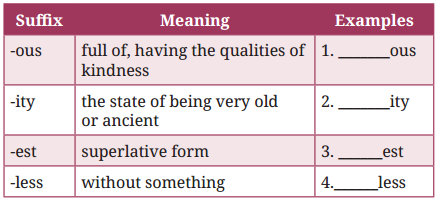
I. Complete the table by choosing words from the poem.
Answer:
| Suffix | Meaning | Examples | |
| -ous | full of, having the qualities of kindness | 1. | generous |
| -ity | the state of being very old or ancient | 2. | antiquity |
| -est | superlative form | 3. | divinest |
| -less | without something | 4. | peerless |
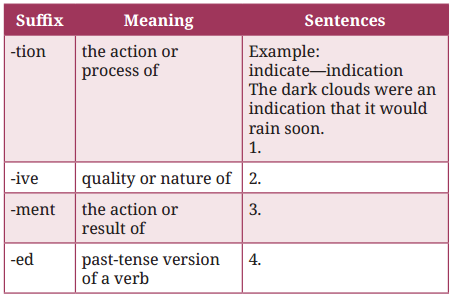
II. Complete the following table by adding a different suffix to form new words. Also, create a sentence using the created word. One example has been done for you.
Answer:
| Suffix | Meaning | Examples |
| -tion | the action or process, of | Example: indicate -indication. The dark clouds were an indication that it would rain soon. |
| -ive | quality or nature of | create – creative. She is very creative and always comes up with new ideas. |
| -ment | the action or result of | achieve – achievement. Winning the award was a great achievement for the team. |
| -ed | past-tense version of a verb | sanctify – sanctified. Many sages sanctified this land with their wisdom. |
Listen and Respond
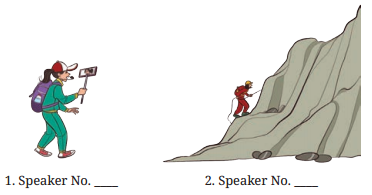
You will listen to four people talk about the places they like to travel to. As you listen, write the speaker number for the two pictures given. (Transcript for teacher on Textbook page 260)
Answer:
1. Speaker No. 4
2. Speaker No. 2
II. You will once again listen to the four speakers. As you listen, match the given statements to the speaker. There are two statements that you do not need. (Transcript for teacher on Textbook page 260)
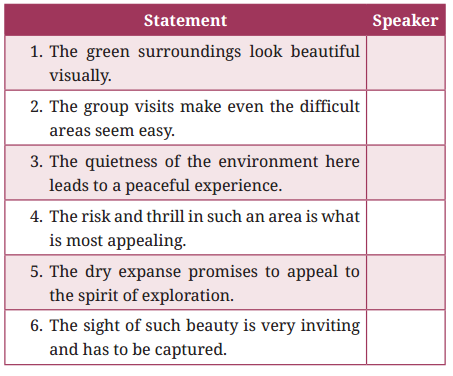
Answer:
| Statement | Speaker | |
| 1. | The green surroundings look beautiful visually. | Speaker 4 (travel vlogger, loves forests) |
| 3. | The quietness of the environment here leads to a peaceful experience. | Speaker 1 (elderly man, riverside calm) |
| 4. | The risk and thrill in such an area is what is most appealing. | Speaker 2 (adventure -enthusiast, mountains) |
| 6. | The sight of such beauty is very inviting and has to be captured. | Speaker 3 (photographer, deserts) |
So, the two statements that are not needed are:
- Statement 2
- Statement 5
Speaking Activity
Question 1.
In pairs, take turns to speak about the aspects of your village/town/city that you feel are an asset. It could be about geographical, cultural, traditional features, or even its history. Use the cues given in textbook to express your praise and admiration.

One thing that I find truly wonderful about my village/town/city is…
- If I had to describe my village/town/city in one word, it would be…
- I have always been fascinated by the way the people of my village/town/city…
- What I want other people to know about my village/ town/city is…
- When it comes to the scenery, my village/town/city truly shines because…
- I feel a deep sense of pride when I think about my village/town/city…
Answer:
One thing that I find truly wonderful about my village/town/city is the lively festivals that bring everyone together.
- If I had to describe my village/town/city in one word, it would be ‘welcoming/
- I have always been fascinated by the way the people of my village/town/city respect traditions while also embracing modem life.
- What I want other people to know about my village/town/city is that it has a rich history and monuments that tell amazing stories.
- When it comes to the scenery, my village/town/city truly shines because of the green parks, riversides, and beautiful sunsets.
- I feel a deep sense of pride when I think about my village/town/city because it has produced great leaders, artists, and thinkers.
[Note: Using the above pointers as reference, students are expected to do this activity on their own.]
Writing Task
I. Write a paragraph about a place that you have visited which has stayed in your memory.
Remember to mention the following:
- Why did you go there?
- Who did you travel with?
- How did you prepare for the travel?
- Where did you stay?
- What activities did you do there?
Answer:
Last year, I visited Jaipur, a trip that has stayed fresh in my memory. I went there to explore its historical forts and palaces, and I travelled with my family, which made the experience even more enjoyable. Before the journey, we prepared for the trip by reading about the city’s heritage, booking tickets in advance, arid packing light clothes suitable for the warm climate. We stayed in a malI heritage hotel near the old city, which gave us a taste of traditional Rajasthani hospitality. During our stay, we visited Amber Fort, City Palace, and Hawa Mahal, and we also enjoyed shopping for handicrafts in the local markets. The highlight was watching the sunset from Nahargarh Fort, which made the whole trip unforgettable.
[Note: The above answer is given as a reference. Students are expected to attempt this activity on their own.]
Learning Beyond the Text
I. Search for poems or songs dedicated to India, your motherland, in your regional language. Share them with your classmates and explain their meaning too.
Answer:
Poems or Songs Dedicated to India:
Regional Language Examples include:
- Hindi: ‘Vande Mataram’ — praises the motherland as divine and nurturing.
- Bengali: ‘Amar Sonar Bangla’ – celebrates the golden beauty of Bengal.
- Tamil: ‘Tamil Thai Valthu’ — a hymn to Mother Tamil, symbolising pride in culture.
II. In groups of six, prepare an interdisciplinary project on India’s major geographical features. For each feature, describe the region, explain its importance in the lives of the people living there and mention the languages spoken in that region. Include one example of each of the following.
- Mountains – Himalayas, Western Ghats, etc.
- Rivers – Ganga, Yamuna, Krishna, Kaveri, Godavari, etc.
- Deserts – Thar Desert, Rann of Kutch, etc.
- Valleys – Kangra Valley, Nubra Valley, etc.
- Islands – Andaman and Nicobar Islands, Lakshadweep, etc.
- Plateaus – Deccan, Malwa, Meghalaya, etc.
Answer:
Interdisciplinary Project on India’s Geographical Features
(Students can divide into six groups, each j focusing on one feature)
1. Mountains (Himalayas, Western Chats)
- Region: The Himalayas are located in northern India and consist of high, snow çovered mountain ranges. The Western Ghats run along the western coast and are covered with dense forests and rich biodiversity.
- Importance: The Himalayas act as a natural barrier, influence climate, and are the source of many important rivers. The Western Ghats play a key role in bringing rainfall and supporting a wide variety of plant and animal life.
- Languages Spoken:
Himalayan region: Hindi, Nepali, Kashmiri, Pahari languages
Western Ghats region: Marathi, Konkani, Kannada, Malayalam, Tamil
2. Rivers (Ganga, Yamuna, Krishna, Kaveri, Godavari)
- Region: These rivers flow through the northern plains and the peninsular plateau, forming fertile river basins.
- Importance: Rivers provide water for agriculture and daily use. They are also important for transport, religious practices
- Languages Spoken:
Northern River regions: Hindi, Bhojpuri, Bengali, Maithili
Southern River regions: Telugu, Kannada, Tamil
[Note: Two geographical features have been given as reference. Students are expected to do this activity on their own.]
Bharat Our Land Class 9 Extra Questions and Answers
Bharat Our Land Short Question Answer
Question 1.
If the references to the Himavant and the Ganga were removed from the extract, how would it affect the tone and persuasive power of the poem? Justify your response.
Answer:
Removing the references to the Himavant and the Ganga would strip the poem of its most vivid symbols. Without these iconic landmarks, the imagery loses its emotional depth and the praise of India’s greatness becomes less persuasive and relatable.
Question 2.
How do the Upanishads add to India’s greatness?
Answer:
The Upanishads add to India’s greatness by offering profound spiritual knowledge and philosophical depth. They reflect the intellectual and moral richness of the country, guiding people towards truth and self-realisation. Through them, the poet highlights India’s long-standing tradition of. wisdom and deep thinking.
Question 3.
What role do sages play in the poem?
Answer:
Sages in the poem play a significant role by sanctifying and blessing the land through their presence and spiritual practices. They represent purity, wisdom and devotion. Their contribution enhances the spiritual value of the nation, making it a place of enlightenment and divine connection.
Question 4.
How does the structure of the poem contribute to its overall impact on the reader?
Answer:
The poem is structured as a series of assertions followed by the refrain “she’s peerless, let’s praise her!” This rhythmic progression builds emotional momentum, moving the reader from visualising natural beauty to appreciating cultural depth and historical legacy, resulting in a persuasive and unified impact.
Question 5.
What impression do you form about the nation’s legacy based on the poet’s description?
Answer:
The poet describes a legacy of ‘hoary antiquity’ where bravery (warriors) and wisdom (sages) coexist. This creates an impression of a well-rounded civilisation that values both the strength to protect its borders and the spiritual depth to seek universal truths through ‘Upanishads’ and ‘Dhamma’.
Question 6.
What role does admiration play in shaping the tone of the poem? Explain how it influences your understanding of the poet’s intent.
Answer:
Admiration creates a reverent and celebratory tone, primarily with adjectives like “mighty” and “peerless”. This influences our understanding by revealing the poet’s intent to inspire collective pride and a sense of shared belonging among the readers. Moreover, the tone of admiration also highlights poet’s relentless devotion and love towards the nation, shaping it as a patriotic poem.
Bharat Our Land Long Question Answer
Question 1.
How are geographical features, spiritual heritage and emotional tone interconnected in the poem to create a unified vision of national pride? What insight does this offer about the nation’s identity?
Answer:
The poet interconnects the physical and metaphysical by portraying nature as the foundation of spirituality. The “rnighty Himavant” and “generous Ganga” are not just terrain; they are the backdrop for the “sacred Upanishads”. The emotional tone of high praise acts as a bridge, linking these geographical wonders to the intellectual achievements of sages and the Buddha. This synthesis offers the insight that the nation’s identity is holistic—it is a “sunny golden land” where physical beauty is inseparable from its spiritual and ethical wealth. By weaving these threads together, Bharati presents national pride as a deep-rooted appreciation for both the visible land and the invisible values it nurtures.
Question 2.
The poem presents India not just as a place but as an idea. Discuss how the poet builds this idea through different aspects highlighted in the poem.
Answer:
The poet constructs India as an ‘idea’ of a perfect civilisation by highlighting a balance of diverse virtues. He presents the ‘idea’ of India as a sanctuary for both action and contemplation—symbolised by “gallant warriors” and “sanctified sages”. This idea is further expanded to include intellectual curiosity (Brahma-knowledge) and ethical conduct (Dhamma). By moving away from specific dates or maps and focusing on ‘auspicious things’ and ‘grace’, Bharati transforms the physical territory into a conceptual symbol of harmony and excellence. Thus, the nation becomes a living idea of a spiritual and cultural powerhouse that is both ‘sunny’ and ‘sacred’, inviting the world to appreciate its internal light.
Question 3.
What contrast do warriors and sages create?
Answer:
The contrast between warriors and sages highlights two essential aspects of a nation’s greatness: strength and wisdom. Warriors represent courage and the ability to protect the nation, while sages stand for knowledge, peace and spiritual insight. By presenting both together, the poet suggests that true greatness lies in maintaining a balance between action and thought. A nation is not defined only by its power but also by its values and understanding. This contrast enriches the image of the land, showing it as both strong and thoughtful. It reflects a well- rounded identity where physical capability and intellectual depth exist together and .contribute equally to the nation’s progress.
Question 4.
In the poem, Subramania Bharati places the Upanishads alongside the Himalayas and the Ganga. What does this placement tell us about how he views scripture as part of cultural identity?
Answer:
Bharati’s placement of the Upanishads with the Himalayas and the Ganga serves a symbolic purpose. The Himalayas represent physical grandeur and permanence, while the Ganga symbolises spiritual purification and life-giving grace. By placing the Upanishads in this company, Bharati elevates the ancient scripture to the same status as nature’s greatest gifts: something eternal, irreplaceable and uniquely, India’s own. He is’ saying that India’s identity is not built on land alone, but equally on the wisdom contained in her sacred texts. The Upanishads, in his vision, are not merely religious documents but a civilisational treasure that defines what Bharat is and has always been.
Question 5.
How can you show pride for your country in daily life?
Answer:
Showing pride for one’s country does not always require grand actions; it can be reflected through small, meaningful choices in our daily lives. One can begin by respecting national symbols such as the flag and the anthem and by being aware of the country’s history and culture. Practising honesty, responsibility and discipline in everyday actions also contributes to building a strong nation. Supporting local products, preserving the environment and keeping public spaces clean are practical ways of showing care for the country. Additionally, respecting diversity in terms of different languages, cultures and traditions helps promote unity. Being a responsible citizen, following rules and contributing positively to society are all expressions of true patriotism. Thus, pride for one’s country is best shown through consistent actions that reflect respect, responsibility and love for the nation.
Question 6.
How can India’s heritage be promoted through social media?
Answer:
India’s rich heritage can be effectively promoted through digital platforms to learn and share knowledge, stories and visuals with a global audience. People can create engaging content such as short videos, blogs, reels and posts showcasing historical monuments, traditional art forms, festivals and cultural practices. Educational pages and influencers can simplify complex historical or philosophical ideas in interesting manner. Virtual tours, storytelling and creative campaigns can help highlight lesser-known aspects of India’s heritage. It is also important to ensure that the information shared is accurate and respectful to avoid misinformation. By using hashtags, collaborations, and interactive content, social media can connect people worldwide and create awareness about India’s cultural richness. In this way, digital platforms become powerful tools for preserving and celebrating heritage in the modem age.
Writing Task
Question 1.
Step into the shoes of a modem-day poet! Write a four-line stanza in the style of Bharati, focusing on one or more achievements of Modem India (e.g., Space exploration, Digital connectivity, Sports glory, or Green energy).
Your stanza must conclude with your own original version of a refrain that captures the spirit of India today.
Answer:
A billion voices weave as one through unseen, shining streams,
From village paths to city lights, she powers countless dreams;
No hand untouched, no mind unheard—her networks bind us all—
She thrives in every pulse—let’s praise her, standing tall!
[Note: The above poem is given for reference. Students are expected to do this activity on their own.]
Question 2.
Subramania Bharati wrote “Bharat Our Land” during freedom struggle. Identify four ways in which his writing aimed to inspire people during the freedom struggle. Support each with an idea from the poem.
Answer:
Four Ways Subramania Bharati’s Writing Inspired People During the Freedom Struggle
i)Instilling pride in the nation:
Bharati presents India as “peerless” — a nation without equal — directly countering the colonial narrative that India was inferior or unfit for self-rule. By opening with this declaration, he gives people a reason to hold their heads high rather than feel defeated.
ii) Celebrating unity in diversity:
Rather than presenting a singular, uniform India, Bharati weaves together references to varied landscapes, peoples, and traditions to show that India’s strength lies in its diversity. This reminded readers that they were not isolated communities but parts of one great whole — a powerful counter to the British policy of divide and rule.
iii) Reviving cultural and spiritual heritage:
By invoking sages, ancient wisdom, and India’s intellectual legacy, Bharati reminds his readers that theirs is a civilisation that gave the world profound knowledge. This sense of a glorious past was not mere nostalgia — it was a call to reclaim what was rightfully India’s, including its freedom.
iv) Inspiring through affirmation, not anger:
Rather than dwelling on suffering under colonial rule, Bharati celebrates what India is — great, ancient, and enduring. This was a deliberate inspirational strategy: by making people believe in the nation’s greatness.
[Note: The above answer is given for reference.. Students are expected to do this activity on their own.]