Believe in Yourself Question Answer Class 9 English Kaveri Poem 8

Believe in Yourself Class 9 Question Answer

Reflect and Respond

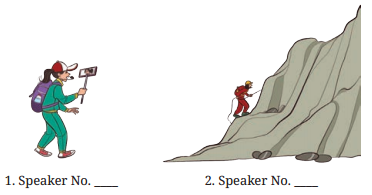
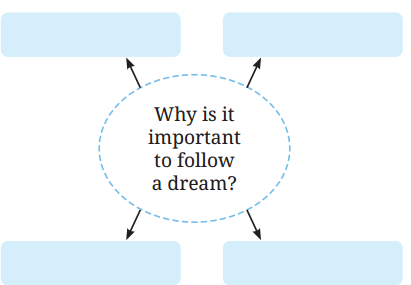
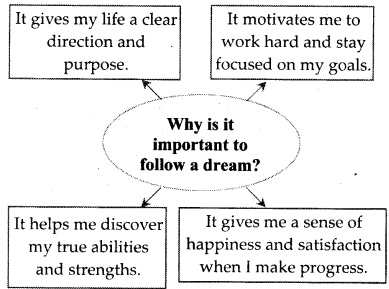
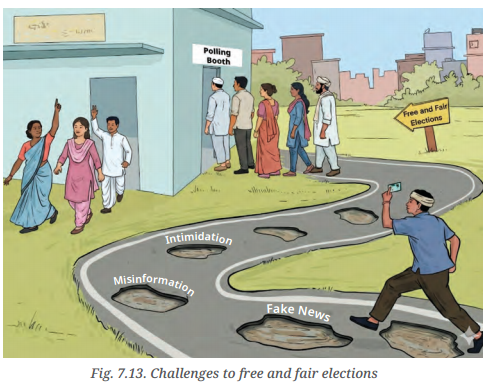
I. Imagine that you are the person in the image.

Question 1.
What emotions do you feel standing at the base of a difficult task?

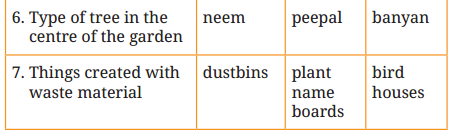
Believe in Yourself Question Answer Class 9 English Kaveri Poem 8 1
Answer:
Standing at the base of a difficult task, I feel a mixture of emotions all at once. There is excitement at the possibility of what lies ahead, but alongside it sits a quiet nervousness about whether I am truly capable of what is being asked of me. I feel the weight of uncertainty pressing down, and somewhere beneath all of that, there is also a small but steady flicker of determination reminding me that I have come this far already and that, in itself, is an achievement.

Question 2.
What might make you take the first step?
Answer:
Several factors can motivate me to take the first step. Remembering the purpose behind my goal gives me clarity and direction. The thought of looking back with regret is far more unsettling than the fear I feel in the present. In addition, a few encouraging words from someone who believes in me can boost my confidence. Sometimes, simply realising that waiting will not make things easier is enough to push me forward and begin.

II. Think about a time when you had to face a challenge.

Question 1.
What was it, and how did you feel at the start of the journey?
Answer:
One challenge I faced was speaking in front of the entire school during an assembly presentation. At the start, I felt terrified. My hands were cold, my thoughts were scattered, and I genuinely considered asking someone else to take my place. The fear of forgetting my words or being judged felt enormous, and I seriously doubted whether I was ready for something like that.

Question 2.
How did you feel once you made the decision to move forward?
Answer:
The moment I decided to go ahead and not back down, something shifted inside me. The fear did not disappear entirely, but it became smaller and more manageable. Once I began speaking, I found my rhythm and the words came more naturally than I had expected. When it was over, what I felt was not just relief but a genuine sense of pride. It was the kind that only comes from doing something that frightened you and discovering that you were more capable than you had believed.

III. What does the phrase ‘believe in yourself’ mean to you? Write some words or phrases you associate with believing in yourself.
Answer:
To me, ‘believe in yourself’ means trusting my own abilities even when the outcome is uncertain and others may doubt me. It means choosing to move forward not because the path is clear but because I know I have what it takes to figure it out as I go.

Words and phrases I associate with believing in yourself:
Courage, Self-trust, Inner strength, Resilience, Confidence, Determination, Taking the first step, Trusting the process, Knowing your own worth, Moving forward despite fear, Not waiting for permission and Being your own greatest supporter.

IV. Select the correct meaning of ‘status quo’ based on the given sentence.

Even though some kids wanted to try new activities, most of them were happy with the status quo and didn’t want any changes.
1. A plan to make things more exciting.
2. A situation to keep things the same.
3. A decision where everything is completely different.
4. A choice to change things quickly without thinking.
Answer:
2. A situation to keep things the same.
Hint
The sentence shows that the children were comfortable with how things already were and did not want anything to change.

Class 9 English Believe in Yourself Poem Question Answer

Check Your Understanding

I. Based on your understanding of the poem, select the correct central idea for each stanza from the options given.
Stanza 1
i) Facing challenges requires personal responsibility and a clear focus on one’s future.
ii) Facing challenges is a journey best taken with support and guidance from others.
Answer:
i)
Hint
The stanza emphasises that there is no crowd watching and no one else to rely on. The challenge is entirely personal, and the focus must remain on where the individual wants to be.

Stanza 2
i) Fear and uncertainty make it difficult to make choices as the future approaches.
ii) Facing the future with confidence makes choices easier and more straightforward.
Answer:
i)

Stanza 3
i) Personal growth involves finding balance between comfort and change.
ii) Personal growth requires leaving behind comfort and embracing change.
Answer:
ii)

Stanza 4
i) The first step towards change may feel easy if you place your trust in others to guide you and provide support.
ii) The first step towards change is difficult, but having self-belief and confidence helps you stay on track.
Answer:
ii)

II. Rhyme Scheme

Fill in the blank to complete the following sentence.
The poem follows a simple, yet effective rhyme scheme _______ that flows steadily through each stanza.
Answer:
The poem follows a simple, yet effective rhyme scheme ABCB that flows steadily through each stanza.

III. Tone

State whether the following statements are true or false.
1. The overall tone of the poem is motivational and encouraging.
2. The tone shifts from thoughtful in the beginning to one of determination by True the end of the poem.
Answer:
1. True
2. True

IV. Speaker

Fill in the blanks with the correct options from those given in the brackets in textbook.
Answer:
The speaker in this poem is not distant; rather, he/ she comes across as a guide who understands the struggle and is encouraging the reader to take control of his/her own future.
The use of direct address ‘You’ creates a close connection, as though the speaker is talking directly to the reader.

V. Imagery

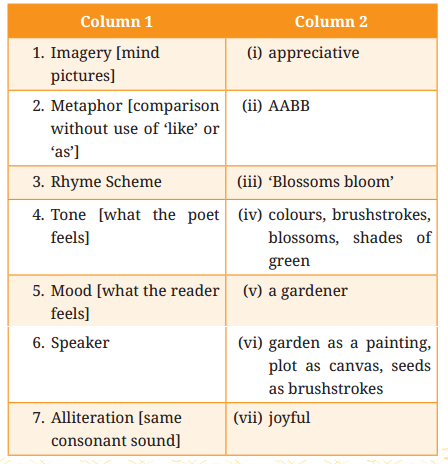
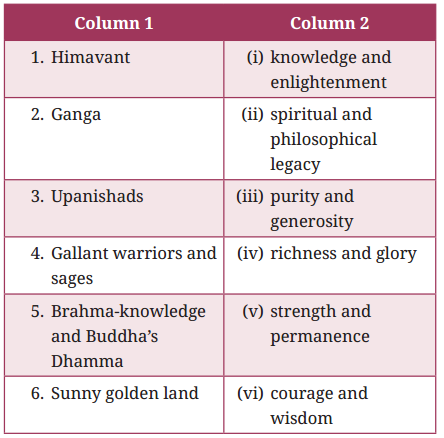
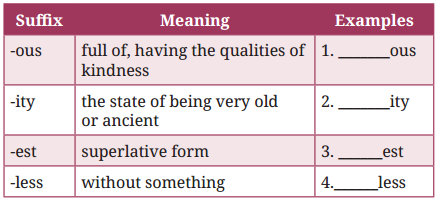
Match the phrases from the poem in Column 1 with the imagery they represent in Column 2. An extra representation is given.
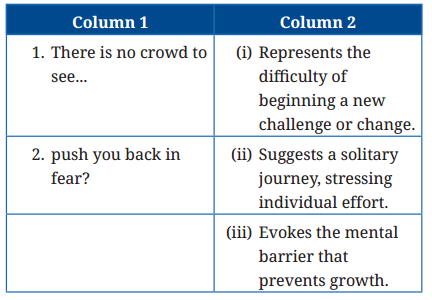
Believe in Yourself Question Answer Class 9 English Kaveri Poem 8 2
[Note: Option (i) is extra.]
Answer:
(1 – ii), (2 – iii)

VI. Symbolism

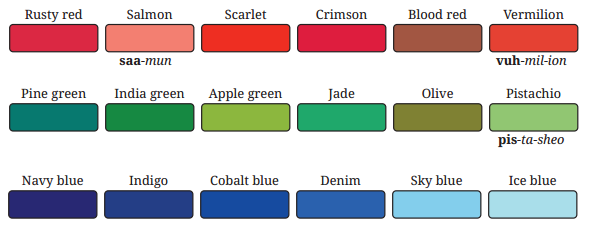
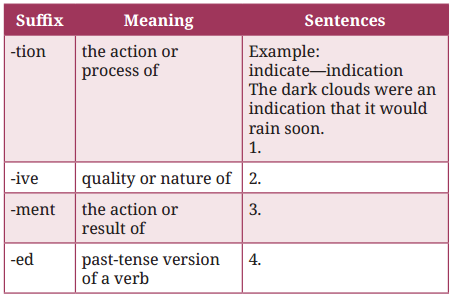
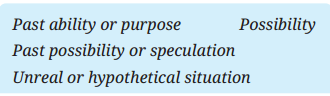
Select the words/phrases from the box below to complete the given sentences.
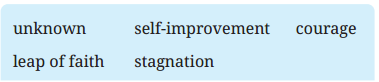
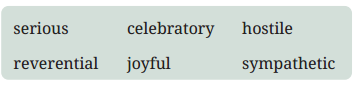
Believe in Yourself Question Answer Class 9 English Kaveri Poem 8 3

1. Comfort and the status quo represent _______ and fear of change, symbolising the comfort zone that holds one back.
2. The future symbolises the _______, the potential for change and success that lies ahead but requires _______ to step into.
3. The first step symbolises the initial ________ required to begin the journey of ________ or personal development.
Answer:
1. stagnation
2. unknown, courage
3. leap of faith, self-improvement

VII. Metaphor

The poet uses a metaphor in the line, ‘The first step is the hardest’. Explain why this is metaphorical.
Answer:
The line ‘The first step is the hardest’ is metaphorical because it does not refer literally to a physical step taken by a foot. Rather, ‘the first step’ is used figuratively to represent any initial act of courage — the decision to begin something new, difficult, or uncertain. The word ‘hardest’ extends this metaphor by suggesting that the greatest obstacle in any journey of personal growth is not the journey itself but the moment of beginning it. The poet compares the entire complex experience of overcoming fear, self-doubt, and inertia to the simple, familiar physical act of taking a step, making an abstract emotional experience feel immediate, relatable, and deeply human.

VIII. The poem uses antithesis in a couple of lines.

Antithesis is a rhetorical device that pairs contrasting or opposite ideas in a parallel grammatical structure to highlight differences or create emphasis. It simplifies complex ideas through contrast, making them easier for readers or listeners to understand.

Consider the famous quote from Neil Armstrong when he stepped onto the moon:

“Setting foot on the moon may be a small step for a man, but a giant leap for mankind.”

Here, the antithesis lies in contrasting the ‘small step’ for an individual with the ‘giant leap’ for all humanity. The parallel structure of the two phrases highlights the incredible signifiance of this event, presenting it as both a personal and massive achievement.

Other examples:

  • Speech is silver, but silence is gold.
  • Patience is bitter, but it has a sweet fruit.
  • Man proposes, God disposes.

Identify the lines from the poem that show antithesis and explain why it is so.
Answer:
Line 1: “Will it pull you forward/Or push you hack in fear?”
Explanation: This is a clear example of antithesis. The poet places two directly opposing ideas – ‘pull you forward’ and ‘push you back’ – in a parallel grammatical structure within the same question. ‘Pull you forward’ represents progress, ambition, and the positive embrace of the future, while ‘push you back in fear’ represents retreat, self-doubt, and the negative power of anxiety. The contrast between moving forward and moving backward, and between motivation and fear, highlights the central choice every individual must make when standing before an uncertain future. The parallel structure makes both possibilities feel equally real and equally powerful, forcing the reader to recognise that the outcome depends entirely on their own response to what lies ahead.

Line 2: “There is such ease in comfort/To maintain the status quo,/But this isn’t what we are made for/This isn ‘t how we grow.”
Explanation: This is a sustained antithesis built across four lines. The first two lines present the appealing ease and familiarity of comfort and the status quo, while the final two lines firmly oppose this with the truth that comfort is incompatible with growth and human purpose. The contrast between ‘ease in comfort’ and ‘how we grow’ is the heart of the antithesis — ease suggests effortlessness and passivity, while growth demands effort, challenge, and change. The conjunction ‘but’ signals the turn and makes the opposition structurally clear. By placing these two opposing ideas side by side, the poet creates maximum emphasis, making the rejection of comfort feel not harsh but logical, inevitable, and deeply honest.

Critical Reflection

I. Read the extract given below and answer the questions that follow.

Question 1.
Step up to the challenge
There is no crowd to see,
It’s just you and the future
And where you want to be.

i) What does the line, ‘There is no crowd to see’ suggest about facing challenges?
Answer:
The line suggests that facing challenges is a personal journey with no audience, or external validation.

ii) Complete the following suitably.
The line ‘It’s just you and the future’ suggests that ________.
Answer:
achieving one’s goals is a personal journey where individuals must make their own choices and take responsibility for shaping their future

iii) Fill in the blank with the appropriate word/phrase from the extract.
Latha will _______ her efforts to improve her vocal performance by practicing harder each day.
Answer:
step up

iv) Select the most suitable title for the extract.
(A) The Struggles of Change
(B) Facing the Future Alone
(C) A Journey of Growth
(D) The Power of Fear
Answer:
(C) A Journey of Growth
Hint
The extract encourages one to take personal responsibility for future by stepping up to the challenges and doing it for oneself and one’s dreams. All these ideas together capture the essence of growth (or the journey of growth).

v) Complete the analogy by using a word from the extract.
achieve: goal:: face : _______
Answer:
challenge

II. Answer the following questions.

Question 1.
What is the significance of the metaphor, ‘The first step is the hardest’ in the context of personal growth?
Answer:
This metaphor highlights that beginning is the most difficult part of growth. By representing abstract fear as a physical step, it makes the struggle relatable. It suggests that overcoming initial hesitation builds the momentum necessary to make further progress easier.

Question 2.
What message does the antithesis in the poem convey about the nature of personal development?
Answer:
The antithesis reflects the tension between growth and fear. By juxtaposing “pulling forward” with “pushing back,” the poet shows that progress requires choosing change over comfort. It emphasises that confronting internal conflict is an essential condition for true personal development.

Question 3.
Do you think the poet’s message is realistic in the context of real-world struggles? (Clue: Evaluate whether simply ‘believing in yourself’ is enough to overcome obstacles or other factors are also necessary.)
Answer:
The poet’s message is inspiring and largely true, but only partially realistic when applied to real-world struggles. Self-belief is undeniably a powerful and essential foundation. However, believing in oneself alone is rarely sufficient to overcome the complex obstacles that people face in real life. Systemic challenges such as poverty, lack of access to education, social inequality and discrimination cannot be resolved through self-belief alone. Personal growth also requires sustained effort, access to opportunities, support from others, the willingness to learn from failure, and sometimes, a degree of external guidance and encouragement. The poem is most valuable as a starting point — a reminder that the inner decision to believe and begin is necessary, but it is the first step of many, not the only one required.

Question 4.
Consider a situation where you or someone you know had to take a difficult first step towards a goal. How does the poem’s message about the importance of self-belief apply to this situation?
Answer:
I experienced this situation when I was afraid to join my sister’s karate class because the teacher seemed very strict and often scolded her. I refused at first, convinced I would not be able to cope. However, with my sister’s encouragement, I agreed to attend one class. Though I was nervous, the teacher turned out to be patient and supportive. Gradually, my confidence grew. Now I was practicing regularly. Even w,hen it got hard, I believed that I would be able to master this. Before I knew it, i earned my first belt! The poem’s message about the importance of self-belief applies deeply to my experience; J took that ‘first step’ with courage and faith in my own abilities.

Vocabulary in Context

I. The phrase ‘status quo’ is a Latin expression that translates to ‘the state in which’ or ‘the existing state of affairs.’ Over time, it has become a popular term used in English to refer to the current situation or condition, especially when things remain unchanged.

Fill in the blanks in the given sentences, with the Latin expressions used in English from the table given in textbook.
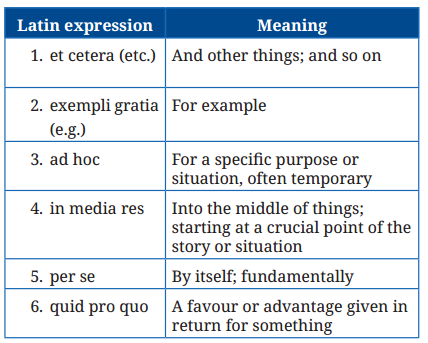
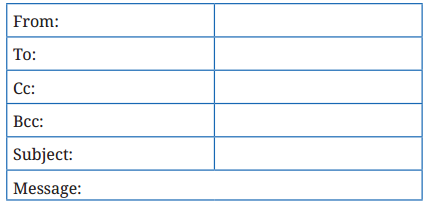
Believe in Yourself Question Answer Class 9 English Kaveri Poem 8 4
(i) I enjoy reading fantasy books, _________ Harry Potter and Magical Paint Brush.
(ii) After helping Tanya with the homework, Ritu asked for a _________ to borrow her notes next time.
(iii) I love all kinds of outdoor activities, such as trekking, hiking, biking, _________.
(iv) The park is not very special _________; it becomes more fun when you visit with friends.
(v) We created an _________ team to organise the school festival.
(vi) The movie started _________, with the hero already fighting the villain in a huge battle.
Answer:
i) I enjoy reading fantasy books, e.g., Harry Potter and Magical Paint Brush.
ii) After helping Tanya with the homework, Ritu asked for a quid pro quo to borrow her notes next time.
iii) I love all kinds of outdoor activities, such as trekking, hiking, biking, etc
iv) The park is not very special per se; it becomes more fun when you visit with friends.
v) We created an ad hoc team to organise the school festival.
vi) The movie started in media res, with the hero already fighting the villain in a huge’ battle.

II. Read the following rhetorical questions and state what they intend to achieve.

i) Isn’t it obvious that we must act now? Don’t we all have a responsibility to make a change?
ii) Will we let fear control us, or will we rise above it?
Answer:
i) These rhetorical questions intend to create a sense of urgency and shared moral responsibility in the reader.
ii) This rhetorical question intends to inspire courage and challenge the rader to make a deliberate choice between two clearly contrasting paths.

III. Match the situations in Column 1 to the rhetorical questions in Column 2.
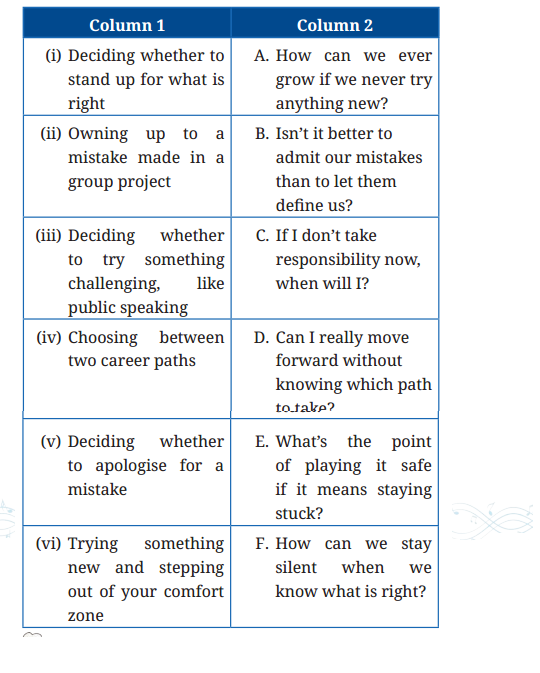
Believe in Yourself Question Answer Class 9 English Kaveri Poem 8 5
Answer:
(i – F), (ii – B), (iii – A), (iv – D), (v – C), (vi-E)

Listen and Respond

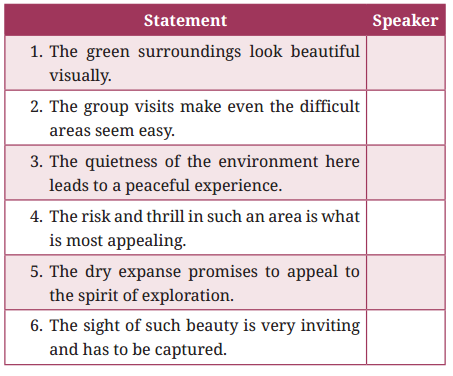
I. You will listen to a conversation between two friends. As you listen, answer the following questions in one to three exact words that you hear. (Transcript for teacher on page 275)

Question 1.
How did the boy feeF before the play?
Answer:
The boy felt so nervous.

Question 2.
According to the girl, where does confidence come from?
Answer:
According to the girl, confidence comes from taking action.

Question 3.
What was the girl finally sure about regarding the boy?
Answer:
The girl was finally sure that the boy would shine.

II. You will once again listen to the conversation. As you listen, select the four true statements from 1-7 given below.

1. The boy feels confident but is worried about freezing on stage.
2. The girl encourages the boy to push through his doubts by trusting in his preparation.
3. The boy thinks that the audience will be supportive regardless of his performance.
4. The girl believes that self-doubt is a normal part of preparing for a big performance.
5. The boy feels that his preparation is not enough and doubts his abilities, even though he has practiced.
6. The girl suggests that the boy should avoid feeling nervous and perform perfectly.
7. The girl believes that pushing through nervousness will help the boy grow and build confidence.
Answer:
Statements 2, 4, 5, and 7 are true.

Speaking Activity

I. Work in pairs. Read the three Sayings/Proverbs given below. For each one, think of a real-life situation where it Could apply. Do the suggested role play and use the Saying/Proverb.

Remember:

  • Before diving into a real-life situation, briefly explain the meaning of the saying.
  • Describe the situation in the following way—
  • Introduction: Briefly explain the saying.
  • Situation/Example: Share a personal story or relate the saying to something familiar.
  • Conclusion: Reflect on what the saying teaches or what you learned from the experience.
  • For the role-play, work in pairs to create the dialogues fist and then enact. Take turns to choose your sayings/proverbs.

Sayings/Proverbs
1. Don’t judge a book by its cover.

  • Situation to consider: Have you ever misjudged someone based on their appearance or fist impression? What happened?
  • Role-play: One student acts as someone who judges others based on their looks or fist impressions. The other student plays someone who shows the true personality after a deeper conversation, proving that appearances can be deceptive.

2. Actions speak louder than words.

  • Situation to consider: Think of a time when someone’s actions proved more valuable than their words.
  • Role-play: One student talks about how they will improve their grades, and the other shows how they actually put in the effort. Compare the impact of talking versus doing.

3. When the going gets tough, the tough get going.

  • Situation to consider: Can you think of a time when you faced a difficult challenge but didn’t give up?
  • Role-play: One student plays someone who is giving up on a tough school project, while the other encourages that student to keep going. Show how perseverance leads to success despite difficulties.

Refer to the instructions and proverbs.
Answer:
Saying 1: Don’t judge a book by its cover. Introduction: Simply put, this saying tells us notjto form opinions about people based on how they look. Just like a plain-looking book might turn out to be your favourite read, a person you overlook at first could become someone truly important to you.

Situation/Example: When I joined a new school, there was this quiet boy who always sat alone. Most of us assumed he was unfriendly and just left him alone. Then one day we got paired for a project and honestly, he turned out to be the-; funniest, most thoughtful person in the class. He just needed time to warm up.

Conclusion: It was a bit of an embarrassing realisation, honestly. I had completely written someone off without giving them a fair chance. Now I make it a point to actually talk to people before deciding what I think of them.

Role-play Dialogue:
A: (Whispering to a friend) Have you seen the new girl? She barely talks and just sits by herself. It doesn’t seem like she’d getting along with us.
B: Hi, are you talking about me? I’m just taking my time to warm up to this new place as I’ve lived in Netherlands.
A: I’m sorry to be speaking behind your back. But Netherlands, seriously? I had no idea.
B: Yeah, I used to have many friends there who used to sing and write like me.
A: Even I love writing! Which genre do you usually write in?
B: I’ll show you my work. Before that, shall we have a proper introduction?
A: (Laughs) Sure!
[Note: One proverb has been covered for reference. Students are expected to do this activity on their own.]

Writing Task

I. Your class is conducting the morning assembly. You have been asked to deliver a speech on the topic, ‘Turning Challenges into Opportunities’. Draft this speech by following the guidelines given below.

  • Consider how challenges can lead to new learning experiences, growth, or unexpected benefits.
  • Why do you think people often feel scared or anxious when faced with change?
  • How can change open doors to new opportunities? Can you think of an example from your own life or someone you know?
  • What are some strategies or attitudes you can adopt to approach change with a positive mindset?
  • Think about how facing challenges builds skills, determination, and confidence, all of which are essential for success.

Answer:
Turning Challenges into Opportunities

The first step is the hardest, but it is where a new possibility begins.

Good morning respected Principal, teachers, and friends. I am Arjun Sharma from Class IX B. Today, I want to share why challenges are not roadblocks, but essential stepping stones to success.

We often feel anxious when faced with change because we fear the unknown. However, has anything truly great ever come from staying comfortable? I don’t think any of us have come this far without facing the things we fear or feel challenged by. For instance, when I was asked to join an inter-school debate, I was terrified and almost refused. Although I didn’t win, the challenge taught me to research and speak under pressure—skills no regular classroom lesson could provide. Don’t you agree that our greatest growth happens when we are pushed out of our comfort zone?

To approach any change or challenge with a positive mindset, we must remember that feeling scared is normal; it simply means the task matters. By focusing on learning rather than just the result, we build the determination and confidence necessary for excellence. Isn’t it true that every leader we admire once stood exactly where we are, choosing to step forward despite their fear?

Therefore, I encourage each one of us to embrace every difficulty as a chance to evolve. Let us find the courage to say “yes” to what scares us, for that is where our extraordinary journey begins. Thank you!

Learning Beyond the Text

I. Explore the stories of Indian leaders who faced significant challenges and turned them into opportunities for success given below.
For example:
1. Dr. B. R. Ambedkar
At school, Ambedkar suffered untold humiliations and discrimination but he never gave up.

It was for sheer grit, hardwork, and perseverence that he went on to study Politics and Economics. His self-motivation proved to be a life-changing event not only for him but also for the nation. He is known as a great jurist, economist, and social reformer.

He rose to become the Chairperson of the Drafting Committee of the Constitution of India.

2. Lal Bahadur Shastri
He endured many hardships throughout his life. His father passed away when he was just a year and a half old, leaving the family in financial distress. Despite the challenges, he remained committed to his education, often walking several miles barefoot to attend school, even in extreme weather. After graduating from Kashi Vidyapeeth in Varanasi, he was honoured with the title “Shastri,” meaning scholar.

Deeply involved in India’s freedom movement, Shastri was imprisoned multiple times alongside other freedom fighters for his active participation. Following India’s independence, he dedicated himself to the progress and unity of the nation. Through unwavering determination and sincere efforts, Lal Bahadur Shastri rose to become the Prime Minister of India, leaving a legacy of humility, service, and patriotism.

3. Dr. APJ Abdul Kalam
Kalam’s family faced financial difficulties, which made it hard for them to support his education fully. To help with his school expenses, Kalam took on a job delivering newspapers early in the morning. He would wake up before dawn, distribute newspapers across the town, and then head to school.

This job was more than just a way to earn money; it was a valuable learning experience for Kalam. Through this work, he learnt the importance of hard work, perseverance, and managing responsibilities. It also gave him a sense of independence and taught him the value of hard work.

He was a renowned scientist, also known as the ‘Missile Man of India’. He rose to become the 11th President of India.

Now find out about such personalities from your village, town, city, or state and present their success stories in class.
Answer:
The Mother of Orphans
Sindhutai Sapkal was bom into extreme poverty in a small village in Maharashtra. She was married off at an early age and by the time she was twenty, she had been abandoned by her husband and left on the streets with a newborn daughter. She had no money, no shelter and no one to turn to.

Instead of giving up, she began begging at railway stations to feed herself and her child. But what she saw around her broke her heart even further – hundreds of orphaned and abandoned children with nobody to care for them.

She made a decision that changed everything. She adopted every child she found on the streets, eventually becoming a mother to over 1,400 orphans across India. She gave away her own biological daughter to an orphanage so that she would never show favouritism among her children.

She received over 750 national and international awards during her lifetime and was honoured with the Padma Shri in 2021. She passed away in 2022, leaving behind thousands of children who called her Mai, meaning mother.

What her story teaches us:
She had every reason the world could offer to give up. Instead, she chose /to turn her own pain into purpose. That is the very definition of turning a challenge into an opportunity.
[Note: The above answer is given for reference. Students are expected to do this activity on their own.]

Believe in Yourself Class 9 Extra Questions and Answers

Believe in Yourself Short Question Answer

Question 1.
What does the poet suggest about the relationship between comfort and personal growth?
Answer:
The poet suggests that comfort and personal growth are fundamentally incompatible. While comfort offers a pleasant and tempting ease, it prevents the very challenges and experiences that allow human beings to develop and grow. The lines ‘this isn’t what we are made for/this isn’t how we grow’ make this incompatibility clear and direct.

Question 2.
How does the image of the future as something that either ‘pulls’ or ‘pushes’ reflect the power of an individual’s mindset?
Answer:
The image reflects that the future is not fixed or predetermined but responds to how the individual approaches it. When a person has self-belief and ambition, the future appears motivating and pulls them forward. However, when fear dominates, it seems to push them back. Thus, ,the poet highlights that attitude determines one’s direction of growth.

Question 3.
Why does the poet choose to address the reader directly as ‘you’ throughout the poem?
Answer:
By addressing the reader as you, the poet transforms general advice into a direct, personal conversation. This creates a sense of intimacy and accountability, making the emotional challenges of fear and choice feel immediate. It establishes a mentor-like connection that encourages the reader to take personal responsibility for their future.

Question 4.
How does the poem balance honesty about difficulty with encouragement and hope?
Answer:
The poet balances realism with hope by acknowledging that choices are difficult and comfort is tempting, which builds trust with the reader. This honesty ensures that the subsequent encouragement feels earned rather than empty, leaving the reader motivated by a grounded and genuine sense of empowerment to take action.

Question 5.
Cap you think of a time when someone’s encouragement helped you take a difficult first step?
Answer:
Yes, I remember a time when my parents encouraged me to take the first step of seeking help for my habit of fumbling. I used to fumble a lot in stressful situations. Though I was scared and nervous, my parents assured me that I can get over it with proper guidance from a speech specialist.

Believe in Yourself Long Question Answer

Question 1.
The poem ‘Believe in Yourself’ argues that self-belief is more powerful than any external circumstance in determining the direction of a person’s future. Discuss thisview with reference to the poem, using at least three examples of poetic devices to support your answer.
Answer:
Robert Langley’s poem ‘Believe in Yourself powerfully argues that self-belief is far more influential than external circumstances in shaping one’s future. The poet asserts that the future is not fixed but moulded by an individual’s inner conviction and courage. This idea is supported by powerful poetic devices. Personification is used when the future is described as something that can “pull you forward” or “push you back in fear,” showing that our mindset decides its direction. Antithesis appears in the contrast between the “ease in comfort” of the status quo and the fact that “this isn’t how we grow.” Additionally, the line “for your future to be on track” shows that self-belief helps one stay focused and move in the right direction. Through these devices, Langley convincingly proves that internal belief determines our path more than outside conditions.

Question 2.
Robert Langley wrote ‘Believe in Yourself’ as a poem of encouragement and motivation. How successfully does he achieve this purpose through his choice of language, structure, and poetic devices?
Answer:
Langley achieves his motivational purpose effectively through clear language, relatable ideas, and simple poetic devices. The poem acknowledges difficulty through the line ‘the first step is the hardest, making the message honest and realistic rather than idealistic. The use of direct address such as ‘you’ and ‘your’ creates a personal tone, helping the reader feel directly encouraged.

The steady rhyme scheme gives the poem a smooth and conversational flow, reinforcing its accessibility. Additionally, the concluding idea that one must believe in oneself leaves a strong and lasting impression. Together, these elements ensure that the poem motivates while remaining grounded in real experience.

Question 3.
The first step is the hardest/There is no turning back.’ These two lines are considered the emotional climax of the poem. Examine why the poet places this acknowledgement at the beginning of the final stanza and what effect it creates on the reader.
Answer:
The poet places these lines at the beginning of the final stanza to create a powerful emotional impact. By this stage, the reader has been encouraged to face challenges and move beyond comfort. The line “the first step is the hardest” acknowledges the reader’s fear, making the message feel honest and relatable. This validation builds trust, as the poet does not ignore the difficulty of beginning.

The phrase “there is no turning back” then reinforces commitment, preparing the reader for action. Together, these lines act as a turning point, where doubt is recognised but not allowed to dominate. As a result, the reader feels both understood and motivated to move forward with confidence.

Question 4.
The poem presents the comfort zone as an enemy of growth. Do you agree that remaining in one’s comfort zone is ultimately harmful, or do you think there is value in comfort and stability? Justify your answer with evidence from the poem and examples from your own life.
Answer:
The poem presents the comfort zone as a barrier to growth, especially through lines that suggest we are not meant to remain where things feel easy. I agree with this view to a large extent. Real progress often begins when we step beyond what feels safe. For example, A.P.J. Abdul Kalam overcame poverty, limited resources, and repeated failures in early projects, while Mary Kom faced financial struggles, lack of support, and the challenge of balancing motherhood with training. Their journeys show that growth requires effort and courage. However, some comfort is necessary for rest and stability, but it should be for coming back stronger.

Question 5.
How does the line “for your future to be on track” reflect the poet’s view on self-belief as a driver of destiny, and to what extent do you agree?
Answer:
The line “for your future to be on track” reflects the poet’s view that self-belief acts as the main driver of one’s destiny. The metaphor compares life’s journey to a train or vehicle that must stay on its proper track. Self-belief serves as the steering mechanism that prevents one from derailing into doubt and fear. The poet believes that when a person trusts their own abilities, they can confidently move towards their goals and shape a successful future. I largely agree with this view. Although external factors like opportunities, resources and support do matter, it is ultimately the unshakeable inner belief in oneself that gives the courage to take the first difficult step and persis through challenges, thereby creating better possibilities in life.

Question 6.
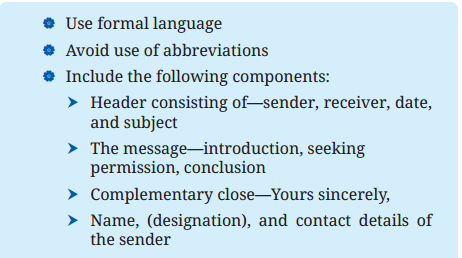
You have a close friend who is hesitant to participate in the school’s annual science exhibition due to fear of failure and lack of confidence in their project. Drawing inspiration from the poem ‘Believe in Yourself’ by Robert Langley, write a letter (120-150 words) encouraging your friend to take the first step and believe in their abilities.
Answer:
Dear Mansi,

How are you? When we last spoke, I sensed that you were feeling anxious and unsure about participating in the science exhibition. I understand your fear, but I truly believe you should give it a chance.

You have always shown a natural interest in science and technology and follow new findings with immense dedication. It is okay to feel nervous, but remember, the first step is always the hardest.

Try to trust your abilities and focus on your effort rather than the outcome. Every experience teaches you something valuable.

Have the courage to begin. I believe in you, and you should too.

Yours lovingly,
Ananya
Kaveri Book Class 9 Solutions

Words Question Answer Class 9 English Kaveri Poem 7

Words Class 9 Question Answer

Reflect and Respond

I. Why are words important? Can we communicate without words? How? Share your answers with your classmates and teacher.
Answer:

  1. Words are the most powerful tools human beings possess, allowing us to express feelings, build relationships, and pass
    knowledge across generations. A single word, spoken at the right moment, can comfort, inspire, or even change the course of a life, giving shape to our inner world and allowing others to truly know us.
  2. Yes, we can communicate without words. There are many powerful and meaningful ways to do it such as:
    • Facial expressions – A smile, a frown, or a look of concern can convey feelings instantly and across all language barriers.
    • Body language – A warm hug, a firm handshake or a gentle pat on the shoulder communicates care and connection without a single syllable.Silence – A deliberate, shared silence can express grief, respect or understanding more profoundly than any speech.
    • Art and music – A painting, a melody, or a dance can communicate complex emotions and ideas that words often fail to capture.
    • Actions – Helping someone carry a heavy bag, sitting beside a friend who is upset, or simply showing up when someone needs you speak louder than any words ever could.
  3. [Note: The above answer is given for reference. Students are expected to do this activity on their own.]

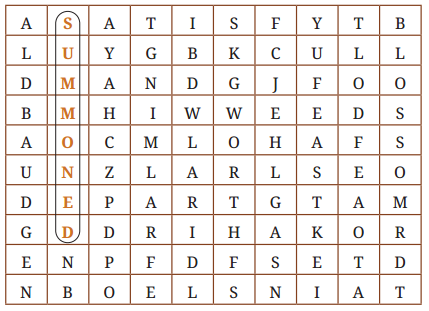
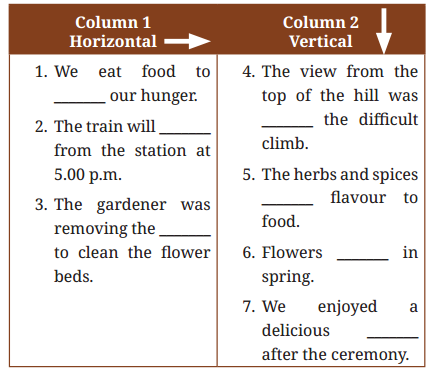
II. Use the given sentences as clues to find words from the grid and fill the blanks. One example has been done for you.

My mother summoned me to introduce her friends.
Words Question Answer Class 9 English Kaveri Poem 7 1
Words Question Answer Class 9 English Kaveri Poem 7 2
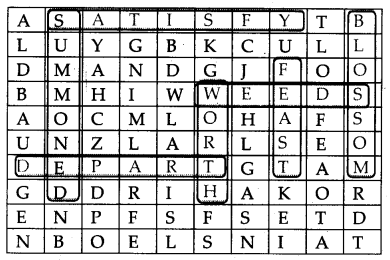
Answer:

Column 1 Horizontal: Column 2 Vertical:
1. We eat food to satisfy our hunger. 4. The view from the top of the hill was worth the difficult climb.
2. The train will depart from the station at 5.00 p.m. 5. The herbs and spices summoned flavour to food.
3. The gardener was removing  the weeds to clean the flower beds. 6. Flowers blossom in spring.
7. We enjoyed a delicious feast after the ceremony.

Words Question Answer Class 9 English Kaveri Poem 7 3
[Note: The grid supports most answers; one word can be identified using the clue alone.]

Class 9 English Words Poem Question Answer

Check Your Understanding

I. Fill in the blanks with one word from the poem. One example has been done for you.

In this poem, the poet reflects that words fail to truly satisfy what the heart wants to convey. Words are compared to summer birds who 1. __________, leaving nothing behind. The heart, is equated to a 2. __________ who fids that words are as worthless as 3. __________ when needed. He feels that a few sincere words can bring more 4. __________ than many meaningless ones. He adds that a voice that brings happiness to a 5. __________ place does not say much, but the few words it does, are very precious. Moreover, if words could satisfy us, the 6. __________ would celebrate but words often fail to do that. The poem ends on the note that empty words may look impressive with lots of flowers, but they cannot produce anything valuable, like a 7. __________.
Answer:
In this poem, the poet reflects that words fail to truly satisfy what the heart wants to convey. Words are compared to summer birds who 1. depart, leaving nothing behind. The heart, is equated to a 2. pilgrim who finds that words are as worthless as 3. weeds when needed. He feels that a few sincere words can bring more 4. joy than many meaningless ones. He adds that a voice that brings happiness to a 5. lonely place does not say much, but the few words it does, are very precious. Moreover, if words could satisfy us, the 6. world would celebrate but words often fail to do that. The poem ends on the note that empty words may look impressive with lots of flowers, but they cannot produce anything valuable, like a 7. fruit.

II. Let us appreciate the poem.

Question 1.
Read the poem again. Find any four sets of rhyming words and also write the rhyme scheme of the poem.
Answer:
Four sets of rhyming words from the poem: heart/depart, care/air, needs/weeds, say/way
The rhyme scheme of each stanza is ABAB – the first and third lines rhyme with each other, and the second and fourth lines rhyme with each other.

Question 2.
Read the following phrases and sentences taken from the poem. Identify the poetic device in each of them and explain what the poet wants to communicate through their usage.
[Note: Refer to the phrases and sentences in the textbook]
Answer:

  1. Simile. Words are compared to summer birds using ‘like’. Just as migratory birds arrive briefly and depart with the season, words are transient and unreliable as they come and go without leaving anything truly meaningful behind.
  2. Metaphor. The heart is directly compared to a pilgrim, a wanderer on a sacred journey. The poet communicates that the human heart is always searching for genuine meaning and connection.
  3. Simile. Words are compared to weeds, unwanted, valueless, and crowding the space where something meaningful might grow. The poet communicates that hollow words do not just fail to help but actively crowd out genuine communication.
  4. Repetition and Irony. The conditional phrase ‘if words could satisfy’ is repeated to reinforce the poet’s central argument. The irony lies in the fact that words which exist precisely to communicate and connect most often fail completely when truly needed.
  5. Hyperbole and Imagery. The idea that the entire world would celebrate is an exaggeration used to suggest the grand promise that words appear to make. The image of a feast creates a vivid picture of abundance and joy which the poet then immediately deflates by showing that words fail to deliver on this promise.
  6. Simile and Imagery. Words are compared to plants that produce a spectacular but * hollow display of blossoms. The poet communicates that some words are visually and acoustically impressive but like these showy plants, they have no real substance beneath their attractive surface.
  7. Symbolism. The inability to grow even one particle of fruit symbolises the complete failure of empty words to produce any , genuine meaning, lasting comfort, or real connection. Fruit represents true value and nourishment, everything that hollow words can never provide.

Question 3.
Which words are repeated in the poem? Why does the poet use repetition?
Answer:
The words most notably repeated in the poem are ‘words’ and ‘satisfy.’ The phrase ‘If words could satisfy’ is repeated at the beginning of the first and fifth stanzas, creating a circular structure that reinforces the poem’s central argument. The poet uses repetition deliberately for two purposes. First, it creates a rhythmic, emphatic quality that drives the message deeper into the reader’s mind with each recurrence. Second, the repetition of ‘satisfy’, the very thing words fail to do highlights the gap between what language promises and what it delivers, making the poem’s critique of empty speech even more powerful and memorable.

Question 4.
The stanzas 4,5, and 6 end with exclamation mafks. Choose the option that displays the emotions being expressed through them.
(i) 4. disillusionment
5. admiration and
6. frustration

(ii) 4. frustration
5. admiration and
6. disillusionment

(iii) 4. admiration
5. frustration and
6. disillusionment

(iv) 4. frustration
6. admiration
5. disillusionment and
Answer:
(iii) 4. admiration 5. frustration and 6. disillusionment

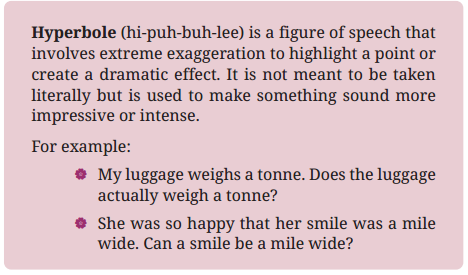
III. Identify examples of hyperbole from the given lines.
If words could satisfy the chest,
The world might hold a feast.
Answer:
The hyperbole in the given lines is: ‘The world might hold a feast’ – the idea that the entire world would hold a celebratory feast is a deliberate exaggeration used to highlight how grand the promise of words appears to be, making their ultimate failure all the more striking.

Work in pairs. Complete the sentences given in textbook with hyperboles. Use the hints given in the brackets.
1. I have ______________ things to do on this weekend. (lots of/tonnes of)
2. The player missed the basket by ______________. (a mile/ an inch)
3. My mother is so tired that she can sleep for a ______________. (night/decade)
4. I will be back in ______________. (fie minutes/two seconds)
Answer:
1. I have tonnes of things to do on this weekend.
2. The player missed the basket by a mile.
3. My mother is so tired that she can sleep for a decade.
4. I will be back in two seconds.

IV. Listen to the teacher read the poem. As you listen, underline the syllables that are stressed in all the lines of the poem. Share your answers with the teacher.
If words could sa tis fy the heart,
The heart might find less care;
But words, like sum mer birds, de part,
And leave but emp ty air.
Answer:
Stanza 1:
If words could sa-tis-fy the heart,
The heart might find less care:
But words, like sum-mer birds, depart.
And leave but emp-ty air.

Stanza 2:
The heart, a pil-grim up-on earth.
Finds of-ten, when it needs.
That words are of as lit-tle worth
As just so ma-ny weeds.

Stanza 3:
A lit-tle said, and tru-ly said,
Can dee-per joy im-part
Than hosts of words, which reach the head.
But ne-ver touch the heart.

Stanza 4:
The voice that wins its sun-ny way.
A lone-ly home to cheer.
Hath oft the few-est words to say;
But, oh! those few, how dear!

Stanza 5:
If words could sa-tis-fy the chest.
The world might hold a feast:
But words, when sum-moned to the
test. Oft sa-tis-fy the least!

Stanza 6:
Like plants that make a gau-dy show,
All blos-som to the root;
But whose poor na-ture can-not grow,
One par-ti-cle of fruit!
[Note: The above activity is given for reference. Students are expected to do this activity on their own.]

Critical Reflection

I. Read the following lines and answer the questions.

Question 1.
The heart, a pilgrim upon earth.
Finds often, when it needs,
That words are of as little worth
As just so many weeds.

i) Why has the poet referred to the heart as ‘a pilgrim’?
Answer:
The poet calls the heart a pilgrim because it constantly searches for something true and meaningful like a traveller on a sacred journey.

ii) When would a heart ‘need’ words?
Answer:
A heart would need words during its most vulnerable and emotionally intense moments like grief, loneliness, fear, confusion or deep personal struggle.

iii) Complete the sentence with an appropriate reason.
The words are like weeds because ________.
Answer:
they are plentiful, unwanted and completely without value.

iv. Mention two emotions the heart might be experiencing when it finds words to be of ‘little worth’.
Answer:
The two emotions the heart might be experiencing are: disappointment and loneliness.

v) What do these lines suggest about the nature of communication?
Answer:
These lines imply that most communication is ineffective as words offer little value and so genuine communication rarely takes place.

Question 2.
If words could satisfy the chest,
The world might hold a feast;
But words, when summoned to the test,
Oft satisfy the least!

i) How can words ‘satisfy the chest’?
Answer:
Words can ‘satisfy the chest’ by being sincere, warm, and comforting, creating a sense of emotional connection and contentment.

ii) How can words be ‘summoned to the test’?
Answer:
Words can be ‘summoned to the test’ during moments of true emotional need, such as grief or loneliness.

iii) What does ‘the world’ holding ‘a feast’ imply?
Answer:
The image of ‘the world holding a feast’ is a hyperbole suggesting universal rejoicing and fulfilment when words truly meet the heart’s deepest needs.

iv) Complete the sentence with an appropriate reason.
The poet mentions that words satisfy the least because ______ .
Answer:
they often fail to provide genuine comfort when they are most needed.

v) Select the word that does not mean the same as ‘oft’.
(A) always
(B) usually
(C) frequently
(D) often
Answer:
(A) always

II. Answer the following questions.

Question 1.
What is the comparison that the poet draws between words and ’empty air’?
Answer:
The poet compares words to empty air to show that hollow speech, though it fills space, leaves nothing meaningful behind. Like air, words cannot hold or offer comfort, creating only an illusion of communication without real connection or understanding coming out of it.

Question 2.
According to the poet meaningful words are more precious than a lot of them. Explain.
Answer:
The poet shows that a few sincere words can » bring deeper joy than many empty ones, as they touch the heart rather than just the mind. He emphasises that true value lies in quality of words rather than the quantity because even a few, sincere words can comfort and create genuine connection.

Question 3.
Do you agree that the poet presents contrasting ideas related to ‘words’ in the. poem? If yes, why? If no, why not?
Answer:
Yes, the poet presents contrasting ideas about words. While they have the power to comfort and satisfy, he shows that they often fail, proving empty or ineffective. He highlights the contrast between many hollow words and a few sincere ones, emphasising that true value lies in genuine expression.

Question 4.
The theme of loneliness hovers over the poem. Support this statement with examples from the text.
Answer:
Loneliness runs quietly through the poem as a persistent theme. The heart as ‘a pilgrim’ suggests solitary wandering and a lack of true connection. The line ‘finds often, when it needs’ highlights moments of emotional need, while the image of ‘a lonely home’ reinforces the deep despair that only sincere words can truly comfort.

Question 5.
How does the poet convey the superficial nature of words? What ought to be done to address this?
Answer:
The poet conveys the superficial nature of words through vivid comparisons. He compares them to summer birds that are pleasant but fleeting, to weeds that are plentiful but worthless, and to gaudy plants that bloom brightly but bear no fruit. These images collectively highlight how words without sincerity may appear impressive on the surface but lack any real substance beneath. To address this, the poet suggests speaking less but with greater thoughtfulness and sincerity. He believes that words must stem from ‘ genuine feeling rather than mere habit or obligation. Even a few honest and heartfelt words, he argues, carry the power to offer true comfort and forge meaningful human connection.

Vocabulary in Context

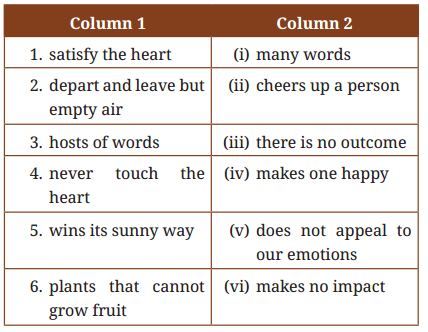
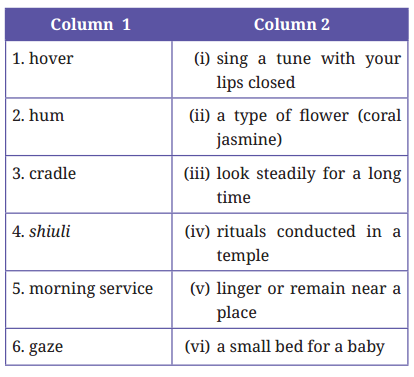
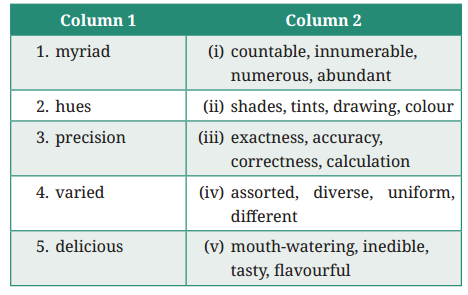
I. The poet has used some figurative phrases. Match the phrases in Column 1 with their correct meanings in Column 2. Use each phrase in a sentence of your own.
Words Question Answer Class 9 English Kaveri Poem 7 4
Answer:

Column 1 Column 2
1. satisfy the heart iv. makes one happy
2. depart and leave but empty air, vi. makes no impact
3. hosts of words i. many words
4. never touch the heart v. does not appeal to our emotions
5. wins its sunny way ii. cheers up a person
6. plants that cannot grow fruit iii. there is no outcome

Sentences:
1. A kind and sincere apology can truly satisfy the heart in ways that no amount of expensive gifts ever could.
2. His long farewell speech seemed to depart and leave but empty air, for no one felt truly moved by a single word he said.
3. The guest speaker filled his address with hosts of words, yet by the end, no one could recall a single meaningful promise he had made.
4. A speech that only appeals to logic and reason will never touch the heart of an audience that is searching for genuine comfort and understanding.
5. Her warm and gentle voice wins its sunny way into every room she enters, making even the most anxious person feel instantly at ease.
6. His repeated promises were like plants that cannot grow fruit, beautiful to hear in the moment but never followed through with any real action.

II. Create a ‘Word Map’ for each of the words from the poem given in the box.

Words Question Answer Class 9 English Kaveri Poem 7 5
To complete the word map include:
1. Meaning (in your own words)
2. Synonyms of the word
3. Antonyms of the word
4. Sentence using the word
5. A quick sketch or symbol that represents the word
One example has been done for you. [Note: Refer to the example given in textbook]
Answer:
WORD MAP

Word Meaning Synonyms Antonyms Sentence Symbol / Picture
Cheer to give a loud shout of approval or encouragement comfort sadden The audience cheered her for great performance. Picture of sunshine, sunflower, or a smiling face
Depart to leave a place or go away from somewhere leave, go, exit, withdraw, set off arrive, come, return, stay, remain The last train will depart from the platform at midnight, so we must hurry. (Icon or picture of a person walking away or plane taking off)
Pilgrim a person who travels on a long, often spiritual journey in search of something meaningful wanderer, traveller, seeker, voyager, wayfarer settler, resident, homebody, dweller The pilgrim searched for a shelter after travelling all day. (Picture of a traveller on a long road)
Word a single unit of language used to express meaning or communicate with others expression, utterance, term, statement, remark silence, quietness, muteness, speechlessness She shared words of inspiration with her students. (Icon of a speech bubble)
Sunny bright, warm, and full of cheerfulness; also used to suggest a gentle, hopeful, and comforting quality bright, warm, cheerful, radiant, pleasant gloomy, dark, dull, cold, overcast People appreciate Nina for her sunny disposition in every situation. (Icon of a bright sun emerging from clouds)
Satisfy to fulfil a need, desire, or expectation completely and leave nothing wanting fulfil, content, please, gratify, appease disappoint, frustrate, dissatisfy, displease, fail To satisfy someone’s standards, you need to be satisfied first. (Icons of a tick mark beside a contented face)
Heart the centre of a person’s emotions, feelings, and deepest inner life soul, spirit, core, feeling, emotion indifference, coldness, apathy, detachment His sincere farewell words at farewell touched every heart in the room (Icon of a heart)

Listen and Respond

I. You will listen to a conversation between a girl and a boy. As you listen, mark four statements from 1-6 that are true. (Transcript for teacher on Textbook page 273)
1. The girl was excited to participate True in the declamation contest.
2. The boy was doubtful about the True suitability of the topic chosen for the contest topic chosen for the contest.
3. The girl explained that people False prefer to keep their personal experiences to themselves.
4. The boy was unaware of the role. True played by body language in reflecting the speaker’s confidence.
5. According to the girl, body False language had an insignificant role to play in communication.
6. The girl had issued the book on True body language earlier from the library.
Answer:
1. True
2. True
3. False
4. True
5. False
6. True

Speaking Activity

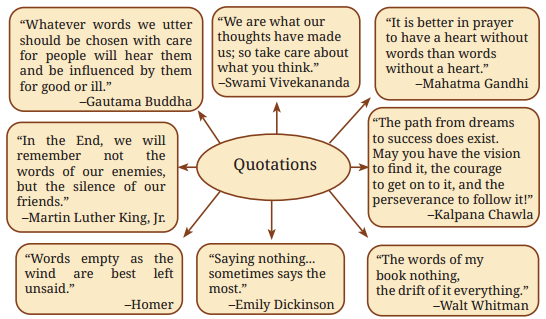
I. Read the following quotations and select the one you like the most. Explain the quotation and share the reason for your choice with your classmates and teacher. You may talk about a connected personal experience too.
Words Question Answer Class 9 English Kaveri Poem 7 6
You may use the cues given below to state your choice and the reason.

  • I chose_____ because…
  • I selected _____ since…
  • I decided on _____due to…
  • I picked _____as…
  • I settled for _____ because…

[Note: Refer to the cues given in the textbook for reference]
Answer:
Selected Quotation:
“Whatever words we utter should be chosen with care for people will hear them and be influenced by them for good or ill.” — Gautama Buddha
Explanation of the Quotation

  • Words have the power to influence people’s feelings and thoughts.
  • Careful speech can encourage and uplift others.
  • Careless words can hurt and leave a lasting impact.
  • Therefore, we should always speak thoughtfully and aim to create a positive effect.

Reason for My Choice

  • I chose this quotation because it teaches an important life lesson about responsible I communication.
  • We often speak without thinking, both at school and at home.
  • I selected this idea since it reminds me that being a good person includes being mindful of my words.
  • I decided on this thought due to the fact that thoughtful speech helps build strong relationships and prevents unnecessary conflicts.

Personal Experience

  • I picked this idea as it connects with a personal experience during a group project.
  • During a group project, a classmate made a casual remark about my idea.
  • Although unintentional, it affected my confidence and made me hesitant to share ideas;-
  • Later, my teacher encouraged me by appreciating my thinking.
  • This restored my confidence and showed the impact of kind words.
  • I settled for this quotation because it reflects how words can either hurt or heal, making it important to use them with care.

[Note: The above pointers are given for one of the quotations as a reference. Students are expected to do this activity on their own.]

Writing Task

I. Write an essay on any one quotation from speaking activity. Follow the guidelines given in textbook while drafting the essay.
Answer:
Among all the quotations, I chose Gautama Buddha’s words because they capture a truth we often overlook in daily life. This essay explains why choosing words carefully is an important responsibility.

The quotation suggests that words are never neutral. Every word leaves an impact on the listener’s mind and heart. The phrase ‘for good or ill’ shows that words can either heal or harm. For instance, a teacher’s encouragement can build confidence, while a careless remark can create lasting self- doubt. This idea also connects with the poem ‘Words’, WhiCh shows that only sincere words truly touch the heart. Thus, both highlight the importance of thoughtful expression.

In today’s world of instant communication, this message is even more relevant. Through social media and messaging, words spread quickly and influence many people. Encouraging words can build confidence and resilience, while careless ones can harm a person’s self-image.

Some may feel that this idea restricts free expression. However, it is not about fear but awareness. Choosing words carefully simply means thinking before speaking.

In conclusion, Gautama Buddha’s quotation conveys a timeless truth. Words are powerful and must be used responsibly. Meaningful and sincere words can create a lasting positive impact.

[Note: The above answer is given for reference. Students are expected to do this activity on their own.]

Words Class 9 Extra Questions and Answers

Words Short Question Answer

Question 1.
What does the poet suggest about the relationship between the quantity of words and their emotional impact?
Answer:
The poet suggests that quantity of words and their emotional impact are inversely related. A large number of words does not guarantee genuine feeling or connection with people. In fact, ‘a little said, and truly said’ creates far deeper joy than ‘hosts words’ said without any thought.

Question 2.
What is the central irony regarding the poet’s use of language in the poem?
Answer:
The central irony is that the poet skillfully uses a multitude of carefully chosen ‘words’, complex rhymes, and rich poetic devices to argue that ‘language’ is ultimately inadequate, transient and inferior to simple, silent emotional sincerity.

Question 3.
How does the imagery of the “sunny way” in the third stanza contrast with the “empty air” in the first stanza?
Answer:
“Empty air” creates a cold, disappointing image of words vanishing without a trace. In contrast, the “sunny way” evokes warmth, light, and permanence, highlighting the enduring comfort and positive atmosphere created by a few sincere, heartfelt words.

Question 4.
How does the closing image of plants without fruit serve as a fitting conclusion to the poem’s central message?
Answer:
The image of plants that blossom but bear no fruit mirrors the poem’s argument. These plants offer visual beauty without nourishment, like hollow words that sound impressive without meaning. The image provides a vivid symbol that concludes the poem’s central idea: outward show without substance is ultimately worthless.

Question 5.
The poet compares worthless words to ‘so many weeds’. In today’s digital age, what might represent these weeds, and why?
Answer:
In the digital age, ‘weeds’ could represent mindless social media comments, emojis, or forwarded messages. Like weeds, they are abundant, require no real effort to produce, and lack the nourishing substance of a genuinely thoughtful, personal interaction.

Words Long Question Answer

Question 1.
The poem ‘Words’ argues that the value of communication lies not in abundance but in sincerity. Discuss this view with reference to the poem, using at least three examples of poetic devices to support your answer.
Answer:
Charles Swain builds his central argument that sincerity matters more than abundance in communication through carefully chosen poetic devices. The simile ‘words, like summer birds, depart’ shows how empty words vanish without leaving anything meaningful behind. The metaphor ‘hosts of words, which reach the head, but never touch the heart’ distinguishes between intellectual and emotional communication, firmly valuing the latter.

The symbolism of flowering plants that bear no fruit provides a lasting image of how impressive-sounding words without genuine feeling are ultimately hollow and worthless. Together, these devices reinforce the poet’s conviction that a few words spoken with truth and warmth will always carry more power than any quantity of empty, decorative language.

Question 2.
Charles Swain relies heavily on natural imagery to critique human communication, Analyse how the metaphors of ‘summer birds’, ‘weeds’, and ‘fruitless plants’ collectively build the poem’s central theme.
Answer:
Swain masterfully uses nature to illustrate the deceptive and transient nature of superficial words. ‘Summer birds’ signify fair-weather comfort that vanishes when the harshness of life arrives. ‘Weeds’ represent the abundant but useless nature of insincere words conveyed to a struggling ‘pilgrim’, the heart or the emotional centre of a person.

Finally, the ‘gaudy’ plants that blossom completely but yield not ‘one particle of fruit’ powerfully symbolise people who, speak impressively but offer no practical help. Collectively, these natural metaphors assert that true value lies in quiet, nourishing sincerity rather than in colourful, beautified displays. The poet establishes that the emotional quality of our communication is of utmost importance than its sheer volume.

Question 3.
The poet describes the heart as “a pilgrim upon earth”. Based on this metaphor, evaluate the struggles this pilgrim faces with the language of others, and what it ultimately seeks to find.
Answer:
A pilgrim suggests a traveller on a difficult, sacred, and often lonely journey seeking spiritual or emotional peace. In the poem, this pilgrim’s struggle is navigating a world full of noise but devoid of substance. When the heart is weary and in desperate need of solace, it is met with words that are as worthless as weeds. The pilgrim is not looking for the superficial displays or series of words that merely stimulate the intellect. Instead, the journeying heart seeks a warm voice—a rare, genuine connection that offers deep resonance. The poem suggests the pilgrim’s true destination is not found in grand speeches, but in the quiet, comforting sanctuary of sincere emotional connection.

Question 4.
Flowers and blossoms serve as powerful symbols in both poems. Analyse how Charles Swain’s “Words” and Maya Anthony’s “Canvas of Soil” use these natural images differently to express contrasting ideas about beauty and substance.
Answer:
In the poem “Words”, Charles Swain uses the image of flowering plants as a symbol of hollow impressiveness. He describes plants that make a gaudy show, blooming brilliantly yet bearing no fruit, representing words that appear meaningful but lack sincerity or substance. The blossom here is a warning, a reminder that outward beauty without inner worth is ultimately empty. In contrast, Maya Anthony’s “Canvas of Soil” presents blossoms as a celebration of life, creativity and natural artistry.

She portrays blooming flowers as brushstrokes on a living canvas, where beauty and purpose coexist harmoniously. Here, the blossom is not deceptive but deeply fulfilling. Thus, while Swain uses floral imagery to caution against superficiality, Anthony employs it to honour the genuine beauty found in nature and human endeavour, offering two strikingly contrasting perspectives on the same natural image.

Question 5.
What lesson does the poem teach about everyday speech in homes, schools, and relationships?
Answer:
The poem teaches that everyday speech should be thoughtful, honest, and gentle. In homes, schools, and friendships, people are often affected more by the sincerity of words than by how many words are spoken. A kind sentence can make someone’s day and brighten their lives while careless speech can cause lasting damage to their mind. The poem’s message remains relevant today, when people often speak quickly and without reflection. The poet reminds us that words should not merely fill silence; they should be carried with care, truth, and warmth. In this way, speech becomes a force that can truly help others and build stronger human bonds.

Question 6.
The poem ‘Words’ was written in the nineteenth century, yet its message feels entirely relevant to the world today. Do you agree that in an age of constant communication, social media, and information overload, the poet’s warning about empty words has become more urgent than ever? Justify your answer with evidence from the poem and examples from contemporary life.
Answer:
Swain’s warning feels not only quite relevant today but also more urgent than at any point in human history. We live in an age where words are produced in quantities the poet could never have imagined. Social media posts, instant messages, comments, and notifications pour into our lives every minute of the day. Yet for all this abundance of language, genuine connection has arguably become rarer and more difficult to find. Swain’s image of words that ‘satisfy the least’ when put to the test is a perfect description of a world where communication is constant but meaning is scarce.

His concluding symbol of plants that blossom brilliantly but bear no fruit captures the essence of the online communication – visually impressive, widely shared, but ultimately empty of real nourishment. The poem reminds us that what the human heart truly needs has never changed – not more words, but truer ones.

Question 7.
What do you think will lead to effective and meaningful conversations? Do you agree with Charles Swain’s views in the poem “Words”? If yes, why? If no, why not?
Answer:
Effective and meaningful conversations are built on the pillars of empathy, active listening, and conscious responses. By ‘weighing’ our words, as suggested in the poem, we ensure our speech serves a purpose rather than just filling the silence. I strongly agree with Charles Swain’s view that the quality of communication outweighs quantity. His metaphors of fruit and sunlight remind us that sincere, brief interactions often provide more genuine comfort than elaborate, hollow rhetoric. Ultimately, conversations become meaningful when we prioritise the listener’s heart over our own intellectual display.

Question 8.
Imagine you attended a formal event where a guest spoke for a long time using complex language, yet the audience remained uninterested. Shortly after, a different speaker shared just two sincere sentences that immediately connected with everyone, resulting in a standing ovation.
Write a Diary Entry in 120-150 words describing this experience. In your writing, reflect on the following:

  1. Compare the impact of a host of words versus the fewest words spoken with heart.
  2. Discuss the difference between a flashy show of language and communication that bears fruit.
  3. Explain what this taught you about why sincerity is more powerful than the length of a speech.

Answer:
Saturday, 28th February 2026
10:00 PM

Dear Diary,

Today’s event taught me a vital lesson about the true weight of communication. It was National Science Day—a day I love to celebrate—but the first speaker was a disappointment. Although he spoke with high fluency and used complex jargon, his words didn’t resonate at all. It felt like a flashy show of intellect that lacked any real fruit or substance. I found myself completely zoned out, as his speech was just empty air to me.

Next came a speaker who immediately caught my attention. She simply declared her love for science and asked us all to put our science glasses on! We laughed with her, and suddenly, I was fully engaged. It felt like a genuine dialogue rather than a one-way lecture. Her words and sincere intent taught me that to engage meaningfully, one must speak from the heart. I was so inspired that I’ve already signed up for her next seminar. I’m definitely adding sincere engagement to my list of productive habits!

Prerna
[Note: The above answer is given for reference. Students are expected to do this activity on their own.]

Kaveri Book Class 9 Solutions

A Friend Found in Music Question Answer Class 9 English Kaveri Poem 6

A Friend Found in Music Class 9 Question Answer

Reflect and Respond

I. Read the questions given below and share your answers with your classmates and teacher.

Question 1.
What kind of music do you prefer to listen to—vocal or instrumental?
Answer:
I prefer vocal music because the lyrics and the singer’s voice create a strong emotional connection. However, I also enjoy instrumental music when I want to relax or concentrate.

Question 2.
Name your favourite musician(s).
Answer:
Some of my favourite musicians are A.R. Rahman, Arijit Singh and Lata Mangeshkar. Each of them has a unique and soulful style that makes their music timeless and deeply moving.

Question 3.
Give reasons for your choice.
Answer:
A. R. Rahman is my favourite because his music beautifully blends Indian classical and modern styles. Arijit Singh’s voice is expressive and emotional. Lata Mangeshkar’s voice is pure and timeless, and her songs are loved across generations.
[Note: The above answers are given as reference. Students are expected to write the answers on their own.]

Class 9 English A Friend Found in Music Poem Question Answer

Check Your Understanding

I. Read the poem again to complete the poet’s diary about her feelings on music. Fill in the blanks with words from the poem.

Today, I’ve been thinking about how essential music is to me. It is like an ocean that calls me to its 1. ____. Music is the 2. _____ that harmonises with my 3. _____, moving me in ways I can’t explain. When I feel sad or upset about things, music is the 4. _____ that eases the ache. It is amazing how music has the power to lift my 5. ____, and give me strength to pull through difficult times. I know that it is the effect of music whenever I feel 6. ____. Music is the much 7. _______, dependable friend when there is no one to 8. ______. Thank you, my dear music, for being my all-time comfort.
Answer:
1. shore
2. rhythm
3. core
4. therapy
5. spirits
6. cheerful
7. needed
8. care

II. Let us appreciate the poem.

Question 1.
The phrase ‘moves me’ in the line ‘That moves me to the core,’ is an example of ______.
Answer:
Personification.

Question 2.
The poet uses metaphors for music. List these metaphors and rewrite them as similes. For example, Music is as _______ as _____.
Answer:
Metaphors rewritten as similes:
Music is as vast and powerful as an ocean. Music is as healing and soothing as therapv. Music is as loval and dependable as p needed friend.

Question 3.
What is the rhyme scheme of the poem? What impact does it have?
Answer:
The rhyme scheme of the poem is ABCB (the second and fourth lines of each stanza rhyme). This creates a musical, flowing rhythm that mirrors the theme of music itself, making the poem pleasant and easy to read.

Question 4.
What is the poet’s purpose in using the word ‘music’ repetitively?
Answer:
The poet uses the word ‘music’ repetitively to emphasise its central and constant role in her life. The repetition also creates a rhythmic, almost musical effect, reinforcing
the poem’s theme.

Question 5.
What is the message the poet wishes to convey through the poem?
Answer:
The poem conveys that music is a constant and comforting companion in human life. It heals sadness, lifts our spirits, and gives strength during difficult times. The poet shows that music supports us in both happiness and loneliness, making it a dependable source of emotional comfort and inner peace.

Question 6.
Identify the mood of the poem from the options given below.
i) nostalgic
ii) thoughtful
iii) amused
iv) playful
Answer:
ii) thoughtful.

Question 7.
Give evidence from the poem to support that the speaker is the poet herself.
Answer:
The speaker is the poet herself, as she uses first-person expressions such as “pulls me,” “moues me,” “I need,” “my spirits,” and the most cheerful.” These phrases show that the poem reflects her personal feelings and experiences, revealing her deep emotional connection with music as a companion in her life.

Critical Reflection

I. Read the extract given below and answer the questions that follow.

Music is the therapy
I need when I feel blue.
Music lifts my spirits
To make sure I pull through.

i) Complete the following sentence suitably.
The phrase ‘feel blue’ indicates _______.
Answer:
a state of sadness, low mood or emotional distress.

ii) Identify the line which shows music makes the poet happy.
Answer:
‘Music lifts my spirits’ shows that music makes the poet happy.

iii) What does the last line of the extract signify?
Answer:
The last line signifies that music gives the poet the strength and hope to overcome difficult times.

iv) State whether the following sentence is true or false.
Music plays a vital role in the poet’s life.
Answer:
True

v) Select the central idea of the extract from the following options.
(A) Music brings comfort during sadness.
(B) Music is a necessity in times of happiness.
(C) Music improves our ability to pull heavy loads.
(D) Music is a source of knowledge and excitement.
Answer:
(A) Music brings comfort during sadness.

II. Answer the following questions.

Question 1.
How is music able to move the poet ‘to the core’?
Answer:
Music moves the poet ‘to the core’ because it deeply affects her emotions and inner feelings. Its rhythm creates a strong personal connection with her heart and mind. It does not merely entertain her but touches the deepest part of her being and provides emotional comfort.

Question 2.
Why does the poet compare music to a ‘needed friend’?
Answer:
The poet compares music to a ‘needed friend’ because it comforts and supports her during lonely moments when no one seems to care. Like a true friend, music stays with her in both happy and difficult times and gives her emotional strength and reassurance.

Question 3.
Explain the poet’s attitude towards music.
Answer:
The poet’s attitude towards music is one of deep love, trust and gratitude. She considers music a constant companion in her life. It comforts her during sadness, lifts her spirits in difficult times and remains with her during happy moments as a faithful source of support.

Question 4.
Support the opinion that this poem has a universal appeal.
Answer:
This poem has universal appeal because almost every person in the world has experienced sadness, loneliness, or the need for comfort. Music is a global language that transcends culture and language, and the poet’s feelings of being uplifted and comforted by music are feelings that people everywhere can relate to.

Question 5.
Compare your experience of music with the feelings expressed in the poem.
Answer:
Like the poet, I also turn to music when I feel sad or stressed. Listening to my favourite songs instantly improves my mood and helps me feel less alone. Music gives me comfort and motivation, and I can relate to the poet’s feelings about music being a supportive companion.

Vocabulary in Context

I. Read the following phrases from the poem denoting happiness and sadness.

Classify the words given in the box below as positive emotions and negative emotions.
A Friend Found in Music Question Answer Class 9 English Kaveri Poem 6 1
Answer:
Positive emotions: List my spirits. most cheerful
Negative emotions: feel blue

Now, fill in the blanks by choosing the correct word from those given in the brackets.

1. The familiar tune stimulated a rush of______ transporting listeners back to cherished moments from their past. (nostalgia/elation)
2. The soulful ballad expressed the singer’s, leaving the audience moved by the intensity of their emotions. (despondence/anguish)
3. The pianist played a soulful melody on the stage, creating an ambience of ______. (melancholy/despair)
4. The festive symphony filled the air with ________ tones, lifting the spirits of everyone present on the joyous occasion, (jubilant/euphoric)
Answer:
1. nostalgia
2. anguish
3. melancholy
4. jubilant

II. Choose the correct meaning from the box given below for the underlined phrasal verbs in the following sentences.

1. He’s planning to move out of his parents’ house next month.
2. Our new neighbours moved in yesterday.
3. I’ve been in this job long enough—it’s time I moved on.
4. Can you move over a bit so I can sit down?
5. The police officer told the crowd to move along.
6. The bus moved off as soon as all the passengers were seated.

(i) to start doing or discussing something new
(ii) to begin living in a new home or place
(iii) to start moving; to leave
(iv) to go to a new position, especially in order to make room for other people
(v) to leave a place where one has been living
(vi) to shift position to make space for someone or something
Answer:

Phrasal Verb sentences Meanings
1. move out (v) to leave a place where one has been living
2. moved in (ii) to begin living in a new home or place
3. moved on (i) to start doing or discussing something new
4. move over (vi) to shift position to make space for someone or something
5. move along (iv) to go to a new position, especially in order to make room for other people
6. moved off (iii) to start moving; to leave

III. Create phrasal verbs from the verbs ‘put’, ‘get’, ‘look’, ‘break’. Find the meanings of the phrasal verbs you create. Make, sentences with the phrasal verbs. Discuss them with your classmates and teacher.
Answer:

Phrasal Verb Meaning Sentence
put off to postpone He put off the meeting to the next day.
put up with to tolerate She could not put up with the noise any longer.
get over to recover from It took him weeks to get over his illness
get along to have a good relationship The two friends get along very well.
look after to take care of She looks after her younger siblings.
look forward to to await with excitement I look forward to the annual trip.
breakdown to stop functioning The car broke down on the highway
breakout to begin suddenly A fire broke out in the building.

I. Before you listen, read the questions and guess the responses to the given questions.

Question 1.
How are the two speakers connected?
(i) parent-child
(ii) teacher-student
(iii) brother-sister
Answer:
(i) parent-child (mother and son)

Question 2.
Where is the conversation taking place?
(i) music centre
(ii) park
(iii) school reception area
Answer:
(i) music centre

Question 3.
Which musical instrument is the reason for the problem?
(i) sitar
(ii) santoor
(iii) sarod
Answer:
(ii) santoor

Question 4.
What is the problem being discussed?
(i) inability to play the musical instrument
(ii) irregularity of the music class
(iii) lack of choice of the musical instrument
Answer:
(ii) irregularity of the music class

Question 5.
What has been the unsuccessful solution?
(i) practising for longer hours
(ii) singing while playing the instrument
(iii) watching videos about playing the instrument
Answer:
(iii) watching videos about playing the instrument

Question 6.
What is the final decision taken?
(i) change classes
(ii) pick a simpler instrument
(iii) purchase the musical instrument
Answer:
borrow the santoor from a friend and purchase their own instrument for home practice.

II. Now, listen to the conversation between the two people. As you listen, check your answers and rectify them wherever needed. Once done, discuss your responses with your classmates and teacher. (Transcript for teacher on page 270)
[Students are expected to cross check their above answers.]

Speaking Activity

I. Work in groups of four and choose a role each. Use the cues given below to present a role play in the class. Frame your responses logically in complete sentences. You may frame appropriate questions to ensure continuity in the conversation.
A Friend Found in Music Question Answer Class 9 English Kaveri Poem 6 2
Answer:
Role-Play: Should I Join Music Classes?
Music Teacher Good morning everyone. I would like to encourage students to join music classes. Learning music improves concentration, creativity, and confidence. It also helps students relax after studies.

Student 1: I am interested in music, but i am worried it may take away time from my studies. I already have homework and exams to prepare for.

Parent: I share the same concern. I want my child to do well in academics. Will music classes affect study time?

Student 2: I have been learning music for two years. It has helped me manage stress and improve my focus. I follow a timetable and balance both studies and practice easily.

Music Teacher: That is true. Music actually improves discipline and memory. We also plan practice time carefully so it does not disturb academic work.

Student 1: That sounds reassuring. If I can manage both studies and music, I would like to try joining the class.

Parent: After listening to this discussion, I feel more confident. I now support my child joining music classes.

Music Teacher Wonderful! I am sure this decision will help in your overall development.
[Note: The above answer is given as reference. Students are expected to attempt the above activity on their own.]

Writing Task

I. Your school is organising a musical evening on 21 June, World Music Day. You are presenting a Sitar recital at the event, Draft an invitation letter requesting your grandparents to attend the event.
A Friend Found in Music Question Answer Class 9 English Kaveri Poem 6 3
Follow the guidelines given to draft the invitation letter.
Format:
Sender’s address
Date
Salutation: Dear…
Body of the letter:

  • Ask about their well-being.
  • Mention the event and give details—date, time, and venue.
  • Request them to attend.

Complimentary close: Yours affectionately,
Name of the sender
Language:

  • Use fist person—‘I’ and second person ‘We’ and ‘You’.
  • Write in a warm and personalised style.

Answer:
12, Shanti Nagar Colony
Sector 4, Ghaziabad
Uttar Pradesh —201001

18 June 2026

Dear Dadu and Dadi,

I hope this letter finds you both in the best of health and high spirits. I have been missing you dearly and thinking of you often these days. I am writing to share some wonderful news with you. Our school, Dethi Public School, is organisirig a grand Musical Evening on the occasion of World Music Day, 21 Jurie 2026. The event will be held in the School Auditorium and will begin at 5:30 p.m. it promises to be a beautiful and memorable evening filled with music, culture and joy.

I am especially excited to tell you that I will be presenting a Sitar recital at this event. It would mean the world to me to have you both in the audience as I perform. Your presence will give me immense confidence and make this occasion truly special and unforgettable for me.

I sincerely request you to please make it a point to attend. We have reserved seats in the front row especially for our family. Refreshments will be served after the performance and we can spend some quality time together afterwards.

I eagerly await your arrival and look forward to making you proud.

Yours affectionately,
Ananya Sharma

Learning Beyond the Text

I. Did you know, India’s rich musical heritage has a lot to offer to our wellbeing? Raga Chikitsa, one of the ancient texts, elaborates on the healing properties of music. A seventeenth century work titled Sangita Sudha gives an account of the effects of music on emotions. Find out how music is used as an alternative therapy in the present times.
Answer:
Music therapy is widely recognised today as a powerful alternative healing method. Here is how it is used:

What is Music Therapy? Music therapy is a clinical practice where trained therapists use music to address the physical, emotional, cognitive, and social needs of individuals.

How it is used today:

  • Mental Health: Music therapy is used to treat depression, anxiety, stress, and PTSD. Listening to calming music reduces the levels of cortisol, the stress hormone, in the body.
  • Alzheimer’s and Dementia: Patients with memory loss often respond positively to familiar music, helping them recall memories and feel emotionally grounded.
  • Cancer Care: Many hospitals use music therapy to reduce pain, nausea, and emotional distress in cancer patients undergoing treatment.
  • Children with Autism: Music helps children with autism improve their communication, social interaction, and emotional expression.
  • Physical Rehabilitation: Rhythmic music is used to help stroke patients regain movement and coordination through a technique called Neurologic Music Therapy.
  • Neonatal Care: Soft lullabies and gentle sounds are played in neonatal units to soothe premature babies and support their development.
  • Yoga and Meditation: Specific ragas and sound frequencies such as 432 Hz and 528 Hz are used in meditation practices to promote healing and inner peace.

[Note: The above answer is given as reference. Students are expected to attempt the above activity on their own.]

II. Everything in nature has a rhythm or sound vibration, even our heartbeat. Speak to your music teacher and find out about the origin of the seven swaras (notes) of Indian classical music.
Answer:

Swara Full named Inspired by
Sa Shadja The cry of the peacock
Re Rishabha The sound of the bull or ox
Ga Gandhara The bleat of a goat
Ma Madhyama The call of the dove or heron
Pa Panchama The call of the cuckoo (Koyal)
Dha Dhaivata The neigh of a horse or the sound of a frog’
Ni Nishada The trumpeting of an elephant

Origin and Significance: The seven swaras are believed to have originated from the sounds of nature and animals. Ancient Indian musicologists observed that all sound in nature could be organised into these seven fundamental notes. They are mentioned in ancient texts such as the Natya Shastra by Bharata Muni, which is considered the foundational text of Indian classical music and performing arts. The swaras form the basis of all ragas and are deeply connected to human emotions, times of the day, and seasons.
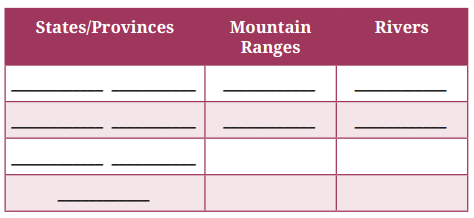
[Note: The above answer is given as reference. Students are expected to attempt the above activity on their own.]

III. You must have read or heard poems and songs about music – both in English and in your own language. Share some of them with your classmates and create a collection of these poems and songs together.
Answer:
In English:

  • ‘Music’ by Longfellow – a beautiful poem describing music as art divine
  • ‘I Wandered Lonely as a Cloud’ by William Wordsworth -though about nature, it captures the musical rhythm of poetry itself
  • ‘A Friend Found in Music’ by Bryanna T. Perkins -the poem we have studied, celebrating music as a companion

In Hindi:

  • ‘Sur Na Saje’ -a popular song reflecting the importance of music in life
  • ‘Vaishnav Jan To’ -a devotional composition by Narsinh Mehta, set to music by many artists including M.S. Subbulakshmi
  • ‘Man Tarpat Hari Darshan Ko Aaj’ -a classical Hindi song from the film Baiju Bawra, showcasing the healing power of music

In Other Indian Languages:

  • Tamil: ‘Isaiye Thunai’ – a song about music being a companion
  • Bengali: Rabindranath Tagore’s Rabindra Sangeet compositions, many of which speak of music as the language of the soul

[Note: The above answer is given as reference. Students are expected to attempt the above activity on their own.]

A Friend Found in Music Class 9 Extra Questions and Answers

A Friend Found in Music Short Question Answer

Question 1.
How does the poet use the image of the ocean to describe her relationship with music? What does this comparison reveal about the depth of her feelings?
Answer:
The poet compares music to an ocean to suggest that it is vast, powerful and strongly attractive. Just as the ocean pulls water to the shore, music draws her toward comfort and belonging. This comparison reveals that her connection with music is deep, natural, and impossible to resist.

Question 2.
What does the poet mean when she says music ‘moves her to the core’? How is this different from simply enjoying music?
Answer:
When the poet says music moves her to the core, she means it deeply affects her emotions and inner feelings. This is different from simply enjoying music because it shows a strong personal connection that influences her deeply rather than giving only temporary pleasure or entertainment.

Question 3.
Why does the poet call music her ‘therapy’? What does this word choice suggest about her emotional state?
Answer:
The poet calls music her therapy because it comforts her when she feels sad and helps her regain emotional strength. This word choice suggests that she experiences moments of loneliness and depends on music for healing, reassurance, and support during difficult situations in her life.

Question 4.
Explain the significance of the phrase ‘pull through’ in the context of the poem. What does it tell us about the poet’s struggles?
Answer:
The phrase ‘pull through’ means to successfully overcome difficult situations. In the poem, it suggests that the poet faces emotional struggles but finds strength through music. Music supports her during challenging times and helps her remain hopeful, strong, and confident despite her difficulties.

Question 5.
What does the poet reveal about the nature of human relationships through the line ‘when no one seems to care’?
Answer:
Through the line ‘when no one seems to care’, the poet suggests.. that she has experienced loneliness and a lack of emotional support from others. This highlights how human relationships may sometimes fail, while music remains a dependable companion that provides comfort and reassurance during such moments.

Question 6.
How does the repetition of the word ‘music’ throughout the poem contribute to its overall effect?
Answer:
The repetition of the word ‘music’ emphasises its importance in the poet’s life. It creates a rhythmic and musical effect that strengthens the theme of the poem and shows that music remains constantly present in her thoughts, emotions and experiences as a faithful companion.

Question 7.
In what ways is music present during both the joyful and sorrowful moments of the poet’s life? Support your answer with evidence from the poem.
Answer:
Music supports the poet during sad moments when she says, “Music is the therapy I heed when I feel blue.” It is also present during her happiest moments, as she says, ‘the times when I’m most cheerful, it’s clear, music was there.’ This shows music remains with her in all emotional situations. ‘

Question 8.
How does the poet personify music in the poem? What human qualities does she attribute to it?
Answer:
The poet personifies human qualities of presence. It lifts her spirits, heals her when she feels blue, stays with her during cheerful moments, and supports her when no one seems to care. These qualities show music as loyal, comforting, dependable, and emotionally understanding like a true friend.

Question 9.
Why is music considered a universal language across cultures?
Answer:
Music is understood and appreciated by people all over the world, regardless of language differences. It expresses emotions such as happiness, sadness, and hope. This universal quality makes music an important form of communication across societies and cultures. ”

Question 10.
Music is often shared during celebrations, travel, or family time. Describe an occasion when you shared music with your friends or family members. How did this experience strengthen your relationship with them?
Answer:
Yes, I once shared music with my family during a long car journey. We listened to our favourite old songs and sang together happily. This created a joyful atmosphere and helped us spend quality time together. The experience strengthened our bond and showed how music brings people closer emotionally.

Question 11.
Music often helps people manage stress and emotions. Have you ever listened to music when you felt sad or worried? How did it help you?
Answer:
Yes, I have listened to music when I felt sad or stressed. It helped me relax and improved my mood. Like the poet in the poem, I felt comforted and supported by music. It gave me strength and helped me think more positively during difficult situations.

A Friend Found in Music Long Question Answer

Question 1.
The poet describes music as playing j multiple roles in her life. Discuss in detail ! the various roles music plays for the poet ! as described in the poem. Do you think music can truly fulfil these roles for j everyone?
Answer:
In the poem, music plays several important roles in the poet’s life. She compares music to an ocean that draws her towards comfort and belonging. She also describes it as rhythm that touches her deeply and connects with her inner feelings. The poet calls music her therapy because it heals her sadness when she feels blue and lifts her spirits during difficult times.

She further presents music as a needed friend who stays with her when no one seems to care and shares both her joyful and lonely moments. Music can indeed fulfil these roles for many people, as it is a universal language that transcends barriers of age, culture, and language. However, the depth of its impact depends on the individual’s emotional sensitivity and personal relationship with music.

Question 2.
The poem uses several metaphors to describe music. Analyse how these metaphors collectively build the central theme of the poem.
Answer:
The poet uses several meaningful metaphors to present music as an essential companion in her life. She compares music to an Ocean to show its vast and powerful influence that draws her towards comfort and belonging. The metaphor rhythm suggests that music deeply affects her inner emotions. By calling music therapy, she presents it as a source of healing during sadness.

The most personal metaphor describes music as a needed friend who supports her when no one seems to care. Together, these metaphors develop the central theme that music provides comfort, strength, and companionship. They show that music is not just entertainment but a dependable presence throughout the poet’s life.

Question 3.
What is the message of the poem and how effectively does the poet convey it through her choice of language and poetic devices?
Answer:
The central message of the poem is that music is a powerful and reliable source of emotional comfort, healing, and companionship in human life. The poet conveys this message effectively through simple language and meaningful poetic devices. Her use of metaphors such as ocean, rhythm, therapy, and needed friend clearly shows the deep influence of music on her emotions.

The repetition of the word “music” at the beginning of several lines emphasises its importance and creates a rhythmic quality in the poem. The ABCB, rhyme scheme gives the poem a smooth and musical flow that reflects its theme. Through her honest expression of loneliness as well as happiness, the poet successfully highlights the constant and comforting presence of music in her life.

Question 4.
‘A Friend Found in Music’ presents music as more reliable than human companionship. Do you agree with this view? Justify your answer with reference to the poem and your own experience.
Answer:
The poem suggests that music can sometimes be more reliable than human companionship. The poet calls music her “needed friend” when no one seems to care, showing that it supports hr during lonely moments. She also says that music was present during her cheerful times, which proves that it remains a constant companion in both happiness and sorrow.

Unlike people, music is always available and never judges or leaves her alone. From my experience, listening to music often brings comfort and relief during stressful situations. However, it is important to recognise that human connection remains irreplaceable in ways that music cannot fully substitute. The ideal lies in embracing both music as a constant companion and people as sources of love and understanding.

Kaveri Book Class 9 Solutions

Nine Gold Medals Question Answer Class 9 English Kaveri Poem 5

Nine Gold Medals Class 9 Question Answer

Reflect and Respond

I. Work in pairs. Discuss the difference between Olympics, Special Olympics, and Paralympics.
Answer:
1. Olympics:
An international multi-sport event held every four years for athletes without disabilities, where participants compete for gold, silver, and bronze medals at the highest level.

2. Special Olympics:
An international sporting event for athletes with intellectual disabilities, focusing on participation, confidence-building, inclusion, and personal achievement.

3. Paralympics:
An international multi-sport event for athletes with physical, visual, and certain intellectual disabilities, held shortly after the Olympics in the same host city.
II. Work in pairs to match the words ’empathy’, ‘sympathy’, and ‘compassion’ to the sentences given in the table below.
Nine Gold Medals Question Answer Class 9 English Kaveri Poem 5 1
Answer:
’I am so sorry for what is happening to you. It is sad, do you want something to eat?’ – Sympathy
‘I can imagine how you feel. I understand that you are upset and why.’ – Empathy
‘I understand why you feel terribly low. I will spend some time with you, so that you don’t feel lonely.’ – Compassion

III. Work in pairs. List the words you associate with ’empathy’. Share your responses with your classmates and teacher.
Answer.
Words associated with empathy: understanding, listening, sensitivity, awareness, care, acceptance, patience, respect, support, connection, concern, kindness.

Class 9 English Nine Gold Medals Poem Question Answer

Check Your Understanding

I. Work in pairs. Match the words and phrases in Column 1 with their meanings in Column 2. You may read the poem again and infer the contextual meaning. Check your answers with the teacher.
Nine Gold Medals Question Answer Class 9 English Kaveri Poem 5 2
Answer:
1. – (ii), 2. – (iv), 3. – (i), 4. – (v), 5. – (iii)

II. Identify the gist of each stanza. Write the number of the stanza in the boxes given.

1. Spectators cheered participants of different events and waited enthusiastically for the final event to start.
2. All runners dashed ahead as soon as they heard the gun shot suddenly, one of the athletes tripped and fell on the ground.
3. The race fiished with nine athletes holding hands and winning the well-deserved gold medals; their smiles, and spectators standing up to applaud, conveyed everything.
4. Participants got ready at the starting line and nine determined athletes waited for the sound of the gun.
5. Athletes from various parts of the country had gone through months of training; had big dreams of winning a medal.
6. The eight athletes stopped to help the young fallen athlete stand up, forgetting that they were competing.
7. Nine athletes held the banner and walked hand in hand; this gesture represented the ethos of Special Olympics.
8. The young athlete felt his dreams were shattered and cried in pain and disappointment, but something unique happened.
Answer:
1. Spectators cheered participants of different events and waited enthusiastically for the final event to start. [2]
2. All runners dashed ahead as soon as they heard the gun shot suddenly, one of the athletes tripped and fell on the ground. [4]
3. The race fiished with nine athletes holding hands and winning the well-deserved gold medals; their smiles, and spectators standing up to applaud, conveyed everything. [8]
4. Participants got ready at the starting line and nine determined athletes waited for the sound of the gun. [3]
5. Athletes from various parts of the country had gone through months of training; had big dreams of winning a medal. [1]
6. The eight athletes stopped to help the young fallen athlete stand up, forgetting that they were competing. [6]
7. Nine athletes held the banner and walked hand in hand; this gesture represented the ethos of Special Olympics. [7]
8. The young athlete felt his dreams were shattered and cried in pain and disappointment, but something unique happened. [5]

III. Let us appreciate the poem.

Question 1.
Two examples of alliteration from the poem are (i) _________ and (ii) __________ .
Answer:
j. stumbled and staggered
ii. dashed in the dirt

Question 2.
Give three examples of visual imagery from the poem.
Answer:
i. fell to the asphalt instead
ii. nine beaming faces
iii. they came to the finish line holding hands still

Question 3.
Give an example of auditory imagery from the poem. (i) ________
Answer:
the pistol exploded

Question 4.
How does the use of imagery make the poem more appealing?
Answer:
Imagery makes the poem more appealing by helping readers clearly visualise and experience the events of the race. Expressions like ‘fell to the asphalt’ and ‘nine beaming faces’ create vivid pictures, while ‘the pistol exploded’ adds sound imagery that makes the scene more realistic and engaging.

Question 5.
How does the poet’s tone change from the beginning to the end of the poem?
Answer:
The tone begins with excitement and anticipation, shifts to shock and sadness when the runner falls, changes to compassion and warmth as the athletes help him, and ends with joy and admiration when all nine runners finish the race together.

Question 6.
What is the overall mood created by the poem?
Answer:
The overall mood of the poem is uplifting and deeply moving. It begins with anticipation, passes through a moment of pain and sympathy, and ends with a strong feeling of joy, unity, and hope. The poem leaves the reader emotionally touched and inspired by the runners’ act of compassion.

Question 7.
What is the message being conveyed by the poem?
Answer:
The poem conveys that true victory lies in compassion, cooperation, and humanity rather than individual success. It reminds us that empathy and kindness are more valuable than winning a medal, and that real success is achieved when people support one another.

Critical Reflection

I. Read the extracts given below and answer the questions that follow.

Question 1.
The eight other runners pulled up on their heels
The ones who had trained for so long to compete
One by one they all turned round and went back to help him
And brought the young boy to his feet.

i) Select the correct option to complete the sentence.
The phrase ‘pulled up on their heels’ means that the runners .
(A) moved aside
(B) stopped running
(C) tried to run faster
(D) jumped ahead
Answer:
(B) stopped running

ii) Mention one character trait common to all the eight other runners.
Answer:
Compassion
[Note: Other acceptable answers: empathy/ kindness/ sportsmanship]

iii) What is the tone of the poet in these lines?
Answer:
The tone of the poet in these lines is warm, admiring and appreciative.

iv) How might the young athlete have felt on being helped by the others?
Answer:
The young athlete might have felt grateful, comforted, and encouraged when the other runners helped him stand up.

v) Would you consider this incident as a turning point in the poem? If yes, why? If no, why not?
Answer:
Yes, this incident is a turning point in the poem because it changes the race from a competition into an act of compassion and unity.

Question 2.
That’s how the race ended, with nine gold medals They came to the finish line holding hands still And a standing ovation and nine beaming faces Said more than these words ever will.

i) How did the nine contestants feel when they reached the finishing line together?
Answer:
The nine contestants felt joyful, proud, and united when they reached the finishing line together, as shown by their beaming faces.

ii) Why do you think all the nine contestants were given gold medals?
Answer:
All nine contestants were given gold medals because they showed unity and compassion by finishing the race together instead of competing individually.

iii) Complete the sentence appropriately.
The holding of hands signifies a feeling of
Answer:
unity, compassion and togetherness

iv) Choose the correct option to complete the sentence.
The spectators giving a ‘standing ovation’ indicates that they were _______.
(A) amazed
(B) speechless
(C) distracted
(D) thoughtful
Answer:
(A) amazed

v) Explain the last line of the extract.
Answer:
The last line suggests that the moment was so powerful that the runners’ unity and the spectators’ appreciation expressed feelings that words alone could not fully describe.

II. Answer the following questions.

Question 1.
Describe how the setting established in the first two stanzas of the poem create a vivid atmosphere for the events that follow.
Answer:
The first two stanzas create an atmosphere of excitement and anticipation. Athletes arrive from across the country after months of training, and spectators gather eagerly to watch the final event of the day. This builds suspense and creates the perfect backdrop for the events that follow.

Question 2.
How do you think the youngest athlete might have felt when he fell?
Answer:
The youngest athlete likely felt a crushing mix of physical pain, humiliation and deep disappointment when he fell. After months of training, he must have felt that his dreams had suddenly been shattered. His cry of frustration and anguish shows both his physical hurt and emotional distress.

Question 3.
Why were the athletes eager to begin the race?
Answer:
The athletes were eager to begin the race because they had trained for many weeks and months for this important event. It was also the final event of the day, making it the most anticipated moment of the entire competition. The athletes were excited to compete for the gold, silver, and bronze medals before a cheering crowd.

Question 4.
What does the transformation of the hundred-yard dash to a walk symbolise?
Answer:
The transformation of the hundred-yard dash into a walk symbolises the shift from competition to compassion. It suggests that the race itself became secondary to the act of supporting a fellow human being. Speed and victory gave way to solidarity, showing j that moving forward together is more meaningful than winning individually.

Question 5.
How might the poem be different if the focus was solely on individual achievement rather than collective support?
Answer:
If the poem focused only on individual achievement, it would end with one runner winning the race while the others were left I behind. In such a case, the poem would remain a simple description of a sporting event rather than a powerful message about compassion and unity. The emotional impact created by the runners stopping to help their fallen companion would be completely lost. There would be no shared victory, no nine gold medals, and no standing ovation from the spectators. Most importantly, the poem would not challenge the usual idea of success as coming first in a race. Instead, it would reinforce competition rather than cooperation. By presenting collective support instead of individual victory, the poet shows that true success lies in empathy, teamwork, and humanity rather than personal achievement alone.

Question 6.
How does the poet’s use of language and tone enhance the reader’s engagement with the poem?
Answer:
The poet’s use of simple and direct language makes the poem easy to understand and emotionally engaging for readers. Words such as ‘stumbled,’ ‘staggered,’ and ‘anguish’ create vivid images and help readers feel the pain of the fallen athlete. At ‘the beginning, the tone of the poem is full of excitement and anticipation as the runners prepare for the race. This tone changes to sadness and sympathy when the smallest runner falls. It later shifts to warmth and admiration when the other runners return to help him, and finally ends with joy and inspiration as all nine athletes finish the race together. These changes in tone reflect the emotional journey of the event and keep the reader deeply involved in the poem. As a result, the poem becomes memorable and meaningful.

Question 7.
What might be the poet’s purpose of writing this poem?
Answer:
The poet’s purpose in writing Nine Gold Medals is to show that true victory lies in empathy, unity, and cooperation rather than individual success. At the beginning of the poem, the runners are focused on winning medals after months of training. However, when the smallest runner falls, the other athletes stop and help him instead of continuing the race. Their action changes the meaning of the competition and shows the true spirit of sportsmanship. By allowing all nine runners to finish the race together and receive gold medals, the poet emphasises the importance of compassion and inclusion. Through the setting of the Special Olympics, he reminds readers that real achievement lies not in defeating others but in supporting one another. The poem encourages readers to value kindness and humanity above personal success.

Vocabulary in Context

I. The phrase ‘standing ovation’ is an example of an adjective-noun collocation. Identify two other similar examples from the poem.

Collocation is a pair or group of words that habitually appear together.
Answer:
1. resolved athletes — adjective (resolved) + noun (athletes)
2. smallest runner — adjective (smallest) + noun (runner)
[Other acceptable alternatives: old field, final event, nine runners, beaming faces]

II. Complete the table given below by writing four nouns in Column 2 that collocate with the adjectives in Column 1. One example has been done for you. You may take the help of a dictionary.
Nine Gold Medals Question Answer Class 9 English Kaveri Poem 5 3
Answer:

Column 1 Column 2
1. big i. disappointment, failure, surprise, decision
2. heavy ii. rain, traffic, burden, loss
3. strong iii. determination, will, belief, character
4. large iv. crowd, number, scale, audience
5. great V. achievement, courage, effort, victory

III. Choose the correct adjectives from those given in the box for the underlined words given in the sentences below. Ensure you do not use the same adjective twice.

Nine Gold Medals Question Answer Class 9 English Kaveri Poem 5 4
1. The littlest athlete was moving at a steady pace. _____________________
2. The eight athletes had a smiling attitude. _____________________
3. When the athlete fell, he gave a huge cry of pain. _____________________
4. The spectators saw a terrible difference in the athletes who had only come to compete. _____________________
5. The gaudy crowd cheered the runners enthusiastically. _____________________
Ans:
1. The littlest athlete was moving at a steady pace. [youngest]
2. The eight athletes had a smiling attitude. [positive]
3. When the athlete fell, he gave a huge cry of pain. [loud]
4. The spectators saw a terrible difference in the athletes who had only come to compete. [significant]
5. The gaudy crowd cheered the runners enthusiastically. [noisy]

Listen and Respond

I. You will listen to a radio-talk about Patrick Gomes, a coach of special athletes. As you listen, write true or false for the statements given. (Transcript for teacher on page 268)
1. Patrick Gomes began his career in sports with track events.
2. Patrick Gomes has been coaching special athletes for 10 years.
3. Patrick Gomes does all the household work himself.
Answer:
1. True
2. False (He has been coaching for over 15 years.)
3. True

II. You will listen to the radio-talk once again. As you listen, choose the correct option for each question.

Question 1.
When the speaker uses the phrase ‘push your boundaries’, he wants listeners to _______.
(A) challenge themselves
(B) meet new people
(C) be open-minded
Answer:
(A) challenge themselves

Question 2.
Patrick Gomes is a ________ at present.
(A) special athlete
(B) coach of special athletes
(C) value education teacher
Answer:
(B) coach of special athletes

Question 3.
Special Olympic Games held at Connecticut was a ______ for Patrick Gomes. …
(A) motivational year
(B) turning point
(C) gradual change
Answer:
(B) turning point

Question 4.
As a special athlete, Patrick Gomes mostly participated in __________.
(A) track events
(B) jogging
(C) football
Answer:
(C) football

Question 5.
Patrick Gomes believes that sports is essential because it encourages _________ along with fitness.
(A) a positive outlook
(B) a peaceful mind
(C) an active life
Answer
(A) a positive outlook

Speaking Activity

I. Work in pairs. Take turns to express your points of view regarding Special Olympics. Use the key points given to develop the conversation.
Key points:
V Importance of Special Olympics (promotes inclusion)
V Impact of Special Olympics on sportspersons with special abilities
V How to create awareness regarding Special Olympics
Use the sentence starters given in the table below when you speak.
Nine Gold Medals Question Answer Class 9 English Kaveri Poem 5 5
Answer:
Student A: What is your opinion on the Special Olympics and why do you think it matters?
Student B: Personally, I believe that the Special Olympics is one of the most important sporting events in the world. It promotes inclusion by giving athletes with intellectual disabilities a platform to compete, be recognised, and feel valued – something that mainstream sport does not always offer them.

Student A: How do you feel about the impact it has on the sportspersons who participate?
Student B: I hold the opinion that the impact is truly life-changing. ¡t builds confidence, discipliner and a sense of belonging. Patrick Gomes is a perfect example – without the Special Olympics, he himself said he could not imagine what else would have been there for him.

Student A: in your view, is enough being done to create awareness about the Special Olympics?
Student B: It is my belief that awareness is still quite limited, especially in schools and local communities. Most people know about the Olympics and the Paralympics but have very little knowledge about the Special Olympics and what it stands for.

Student A: What is your take on how we as students can help spread awareness?
Student B: From my perspective, we can start small by talking about it in class, organising awareness drives in school, inviting special athletes to share their stories, or simply including students with special needs in our everyday sports activities, inclusion begins not on a world stage but in our own classrooms and playgrounds.

Student A: Do you think attitudes toward athletes with special needs are changing?
Student B: I have a strong feeling that they are, slowly but surely. Poems like ‘Nine Gold Medals’ and stories like Patrick Gomes’ are helping people understand that ability is not measured by speed or strength alone, but by courage, determination and the willingness to show up.
[Note: Students can use the above answer for reference and attempt the activity on their own.]

Writing Task

I. Work in pairs to write three creative slogans on Special Olympics. One example of a slogan on Special Olympics has been given below.
Special Olympics: Igniting a Universe of Potential .
Present your slogans in a creative manner and share with your classmates and teacher.
Nine Gold Medals Question Answer Class 9 English Kaveri Poem 5 6
Steps to write a slogan
V Understand the theme on which you want to write a slogan.
V Brainstorm ideas and use them to create the slogan.
V Keep it brief and simple.
V It should not be more than eight to ten words. V Make the slogan catchy
Answer:
1. Every Athlete has a Story. Every Story Matters.
2. Not Different. Just Differently Brilliant.
3. When We Run Together, Nobody Finishes Last.
[Note: Students can use the above answer for reference and attempt the activity on their own.]

II Create a poster based on the inspiration you have drawn from the poem. Present your poster to the class and display it on the classroom board.

[Guidelines to attempt the activity:
Choose one key idea from the poem such as unity, compassion, inclusion, or true victory.
Write a short title or slogan related to the poem’s message.
Add simple drawings or symbols (e.g., runners holding hands, finish line, gold medals, cheering crowd).]

Learning Beyond the Text

I. Read the information given below about some athletes who participated in Special Olympic Games 2023 held in Berlin, Germany.
RAVIMATHI ARUMUGAM : She is an athlete who made India proud by clinching the gold medal in the 400 metre, Level C women’s race.
AANCHAL GOYAL : She won the gold medal in the 400 metre, Level B women’s race.
SAKET KUNDU : Saket Kundu achieved a rare double in track and field by winning a silver medal in the Level B mini javelin event and a bronze in the Level B 400 metre men’s race.
Find out more about other Indian achievers of Special Olympics.
Answer:
Diksha Jitendra Shirgaonkar — Gold medals (swimming), Special Olympics World Games 2023 (Berlin)
Indu Prakash — Gold medal (cycling), Special Olympics World Games 2023 (Berlin)
Ranveer Singh Saini — Gold medal (Golf), Special Olympics World Summer Games 2015 (Los Angeles, USA
Monika Mahto — Gold and Silver medals (Badminton), Special Olympics World Summer Games 2019 (Abu Dhabi, UAE)

II. Create an infographic on any sport and present it in the class.
[Note: Students are expected to do the activity on their own using the infographic given in the textbook as reference.]

Nine Gold Medals Class 9 Extra Questions and Answers

Nine Gold Medals Short Question Answer

Question 1.
Why had the athletes come from all over the country?
Answer:
The athletes had come from all over the country to take part in the race after many weeks and months of training. They hoped to win gold, silver, or bronze medals, and the event represented the result of their dedication and preparation.

Question 2.
What does the poet mean by ‘all coming down to these games’?
Answer:
The phrase suggests that months of hard work and preparation depended on the outcome of these games. The athletes felt that their efforts, discipline, and expectations would be decided in this important event, making it a significant moment in their lives.

Question 3.
Why does the poet describe the pistol as having exploded’ rather than simply ’fired’?
Answer:
The word “exploded” makes the starting signal sound sudden and powerful. It creates a strong sense of excitement and urgency and helps the reader imagine the energy with which the runners began the race.

Question 4.
What was the reaction of the smallest runner when he fell?
Answer:
The smallest runner cried out in frustration and anguish. He felt both physical pain and deep disappointment. His reaction shows how suddenly his hopes and efforts were destroyed at the very start of the race.

Question 5.
What does the phrase ‘dreams and efforts dashed in the dirt’ reveal about the > runner’s emotional state?
Answer:
The phrase shows that the runner felt deeply disappointed after his fall. His hopes seemed suddenly lost. It. suggests that he felt helpless because his chances of success were destroyed at that important- moment.

Question 6.
Why does the poet mention that the eight runners ‘had trained for so long to compete before describing their decision to stop?
Answer:
The poet mentions the eight runners’ long training to show the importance of what the runners were ready to sacrifice. They had prepared for many weeks and months to compete. By stopping to help the fallen runner, they chose compassion over personal success.

Question 7.
What does the image of the runners ‘joining hands’ suggest about the i transformation that takes place in the poem?
Answer:
The image of the runners joining hands shows a shift from competition to unity. Instead of trying to win individually, they choose to : support one another. It highlights that compassion and togetherness become more important than personal success in the race.

Question 8.
Why is the hundred-yard dash being reduced to a walk a powerful moment in the poem?
Answer:
The hundred-yard dash being reduced to a walk shows a shift from competition to compassion. Instead of racing to win, the runners slow down to support their fellow athlete. This moment highlights that unity and kindness become more important than speed and individual victory.

Question 9.
Why does the poet say the banner ‘Special Olympics’ could not have been more on the mark’?
Answer:
The banner ‘Special Olympics’ could not have been more on the mark because the event truly reflected its spirit. It was special not only because the race involved specially abled athletes. It was also special because the runners showed unity and compassion by helping their fellow athlete and finishing together.

Question 10.
How does the final stanza bring together all the poem’s central themes?
Answer:
The final stanza brings together the poem’s main themes of compassion, unity, and shared success. The runners finish the race holding hands and receive nine gold medals together. The standing ovation shows that kindness and cooperation are more important than individual victory.

Question 11.
What does the standing ovation reveal about the crowd’s understanding of what had just happened?
Answer:
The standing ovation shows that the crowd understood the importance of the runners’ actions. They appreciated that helping a fellow athlete was more important than winning the race. Their response shows respect for the runners’ unity, compassion, and true sportsmanship.

Question 12.
According to you, what does “true victory” mean in school life?
Answer:
True victory in school life means helping classmates and learning together instead of competing alone. It also means showing respect and cooperation during group work. Supporting others makes success more meaningful.

Question 13.
How do the values demonstrated by the eight runners apply to everyday life outside of sport?
Answer:
The runners’ actions teach us to help others when they face difficulties instead of thinking only about personal success. In everyday life, whether in school, work, or the community, supporting others shows kindness, cooperation, and a sense of responsibility.

Nine Gold Medals Long Question Answer

Question 1.
The poem never tells us why the smallest runner fell. How does this deliberate silence affect the reader’s response to his situation?
Answer:
The poet does not explain why the smallest runner fell because the reason is not important to the poem’s message. By leaving it unclear, the incident becomes more universal and relatable for readers. Anyone can face unexpected failure despite hard work and preparation. This silence shifts the reader’s attention from the cause of the fall to the response of the other runners. Their decision to stop and help him becomes the real focus of the poem. It highlights compassion, unity and true sportsmanship. As readers, we are encouraged to feel sympathy for the fallen runner and admire the kindness shown by the others. This makes the moment more meaningful and memorable.

Question 2.
Analyse how the poet uses the contrast between the beginning and the end of the poem to convey a powerful message about human values.
Answer:
The poem opens with a fiercely competitive atmosphere. Athletes arrive from across the country, months of training behind them, eyes fixed on gold, silver, and bronze. Individual achievement is everything. By the final stanza, this atmosphere has been completely transformed. The hundred-yard dash has become a walk. Nine runners hold hands instead of racing. One gold medal has become nine. The contrast is striking and deliberate. The poet uses it to show that the values we begin with, competition, speed and individual glory, are not the values that ultimately define us. Through this transformation, the poem teaches that true success lies in helping others and moving forward together. The ending does not replace ambition; it elevates it into something more lasting and more human.

Question 3.
Do you think the eight runners made the right decision in stopping to help their fallen competitor? Could their act be seen as unfair to themselves? Give reasons for your answer.
Answer:
Yes, the eight runners made the right decision by stopping to help their fallen competitor. They had trained for many weeks and months for the race, yet they chose compassion over personal success. Some people may feel their decision was unfair to themselves because they gave up the chance to win individually. However, their action showed true sportsmanship and respect for their fellow athlete. By helping him stand and walking with him to the finish line, they showed unity and kindness. The poem suggests that fairness is not only about winning but also about . supporting others. Their decision teaches that true victory lies in cooperation and humanity rather than individual achievement.

Question 4.
The poem is set at the Special Olympics. How does this specific setting deepen the poem’s message about inclusion and human dignity?
Answer:
The setting of the Special Olympics strengthens the poem’s message about inclusion and human dignity. The Special Olympics provides opportunities for athletes with intellectual disabilities to participate in sports with confidence and pride. Their participation itself reflects courage and determination. When the eight runners stop to help their fallen companion, they show the true spirit of the Special Olympics. Their actions highlight values such as cooperation, respect, and unity instead of competition alone. The banner above the finish line becomes especially meaningful because it matches what happens in the race. Through this setting, the poet clearly shows that participation, kindness, and dignity are more important than winning medals. The event did not simply take place at the Special Olympics. It clearly showed the values of inclusion, courage and unity that the Special Olympics represents.

Question 5.
The eight runners in the poem demonstrate values that are essential for the 21st century. Identify these values and explain how they are relevant to the world we live in today.
Answer:
The eight runners demonstrate important values such as empathy, compassion, teamwork, and respect for others. These values are essential in today’s world. Instead of focusing only on winning the race, they chose to help their fallen companion and finish together. Their actions show that supporting others is more important than personal success. In modern society, people often compete to move ahead individually. However, the runners remind us that cooperation and kindness help build stronger communities. These values are important in schools, workplaces, and everyday life. The poem teaches that true leadership means caring for others and ensuring that no one is left behind.

Question 6.
How does the poem change our understanding of what it means to win? Explain with examples from the poem.
Answer:
The poem challenges the conventional idea that winning means finishing first in a race. At the beginning, the athletes aim to win gold, silver, or bronze medals after months of training. However, when the smallest runner falls, the situation changes. The other runners stop to help him and choose to finish the race together. As a result, all nine runners receive gold medals. This shows that true victory lies in compassion, cooperation, and unity rather than individual success. The poet successfully changes the reader’s understanding of winning by showing that helping others and moving forward together is more meaningful than winning alone.

Question 7.
Why does the poet describe the fallen runner as “the smallest among them” instead of giving him a name? How does this description affect the reader?
Answer:
The poet describes the fallen runner as “the smallest among them” to highlight his vulnerability and courage. Instead of giving him a name, the poet makes him represent. anyone who faces difficulty despite sincere effort. The word “smallest” creates sympathy in the reader and shows that his participation in the race itself required determination. His fall therefore becomes more meaningful and emotional. This description also helps readers understand why the other runners chose to help him. By presenting him in this way, the poet ; strengthens the message of compassion and unity in the poem and makes the incident more touching and memorable.

Question 8.
Imagine you were one of the eight runners who stopped to help the fallen athlete. Describe what you would feel at that moment and what lesson you would carry from that experience.
Answer:
If I were one of the runners, I would not think about winning at that moment. Seeing a fellow athlete fall would make me feel concerned and responsible. Helping him stand up and walking together to the finish line would feel more important than finishing the race first. The standing ovation would make me realise that kindness and unity matter more than individual success. I would feel proud that I chose to help someone in need. I would carry this experience with me as an important lesson in compassion and true sportsmanship. It would remind me throughout my life that supporting others is more meaningful than winning alone.

Question 9.
How does the structure of the poem, moving from competition to compassion across eight stanzas, mirror the emotional journey of both the athletes and the reader?
Answer:
The structure of the poem shows a clear shift from competition to compassion. ¡n the first few stanzas, the athletes prepare for the race after months of training, creating excitement and anticipation. The mood changes when the smallest runner falls, bringing sadness and concern. In the following stanzas, the other runners stop to help him and walk together to the finish line. This change highlights unity and kindness instead of competition. As the poem progresses, the reader’s feelings also change from excitement to sympathy and finally to admiration. The structure helps the reader experience this emotional journey along with the athletes.

Question 10.
How can the lessons learned from The World of Limitless Possibilities and Nine Gold Medals help students respond positively to challenges in real life?
Answer:
Both texts teach students how to respond positively to challenges in real life. The World of Limitless Possibilities explains that setbacks should not discourage individuals but should motivate them to try again with confidence and determination. It encourages students to believe in their abilities and make use of guidance from their support systems. Similarly, Nine Gold Medals shows that helping others during difficult moments is more important than focusing only on personal success. The runners’ actions demonstrate empathy and teamwork even in a competitive situation. Together, these texts teach students to remain hopeful, during failures and supportive towards others facing difficulties. By practising these values in school and daily life, students can develop resilience and contribute to a caring and inclusive environment.

Question 11.
Both The World of Limitless Possibilities and Nine Gold Medals show that success is not only about winning but also about attitude and values. Explain how both texts present this idea.
Answer:
Both The World of Limitless Possibilities and Nine Gold Medals show that true success depends on attitude and values rather than only achievement. In the prose lesson, the speaker explains that setbacks should be seen as opportunities for growth and learning instead of failures. Confidence, persistence, and support from others help individuals move forward in life. Similarly, in the poem, the runners give up their chance to win individual medals to help a fallen athlete complete the race. Their action shows that compassion and unity are more important than personal victory. While the lesson focuses on developing inner strength during challenges, the poem highlights kindness towards others during competition. Together, both texts teach that real success lies in resilience/ cooperation, and humanity rather than coming first in a race.

Kaveri Book Class 9 Solutions

I Cannot Remember My Mother Question Answer Class 9 English Kaveri Poem 4

 I Cannot Remember My Mother Class 9 Question Answer

Reflect and Respond

I. Work in pairs. Discuss the memories from your childhood that you remember. List them and share with your classmates and teacher.
Answer:
[Note: Some common childhood memories students
may recall and share include:

  • the smell of food being cooked at home
  • being carried to bed after falling asleep
  • hearing a familiar voice calling their name
  • a lullaby or bedtime rhyme
  • someone holding their hand while crossing the road
  • celebrating festivals with family
  • being comforted after getting hurt
  • the smell of a grandparent’s home
  • a favourite toy from childhood
  • the sound of rain while staying safe indoors]

II. Discuss how children’s relationship with their mother can influence their emotions and memories.
Answer:
[Note: Students may discuss the following points:

  • A mother is often a child’s first source of love, care, and emotional security.
  • Her presence helps shape a child’s feelings of comfort and confidence.
  • Daily experiences with the mother often become strong and lasting childhood memories.
  • Children may remember their mother through familiar sounds, smells, or routines associated with her.
  • Even in her absence, the emotional bond with the mother continues to influence a child’s thoughts and memories.]

III. Match the words given in Column 1 with their meanings in Column
I Cannot Remember My Mother Question Answer Class 9 English Kaveri Poem 4 1
Answer:
(1 – v), (2 – i), (3 – vi), (4 – ii), (5 – iv), (6 – iii)

Class 9 English I Cannot Remember My Mother Poem Question Answer

Check Your Understanding

I. Fill in the blanks with appropriate words. Stanza 1

1. The poet remembers his mother while he ______.
2. The poet remembers the ________ but not the
Setting: (outdoor/indoor)

Stanza 2
1. The poet remembers his mother in the _______ season.
2. The poet remembers his mother by the smell of _____.
Setting: (outdoor/indoor)

Stanza 3
1. The poet feels that his mother at him from the ______.
Setting: _______ (outdoor/indoor)
Answer:
Stanza 1
1. plays
2. tune; words
Setting: Indoor

Stanza 2
1. autumn
2. shiuli flowers
Setting: Outdoor

Stanza 3
1. gazes/looks
2. sky
Setting: Indoor

II. The senses of olfactory (smell), auditory (hearing), and visual (sight), are three of the five basic senses in humans. Give examples of references to senses from the poem. Complete the table given below.
I Cannot Remember My Mother Question Answer Class 9 English Kaveri Poem 4 2
Answer:

Stanza Lines from the Poem Senses
1. a tune seems to hover over my playthings, the tune of some song that she used to hum while rocking my cradle Auditory
2. the smell of the shiuli flowers floats in the air, the scent of the morning service in the temple comes to me as the scent of my mother Olfactory
3. when from my bedroom window I send my eyes into the blue of the distant sky, the stillness of my mother’s gaze on my face has spread all over the sky Visual

III. Read the poem silently once again and complete the following.

Question 1.
Two examples of alliteration from the poem are (i) _____ and (ii) ________.
Answer:

  1. some song (repetition of the s sound)
  2. smell of the shiuli (repetition of the s sound)
  3. morning my mother (repetition of the m sound)
  4. stillness … spread … sky (repetition of the s sound)

[Note: Students are expected to write any two examples.]

Question 2.
An example of onomatopoeia is _______.
Answer:
hum

Question 3.
The poem uses imagery extensively. Explain.
Answer:
The poem uses imagery extensively by appealing to three different senses in its three stanzas. The auditory image of a hovering tune, the olfactory image of the fragrance of shiuli flowers, and the visual image of the distant blue sky create vivid sensory impressions. These images help the reader experience the child’s memories of his mother through sound, smell, and sight.

Question 4.
Although the poem does not have a rhyme scheme, it is enjoyable because ______.
Answer:
of its gentle rhythm, repetition of the refrain, and vivid sensory imagery that create a soft and emotional effect.

Question 5.
What is the tone of the poet? Why do you say so?
Answer:
The tone of the poem is tender, reflective and melancholic. The poet repeatedly admits that he cannot remember his mother, yet each stanza reveals how deeply her presence is felt through sensory memories. This creates a quiet sadness mixed with warmth and longing.

Question 6.
What impact does the title of the poem have on the overall mood of the poem?
Answer:
The title immediately establishes a mood of loss and longing. By beginning with the words “I cannot remember,” the poet sets an honest and vulnerable tone that prepares the reader for a deeply personal and emotionally gentle poem about absence, memory and lasting emotional connection.

Question 7.
The poet uses ‘I cannot remember my mother’ as a refrain because _______.
Answer:
it emphasises his inability to recall her clearly while highlighting his deep longing and the continued presence of his mother through sensory memories.

Question 8.
The poet uses symbolism to indicate the memory of his mother’s presence. Identify the symbols used in the poem.
Answer:
The poet uses the tune, the fragrance of shiuli flowers, the scent of the morning temple service, and the vast, still sky as symbols to indicate the memory of his mother’s presence. The tune symbolises her nurturing care, the fragrance of shiuli flowers and the temple scent suggest her purity and devotion, and the vast, still sky represents her calm, loving and ever-present gaze.

Critical Reflection

I. Read the extracts given below and answer the questions that follow.

Question 1.
I cannot remember my mother
only sometimes in the midst of my play
a tune seems to hover over my playthings,

i) Complete the following sentence appropriately. The poet is reminded of his mother during his _________.
Answer:
playtime/ play

ii) What is the primary emotion conveyed by the line ‘a tune seems to hover over my playthings’?
(A) It enhances the joy of play.
(B) It disrupts the playtime atmosphere.
(C) It activates memories of the mother.
(D) It symbolises the carefree nature of childhood.
Answer:
(C) It activates memories of the mother.

iii) In the context of the poem, what role does the hovering tune play during the speaker’s playtime?
Answer:
The hovering tune connects the speaker’s playtime with the memory of his mother and suggests her comforting presence returns quietly during his play.

iv) State whether the following sentence is true or false.
The poet experiences the tune lingering over playthings only occasionally during playtime.
Answer:
True

v) How could the poet feel his mother’s presence, even though she isn’t there?
Answer:
The poet feels his mother’s presence through the tune that seems to hover over his playthings, which reminds him of the song she used to hum for him.

Question 2.
I feel that the stillness of
my mother’s gaze on my face
has spread all over the sky.

i) What does the poet suggest about the stillness of his mother’s gaze spreading
over the sky?
(A) The mother’s gaze is physically present in the sky.
(B) The sky is a symbolic extension of the mother’s presence.
(C) The sky mirrors the mother’s emotions.
(D) The stillness is fleeting and unrelated to the mother.
Answer:
(B) The sky is a symbolic extension of the mother’s presence.

ii) What emotion does the poet associate with the ‘stillness’ of his mother’s gaze?
(A) a sense of grief
(B) a sense of anticipation
(Q a sense of nostalgia
(D) a sense of serenity
Answer:
(D) a sense of serenity

iii) State whether the following sentence is true or false.
The poet suggests that the mother’s gaze has a tangible and visual effect on the sky.
Answer:
False. (The poet’s comparison is symbolic. He does not suggest that the mother’s gaze physically affects the sky.)

iv) What is the purpose of likening the mother’s gaze to the sky?
Answer:
The poet likens his mother’s gaze to the sky to suggest that her love is vast, calm, all encompassing and always present around him.

v) Complete the sentence appropriately.
The tone of the poet in the given extract is because .
Answer:
serene and reflective; he feels comfort and peace in the memory of his mother’s gentle gaze rather than grief.

II. Answer the following questions.

Question 1.
What is the emotional impact of the refrain, ‘I cannot remember my mother’?
Answer:
The refrain creates a deep sense of loss, longing and sadness. Its repetition shows the poet’s pain at being unable to recall his mother clearly. At the same time, it suggests that her presence still lives on in his memories, feelings and sensory impressions.

Question 2.
Interpret the connection between the poet’s mother and the following:
i) shiuli flowers
ii) humming tune
Answer:
i) shiuli flowers: The fragrance of shiuli flowers reminds the poet of his mother. As these flowers are associated with morning temple worship, they symbolise her purity, devotion and gentle presence.

ii) humming tune: The humming tune reminds the poet of his mother’s nurturing love and care. It brings back the feeling of her comforting presence during his playtime.

Question 3.
What role does nature play in the poet’s description of the memory of his mother?
Answer:
Nature plays a central role in the poet’s description of his mother’s memory. Elements such as the fragrance of shiuli flowers and the vast blue sky help him feel her presence. Along with the tune he hears, these sensory experiences act as carriers of memory. They allow the poet to reconnect with his mother emotionally, even though he cannot remember her clearly.

Question 4.
What can be inferred about the poet’s perception of the mother-child relationship?
Answer:
The poet suggests that the mother-child relationship is one of the deepest and most lasting emotional bonds in human life. Even though he cannot clearly remember his mother’s face, her presence continues to shape his feelings and memories, through sound, smell and sight. The hovering tune, the fragrance of shiuli flowers, and the vast blue sky help him experience her love and care in different ways. This shows that a mother’s influence does not disappear with time or absence. Instead, her love becomes part of the child’s inner world and remains a source of comfort, guidance and emotional strength throughout life.

Vocabulary in Context

I. Work in pairs to classify the sensory words given in the box below. One example has been done for you.

I Cannot Remember My Mother Question Answer Class 9 English Kaveri Poem 4 3
Answer:

Visual Auditory Olfactory Tactile
glowing hiss aroma sticky
vibrant rustle fragrant rough
crimson squeaky stale chilled
gigantic sizzle stinky smooth
minuscule deafening pungent slimy
gloomy ear- splitting scent fluffy
hairy hairy

II. Fill in the blanks with sensory words in the box for the following passage written by Sarojini Naidu. There are two extra words.

I Cannot Remember My Mother Question Answer Class 9 English Kaveri Poem 4 4

Come and share my exquisite March morning with me: this sumptuous blaze of gold and sapphire sky; these 1. _____________ lilies that adorn the sunshine; the voluptuous 2. _____________ of neem and champak and serisha that beat upon the languid air with their implacable 3. _____________; the thousand little gold and blue and silver breasted birds bursting with the 4._____________ ecstasy of life in nesting time. And, do you know that the scarlet lilies are woven petal by petal from my heart’s blood, these little quivering birds are my soul made incarnate music, these heavy 5. _____________ are my emotions dissolved into aerial 6. _____________, this 7. _____________ blue and gold sky is the ‘very me’…
Answer:
Come and share my exquisite March morning with me: this sumptuous blaze of gold and sapphire sky; these 1. scarlet lilies that adorn the sunshine; the voluptuous 2. scents of neem and champak and serisha that beat upon the languid air with their implacable 3. sweetness; the thousand little gold and blue and silver breasted birds bursting with the 4. shrill ecstasy of life in nesting time. And, do you know that the scarlet lilies are woven petal by petal from my heart’s blood, these little quivering birds are my soul made incarnate music, these heavy 5. perfumes are my emotions dissolved into aerial 6. essence, this 7. flaming blue and gold sky is the ‘very me’…

III. Write numbers against each picture with the phrases that describe them with their sensorial associations. One example has been done for you.

1. beats of music echo in air
2. melody of soothing scent, dancing in the air
3. fragrant breeze of blooming buds
4. gentle lullaby, a soft melody
5. colourful sky, painting a lively sight
6. attractive canvas painting the horizon
I Cannot Remember My Mother Question Answer Class 9 English Kaveri Poem 4 5
Answer:
I Cannot Remember My Mother Question Answer Class 9 English Kaveri Poem 4 6

Listen and Respond

I. You will listen to four short extracts of people expressing their childhood memories. As you listen, match each statement 1-6 to each speaker (i)-(iv). There are two statements that you do not need. (Transcript for teacher on textbook page no. 266)
I Cannot Remember My Mother Question Answer Class 9 English Kaveri Poem 4 7
Answer:

Statement Speaker
1. The precious memories by the seaside are not the same anymore. (iv)
2. My grandfather’s encouragement influences me in moments of difficulty. (i)
3. The school days are a source of recollection to stay in touch. Not needed
4. Childhood days are about freedom and ordinary pleasures in outdoor activities. (ii)

Speaking Activity

I. Work in pairs. Think of an object, song, or a place that is memorable for you. Take turns to speak about it using the prompts given in the textbook.

  • Introduce it briefly
  • Describe it in detail including sensory details
  • Narrate the specifi memory associated with it
  • Explain how it has impacted your life
  • Summarise why this memory is meaningful to you even now

You may use the following phrases.

  • During my childhood…
  • Growing up, I fondly remember…
  • Recalling those early years, I can’t forget…
  • In my younger days, I used to…
  • I have a clear memory of…
  • A routine activity in my childhood involved…
  • A cherished part of my childhood includes…
  • As a child, I was fond of…
  • One of my favourite childhood moments is…
  • Thinking about my early years, I recall…
  • A common occurrence during my youth was…

Answer:
During my childhood, one object that I can never forget is my grandmother’s old wooden radio. It sat in the comer of her room, dark brown and slightly scratched, with a round dial that clicked softly when you turned it. Growing up, I fondly remember sitting beside it every evening, the warm glow of its tiny orange light filling the room as old film songs floated through the speaker. Recalling those early years, I can’t forget the particular smell of that room, a mix of sandalwood, old wood, and the faint scent of mustard oil from my grandmother’s hair. The songs were soft and unhurried, and her voice would hum along quietly, almost without realising it.

I have a clear memory of one rainy evening when the power went out and only the radio worked. My grandmother and I sat in the dim room, listening to a song she said her own mother used to sing. She held my hand and said nothing, and I somehow understood that the music was carrying her somewhere far away.

A cherished part of my childhood includes those quiet evenings, and they have impacted my life deeply. Even today, when I hear an old Hindi song on the radio, something in me slows down and softens. Thinking about my early years, I recall that the radio was never just an object. It was a bridge between generations, a keeper of memories, and a reminder that the most meaningful moments in life are almost always the quietest ones.
[Note: The above speech is given as reference. Students are expected to attempt the activity on their own.]

Writing Task

I. Imagine you had been on a school trip to a scenic place which appealed to all your senses. Write a diary entry describing the place and why it was a memorable experience.
Answer:
Thursday, January 10, 2026
8:45 PM

Dear Diary,
Today was one of the most memorable days of my life. Our school took us on a trip to Rishikesh, and the experience appealed to all my senses from the very beginning.

The first thing I noticed was the sound of the Ganga. The rushing water was louder than I had imagined and filled the air with energy. When I stood at the ghaat and dipped my fingers into the river, I felt how cold and powerful the water was. The air carried a pleasant smell of incense from nearby temples mixed with the freshness of the river and wet stones. Later, we tasted local food, and the warm, spicy flavours made the experience even more enjoyable.

In the afternoon, we walked across the Lakshman Jhula. The bridge swayed gently as we crossed it, and I felt both excited and nervous while looking at the flowing river below.

In the evening, the sky turned beautiful shades of orange and pink. During the aarti, I watched small lamps floating on the river. Their soft light made the moment calm and magical.

Reflecting on the trip, I realised that the sounds of the river, the fragrance of incense, the cool water, local food taste and the beautiful sights made this journey unforgettable. I will always cherish this special experience.

Goodnight.

Learning Beyond the Text

I. You read about the shiuli flowers from the poem.

Gather more information on unique flowers of India — where they are found, how they look, what smell they emit, and what the historical significance is, if any. [For example, Kurinji or Neelakurinji that blooms once in twelve years.] Add more flowers to this list.

Shiuli Flowers:

  • known as Parijat, Parijata, and Harsingar
  • revered and used for various ceremonial purposes
  • release a sweet fragrance
  • associated with numerous Indian legends
  • bloom exclusively during the night
  • Answer:

Unique Flowers of IndiaKurinji / Neelakurinji (Strobilanthes kunthiana):

  • found in the Western Ghats, especially in Kerala and Tamil Nadu
  • bluish-purple flowers covering hillsides
  • blooms once every twelve years
  • attracts tourists and botanists during its rare flowering cycle
  • symbolises the beauty and uniqueness of India’s biodiversity

Brahma Kamal (Saussurea obvallata):

  • found in the high-altitude Himalayan regions of Uttarakhand, Himachal Pradesh, and Sikkim
  • large white flower surrounded by purple- brown papery bracts
  • emits a mild fragrance that becomes stronger at night
  • considered sacred and offered at Kedamath and Badrinath temples
  • blooms only at night and wilts before dawn
  • state flower of Uttarakhand

Kadamba (Neolatnarckia cadamba):

  • found across India, especially in West Bengal, Assam, and Kerala
  • round, bright orange-yellow flower with a honey-like fragrance
  • closely associated with Lord Krishna
  • mentioned in classical Sanskrit literature and the Bhagavata Purana
  • blooms during the monsoon season

[Note: The above information is given as reference. Students are expected to attempt the activity on their own.]

I Cannot Remember My Mother Class 9 Extra Questions and Answers

I Cannot Remember My Mother Short Question Answer

Question 1.
What does the poet’s inability to remember his mother visually suggest about the nature of early childhood memory?
Answer:
The poet’s inability to remember his mother visually suggests that early childhood memories are often sensory rather than detailed or clear. Even without remembering her face, he recalls her presence through sound, smell, and sight, showing how emotional impressions remain strong over time.

Question 2.
Why does the poet use a tune as the first memory of his mother?
Answer:
The poet uses a tune because it reflects the emotional closeness he shared with his mother during infancy. The lingering sound reminds him of her care and affection and shows how music can preserve memories even when clear visual recollections are absent.

Question 3.
What can be inferred about the poet’s age when he lost his mother?
Answer:
It can be inferred that the poet lost his mother at a very young age. He cannot remember her clearly but recalls her presence through sensory experiences like a tune, fragrance and gaze. This suggests his memories were formed during early childhood.

Question 4.
Why does the poet mention the ‘early autumn morning’ while describing the fragrance of shiuli flowers?
Answer:
The early autumn morning creates a calm and peaceful atmosphere in which shiidi flowers bloom and spread their fragrance. This quiet setting helps the poet recall his mother’s presence and reflects the gentle and reflective mood of the poem.

Question 5.
What does the repeated use of the word ‘only’ reveal about the poet’s memories of his mother?
Answer:
The repeated use of the word ‘only’ shows that the poet’s memories of his mother are limited but meaningful. Although he cannot remember her clearly, the few sensory impressions he recalls remain precious and help him feel emotionally connected to her presence.

Question 6.
What does the vast, still sky symbolise in the poem?
Answer:
The vast, still sky symbolises the calm and boundless presence of the poet’s mother. It suggests that her loving gaze continues to surround and comfort him even though she is no longer physically present, showing that her emotional presence remains strong and lasting.

Question 7.
How does the poet’s memory of his mother expand from the beginning to the end of the poem?
Answer:
The poet’s memory develops from a tune heard during play to the fragrance of flowers and finally to the vast sky. This progression shows how his mother’s presence becomes wider and more meaningful as he connects her memory with nature around him.

Question 8.
Why does the poet connect his memories of his mother with natural elements like flowers and the sky?
Answer:
The poet connects his memories of his mother with natural elements like flowers and the sky because they help him feel her presence through sensory experiences. Nature becomes a medium through which he recalls her love and affection even though he cannot remember her clearly.

Question 9.
The poem ends with the image of the mother’s gaze spread across the sky rather than a feeling of grief or longing. What does this ending suggest about the poet’s relationship with his loss?
Answer:
The ending suggests that the poet accepts his mother absence with calmness and I understanding. Instead of expressing grief, he finds comfort in imagining her loving j gaze spread across the sky, showing that her presence continues to remain part of his emotional life.

Question 10.
What does the poet feel when he looks at the distant blue sky?
Answer:
When the poet looks at the distant blue sky from his bedroom window, he feels that the stillness of his mother’s loving gaze has spread across it. This makes him feel comforted and connected to her presence even though she is no longer with him.

Question 11.
The poem shows how small everyday ; experiences can keep memories alive. : Describe one such experience from your life.
Answer:
Listening to old songs reminds me of the time I spent with my parents during family trips. Whenever I hear those songs again, I feel happy and nostalgic. These simple everyday experiences help me relive those special moments and keep my memories of those joyful journeys alive.

Question 12.
Think of a festival or family routine that reminds you of someone special. Describe how it keeps their memory alive.
Answer:
Celebrating festivals with my family reminds me of my grandparents, who always organised these celebrations with great care and joy. Even today, we follow the same traditions at home. These routines help me feel their presence and keep their love and guidance alive in my memories.

I Cannot Remember My Mother Long Question Answer

Question 1.
Explain how the poet uses the three senses of hearing, smell and sight to express his memory of his mother. How do these sensory impressions help convey his emotional connection with her?
Answer:
The poet expresses his memory of his mother through the three senses of hearing, smell, and sight rather than through clear visual recollection. First, he remembers a tune she used to hum while rocking his cradle. This auditory image reflects her nurturing care and emotional closeness during his early childhood. Next, the fragrance of shiuli flowers and the scent of the morning temple service remind him of her gentle and spiritual presence. These olfactory impressions create a calm and devotional atmosphere associated with her memory.

Finally, the stillness of the vast blue sky represents her loving gaze spread around him, suggesting her constant and protective presence. Through these sensory impressions, the poet shows that although he cannot remember his mother’s face, her love continues to live in his feelings, surroundings, and emotional world.

Question 2.
Analyse how the poet uses the setting in each stanza to show the expansion of his mother’s presence in his memory across the poem.
Answer:
The poet uses the setting of each stanza to reflect how his memory of his mother changes and expands rather than disappears. In the first stanza, the setting is indoors among his playthings, suggesting a 1 close and personal memory connected with childhood. In the second stanza, the setting shifts to an early autumn morning filled with the fragrance of shiuli flowers and temple prayers, showing that his mother’s presence extends into the natural and spiritual world around him.

In the final stanza, the setting becomes the vast blue sky seen from his bedroom window. This wide and open space symbolises the boundless nature of his mother’s loving gaze. Thus, the movement from indoors to the open sky shows that although he cannot remember her clearly, her presence grows wider and continues to surround him everywhere.

Question 3.
The poet does not express anger or bitterness about losing his mother. How does this restraint influence the tone and emotional impact of the poem?
Answer:
The poet’s restraint in expressing anger or bitterness creates a calm and reflective tone throughout the poem. Instead of describing grief directly, he remembers his mother through gentle sensory impressions such as a hovering tune, the fragrance of shiuli flowers, and the stillness of the vast sky. These quiet memories suggest his longing in a subtle and natural way rather than through strong emotional statements.

As a result, the poem feels sincere and deeply touching. The poet’s calm acceptance of his loss also shows that his mother’s presence continues to comfort him even in her absence. This restraint makes the emotional impact of the poem stronger, as the reader experiences his feelings through suggestion and imagery rather than direct expression of sorrow.

Question 4.
The repeated line “I cannot remember my mother” appears at the beginning of each stanza. Explain how this refrain shapes the theme of memory and identity in the poem.
Answer:
The repeated line “I cannot remember my mother” emphasises the poet’s inability to recall her clearly and creates a sense of emotional absence at the beginning of each stanza. However, each repetition is followed by a sensory impression—a tune, the fragrance of shiuli flowers, and the stillness of the vast sky—that reveals her continuing presence in his life.

This contrast shows that memory is not limited to visual recollection but can exist through sound, smell, and sight. The refrain also shapes the theme of identity by suggesting that early childhood experiences continue to influence the poet’s emotional world even without clear memories. It shows that his mother’s presence remains deeply rooted in his inner life and shapes how he connects With the world around him.

Question 5.
Comment on the poet’s use of free verse in the poem. How does the absence of a fixed rhyme scheme support the theme of memory and reflection?
Answer:
The poet uses free verse without a fixed rhyme scheme, which gives the poem a natural and reflective flow. This structure makes the poem sound like personal thoughts rather than formal poetic expression. The absence of a strict rhyme pattern supports the theme of memory because memories often return gently and without order. Instead of rhyme, the poet uses repetition of the line “I cannot remember my mother” to create rhythm and emotional continuity.

This repetition helps connect the three stanzas while highlighting the contrast between forgetting and remembering. The simple and calm structure allows readers to focus on the poet’s sensory experiences of sound, smell, and sight. As a result, the free verse style strengthens the poem’s intimate tone and effectively expresses how the memory of the poet7 s mother returns through everyday moments.

Question 6.
Do you agree that the poem suggests a mother’s love remains present even when clear memories fade? Support your answer with references from the poem.
Answer:
Yes, the poem suggests that a mother’s love remains present even when clear memories fade. Although the poet cannot remember his mother’s face, he continues to feel her presence through a hovering tune, the fragrance of shiuli flowers, and the stillness of the vast sky. These sensory impressions show that her love survives in his emotions and surroundings. The poem highlights that early childhood bonds do not disappear with time or absence. Instead, they remain alive through sound, smell, and sight. By connecting his mother’s presence with elements of nature, the poet suggests that her love has become a lasting part of his inner world. Thus, the poem shows that emotional memory can remain strong even when visual memory fades.

Question 7.
Compare the poet’s way of remembering his mother through nature with how people today preserve memories through photographs and videos. Which creates a deeper emotional connection? Give reasons.
Answer:
The poet remembers his mother through natural sensory experiences such as a tune, the fragrance of shiuli flowers, and the stillness of the vast sky. These impressions make her presence feel alive and emotionally close to him. Today, people often preserve memories through photographs and videos, which help recall a person’s appearance and voice clearly.

However, memories connected with nature and the senses often create a deeper emotional connection because they return naturally in everyday situations. The poet’s memories do not depend on objects but arise from his surroundings and feelings. As a result, his connection with his mother feels more personal and lasting. This suggests that sensory memories can sometimes create stronger emotional bonds than recorded images.

Question 8.
Describe the tone of the poem and support your answer with examples from the text.
Answer:
The tone of the poem is gentle, reflective, and tender. Instead of expressing grief directly, the poet remembers his mother through calm sensor}7 impressions such as a hovering tune, the fragrance of shiuli flowers, and the stillness of the vast sky. These soft and peaceful images create a sense of emotional closeness rather than sadness. The repeated line “I cannot remember my mother” adds to the reflective mood by showing both his sense of loss and his continuing emotional connection with her. The poet’s memories are expressed quietly through nature and1 everyday experiences, which makes the tone sincere and comforting. Thus, the poem presents the mother’s presence as lasting and reassuring even though she is no longer physically with him.

Question 9.
Describe how the poet’s surroundings help him remember his mother.
Answer:
The poet’s surroundings play an important role in helping him remember his mother through sensory experiences. While playing indoors, a hovering tune reminds him of her nurturing presence. In the early autumn morning, the fragrance of shiuli flowers and the scent of the temple service bring back memories of her gentle and spiritual nature. Later, when he looks at the distant blue sky from his bedroom window, he feels her loving gaze spread around him.

These everyday surroundings help him remain emotionally connected to his mother even though he cannot remember her face clearly. The poem shows that nature and familiar experiences can preserve early childhood memories and keep emotional bonds alive even in the absence of clear visual recollection.

Writing Task

I. You are sitting by an open window on a quiet afternoon when a familiar smell drifts in from somewhere outside, perhaps it is the scent of rain on dry earth, freshly made food, an old book, or a flower from your childhood garden. For a moment, everything around you disappears and a memory surfaces: a person, a place, or a feeling you had almost forgotten.
Write a letter to that memory.
Address it directly – not to a person, but to the memory itself. Tell it where you were when it found you, what it felt like when it arrived, and what it reminded you of. Use sensory details to bring both the present moment and the remembered moment to life.
Your letter must include:

  1. An opening that describes the exact moment the memory arrived and what triggered it
  2. At least two sensory details from the present moment (what you saw, heard, smelled, or felt sitting by the window)
  3. A description of what the memory showed you, written as though you are reliving it
  4. An honest reflection on why this memory still matters to you
  5. A closing line that speaks directly to the memory, telling it what you would like it to do – stay, return, or let you go

Remember: You are not writing about a person. You are writing to a memory. Give it a voice. Treat it as something that visits you, not something you go looking for, just as the poet found his mother not in photographs or conscious thought, but in a tune, a fragrance, and the stillness of the sky.
Answer:
Letter to a Memory
Thursday, 14 August 2025 4:15 PM

Dear Memory,
This afternoon, I was sitting quietly beside my window when the soft smell of rain on dry earth drifted in from outside. The sky looked grey and still, and I could hear gentle raindrops tapping on the leaves near the window. The cool breeze touched my face, and suddenly you arrived without warning.

You took me back to my school playground during the first rain of the season. I could see my friends running across the wet ground and hear our laughter echoing around us. My shoes were muddy and my uniform was soaked, but I remember feeling completely free and happy. For a few moments, it felt as if I was living that moment again.

You still matter to me because you remind 1 me of a time when life felt simple and full of small joys. Even today, whenever I smell the rain, I feel calm and comforted.

Dear Memory, please keep visiting me whenever the rain returns, because each time you come back, you bring happiness with you.

Yours lovingly,
A Friend Who Remembers

Kaveri Book Class 9 Solutions

Canvas of Soil Question Answer Class 9 English Kaveri Poem 3

Canvas of Soil Class 9 Question Answer

Reflect and Respond

I. Work in pairs. Discuss what all you see in a garden. Think of the colours you see and where you see them. Share your responses with your teacher.
Answer:
In a garden, we can see trees, plants, flowers, grass, birds, butterflies, and insects. We may also notice sunlight, soil, water, and sometimes small animals.

The colours seen are:
Green – leaves, grass, trees; Red, yellow, pink, purple – flowers, butterflies;
Blue – sky; Brown – soil and tree trunks,  benches, birds

II. Look at the picture of a garden and a painting given below. Speak about any similarities between the garden and the painting.
Canvas of Soil Question Answer Class 9 English Kaveri Poem 3 1
Speak using the following:

  1. Just as a garden ______________, similarly, a painting ______________
  2. A garden and a painting, both ________.
  3. ______________ is common to both a garden and a painting.
  4. Like a garden, a painting too __________.

Answer:

  1. Just as a garden is full of natural beauty and colours, similarly, a painting shows beauty through artistic colours and imagination.
  2. A garden and a painting, both are colourful and pleasing to the eyes.
  3. Variety of colours is common to both a garden and a painting.
  4. Like a garden, a painting too looks lively and full of life.

III. Look at the painting given above and identify palette, canvas, and select a hue.

1. Palette: a thin oval or rectangular board or tablet that a painter holds and mixes colours on.
2. Hue: shade of a colour
3. Canvas: (here) painting
Answer:
1. Palette: The colour board shown on the side with different colours.
2. Canvas: The painting of the landscape (with tree, river, rainbow).
3. Hue: Green (seen in trees and grass) or blue (sky/water).

Class 9 English Canvas of Soil Poem Question Answer

Check Your Understanding

I. Read the poem again and complete the summary of each stanza by filling in the blanks.

1. The ______________ is portrayed as a rich palette where gardeners’ __ __ __ a __ s flourish in the form of ______________ , awaiting spring.
2. The garden flowers ______________ into a beautiful display of diffrent b __ __ __ __ __ m s, resembling a ______________ by Mother Nature, in the light of morning.
3. Each garden is likened to a wide __ __ n __ __ s, integrating art and __________. Through the effrts of gardeners, gardens transform into still-life ______________.
Answer:
1. The earth/soil is portrayed as a rich palette where gardeners’ dreams flourish in the form of seeds, awaiting spring.
2. The garden flowers bloom into a beautiful display of different blossoms, resembling a painting by Mother Nature, in the light of morning.
3. Each garden is likened to a wide canvas. integrating art and life. Through the efforts of gardeners, gardens transform into still-life paintings.

II. Select the appropriate title for each stanza from those given below. There are two extra titles.

1. Nature’s Work of Art
2. Sweet-smelling Blossoms
3. Gardens as Living Canvases
4. Earth and Possibilities
5. The Painter’s Canvas
Answer:
Stanza 1 – Earth and Possibilities
Stanza 2 – Nature’s Work of Art
Stanza 3 – Gardens as Living Canvases

III. Match the poetic devices in Column 1 to the examples in Column 2. Discuss your responses in pairs. Then share the responses with your classmates and teacher.

Canvas of Soil Question Answer Class 9 English Kaveri Poem 3 2
Answer:
(1 – iv), (2 – vi) (3 – ii), (4 – i),(5 – vii), (6 – v), (7 – iii)

Critical Reflection

I. Read the given extracts from the poem and answer the questions that follow.

Question 1.
Brushstrokes of seeds, planted true,
Awaiting spring’s vibrant hue.

i) The poet has used a metaphor in ‘Brushstrokes of seeds’. Which option from those given below uses a metaphor?
(A) Her mother’s heart heard her heartfelt request with kindness.
(B) She has a heart of gold.
(C) Her heart did a dance of joy on seeing the new doll.
(D) She has a very kind heart.
Answer:
(B) She has a heart of gold.

ii) Complete the sentence appropriately. The phrase ‘planted true’ is significant because it implies ________.
Answer:
that the seeds are sown with care, sincerity and purpose, reflecting the gardener’s dedication and hope for growth

iii) Why has the poet used the word ‘hue’ instead of ‘colours’ in the extract?
Answer:
The poet uses ’hue’ instead of ’colours’ because it sounds more poetic and painterly, reinforcing the extended metaphor of the garden as a canvas and connecting to the poem’s central theme of art and nature.

iv) Complete the following analogy correctly with a word from the extract.
Summer: hot:: Spring : _________
Answer:
vibrant

v) Read the Assertion (A) and the Reason (R) and select the option that is correctly suited.
(A) : Gardeners wait for Spring.
(R): Gardens are worth painting in Spring.
(A) Both (A) and (R) are true and (R) is the correct explanation of (A)
(B) Both (A) and (R) are true but (R) is not the correct explanation of (A)
(C) (A) is true but (R) is false.
(D) (A) is false but (R) is true.
Answer:
(B) Both (A) and (R) are true but (R) is not. the correct explanation of (A).

Question 2.
Each plot, a canvas wide,
Where art and life coincide.

i) What does ‘Each plot’ refer to in this extract?
Answer:
Each individual garden plot or piece of land that a gardener tends to.

ii) Select which option imitates the rhyme scheme of the extract.
(A) beautiful and clear laughter and cheer
(B) beautiful and clear laughter and tears
Answer:
(A) beautiful and clear laughter and cheer

iii) Select the line from the extract that conveys that gardening blends aesthetic beauty with natural growth.
Answer:
“Where art and life coincide.”

iv) Complete the following sentence appropriately.
The plot is likened to a canvas suggesting that ______ .
Answer:
a garden, like a painting, is a space where creativity and careful effort come together to create something beautiful.

v) Why has the poet most likely used the word ‘wide’ instead of ‘long’ in ‘canvas wide’?
Answer:
‘Wide’ suggests openness, possibility and expanse like a canvas stretched out with room for creation. ‘Long’ would imply only a narrow dimension, missing the sense of boundless potential that the poet wants to convey.

II. Give reasons for the comparisons made by the poet in the poem.

1. A painter is compared to a gardener because ______________.
2. A palette is like earth as __________________.
3. The brushstrokes are like seeds because _________________.
4. A canvas is similar to a garden plot as __________________.
Answer:
1. A painter is compared to a gardener because both create something beautiful through skill, patience, and careful nurturing like one, on canvas, the other in soil.
2. A palette is like earth as both hold a variety of colours and possibilities, ready to be shaped into something beautiful.
3. The brushstrokes are like seeds because both are the starting point of creation: small, deliberate marks that eventually grow into a larger, colourful picture.
4. A canvas is similar to a garden plot as both are blank spaces that come alive through the work and vision of the one who tends to them.

III. Answer the following questions.

Question 1.
How does the metaphor ‘Brushstrokes of seeds’, enhance the understanding of gardening as an art form?
Answer:
The metaphor ‘Brushstrokes of seeds’ makes gardening feel like a deliberate, creative act rather than mere labour. Just as an artist places each brushstroke with intention, a gardener plants each seed with care and purpose, suggesting, that both are creating something beautiful from nothing.

Question 2.
What can you infer about the poet’s perspective on the relationship between nature and creativity from the following lines?
‘Each plot, a canvas wide,/Where art and life coincide.’
Answer:
The poet sees nature and creativity as inseparable. A garden plot is never just land, it is a canvas waiting to be filled. The word ‘coincide’ suggests that art does not imitate nature; they exist as one, each giving meaning to the other.

Question 3.
Do you think the imagery in the poem successfully paints a vivid picture in the reader’s mind? If yes, why? If no, why not?
Answer:
Yes, the imagery works effectively. Phrases like ‘shades of green, red, and blue,’ ‘blossoms bloom’ and ‘palette of earth’ appeal to the senses of sight and touch, making the garden feel visible and alive in the reader’s mind.

Question 4.
Support the view that the poet’s mention of the colour yellow, besides red, blue and green, would have lent effectively to the imagery.
Answer:
Yellow, the colour of sunflowers and ripening crops, would have completed nature’s full spectrum and added warmth toi the visual palette. Its absence is noticeable since yellow is among the most prominent colours in any garden and including it would have made the imagery even richer and truer to life. .

Question 5.
Considering the line ‘Gardens become paintings still’, what can you interpret about the poet’s view on the timelessness of nature’s beauty?
Answer:
The poet suggests that a garden, once created through human effort and nature’s grace, becomes a timeless work of art..Unlike painted canvases that age and fade, a garden renews itself every season, making its beauty permanently woven into the cycle of life.

Question 6.
Justify the title of the poem, ‘Canvas of Soil’.
Answer:
The title ‘Canvas of Soil’ captures the poem’s central idea perfectly that the earth itself is an artist’s canvas. Soil holds the seeds, nourishes growth, and gives rise to colour and life, just as a canvas’ holds paint and gives rise to a painting. The title unites the two worlds of nature and art in just three words.

Vocabulary in Context

I. The poet refers to the shades of green, red, arid blue in the poem. Let us read some of the names of different shades of these colours. (Refer to diagram given in the textbook) Now, Discuss in pairs, any two things that you can associate with these colours.
Canvas of Soil Question Answer Class 9 English Kaveri Poem 3 3
Answer:
1. Shades of Red

  • Scarlet – a blooming rose, a ripe tomato
  • Crimson – dried chillies, a velvet curtain

2. Shades of Green

  • Olive – army uniforms, pickle jars
  • Apple green – fresh spring leaves, a raw mango

3. Shades of Blue

  • Indigo – the night sky, denim fabric
  • Sky blue – a cloudless afternoon, a calm river

[Note: Some examples from each shade have been covered. Taking reference from this, students are expected to do this activity on their own.]

II. Read the following paragraph and discuss in pairs what the underlined painting-related words might mean. Discuss this way:

I think _______ means______ because the passage talks about ________

Example: I think portrait means a picture of someone’s face because the passage talks about capturing a friend’s features.

In the art studio, young painters eagerly approached their easels, each framing a canvas that they had to work on. The teacher encouraged them to experiment with a diverse tonal range, playing with shades and hues to bring their paintings to life. One student focused on a detailed portrait, capturing his friend’s features, first with careful underpainting and then filing the final colours. Another student worked on a mural, depicting a Spring Day on the right wall of the classroom. The room continued to buzz with artistic energy.
Answer:

  1. I think easels means a stand that holds the canvas while painting, because the passage talks about painters approaching them to work on their canvas.
  2. I think tonal range means the variety of light and dark values in a painting, because the passage talks about experimenting with different shades and hues.
  3. I think portrait means a detailed picture of a person’s face and features, because the passage talks about a student carefully capturing his friend’s features.
  4. I think underpainting means a first rough layer of paint applied before the final colours, because the passage talks about it being done before filling in the final colours.
  5. I think mural means a large painting made on a wall, because the passage talks about a student depicting a Spring Day op the classroom wall.

Listen and Respond

I. You will listen to a young girl describe her school garden. As you listen identify which of the following 1-3, she does not talk about. (Transcript for teacher on Textbook page 264)
Canvas of Soil Question Answer Class 9 English Kaveri Poem 3 4
Answer:
She does not talk about Image 2 — the garden hose/water tap.

The girl mentions the bench (Image 1) and butterflies (Image 3), but says nothing about watering equipment or a hose at any point in her description.

II. You will once again listen to the young girl. As you listen, circle the correct answer from the options given below.
Canvas of Soil Question Answer Class 9 English Kaveri Poem 3 5
Canvas of Soil Question Answer Class 9 English Kaveri Poem 3 6
Answer:
Canvas of Soil Question Answer Class 9 English Kaveri Poem 3 7

Speaking Activity

I. People wish to have a garden at home. Some j like a flower garden and some a vegetable ! garden. Think and note some advantages of ; both these types, as gardens for homes.
Answer:
Advantages of Both Types

Flower Garden Vegetable Garden
1. Brightens the home with colour and fragance Provides fresh, chemical-free produe for the family
2. Attracks butterflies and birds, adding life to the surroundings Saves money on groceries
3. Improves mental well-being and reduces stress Teaches children where food comes from
4. Can be gifted or used for decoration on special occasions Encourages healthy eating habits at home
5. Enhances the beauty and appeal of the home Makes productive use of outdoor or balcony space

II. Would you like to have a flower garden or a vegetable garden at home? Why? Take turns with your partner and speak your points aloud, one by one, by using the given sentence prompts given in textbook to express your preference, with reasons.

  • I prefer __________ to __________ because …
  • For me , it is a __________ instead of a __________ due to …
  • If I had a choice I’d rather have a ________than a __________ as …
  • I would prefer __________ rather than __________ since …

Answer:

  • I prefer a flower garden to a vegetable garden because it fills my home with colour, fragrance, and a sense of calm every single day. ‘
  • For me, it is a vegetable garden instead of a flower garden due to the practical benefit of growing my own fresh tomatoes, spinach, and herbs right at home.
  • If I had a choice, I’d rather have a flower garden than a vegetable garden as watching roses and marigolds bloom every morning brings me genuine joy and peace of mind.
  • I would prefer a vegetable garden rather than a flower garden since it not only saves money but also ensures my family eats healthy, homegrown food every day.

[Note: The above pointers are given for reference. Students are expected to do this activity on their own.]

Writing Task

I. Write a descriptive piece of two to three paragraphs describing the details and colours in the garden you have visited.

  • Focus on how different shades of blue, red, and green interact, create contrast, and bring the garden to life.
  • Pay attention to details like the texture of petals, the varying greens of leaves, and the way light affects the colours.

Answer:
The botanical garden is a living masterpiece where nature’s colours blend like paint on a canvas. Deep, velvety Crimson roses stand out against the bright Cobalt blue of the I hydrangeas, creating a beautiful contrast between warm and cool tones. The leaves; add to this variety, ranging from the dark, I shadowy Pine green of old bushes to the bright Apple green of new shoots. Near the pond, lilies rest on thick Jade pads, while the shifting sunlight turns Sky blue flowers into a pale Ice blue. From the vivid Scarlet hibiscus to the dark Navy blue shadows, every element works together to turn the garden into a peaceful, ever-changing “still I life” painting.

Learning Beyond the Text

I Mini-Project

Objective: Explore the multifaceted world of gardens—their design, cultural signifiance, artistic inspiration, and the art of gardening itself.
Duration: This project can span over a few weeks, allowing students adequate time for research and creative processes.
Select any TWO assignments. Any one from 1 or 2, and any one from 3 or 4

(1)

  • Do research and collect information on any FIVE famous gardens of India, such as Amrit Udyan, Brindavan Gardens, and many others.
  • Focus on history, design elements, and cultural signifiance.
  • Prepare a short report and make a presentation.

(2)

  • Explore various art forms (painting, sculpture) inspired by gardens. Select an art piece and analyse how the garden is represented.
  • Create a visual or written response inspired by the garden.

(3)
Design your own garden

  • Design a garden on paper or using digital tools.
  • Incorporate elements and artistic inspirations learned from parts (1)/(2).
  • Present yourchoices in design and artistic influences to the class.

(4)
Interview with a Gardener or Landscaping Expert

  • Approach a local gardener or a landscaping expert for an interview.
  • Prepare questions focussed on understanding the practical aspects of gardening/landscaping.
  • Write a summary of your experience.

Answer:
Assignment 1: Five Famous Gardens of India

1. Amrit Udyan, New Delhi
Formerly known as Mughal Gardens, Amrit Udyan sits within the Rashtrapati Bhavan complex. Designed in the Mughal style with Persian and English influences, it features long rectangular flowerbeds, fountains, and seasonal flowers like tulips and roses. It opens twice a year (originally, it opened once a year) and holds deep national significance as the President’s garden.

2. Brindavan Gardens, Mysuru
Built in 1932 alongside the Krishnaraja Sagar Dam, these terraced gardens are famous for their symmetrical layout, musical fountain, and vibrant flowerbeds. They represent a blend of Mughal and European garden design and remain one of India’s most visited gardens.

3. Shalimar Bagh, Srinagar
Built by Emperor Jahangir for Empress Noor Jahan in the 17th century, Shalimar Bagh is a classic Mughal Garden set against the backdrop of Dal Lake and the Himalayas. Its terraced layout, chinar trees, and water channels make it one of the finest surviving examples of Mughal landscape design.

4. Rock Garden, Chandigarh
Created by Nek Chand from industrial and urban waste, this garden is unlike any other. Sculptures of humans, animals, and dancers made entirely from broken bangles, tiles, and discarded material fill an approximate 40-acre space. It stands as a, remarkable example of outsider art and environmental creativity.

5. Lodhi Garden, New Delhi
Spread across 90 acres in the heart of Delhi, Lodhi Garden combines history with horticulture. It houses 15th-century tombs of the Lodhi dynasty surrounded by manicured lawns, ancient trees, and seasonal blooms. It serves as both a heritage site and a peaceful green lung of the city.

Assignment 3: Design Your Own Garden
Garden Name: The Palette Garden
Inspired by the poem ‘Canvas of Soil’, this garden is designed to mirror an artist’s palette, where every section represents a different colour family, and the overall layout resembles a canvas from above.

Layout and Design Elements:
The garden is divided into three main sections: the Red Walk, the Green Heart, and the Blue Comer connected by a central stone pathway.
The Red Walk runs along the entrance and features scarlet roses, crimson dahlias and vermilion bougainvillea climbing trellises on either side. The warm tones create a welcoming, energetic first impression.

The Green Heart forms the centre of the garden – a circular lawn surrounded by hedges of varying greens: pine green conifers at the border, apple green shrubp closer in, and a carpet of deep India green grass at the centre. A simple wooden bench sits here, offering a quiet resting point.

The Blue Comer occupies the far end/near a small water feature. Cobalt blue hydrangeas, indigo salvia, and sky-blue morning glories climbing a trellis create a calm, cool contrast to the warmth of the Red Walk.

Artistic Inspiration: The design draws from the poem’s central idea that a garden is a living painting. Each section transitions into the next like brushstrokes on a canvas, and no two beds are identical, reflecting the poem’s line ‘Nature’s artwork, ever new.’
[Note: Two projects have been given as references. Students are expected to do these activities on their own.]

Canvas of Soil Class 9 Extra Questions and Answers

Canvas of Soil Class 9 Short Question Answer

Question 1.
How does third stanza differ in focus from the first stanza of the poem?
Answer:
The first stanza focuses on potential – seeds planted in soil, dreams waiting for spring. This final, third stanza focuses on fulfilment: the garden has become a painting with art and life having merged. Together they form a complete arc from beginning to beautiful conclusion.

Question 2.
How does the poem challenge the common belief that art belongs only in studios and galleries?
Answer:
The poem places art firmly outdoors such as in soil, seeds, and gardens. By comparing plots to canvases and tilling to painting, the poet argues that creativity is not confined to formal spaces. Wherever human effort meets ‘nature, art is already happening.

Question 3.
What is the significance of the poem beginning with ‘palette of earth’ rather than simply ‘the earth’?
Answer:
Opening with ‘palette’ immediately frames the entire poem through an artistic lens. It tells the reader from the very first line that this is not a poem about farming, it is a poem about creation, beauty and the art hidden beneath everyday labour.

Question 4.
How does the poet use the morning as a deliberate setting rather than simply a time of day?
Answer:
Morning carries connotations of freshness, possibility and new beginnings. By setting the garden scene in morning light, the poet heightens the sense of vitality and beauty. The colours appear most vivid at dawn, making the garden feel like a painting revealed for the first time each day.

Question 5.
How does the poet elevate the status of a gardener to an artist without ever using the word?
Answer:
The poet elevates the gardener to an artist through metaphor and imagery alone. Words like ‘palette,’ ‘brushstrokes,’ and ‘canvas’ create a subtle comparison, allowing readers to see gardening as a form of art. By the end, the gardener is perceived as a creator, without this being directly stated.

Question 6.
Why is ‘planted true’ a more powerful phrase than simply saying ‘planted carefully’?
Answer:
‘True’ carries moral weight beyond physical precision. It suggests sincerity, honesty, and genuine intention. A gardener who plants ‘true’ is not merely being careful, they are being faithful to the earth, investing real purpose into every seed, the way an artist commits to every brushstroke.

Question 7.
How does the poem suggest that patience is an essential quality shared by both gardeners and artists?
Answer:
Seeds are planted and then, nothing immediate. The poem captures this waiting in the line ‘awaiting spring’s vibrant hue.’ Both gardeners and artists must trust the process, work without instant results, and believe that what they have begun will eventually bloom into something worth seeing.

Question 8.
How does the colour imagery in ‘shades of green, red, and blue’ reflect the poem’s central theme?
Answer:
A painter works with exactly these primary and natural colours on a palette. By listing them as nature’s own colours, the poet reinforces that the garden is nature’s painting. The colours do not decorate the theme; they are the theme made visible.

Canvas of Soil Class 9 Long Question Answer

Question 1.
The poem uses the extended metaphor of painting throughout. Identify at least three painting-related words from the poem and analyse how each one deepens the reader’s understanding of gardening as a creative process.
Answer:
The poet uses palette, brushstrokes and canvas to build an extended metaphor that transforms gardening into an art form. The “palette of earth” suggests that soil itself holds infinite creative potential, just as a painter’s palette holds colours. “Brushstrokes of seeds” implies that planting is deliberate and precise, with each seed placed with the intention of creating something beautiful. “Canvas wide” suggests that the garden is a large, open space for creative expression. Together, these words shift our perception of gardening from mere physical labour to something deeply imaginative, showing that creativity is not confined to studios and galleries, but flourishes wherever human hands work with purpose and care.

Question 2.
The poet uses the phrase ‘Nature’s artwork, ever new What does the word ‘ever’ contribute to the meaning of this phrase? How does it connect to the poem’s larger message about the relationship between nature and time?
Answer:
The word “ever” highlights the continuous and unending nature of creativity in nature. It suggests that nature is always changing, renewing, and creating something new rather than remaining fixed. Each day, the garden looks slightly different, with new blooms, colours, and patterns emerging. This idea connects to the poem’s larger message about the relationship between nature and time. Unlike human-made art, which remains the same once completed, nature’s artwork is always evolving. The garden is never truly finished, as it keeps growing and transforming with time. Through this, the poet shows that nature is a dynamic and tireless artist, constantly creating beauty without pause.

Question 3.
The poet ends with the line “Gardens become paintings still”. Do you think this is an effective conclusion to the poem? Evaluate its impact, considering both its literal and figurative meaning.
Answer:
The closing line is remarkably effective because it works on two levels simultaneously. Literally, ‘still’ suggests that gardens, once tended, remain beautiful and unchanged, like a moment of nature frozen into a painting. Figuratively, it implies that gardens are always paintings, timeless works of art that renew themselves endlessly.

As a conclusion, it brings together everything the poem has explored, including soil, seeds, blossoms, colour and human effort, and distills it into one quiet, powerful image. The brevity of the line gives it weight. After vivid descriptions of colour and movement, the poem settles into stillness, leaving the reader with a lasting impression of nature as an eternal, living artwork.

Question 4.
Imagine you are a gardener reading this poem for the first time. How would the poem change the way you think about your own work? What new meaning would your daily tasks carry after reading it?
Answer:
Reading this poem as a gardener would be deeply affirming. Tasks that might seem ordinary, such as breaking soil, planting seeds, and watering rows, would suddenly feel like acts of creation. The- image of seeds as brushstrokes would make the act of planting feel intentional and artistic rather than routine. Watching blossoms bloom would feel like seeing a painting come to life.

The line ‘where art and life concide’ would serve as a reminder that a garden is not separate from beauty but is beauty itself. Most powerfully, knowing that one’s hands create ‘paintings still’ would give daily work a sense of permanence and meaning, transforming labour into something closer to a calling.

Question 5.
Using the central theme of the poem, write a short critical appreciation explaining how Maya Anthony successfully blurs the boundary between the natural world and the world of art.
Answer:
Maya Anthony’s Canvas of Soil is a quietly brilliant poem that dismantles the boundary between nature and art by showing that both spring from the same source, which is the human desire to create beauty. What makes the poem particularly successful is its movement. It travels from potential, where seeds lie in soil, to fulfilment, where gardens become paintings, mirroring the actual arc of a garden’s growth.

The structure itself becomes an argument for the poem’s theme. Nature is cast as an artist producing ‘artwork, ever new,’ while the gardener becomes its willing collaborator. The result is a poem that celebrates not just gardens but the quietly artistic nature of all human labour that shapes the living world.

Question 6.
The poem focuses entirely on the beauty of a garden. Do you think the poet has presented a complete picture of a gardener’s life? What aspects might have been left out, and why do you think the poet made that choice?
Answer:
The poet presents a celebration rather than a complete portrait, deliberately focusing on beauty and creativity while leaving out the hardships of a gardener’s life. The physical exhaustion, the disappointment of failed crops, the uncertainty of weather, and the economic pressures that many gardeners face find no place in this poem. This is a conscious artistic choice.

The poem’s purpose is not documentation but inspiration, aimed at elevating the gardener’s work and helping readers see dignity and artistry in it. By showing only the beautiful outcome, the poet invites readers to respect all forms of labour. A more complete picture, however, might have added even greater depth, since beauty earned through struggle carries more weight than beauty that appears effortlessly.

Writing Task

The poem Canvas of Soil shows how everyday work can become a form of art. Think of a person whose work you see in daily life (such as a cook, tailor, or street sweeper). Write a descriptive paragraph (150—180 words) focusing on one moment of that person at work.
Your paragraph should:

  • Describe a single action in detail
  • Include at least two sensory details (sight, sound, smell, or touch)
  • Use one original comparison to show their work as art (without using ‘like’ or ‘as’)
  • End with a sentence showing the importance of their work

Avoid:

  • General descriptions or life stories
  • Starting with “He/She is hardworking”

Answer:
The tailor sits by the window, guiding a piece of deep blue fabric under the steady needle of his sewing machine. The soft whirr of the machine fills the room, rising and falling with the rhythm of his hands. His fingers move with quiet precision, folding the cloth, smoothing its creases, and aligning the edges before each stitch. The faint smell of freshly pressed fabric lingers in the air. As the needle moves swiftly, the fabric begins to take shape, each line of thread holding it together with care.

The stitching forms nqat patterns, turning plain cloth into something purposeful and refined, with an identity of its own. In that moment, his work feels like a silent composition, where every stitch adds meaning and structure. The garment slowly comes alive under his touch, shaped not just by skill but by attention and patience. His work quietly supports daily life, clothing people with comfort, dignity and care.

Question 1.
Now that you have explored the idea of the “palette of earth” in the poem, let us explore the “palette of soil” in India.
Research the different types of soil found in India (such as alluvial, black, red, etc.). Present your findings in a table including:

  • Name of the soil ‘
  • Region where it is found .
  • Colour
  • What they are rich in or key characteristics

Answer:

Soil Type Primary Colour Regions Found Rich In / Characteristics
Alluvial Soil Light Grey to Ash Grey Indo-Gangetic plains (Punjab, Haryana, UP, Bihar, West Bengal), Coastal deltas. Potash and Lime.
It is the most fertile soil, formed by river deposits.
Black Soil (Regur) Deep Black to Grey Deccan Trap (Maharashtra, Gujarat, Madhya Pradesh, Chhattisgarh). Lime, Iron, Magnesium, and Alumina.
High water- retaining capacity; ideal for cotton.
Red & Yellow Soil Red (due to iron diffusion); Yellow (when hydrated) Odisha, Chhattisgarh, southern part of Middle Ganga plain, Western Ghats. Iron and Potash.
Formed from crystalline igneous rocks in low-rainfall areas.
Laterite Soil Rusty Red Karnataka, Kerala, Tamil Nadu, Madhya Pradesh, hilly areas of Odisha and Assam. Iron Oxide and Aluminium.
Formed due to intense leaching; used extensively for making bricks.
Arid / Desert Soil Red to Brown Western Rajasthan, parts of Haryana and Punjab. Soluble Salts.
High calcium (Kankar), content; can be productive only with heavy irrigation.
Mountain / Forest Soil Dark Brown / Black Himalayan regions, Sikkim, Arunachal Pradesh. Humus (Organic matter)
Texture varies from loamy in valleys to coarse­grained on upper slopes:- ..

[Note: The above refrrence is given for reference. Students are expected to do this activity on their own.]

Local to Global: The Universal Nature of Garden

Gardens know no borders
Canvas of Soil Question Answer Class 9 English Kaveri Poem 3 8
Gardens carry a universal language where the earth becomes a canvas for human creativity. From the carefully planned terraces and flowing water channels of Shalimar Bagh to the grand, symmetrical landscapes of the Gardens of Versailles, the art of tilling transforms local soil into a global masterpiece.

Kaveri Book Class 9 Solutions

Gifts of Grace: Honouring Our Vocations Question Answer Class 9 English Kaveri Poem 2

Gifts of Grace: Honouring Our Vocations Class 9 Question Answer

Reflect and Respond

I. Given below are four riddles. Read and identify who these people are.

Question 1.
In furrows deep, secrets I sow, As time passes, I watch them grow.
Who am I?
Answer:
A Farmer

Question 2.
From wheel to kiln, my skill is born, Step by step, an art takes form.
Who am I?
Answer:
A Potter

Question 3.
I lay foundations, brick by brick, to build a house, it’s me you pick.
Who am I?
Answer:
A Mason

Question 4.
I work with pots, pans, and spice, creating dishes that taste so nice.
Who am I?
Answer:
A Cook

II. What is the role and relevance of the people you identified in the riddles. How do they contribute to the society? Discuss with your classmates and teacher.
Gifts of Grace Honouring Our Vocations Question Answer Class 9 English Kaveri Poem 2 1
Answer:
Each of these four people represents an essential pillar of everyday life.
The farmer feeds the nation. Without the farmer’s patience and labour, there would be no food on our tables. Every grain we eat begins in the farmer’s hands.

The potter carries forward an ancient craft. From simple clay, the potter creates useful vessels for daily life and helps preserve a tradition that connects us to our cultural roots. The mason builds the spaces where we live, learn, and work. Every school, home, and hospital stands because someone laid its foundation brick by brick. The mason’s work supports the development of society.

The cook turns raw ingredients into nourishment and comfort. Whether in a home, school or community kitchen, the cook helps maintain people’s health, strength and well-being.
[Note: The above answer is given as reference. Students are expected to write the answer on their own.]

Class 9 English Gifts of Grace: Honouring Our Vocations Poem Question Answer

Check Your Understanding

I. Based on your understanding of the poem, state whether the following statements are true or false. Also, rectify the false statements.

1. The poem highlights the skilled work of craftsperson.
2. The poet shares that musicians express emotions through their instruments.
3. The carpenters in the poem are admired for their logical work.
4. The electricians in the poem are recognised for their crucial role in lighting up lives.
5. The poem pays homage to shoemakers who manufacture quality footwear.
6. The poem celebrates the patriotism of the people of Bharat.
7. The poet feels that each vocation deserves to be respected.
Answer:
1. True
2. True
3. False – The carpenters are admired for their mathematical precision in shaping wood and creating useful objects.
4. True
5. True
6. False – The poem celebrates the dignity of labour and diverse professions, not specifically patriotism.
7. True

II. Let us appreciate the poem.

Question 1.
Rhyme Scheme and Lineation
i) Does the poem strictly adhere to a rhyme scheme, or is it in free verse?
ii) What is the impact of the varying length of lines in the poem?
iii) What is the pattern in the structure of most lines of the poem?
Answer:
i) The poem is written in free verse. It does not follow a regular rhyme scheme.

ii) The varying length of lines:
a. creates a natural conversational rhythm
b. reflects the diversity of vocations
c. makes the poem sound like a flowing celebration of voices across Bharat

iii) Most lines follow a pattern of identifying a specific worker, describing their action/tool, and then stating the value/impact of their work.

Question 2.
Speaker
i) Who appears to be the speaker and what is her/his role here?
Answer:
The speaker appears to be an observer and admirer of the workers of Bharat. The speaker listens carefully to their voices and celebrates their dedication, creativity and contributions to society.

Question 3.
Tone and Mood
i) Fill in the blanks with suitable options from the box given below.
Gifts of Grace Honouring Our Vocations Question Answer Class 9 English Kaveri Poem 2 2
A. The tone is _______ and ________, depicting a sense of admiration and respect for the artisans and craftspersons.
B. There is a ________ mood throughout the poem, capturing the vibrancy and richness of cultural traditions and skills.
Answer:
A. celebratory and reverential
B. joyful

Question 4.
Imagery
i) Select any two descriptions from the poem that evoke visual images.
Answer:
a. woven with colours and myriad hues
b. The carpenters celebrating; they create anything out of wood with mathematical precision
c. The electricians humming; they get ready for work, work with cables and wires to brighten our lives
d. The boatmen gathering their nets from the shore, sailing
e. return to tell the tales of life at sea
f. The shoemakers affirming the quality of their work, for the feet that walk, dance, run, jump, return home
g. The delicious singing of the cook
h. the rhythm of designer, mason
[Note: Students can write any two descriptions.]

ii) Fill in the blanks with suitable phrases.
The poem includes auditory imagery through mentions of artisans with lutes, _______, and ________, emphasising the sounds associated with each vocation.
Answer:
electricians humming; boatmen singing

Question 5.
Metaphor
i) State whether the following sentence is true or false.
The mention of ‘delicious singing’ of the cook is a metaphor because it implies that the quality of the singing is so enjoyable or pleasing that it can be equated to the experience of tasting something delicious.
Answer:
True

Question 6.
Personification
i) Select the line that tells us that the poet personifies vocations by attributing humanlike qualities to them.
Answer:
The voice of their vocation is the voice of their identity.
Here, vocation is given the human quality of having a voice.

Question 7.
Repetition
i) Why might the poet have begun and ended with the same line — ‘I hear Bharat celebrating, the varied vocations I hear!’?
Answer:
The poet might have begun and ended with the same line to emphasise the central idea of celebrating diverse professions and create a rhythmic effect.

Question 8.
Alliteration
i) Identify two examples of alliteration from the poem.
Answer:
“voice of their vocation” (repetition of the V sound), “woven with” (repetition of the ’w’ sound).

Question 9.
Symbolism
i) Each vocation in the poem symbolises something more than just a job. What does it symbolise?
Answer:
Each vocation symbolises:
a. personal identity
b. dignity of labour
c. creativity and skill
d. contribution to society
e. the unity and diversity of Bharat’s working community

Critical Reflection

I. Read the extract given below and answer the questions that follow.

The shoemakers affirming the quality of their work, for the feet that walk, dance, run, jump, return home.
The delicious singing of the cook, or the rhythm of of designer, mason, each celebrating what belongs to them and to none else,

Question 1.
The poet says that the shoemakers ‘affirm’ the quality of their work. What does ‘affirm’ refer to here?
i) to make adjustments in
ii) to declare with confidence
iii) to label the goods
iv) to justify the efforts
Answer:
ii) to declare with confidence

Question 2.
What do quality shoes help with, according to the poet?
Answer:
According to the poet, quality shoes support the feet in all daily activities such as walking, dancing, running, jumping, and returning home safely.

Question 3.
What does ‘return home’ symbolise besides the literal act of returning?
Answer:
Besides its literal meaning, ‘return home’ symbolises safety, comfort, completion of daily efforts, and a sense of belonging in life’s journey.

Question 4.
Identify the phrase that tells us that every worker’s contribution is distinct.
Answer:
‘Each celebrating what belongs to them and to none else.’

Question 5.
Complete the following with suitable words. …for the feet that walk, dance, run, jump, return home refers to _______.
Answer:
the entire journey of human life and the diverse activities that make up our daily existence.

II. Answer the following questions.

Question 1.
Why does the poet say, ‘I hear Bharat celebrating, the varied vocations I hear’?
Answer:
The poet says this to show that people across Bharat are proudly engaged in different kinds of work. Each worker contributes through their skills and dedication. By repeating this line, the poet highlights the dignity of labour and expresses admiration for the diversity of professions that help society function smoothly.

Question 2.
What does the electrician ‘humming’ while getting ready for work suggest?
Answer:
The ‘humming’ suggests a sense of contentment and enthusiasm. It shows that the electrician is not just working for a paycheck; they are mentally and emotionally engaged. It reflects a positive attitude toward labour, where the worker finds a rhythmic peace in their daily routine, ready to ‘brighten lives’ with a cheerful spirit.

Question 3.
Explain the significance of the line, ‘The voice of their vocation is the voice of their identity.’
Answer:
This line means that a person’s profession reflects who they are. It means that a person’s work defines who they are and gives them identity. A carpenter’s ‘voice’ is found in their precision. A cook’s ‘voice’ is in their flavours.

Question 4.
Do you think the role of all the people belonging to different vocations is important in our daily lives? Support your answer with a reason.
Answer:
Yes, the role of people from different vocations is very important in our daily lives because each profession supports society in a unique way. For example: electricians provide light and power, carpenters make useful furniture, shoemakers make comfortable footwear, cooks prepare food.

Without these workers, daily life would become difficult and incomplete.

Question 5.
Why is the poet celebrating all the vocations in the poem? Explain by giving examples from your context.
Answer:
The poet celebrates all vocations to show that every type of work deserves respect. Each worker contributes to the well-being of society. In our daily life too teachers guide students, doctors treat patients, farmers grow food, drivers help people travel safely.

These examples show that every vocation plays an important role in building a strong and supportive community.

Question 6.
How does the poet use sensory imagery to bring out the beauty of everyday work?
Answer:
The poet uses sensory imagery to make the description of work lively and engaging.
i) Auditory Imagery: The ‘humming’ of the electrician, the ‘singing’ of the cook, and the ‘echoing’ lutes create a soundscape of productivity.
ii) Visual Imagery: Descriptions like ‘myriad hues’ of the craftsperson and the ‘nets from the shore’ allow us to see the colours and textures of labour.

Vocabulary in Context

I. People of different vocations are being described in the poem. Match the vocations given in the box below with the descriptions that follow.
Gifts of Grace Honouring Our Vocations Question Answer Class 9 English Kaveri Poem 2 3
1. A person who studies or grows garden plants: _______
2. A trained female community health worker: _______
3. A producer of raw silk: _______
4. A person whose job is making or selling sweets and chocolates: _________
5. A metalworker who specialises in working with precious metals: _______
6. A person who fuses materials together: _______
Answer:
1. Horticulturist
2. ASHA worker
3. Sericulturist
4. Confectioner
5. Goldsmith
6. Welder

II. Identify the word from Column 2 that is not the synonym of the words given in Column 1.
Gifts of Grace Honouring Our Vocations Question Answer Class 9 English Kaveri Poem 2 4
Answer:

Column 1 Column 2
1. myriad i. countable
2. hues ii. drawing
3. precision iii. calculation
4. varied iv. uniform
5. delicious v. inedible

Listen and Respond

I. You will listen to two friends, a boy and a girl discussing the occupations of their parents. As you listen, answer the following question in two to three words only. (Transcript for teacher on textbook page 262)

What does the boy use to understand the details of the tools?
Answer:
toy cars

II. You will listen to the girl and the boy once again. As you listen, answer the questions by selecting the correct option.

Question 1.
The girl is _________ about taking food for her mother at the factory.
(A) happy
(B) boastful
(C) unsure
Answer:
(A) happy

Question 2.
The boy thinks that the job of the girl’s mother carries a lot of ______.
(A) luck
(B) risk
(C) responsibility
Answer:
(C) responsibility

Question 3.
The girl why the boy is good at science exhibitions.
(A) wonders
(B) questions
(C) realises
Answer:
(C) realises

Question 4.
The girl shares her __________ about joining the weekend discussion on tools.
(A) doubts
(B) wish
(C) ideas
Answer:
(B) wish

Speaking Activity

The poet speaks of several occupations in the poem. Create groups of five. Allot the role of any five vocations that the poet talks about. Each student in the group will represent one vocation.

Each student speaks for 1-2 minutes about their vocation — who they are, what they do, where they work, what kind of experiences they have at work, what problems they face and a message for all.
Gifts of Grace Honouring Our Vocations Question Answer Class 9 English Kaveri Poem 2 5
Answer:
1. Carpenter: Hello everyone! I am a carpenter. I work with wood and create useful things like doors, tables, chairs, and cupboards with mathematical precision. I usually work in workshops, homes, and construction sites. My work requires careful measurement, patience, and skill. I feel proud when people use the furniture I make every day. However, my work can be tiring and sometimes risky because I use sharp tools and heavy materials.

My message: Respect skilled workers, because our work helps build comfortable homes and better lives.

2. Electrician: Good morning everyone! I am an electrician. I work with cables and wires to provide electricity and help brighten your lives. I work in houses, offices, schools, and factories.

My work requires technical knowledge and safety awareness. I feel happy when I solve electrical problems and restore light and comfort to people’s homes. However, my job can be dangerous if safety rules are not followed.

My message: Electricity makes modern life possible—please value the workers who make it safe and available.

3. Boatman: Hello friends! I am a boatman. I gather my nets from the shore, sail across rivers and seas, and return with stories and experiences from the water. I work near rivers, lakes, and coastal areas.

My work connects people with nature and helps provide food and transport. I enjoy the beauty of the sea, but I also face challenges like rough weather and long journeys.

My message: Respect nature and the workers who depend on it for their livelihood.

4. Shoemaker: Good morning everyone! I am a shoemaker. I make strong and comfortable footwear for the feet that walk, dance, run, jump, and return home. I work in workshops, markets, and small shops.

My work supports people in their daily activities. I feel satisfied when people walk comfortably using the shoes I make. However, my work requires long hours and careful attention to detail.

My message: Every step you take becomes easier because of someone’s effort—respect all workers.

5. Cook: Hello everyone! I am a cook. I prepare food that brings health, energy, and happiness to people. My work is described as the delicious singing of the cook in the poem. I work in homes, schools, restaurants, and community kitchens.

Cooking requires creativity, patience, and care. I enjoy serving food that makes people feel satisfied and joyful. However, cooking for many people can be tiring and demanding. My message: Food is a gift of care—always respect the hands that prepare it.
[Note: The above speech is given as reference. Students are expected to attempt the activity on their own.]

Writing Task

I. Your school will be organising a ‘Career Mela’ in which students are to be made familiar with the different career options. Complete the poster for the event given below.
Gifts of Grace Honouring Our Vocations Question Answer Class 9 English Kaveri Poem 2 6
Answer:
Gifts of Grace Honouring Our Vocations Question Answer Class 9 English Kaveri Poem 2 7

II. Visit the website https://www.msde.gov.in/ ;
Collect information on any one vocation of your choice. Prepare a presentation explaining the following.

  • Reason for your choice
  • How is it helpful to the society and self?

Answer:
A good choice for presentation could be the vocation of Healthcare Assistant (General Duty Assistant), offered under the Ministry of Skill Development and Entrepreneurship. It is highly relevant today because it supports hospitals, clinics, and patients while also providing secure employment opportunities.

Vocation: General Duty Assistant (Healthcare)

  • Reason for choice
  • I choose this vocation because healthcare assistants support doctors and nurses and play an important role in patient care.
  • How it helps society
  • They assist patients, support hospitals and clinics, and help during emergencies and basic care needs.

How it helps the individual (Self)
This vocation provides employment opportunities, develops healthcare skills, and gives personal satisfaction through service to others.

Presentation Structure

  1. Introduction – Briefly explain what a General Duty Assistant is.
  2. Reason for Choice – Highlight why healthcare is important and why you selected this vocation.
  3. Contribution to Society – Show how GDAs support patients and healthcare institutions.
  4. Benefits to Self – Emphasize career stability, skill development, and personal growth.
  5. Conclusion – End with a message of pride in contributing to India’s healthcare system.

[Note: Above information is given as reference. Students can pick a profession of their choice and create the presentation on their own.]

III. A Japanese Haiku
Create a Haiku poem and share with your classmates and teacher.
Answer:
Soft breeze in the trees (5)
Leaves whisper secrets so low (7)
Nature sings at peace (5)

Gifts of Grace: Honouring Our Vocations Class 9 Extra Questions and Answers

Gifts of Grace: Honouring Our Vocations Short Question Answer 

Question 1.
Explain how the poet presents unity through different professions.
Answer:
The poet presents unity by bringing together various professions like carpenters, electricians, and boatmen, all ‘celebrating’ their work. Despite differences, they form a harmonious society. This is reinforced by the line ‘I hear Bharat celebrating, the varied voices I hear!’ which shows collective unity.

Question 2.
What role do sounds (like humming, singing, rhythm) play in the poem?
Answer:
Sounds bring the poem to life and make work feel joyful rather than burdensome. Through phrases like ‘electricians humming’ and ‘the delicious singing of the cook,’ the poet shows that labour has its own music and energy. These sounds together create a sense of a nation buzzing with energy, where every worker finds happiness and pride in what they do.

Question 3.
Describe the contribution of boatmen as depicted in the poem.
Answer:
Boatmen are shown as hardworking and experienced. They ‘gather their nets,’ sail, and ‘sing while at work,’ and later ‘return to tell the tales of life at sea.’ This highlights both their labour and storytelling role. The boatmen represent both physical hardship and the spirit of storytelling. The poet shows them as people whose contribution goes beyond catching fish as they bring back experiences and narratives that enrich the community around them.

Question 4.
How does the poet highlight the uniqueness of each profession?
Answer:
The poet highlights the uniqueness of each profession by describing their distinct actions and skills. For example, carpenters create with precision, shoemakers affirm quality and designers work with rhythm. The line ‘each celebrating what belongs to them and to none else’ captures it best. No two vocations are the same, and the poet treats each one as irreplaceable and worthy of celebration.

Question 5.
Why does the poet use the word ‘celebrating’ repeatedly?
Answer:
The repetition of the word ‘celebrating’ emphasises the dignity and importance of every profession. It shows that no work is ordinary or lesser. By repeating this word, the poet highlights the joy, pride,” and collective contribution of workers that strengthen the spirit of Bharat.

Question 6.
What does the phrase ‘return home’ suggest in the poem?
Answer:
The phrase ‘return home’ suggests safety, comfort, and a sense of belonging at the end of daily activities. It shows that the shoemaker’s work supports people throughout their journeys, highlighting that work is not only about earning but also about enabling comfort and everyday living.

Question 7.
In what way is the cook’s work described differently from others?
Answer:
The cook’s work is described through a blending of the senses of taste and sound in the phrase ‘the delicious singing of the cook.’ Unlike other workers described through their actions or tools, the cook is presented through sensory imagery, making the description more imaginative and expressive.

Question 8.
What overall impression of Bharat does the poem create?
Answer:
The poem paints Bharat as a land alive with the sounds and rhythms of honest work. From carpenters to boatmen to cooks, every worker contributes something unique. The repeated line ‘I hear Bharat celebrating’ leaves us with an impression of a nation that is diverse, energetic and deeply proud of the people who build it every single day.

Question 9.
How does the poem connect different professions with various areas of knowledge such as art, science, environment and society? Explain with examples from the poem.
Answer:
The poem connects professions with different areas of knowledge by showing how each vocation contributes to society in unique ways. Artisans represent creativity and art, carpenters reflect mathematical precision and practical skills, electricians show scientific application, and boatmen connect with nature and environment. Together, they highlight the multidisciplinary importance of work in society.

Question 10.
Observe any worker in your neighbourhood and explain what skills you noticed in their work.
Answer:
I observed a carpenter working in my neighbourhood. He carefully measured and shaped wooden pieces before assembling furniture. His work required patience, accuracy and planning. This observation helped me understand the importance of precision and skill in everyday professions.

Question 11.
Describe one profession mentioned in the poem that you would like to learn more about and explain why.
Answer:
I would like to learn more about the work of electricians because their role is essential in providing electricity and ensuring safety. Their technical skills support daily life. Understanding their work will help me appreciate how technology improves our living conditions.

Gifts of Grace: Honouring Our Vocations Long Question Answer 

Question 1.
Analyse how the poet creates a sense of movement and liveliness across different professions in the poem. Support your answer with references.
Answer:
The poet creates a strong sense of movement and liveliness by presenting each profession in action across the poem. Craftspersons are described as working with ‘colours and myriad hues’ suggesting creativity and activity. Artisans with ‘lutes’ are ‘hailing varied emotions’ and ‘celebrating dreams,’ adding musical energy to the scene.

Carpenters ‘create anything out of wood with mathematical precision,’ showing careful craftsmanship in motion. Electricians are ‘humming’ as they ‘work with cables and wires to brighten our lives.’ Boatmen are ‘sailing, and singing while at work,’suggesting rhythm and continuity. Shoemakers support ‘the feet that walk, dance, run, jump,’ reflecting constant human movement. The repeated phrase ‘I hear’ adds a musical quality and reinforces the lively atmosphere, presenting work as energetic, joyful and meaningful.

Question 2.
Examine how the poet connects different professions to human life and daily experiences. Give examples from the poem.
Answer:
The poet connects different professions to human life and daily experiences by showing how each vocation supports society in practical and meaningful ways. Craftspersons are described as working with ‘colours and myriad hues,’ highlighting creativity that enriches daily surroundings. Artisans with ‘lutes’ express emotions and dreams, adding beauty and cultural depth to life. Carpenters create objects with ‘mathematical precision,’ supporting everyday needs like furniture and shelter.

Electricians ‘brighten our lives,’ making modem living comfortable and convenient. Shoemakers support ‘the feet that walk, dance, run, jump, return home,’ symbolising human activity and movement. Boatmen gather their nets and share ‘tales of life at sea,’ connecting work with experience and storytelling. Even the cook’s ‘delicious singing’ links food with care and joy. Thus, the poet shows that professions are closely connected to daily life and human experience.

Question 3.
Discuss how the poet blends practicality and creativity in the portrayal of different vocations. Use evidence from the poem.
Answer:
The poet blends practicality and creativity by presenting each vocation as both useful and expressive. Craftspersons are described as working with ‘colours and myriad hues,’ highlighting artistic creativity in their work. Artisans with ‘lutes’ express emotions and dreams, showing the musical and imaginative side of labour. Carpenters demonstrate practicality through ‘mathematical precision,’ reflecting careful planning and skill. Electricians perform technical tasks but are described as ‘humming,’ adding a rhythmic quality to their work.

Similarly, the cook’s work is expressed as ‘the delicious singing of the cook,’ combining usefulness with sensory pleasure. Designers and masons are associated with ‘rhythm,’ suggesting structured yet creative effort. Through these examples, the poet shows that all professions involve both practical usefulness and creative expression, making work meaningful and dignified.

Question 4.
Evaluate how the poet builds the idea of identity through work in the poem. Support your answer with textual references.
Answer:
The poet builds the idea of identity through work by showing that each vocation reflects a person’s individuality and contribution to society. This idea is clearly expressed in the, line ‘The voice of their vocation is the voice of their identity.’ Craftspersons working with ‘colours and myriad hues’ and artisans with ‘lutes’ show how creativity expresses personal identity.

Carpenters create with ‘mathematical precision,’ while boatmen return with ‘tales of life at sea,’ reflecting their experience and connecti with nature. Workers are also described as ‘celebrating what belongs to them and to none else,’ highlighting ownership and pride in their skills. Through these examples, the poet suggests that work is not merely a means of livelihood but an expression of who people are and how they contribute meaningfully to society.

Question 5.
How does the poem encourage respect for unseen or less-recognised work? Illustrate with examples and real-life application.
Answer:
The poem encourages respect for unseen or less-recognised work by highlighting the contributions of workers such as shoemakers, boatmen and masons. Shoemakers are shown ‘affirming the quality of their work,’ while boatmen return with ‘tales of life at sea,’ showing both effort and experience. Even masons contribute quietly through their skilled labour.

By presenting these professions with dignity, the poet shows that every role is important in society. In real life, we can practise this value by appreciating workers such as cleaners, helpers and drivers and recognising their contribution to our daily comfort. The poem teaches that respecting all kinds of work helps build empathy, equality and a more supportive society.

Question 6.
‘Joy in work leads to excellence.’ Discuss this idea in the context of the poem with suitable references.
Answer:
The poem shows that joy in work leads to excellence by presenting workers as happy and engaged in their tasks. Craftspersons are ‘celebrating their craft’ and artisans with ‘lutes’ express emotions and dreams, showing creative satisfaction. Carpenters work with ‘mathematical precision,’ reflecting dedication and skill. Electricians are ‘humming,’ and boatmen are ‘singing while at work,’ which suggests enjoyment in their labour. The cook’s work is described as ‘the delicious singing of the cook,’ combining effort with pleasure. These examples show that when people take pride and joy in their work, they perform it with care and excellence. The poem suggests that joy and dedication go together, leading to better results and a sense of fulfilment in one’s work.

Question 7.
Analyse how the poem presents Bharat as a collective identity shaped by its people. Support your answer with references.
Answer:
The poem presents Bharat as a collective identity formed by its diverse workforce. The repeated line ‘I hear Bharat celebrating’ suggests that the nation’s spirit lies in its people. Different professions: artisans, carpenters, electricians, boatmen and others represent various sections of society. Their combined efforts create ‘varied voices,’ symbolising unity in diversity. The idea that each vocation contributes uniquely reinforces that Bharat is not defined by one group but by all. Thus, the poem portrays the nation as vibrant, inclusive and dynamic, shaped by the effort and dedication of its people.

Question 8.
How do ‘Gifts of Grace: Honounng Our Vocations’ and ‘Bharat Our Land’ together show that Bharat’s identity is shaped by both the work of its people and its cuitural heritage?
Answer:
Both ‘Gifts of Grace: Honouring Our Vocations’ and ‘Bharat Our Land’ show that Bharat’s identity is shaped by both the work of its people and its cultural heritage. In ‘Bharat Our Land’, Subramania Bharati celebrates the nation’s sacred and cultural wealth through references to the Himalayas, the Ganga, the Upanishads and Dhamma. These images show Bharat as a land of wisdom, strength and spiritual greatness. In ‘Gifts of Grace’, Bharat is shown as a living nation built by workers such as craftspersons, carpenters, electricians, boatmen, shoemakers, cooks, designers and masons. Their skills and labour support daily life and give meaning to society. Together, the poems show that Bharat’s identity comes from both its glorious heritage and the continuing contribution of its hardworking people.

Question 9.
The poem highlights the interdependence of professions. Explain this idea and suggest how students can practise this value in real life.
Answer:
The poem highlights the interdependence of professions by showing how different workers support various aspects of daily life.

Craftspersons add beauty through ‘colours and myriad hues,’ carpenters create useful objects with ‘mathematical precision,’ electricians ‘brighten our lives,’ and shoemakers support ‘the feet that walk, dance, run, jump, return home.’ Boatmen also contribute through their work and ‘tales of life at sea.’ These examples show that no profession exists in isolation and that all workers contribute to society’s well-being. The poem teaches us the importance of cooperation, respect for all professions, and teamwork. In real life, we can practise this value by appreciating workers around us, working collaboratively with others, and recognising that collective effort helps society function smoothly.

Writing Task

Question 1.
School Newsletter Article
You have read the poem that celebrates various professions. Imagine you are the editor of your school newsletter. Write an article titled:
‘Celebrating Every Profession: Pride in Our Work.’
[Students can use below instructions to attempt the activity.

  • Begin with an engaging introduction that explains why every profession is important in your school or community.
  • Include examples of professions mentioned in the poem.
  • Explain how these professions contribute to daily life and student/community experiences.
  • Highlight a value from the poem (e.g., respect for work, teamwork, or joy in responsibilities).
  • Conclude with a call-to-action encouraging students to appreciate and take pride in all work.]

Question 2.
i) Choose any five professions from the poem (e.g., artisans, carpenters, boatmen, electricians, shoemakers).
ii) For each profession, research and summarise:
[Students can use below instructions to attempt the activity.
History: How was it practised in the past?
Geography/Environment: Which regions in India are known for it?]

Kaveri Book Class 9 Solutions

Bharat Our Land Question Answer Class 9 English Kaveri Poem 1

Bharat Our Land Class 9 Question Answer

Reflect and Respond

I. Recall the lines of the National Anthem and complete the table given below with the names of the states, mountain ranges, and rivers mentioned in it.
Bharat Our Land Question Answer Class 9 English Kaveri Poem 1 1
Answer:

States/Provinces Mountain Ranges Rivers
Punjab, Sindh, Gujarat, Maratha, Dravida (Southern region), Utkala (Odisha region), Banga (Bengal region) Vindhya, Himachal (Himalayas) Yamuna, Ganga

II. Work in pairs. Discuss what the words जये हे (Jaya he) in the last two lines of the National Anthem convey. Share your answer with your classmates and teacher.
Answer:
The words ‘जये हे’ (Jaya he) express victory{ glory and praise. They convey a feeling of respect, pride and celebration for the nation. Through these words, the singer offers salutations to the spirit and unity of India. They are repeated as a resounding cheer to India’s glory.
[Note: The above answers are given for reference. Students are expected to write these answers on their own.] .

III. Read the underlined words in the given lines of the poem. Choose the odd one out j that does not correspond with the meaning I of the underlined word.

1. She’s peerless, let’s praise her!
valuable, incomparable, unmatched

2. Many a sage has sanctified this land.
blessed, purified, applauded

3. And here all auspicious things are found.
fortunate, fantastic, favourable

4. Of hoary antiquity is Bharat,
ancient times, recent past, time immemorial
Answer:
1. valuable
2. applauded
3. fantastic
4. recent past

Class 9 English Bharat Our Land Poem Question Answer

Check Your Understanding

I. Fill in the blanks by choosing appropriate words from the box given below to complete the summary of the poem.
Bharat Our Land Question Answer Class 9 English Kaveri Poem 1 2
The poem is a tribute to India, celebrating its natural beauty, spiritual heritage, and 1. _______. The poet praises the 2. _______, describing it as mighty and unparalleled. The 3. _______ is depicted as generous and graceful, while the 4. _______ are honoured as sacred and unmatched. The poem highlights the contributions of 5. _______ and 6. _______ who have enriched the land with their bravery and wisdom. It also acknowledges the presence of 7. _______ and the teachings of 8. _______, highlighting India’s deep-rooted spiritual and philosophical traditions. The poet repeatedly asserts that India is 9. _______, urging everyone to 10. ________ her.
Answer:
The poem is a tribute to India, celebrating its natural beauty, . spiritual heritage, and 1. historical greatness. The poet praises the 2. Himavant, describing it as mighty and unparalleled. The 3. Ganga is depicted as generous and graceful, while the 4. Upanishads are honoured as sacred and unmatched. The poem highlights the contributions of 5. warriors and 6. sages who have enriched the land with their bravery and wisdom. It also acknowledges the presence of 7. Brahma-knowledge and the teachings of 8. Buddha, highlighting India’s deep-rooted spiritual and philosophical traditions. The poet repeatedly asserts that India is 9. peerless, urging everyone to 10. praise her.

II. Complete the following features about the poem.

1. The impact on the readers (mood): __________
2. The poet’s attitude (tone): __________
3. The rhyme scheme: ___________
4. Examples of personifiation: ________
Answer:
1. The impact on the readers (mood): Bride, admiration and inspiration
2. The poet’s attitude (tone): Patriotic and reverential
3. The rhyme scheme: Irregular / Free verse (no fixed rhyme scheme)
4. Examples of personification: “The generous Ganga”, “This sunny golden land is ours – she’s peerless” (India and the river are given human qualities)

III. What is the impact of the refrain, ‘she’s peerless, let’s praise her!’?
Answer:
The refrain emphasises India’s unparalleled greatness, fostering a sense of national pride and collective admiration in the reader.

IV. Complete the following sentence appropriately.
India is metaphorically described as ‘this sunny golden land,’ suggesting that it is ________.
Answer:
rich and prosperous

V. The poet uses symbolism. Match the symbols in Column 1 to what they suggest in Column 2.
Bharat Our Land Question Answer Class 9 English Kaveri Poem 1 3
Answer:
(1 – v), (2 – iii), (3 – ii), (4 – vi), (5 – i), (6 – iv)

VI. The poet uses imagery (descriptive language to create vivid mental pictures that appeal to the senses). Give any two examples from the poem.
Answer:
mighty Himavant, sunny golden land
[Note: Other answers include: generous Ganga and many a sage has sanctified this land]

VII. What is the impact of the use of hyphens in the first stanza? Select the options that are true.
Bharat Our Land Question Answer Class 9 English Kaveri Poem 1 4
Answer:
1, 3, 5

VIII. The poem is an ode. Identify examples from the poem that correspond to it being anode.
Bharat Our Land Question Answer Class 9 English Kaveri Poem 1 5
Answer:
“The mighty Himavant is ours – there’s no equal anywhere on earth. “The generous Ganga is ours”; “This sunny golden land is ! ours – she’s peerless, let’s praise her!”; “Gallant warriors have lived here…”

IX. Read the explanations and identify the matching allusions from the poem for the following.

1. An allusion to the ancient Indian scriptures that form the philosophical core and symbolise deep wisdom and enlightenment.
2. An allusion to the concept of spiritual knowledge associated with self-realisation and ultimate truth.
3. An allusion to Gautama Buddha’s teachings, which include compassion, non-violence, and enlightenment. This highlights India’s role in shaping major religious and philosophical traditions.
Answer:
1. Upanishads,
2. Brahma-knowledge,
3. Buddha/Buddha’s dhamma

Critical Reflection

I. Read the extract given below and answer the questions that follow.

The mighty Himavant is ours-
there’s no equal anywhere on earth.
The generous Ganga is ours-
which other river can match her grace?
The sacred Upanishads are ours-
what scriptures else to name with them?

Question 1.
Complete the sentence.
The word ‘mighty’ refers to the ________ of the Himavant.
Answer:
strength

Question 2.
Choose the correct option to complete the sentence given below.
The question mark at the end of the fourth and sixth line of the extract is used to _____.
i) show doubt and uncertainty
ii) emphasise a point
iii) highlight confusion and hesitation
iv) reveal inquiry and curiosity
Answer:
ii) emphasise a point

Question 3.
The poet uses the word ‘generous’ to describe the Ganga. Why?
Answer:
The poet uses the word ‘generous’ to describe the Ganga because of her life-giving and nurturing traits,

Question 4.
Why has the movement of the river been described as graceful?
Answer:
The movement of the river has been described as graceful because it flows smoothly and beautifully.

Question 5.
Fill in the blank with the correct option from the words given in the brackets.
The poet is implying that the Upanishads are _______ (unmatched/abundant) in their wisdom and spiritual depth.
Answer:
unmatched

II. Answer the following questions.

Question 1.
How does the poem reflect a strong connection to cultural identity and’ heritage?
Answer:
The poem reflects a strong connection to cultural identity and. heritage by highlighting India’s natural features, sacred texts, and spiritual traditions. References to the Upanishads, sages, and Gautama Buddha show the country’s rich philosophical legacy, which shapes its, identity and values.

Question 2.
What can you infer about the poet’s attitude towards India from the repeated phrase ‘she’s peerless, let’s praise her!’?
Answer:
The poet expresses deep pride, admiration, and reverence for India. By repeating the phrase, he emphasises the nation’s unmatched greatness and highlights all that it symbolises—its natural beauty, cultural richness, and spiritual heritage. The repetition also encourages readers to appreciate and take pride in the country.

Question 3.
What does the line ‘many a sage has sanctified this land’ suggest about India’s spiritual heritage?
Answer:
The line ‘many a sage has sanctified this land’ suggests India is a spiritual landscape and hallowed ground, purified by the wisdom and penance of ancient thinkers(sages). This sanctified heritage formed a deep foundation for universal truths like Brahma-knowledge to take root, defining BFarat as a peerless nation of hoary antiquity and ethical leadership.

Question 4.
How does the poet connect warriors and music to India’s greatness?
Answer:
The poet connects warriors and music to India’s greatness by presenting them as symbols of strength and cultural richness. While the warriors represent courage and valour, the reference to divine music highlights the country’s artistic and spiritual heritage. Together, they show that India’s greatness lies in both power and refinement.

Question 5.
How does this poem foster a sense of national pride?
Answer:
This poem fosters a sense of national pride by praising India’s uniqueness, heritage and greatness.

Vocabulary in Context

I. Complete the table by choosing words from the poem.
Bharat Our Land Question Answer Class 9 English Kaveri Poem 1 6
Answer:

Suffix Meaning Examples
-ous full of, having the qualities of kindness 1. generous
-ity the state of being very old or ancient 2. antiquity
-est superlative form 3. divinest
-less without something 4. peerless

II. Complete the following table by adding a different suffix to form new words. Also, create a sentence using the created word. One example has been done for you.
Bharat Our Land Question Answer Class 9 English Kaveri Poem 1 7
Answer:

Suffix Meaning Examples
-tion the action or process, of Example: indicate -indication.
The dark clouds were an indication that it would rain soon.
-ive quality or nature of create – creative.
She is very creative and always comes up with new ideas.
-ment the action or result of achieve – achievement. Winning the award was a great achievement for the team.
-ed past-tense version of a verb sanctify – sanctified.
Many sages sanctified this land with their wisdom.

Listen and Respond

You will listen to four people talk about the places they like to travel to. As you listen, write the speaker number for the two pictures given. (Transcript for teacher on Textbook page 260)
Bharat Our Land Question Answer Class 9 English Kaveri Poem 1 8
Answer:
1. Speaker No. 4
2. Speaker No. 2

II. You will once again listen to the four speakers. As you listen, match the given statements to the speaker. There are two statements that you do not need. (Transcript for teacher on Textbook page 260)
Bharat Our Land Question Answer Class 9 English Kaveri Poem 1 9
Answer:

Statement Speaker
1. The green surroundings look beautiful visually. Speaker 4 (travel vlogger, loves forests)
3. The quietness of the environment here leads to a peaceful experience. Speaker 1 (elderly man, riverside calm)
4. The risk and thrill in such an area is what is most appealing. Speaker 2 (adventure -enthusiast, mountains)
6. The sight of such beauty is very inviting and has to be captured. Speaker 3 (photographer, deserts)

So, the two statements that are not needed are:

  • Statement 2
  • Statement 5

Speaking Activity

Question 1.
In pairs, take turns to speak about the aspects of your village/town/city that you feel are an asset. It could be about geographical, cultural, traditional features, or even its history. Use the cues given in textbook to express your praise and admiration.
Bharat Our Land Question Answer Class 9 English Kaveri Poem 1 10
One thing that I find truly wonderful about my village/town/city is…

  • If I had to describe my village/town/city in one word, it would be…
  • I have always been fascinated by the way the people of my village/town/city…
  • What I want other people to know about my village/ town/city is…
  • When it comes to the scenery, my village/town/city truly shines because…
  • I feel a deep sense of pride when I think about my village/town/city…

Answer:
One thing that I find truly wonderful about my village/town/city is the lively festivals that bring everyone together.

  • If I had to describe my village/town/city in one word, it would be ‘welcoming/
  • I have always been fascinated by the way the people of my village/town/city respect traditions while also embracing modem life.
  • What I want other people to know about my village/town/city is that it has a rich history and monuments that tell amazing stories.
  • When it comes to the scenery, my village/town/city truly shines because of the green parks, riversides, and beautiful sunsets.
  • I feel a deep sense of pride when I think about my village/town/city because it has produced great leaders, artists, and thinkers.

[Note: Using the above pointers as reference, students are expected to do this activity on their own.]

Writing Task

I. Write a paragraph about a place that you have visited which has stayed in your memory.

Remember to mention the following:

  • Why did you go there?
  • Who did you travel with?
  • How did you prepare for the travel?
  • Where did you stay?
  • What activities did you do there?

Answer:
Last year, I visited Jaipur, a trip that has stayed fresh in my memory. I went there to explore its historical forts and palaces, and I travelled with my family, which made the experience even more enjoyable. Before the journey, we prepared for the trip by reading about the city’s heritage, booking tickets in advance, arid packing light clothes suitable for the warm climate. We stayed in a malI heritage hotel near the old city, which gave us a taste of traditional Rajasthani hospitality. During our stay, we visited Amber Fort, City Palace, and Hawa Mahal, and we also enjoyed shopping for handicrafts in the local markets. The highlight was watching the sunset from Nahargarh Fort, which made the whole trip unforgettable.
[Note: The above answer is given as a reference. Students are expected to attempt this activity on their own.]

Learning Beyond the Text

I. Search for poems or songs dedicated to India, your motherland, in your regional language. Share them with your classmates and explain their meaning too.
Answer:
Poems or Songs Dedicated to India:
Regional Language Examples include:

  • Hindi: ‘Vande Mataram’ — praises the motherland as divine and nurturing.
  • Bengali: ‘Amar Sonar Bangla’ – celebrates the golden beauty of Bengal.
  • Tamil: ‘Tamil Thai Valthu’ — a hymn to Mother Tamil, symbolising pride in culture.

II. In groups of six, prepare an interdisciplinary project on India’s major geographical features. For each feature, describe the region, explain its importance in the lives of the people living there and mention the languages spoken in that region. Include one example of each of the following.

  • Mountains – Himalayas, Western Ghats, etc.
  • Rivers – Ganga, Yamuna, Krishna, Kaveri, Godavari, etc.
  • Deserts – Thar Desert, Rann of Kutch, etc.
  • Valleys – Kangra Valley, Nubra Valley, etc.
  • Islands – Andaman and Nicobar Islands, Lakshadweep, etc.
  • Plateaus – Deccan, Malwa, Meghalaya, etc.

Answer:
Interdisciplinary Project on India’s Geographical Features
(Students can divide into six groups, each j focusing on one feature)

1. Mountains (Himalayas, Western Chats)

  1. Region: The Himalayas are located in northern India and consist of high, snow çovered mountain ranges. The Western Ghats run along the western coast and are covered with dense forests and rich biodiversity.
  2. Importance: The Himalayas act as a natural barrier, influence climate, and are the source of many important rivers. The Western Ghats play a key role in bringing rainfall and supporting a wide variety of plant and animal life.
  3. Languages Spoken:
    Himalayan region: Hindi, Nepali, Kashmiri, Pahari languages
    Western Ghats region: Marathi, Konkani, Kannada, Malayalam, Tamil

2. Rivers (Ganga, Yamuna, Krishna, Kaveri, Godavari)

  1. Region: These rivers flow through the northern plains and the peninsular plateau, forming fertile river basins.
  2. Importance: Rivers provide water for agriculture and daily use. They are also important for transport, religious practices
  3. Languages Spoken:
    Northern River regions: Hindi, Bhojpuri, Bengali, Maithili
    Southern River regions: Telugu, Kannada, Tamil

[Note: Two geographical features have been given as reference. Students are expected to do this activity on their own.]

Bharat Our Land Class 9 Extra Questions and Answers

Bharat Our Land Short Question Answer

Question 1.
If the references to the Himavant and the Ganga were removed from the extract, how would it affect the tone and persuasive power of the poem? Justify your response.
Answer:
Removing the references to the Himavant and the Ganga would strip the poem of its most vivid symbols. Without these iconic landmarks, the imagery loses its emotional depth and the praise of India’s greatness becomes less persuasive and relatable.

Question 2.
How do the Upanishads add to India’s greatness?
Answer:
The Upanishads add to India’s greatness by offering profound spiritual knowledge and philosophical depth. They reflect the intellectual and moral richness of the country, guiding people towards truth and self-realisation. Through them, the poet highlights India’s long-standing tradition of. wisdom and deep thinking.

Question 3.
What role do sages play in the poem?
Answer:
Sages in the poem play a significant role by sanctifying and blessing the land through their presence and spiritual practices. They represent purity, wisdom and devotion. Their contribution enhances the spiritual value of the nation, making it a place of enlightenment and divine connection.

Question 4.
How does the structure of the poem contribute to its overall impact on the reader?
Answer:
The poem is structured as a series of assertions followed by the refrain “she’s peerless, let’s praise her!” This rhythmic progression builds emotional momentum, moving the reader from visualising natural beauty to appreciating cultural depth and historical legacy, resulting in a persuasive and unified impact.

Question 5.
What impression do you form about the nation’s legacy based on the poet’s description?
Answer:
The poet describes a legacy of ‘hoary antiquity’ where bravery (warriors) and wisdom (sages) coexist. This creates an impression of a well-rounded civilisation that values both the strength to protect its borders and the spiritual depth to seek universal truths through ‘Upanishads’ and ‘Dhamma’.

Question 6.
What role does admiration play in shaping the tone of the poem? Explain how it influences your understanding of the poet’s intent.
Answer:
Admiration creates a reverent and celebratory tone, primarily with adjectives like “mighty” and “peerless”. This influences our understanding by revealing the poet’s intent to inspire collective pride and a sense of shared belonging among the readers. Moreover, the tone of admiration also highlights poet’s relentless devotion and love towards the nation, shaping it as a patriotic poem.

Bharat Our Land Long Question Answer

Question 1.
How are geographical features, spiritual heritage and emotional tone interconnected in the poem to create a unified vision of national pride? What insight does this offer about the nation’s identity?
Answer:
The poet interconnects the physical and metaphysical by portraying nature as the foundation of spirituality. The “rnighty Himavant” and “generous Ganga” are not just terrain; they are the backdrop for the “sacred Upanishads”. The emotional tone of high praise acts as a bridge, linking these geographical wonders to the intellectual achievements of sages and the Buddha. This synthesis offers the insight that the nation’s identity is holistic—it is a “sunny golden land” where physical beauty is inseparable from its spiritual and ethical wealth. By weaving these threads together, Bharati presents national pride as a deep-rooted appreciation for both the visible land and the invisible values it nurtures.

Question 2.
The poem presents India not just as a place but as an idea. Discuss how the poet builds this idea through different aspects highlighted in the poem.
Answer:
The poet constructs India as an ‘idea’ of a perfect civilisation by highlighting a balance of diverse virtues. He presents the ‘idea’ of India as a sanctuary for both action and contemplation—symbolised by “gallant warriors” and “sanctified sages”. This idea is further expanded to include intellectual curiosity (Brahma-knowledge) and ethical conduct (Dhamma). By moving away from specific dates or maps and focusing on ‘auspicious things’ and ‘grace’, Bharati transforms the physical territory into a conceptual symbol of harmony and excellence. Thus, the nation becomes a living idea of a spiritual and cultural powerhouse that is both ‘sunny’ and ‘sacred’, inviting the world to appreciate its internal light.

Question 3.
What contrast do warriors and sages create?
Answer:
The contrast between warriors and sages highlights two essential aspects of a nation’s greatness: strength and wisdom. Warriors represent courage and the ability to protect the nation, while sages stand for knowledge, peace and spiritual insight. By presenting both together, the poet suggests that true greatness lies in maintaining a balance between action and thought. A nation is not defined only by its power but also by its values and understanding. This contrast enriches the image of the land, showing it as both strong and thoughtful. It reflects a well- rounded identity where physical capability and intellectual depth exist together and .contribute equally to the nation’s progress.

Question 4.
In the poem, Subramania Bharati places the Upanishads alongside the Himalayas and the Ganga. What does this placement tell us about how he views scripture as part of cultural identity?
Answer:
Bharati’s placement of the Upanishads with the Himalayas and the Ganga serves a symbolic purpose. The Himalayas represent physical grandeur and permanence, while the Ganga symbolises spiritual purification and life-giving grace. By placing the Upanishads in this company, Bharati elevates the ancient scripture to the same status as nature’s greatest gifts: something eternal, irreplaceable and uniquely, India’s own. He is’ saying that India’s identity is not built on land alone, but equally on the wisdom contained in her sacred texts. The Upanishads, in his vision, are not merely religious documents but a civilisational treasure that defines what Bharat is and has always been.

Question 5.
How can you show pride for your country in daily life?
Answer:
Showing pride for one’s country does not always require grand actions; it can be reflected through small, meaningful choices in our daily lives. One can begin by respecting national symbols such as the flag and the anthem and by being aware of the country’s history and culture. Practising honesty, responsibility and discipline in everyday actions also contributes to building a strong nation. Supporting local products, preserving the environment and keeping public spaces clean are practical ways of showing care for the country. Additionally, respecting diversity in terms of different languages, cultures and traditions helps promote unity. Being a responsible citizen, following rules and contributing positively to society are all expressions of true patriotism. Thus, pride for one’s country is best shown through consistent actions that reflect respect, responsibility and love for the nation.

Question 6.
How can India’s heritage be promoted through social media?
Answer:
India’s rich heritage can be effectively promoted through digital platforms to learn and share knowledge, stories and visuals with a global audience. People can create engaging content such as short videos, blogs, reels and posts showcasing historical monuments, traditional art forms, festivals and cultural practices. Educational pages and influencers can simplify complex historical or philosophical ideas in interesting manner. Virtual tours, storytelling and creative campaigns can help highlight lesser-known aspects of India’s heritage. It is also important to ensure that the information shared is accurate and respectful to avoid misinformation. By using hashtags, collaborations, and interactive content, social media can connect people worldwide and create awareness about India’s cultural richness. In this way, digital platforms become powerful tools for preserving and celebrating heritage in the modem age.

Writing Task

Question 1.
Step into the shoes of a modem-day poet! Write a four-line stanza in the style of Bharati, focusing on one or more achievements of Modem India (e.g., Space exploration, Digital connectivity, Sports glory, or Green energy).
Your stanza must conclude with your own original version of a refrain that captures the spirit of India today.
Answer:
A billion voices weave as one through unseen, shining streams,
From village paths to city lights, she powers countless dreams;
No hand untouched, no mind unheard—her networks bind us all—
She thrives in every pulse—let’s praise her, standing tall!
[Note: The above poem is given for reference. Students are expected to do this activity on their own.]

Question 2.
Subramania Bharati wrote “Bharat Our Land” during freedom struggle. Identify four ways in which his writing aimed to inspire people during the freedom struggle. Support each with an idea from the poem.
Answer:
Four Ways Subramania Bharati’s Writing Inspired People During the Freedom Struggle
i)Instilling pride in the nation:
Bharati presents India as “peerless” — a nation without equal — directly countering the colonial narrative that India was inferior or unfit for self-rule. By opening with this declaration, he gives people a reason to hold their heads high rather than feel defeated.

ii) Celebrating unity in diversity:
Rather than presenting a singular, uniform India, Bharati weaves together references to varied landscapes, peoples, and traditions to show that India’s strength lies in its diversity. This reminded readers that they were not isolated communities but parts of one great whole — a powerful counter to the British policy of divide and rule.

iii) Reviving cultural and spiritual heritage:
By invoking sages, ancient wisdom, and India’s intellectual legacy, Bharati reminds his readers that theirs is a civilisation that gave the world profound knowledge. This sense of a glorious past was not mere nostalgia — it was a call to reclaim what was rightfully India’s, including its freedom.

iv) Inspiring through affirmation, not anger:
Rather than dwelling on suffering under colonial rule, Bharati celebrates what India is — great, ancient, and enduring. This was a deliberate inspirational strategy: by making people believe in the nation’s greatness.
[Note: The above answer is given for reference.. Students are expected to do this activity on their own.]

Kaveri Book Class 9 Solutions

Follow That Dream Question Answer Class 9 English Kaveri Chapter 8

Follow That Dream Class 9 Question Answer

Reflect and Respond

I. Read the questions given below and share your answers with your classmates and teacher.
Question 1.
What is your dream?
Answer:
My dream is to become a veterinary doctor because I love animals and want to take care of them when they are sick or injured. I feel very happy when I help animals, and I want to dedicate my life to their well-being.

Question 2.
Who inspires you to dream?
Answer:
I am inspired by Dr. K. Saket, who works tirelessly to rescue and treat animals. His dedication shows how one person can make a big difference in the lives of voiceless creatures, which motivates me to follow my dream.

Question 3.
What qualities should you have to fulfil your dream?
Answer:
To become a veterinary doctor, I need to be caring and compassionate towards animals. I should be hardworking, patient and responsible. I also need to be brave, as sometimes animals may be injured or aggressive. Along with this, I must be focused on my studies and always willing to learn.

Question 4.
Abdul Kalam said, “Dream is not that you see in sleep, dream is something that does not let you sleep.” Discuss.
Answer:
This quote means that a real dream is something we feel strongly about and are passionate about achieving. It keeps us awake with excitement and determination. For me, becoming a veterinary doctor is not just a wish but a goal that makes me work harder every day so that I can turn my dream into reality.

II. What role can parents and community play to help children achieve their dreams?

I believe parents and the community play a very important role in helping children achieve their dreams. Parents are the first ones who understand us, and their support and encouragement matter a lot. When they motivate us, guide us, and believe in our abilities, it gives us confidence to move forward. They can also help by providing good education and allowing us to explore our interests instead of forcing their own choices on us.

The community also plays a big role. A positive and safe environment helps children grow without fear. Good schools, libraries, and teachers help us learn better. People in the community can also inspire us through their achievements and guide us when needed. I feel that when both parents and the community support a child, it becomes much easier to follow and achieve dreams.

III. Why is it important to follow a dream?
Follow That Dream Question Answer Class 9 English Kaveri Chapter 8 1
Answer:
Follow That Dream Question Answer Class 9 English Kaveri Chapter 8 2
[Note: The above answers are given as reference. [Students are expected to write the answers on their own.]

Class 9 English Kaveri Chapter 8 Question Answer

Check Your Understanding

I. State whether the following sentences are true or false. Share your answers with your classmates and teacher.

Question 1.
Reaching the peak of skill in a field typically demands a focused and intense dedication for about a decade.
Answer:
True

Question 2.
The mother believes that significant effort and personal sacrifices are essential for turning aspirations into reality.
Answer:
True

Question 3.
The path to achieving the deepest desires has very little difficulty or a few obstacles.
Answer:
False

Question 4.
The mother is of the opinion that a person’s life goals and hopes can evolve over time.
Answer:
True

Question 5.
Having a strong network of individuals can be a hurdle in pursuing one’s ambition.
Answer:
False

Question 6.
The mother feels that pursuing a major life goal will not involve any financial expense or sacrifice.
Answer:
False

Question 7.
For many individuals, their aspirations remain just wishes because they don’t move beyond mere daydreaming.
Answer:
True

Critical Reflection

I. Read the extracts given below and answer the questions that follow.

Question 1.
It starts with a passion for a particular interest, then comes the conviction that it is imperative to realise it. Count the cost in years of effort, financial investments and sacrifice. Then if it is still burning in your blood and you are ready to commit yourself to the task, plunge. It could be in any field — sports, science, arts, business, or design. The road may be uphill most of the way and often you are buoyed up only by the knowledge that you are doing what you love best and are doing the right thing. When stamina is running out, the prospect of success will keep you on track.

i) Complete the analogy with a suitable word from the extract.
enthusiasm: passion :: belief:
Answer:
conviction

ii) Choose the correct option to complete the following sentence appropriately.
The author says that a realistic assessment of effort, investment and sacrifice is crucial for preventing ________.
(A) the need for external support network
(B) an early abandonment of the dream
(C) initial excitement from fading over time
(D) others from questioning one’s commitment
Answer:
(B) an early abandonment of the dream

iii) Complete the following with the correct option from those given in the brackets.
The word ‘plunge’ as used in the extract indicates a ________ (complete/gradual) involvement in a task.
Answer:
complete

iv) Complete the sentence with an appropriate reason.
The author’s emphasis on ‘when you are doing what you love best and are doing the right thing’ works as a form of intrinsic motivation because _______.
Answer:
it gives inner satisfaction and encourages a person to continue despite difficulties.

v) Mention one motivating factor besides ‘prospect of success’, that might keep a person on track, despite running out of stamina.
Answer:
1. The knowledge that one is doing what they love.
2. The knowledge that one is doing the right thing.
[Note: Students can write any one factor.]

Question 2.
From my own experience, life itself may change a person’s dreams. These hopes and aspirations are no less than the original dream of younger days. To fulfil them you will need to negotiate a path through a maze of hurdles. The dream will take a much longer time to realise, and the people who are participants in your dreamscape would be , many more.

i) Complete the sentence appropriately.
The phrase ‘life itself may change a person’s dreams’ suggests that dreams are not static but rather ________. (evolving/dynamic)
Answer:
evolving

ii) What does the author mean by, ‘hopes and aspirations are no less than the original dream of younger days’?
Answer:
The author means that even if dreams change over time, they remain equally important and meaningful as the dreams one had in youth.

iii) Identify the phrase from the extract that indicates a complex and challenging journey.
Answer:
“a maze of hurdles”

iv) Complete the sentence with an appropriate reason.
The author says, ‘people who are participants in your dreamscape would be many more’ because ________.
Answer:
achieving dreams often involves the support, guidance and involvement of many people over time.

v) What is the tone- of the author in this extract?
(A) appreciative and celebratory
(B) excited and cheerful
(C) optimistic and encouraging
(D) eager and inquisitive
Answer:
(C) optimistic and encouraging

II. Answer the following questions.

Question 1.
The letter begins thus, ‘By all means follow that dream’. What do you think Ming must have written to her mother about?
Answer:
Ming must have written about her deep “passion for a particular interest” and her desire to pursue it seriously, possibly as an unconventional career. She likely shared both her excitement and hesitation, wondering whether she should commit herself fully, given the “years of effort, financial investments and sacrifice” involved. She may have expressed doubts about the practicality of her dream and sought her mother’s guidance and approval before making an important decision. Her letter probably reflected an inner conflict between ambition and uncertainty about the future. This explains her mother’s encouraging response, “By all means follow that dream,” which supports her choice while also reminding her to think carefully about the commitment required to achieve it.

Question 2.
How can one attain an international level of skill in any field? Mention any two ways.
Answer:
One can attain an international level of skill by pursuing the chosen field “singularly and intensively” for many years, often about a decade. It also requires strong “passion” supported by “conviction” and readiness to “count the cost” in terms of effort, time, and sacrifice.

Question 3.
What differentiates the mere dreamers from actual achievers?
Answer:
The difference between mere dreamers and actual achievers lies in their level of commitment and action. Mere dreamers remain in a “dreamscape,” engaging in wishful thinking without moving beyond ideas or intentions. In contrast, achievers take initiative and “plunge” into their goals with determination and seriousness. They are willing to “count the cost” in terms of time, effort, and sacrifice and are prepared to face difficulties along the way. Even when the journey is “uphill,” they remain motivated by doing what they love and by the “prospect of success.” Achievers also continue despite obstacles by negotiating “a path through a maze of hurdles.” Thus, while dreamers only imagine success, achievers work persistently and transform their aspirations into reality through sustained effort and conviction.

Question 4.
How does Ming’s mother use critical questions and personal anecdotes to persuade Ming and convey her message effectively?
Answer:
Ming’s mother uses reflective questions to encourage Ming to think seriously about the effort required to achieve success. For example, she asks whether Ming knows that reaching a world-class standard in any field requires many years of focused dedication. Such questions guide Ming to reflect and arrive at conclusions on her own rather than simply follow direct advice. Along with this, she uses personal anecdotes to make her message realistic and convincing. She refers to people whose dreams changed due to circumstances such as war and financial responsibilities, and also shares her own experience of pursuing a dream over many years. These real-life examples strengthen her argument and make her advice practical and meaningful. Thus, through questioning and experience, she persuades Ming to think carefully and realistically about pursuing her dream.

Question 5.
How does Ming’s mother balance 1 encouragement with caution in her advice?
Answer:
Ming’s mother carefully balances encouragement and caution. She motivates Ming with, “By all means follow that dream,” and assures Ming that she does not want to discourage her enthusiasm. She highlights that success comes to those who “pursue their dream till it comes true.” However, she also urges Ming to “count the cost” in terms of “years of effort, sacrifice, and dedication,” warning that the journey may be “uphill.” By combining optimism with realism, she treats Ming as capable of making an “informed, passionate, and practical decision.” This balanced approach helps Ming understand that dreams require both passion and careful planning to be successfully achieved.

Question 6.
In the letter, Ming’s mother specifically addresses the challenges people face in pursuing their dreams. Do you think this advice is still relevant in contemporary society? If yes, why? If no, why not?
Answer:
Yes, the advice remains highly relevant today. The “ten-year” idea still applies, as mastery demands sustained effort despite the illusion of quick success. Many still live in a “dreamscape,” avoiding hard work. Challenges like financial limits and social pressures continue to “derail dreams,” making it necessary to “count the cost.” At the same time, support systems and persistence help individuals “negotiate a path through a maze of hurdles.” Importantly, the idea that dreams can evolve remains comforting. Thus, her message of passion, realism, and perseverance is timeless and universally applicable. It encourages young people even today to pursue their aspirations with determination, patience, and thoughtful planning.

Question 7.
What ‘costs’ in terms of effort, sacrifice, and time are you willing or unwilling to invest to pursue your goals?
Answer:
I am willing to invest “years of effort,” disciplined daily practice, and the perseverance to face failure without giving up. I can forgo short-term pleasures and comfort, and I am ready to “count the cost”’ in terms of time, patience, and hard work to achieve my goals. Learning from criticism J and staying committed through an “uphill” journey are sacrifices I accept. However, I would find it difficult to sacrifice my health, core values, and meaningful relationships. Prolonged absence from j family or placing a heavy financial burden on them would be hard to justify.

Thus, if my conviction remains strong after weighing these costs, I would confidently 1 pursue my dream with balance and determination.

Vocabulary and Structures in Context

I. Read the following sentence from the text.
The dream will take a much longer time to realise, and the people who are participants in your dreamscape would be many more.
The word ‘dreamscape’ is a compound word where ‘-scape’ means ‘a view or scene of’.
Now, refer to a dictionary and fid out the meaning of the following words.
Follow That Dream Question Answer Class 9 English Kaveri Chapter 8 3
Answer:

  1. Mindscape: The landscape of a person’s thoughts, imagination, or inner mind.
  2. Seascape: A view or picture of the sea.
  3. Landscape: A view of natural scenery such as mountains, forests, and fields.
  4. Cityscape: The visual appearance of a city, especially a city skyline.

Question 1.
Fill in the blanks in the following dialogue between two friends with the words given in the box.
Sneha Your Goa pictures were beautiful! That (i) ___________ was dreamy.
Kiran Thanks! It was way better than our usual (ii) ___________, so peaceful.
Sneha get that. But sometimes the city lights have their own charm.
Kiran True, but I’m craving a quiet (iii) ___________. Forests, hills—something real.
Sneha Yes, nature clears the (iv)___________, doesn’t it?
KiranExactly. Let’s plan a trip that soothes—inside and out.
Answer:
Sneha: Your Goa pictures were beautiful! That (i) seascape was dreamy.
Kiran: Thanks! It was way better than our usual (ii) citscape, so peaceful.
Sneha: I get that. But sometimes the city lights have their own charm.
Kiran: True, but I’m craving a quiet (iii) landscape. Forests, hills-something real.
Sneha: Yes, nature clears the (iv) mindscape, doesn’t it?
Kiran: Exactly. Let’s plan a trip that soothes inside and out.

II. Read each sentence carefully and choose the best meaning for the underlined j expression. Then, use that expression in a sentence of your own.

Question 1.
She had a dream that seemed to burn in her blood, and she wasn’t going to give up on it easily.
i. make her angry
ii. have a passionate desire
iii. cause physical pain
iv. become violent
Answer:
ii. have a passionate desire Sentence: Her ambition to become a doctor burned in her blood from a young age.

Question 2.
Preparing for the final exam without proper notes felt like an uphill task.
i. a tough challenge.
ii. a slow progress
iii. a hard routine
iv. a difficult choice
Answer:
i. a tough challenge
Sentence: Finishing the project alone felt like an uphill task.

Question 3.
The team was buoyed up by their recent victory and felt confident about the next game.
i. energised by success
ii. encouraged by the result
iii. motivated to improve
iv. lifted in spirit
Answer:
iv. lifted in spirit
Sentence: She was buoyed up by her success in the competition.

Question 4.
He thought he could ace the exam without studying, but that was just wishful thinking.
i. a clever shortcut but no real effort behind it
ii. a confident guess but lacking proper knowledge
iii. a hopeful belief but unlikely to be true
iv. a strong desire but based on facts and planning
Answer:
iii. a hopeful belief but unlikely to be true
Sentence: Thinking you can win without practice is just wishful thinking.

Question 5.
Don’t be a wet blanket—we’re trying to have fun!
i. spoil-sport
ii. latecomer
iii. rule-breaker
iv. daydreamer
Answer:
i. spoil-sport
Sentence: Stop being a wet blanket and join the party!

Question 6.
Excitement was coursing through her veins as she stepped onto the stage for the first time.
i. hiding deep inside
ii. flowing through her body
iii. lingering in her thoughts
iv. causing numbness
Answer:
ii. flowing through her body
Sentence: Nervousness was coursing through his veins before the match began.

III. Complete the sentences using your own words (imperatives):

After all the obstacles are considered, if the burning conviction is still coursing through your veins, then go ahead and do something about it.
Here, the fist conditional is used to talk about real or possible situations in the future. Sometimes, instead of saying ‘will + verb’ in the main clause, we use an imperative (a command or advice).
Complete the sentences using your own words (imperatives):
1. If the idea excites you, ____________________________.
2. If you hear strange noises,_________________________.
3. If this seems too hard, ______________________________.
4. If you care about the issue, _________________________.
5. If you finish early, ______________________________.
Answer:
1. If the idea excites you, go ahead and work on it.
2. If you hear strange noises, stay calm and check carefully.
3. If this seems too hard, take a break and try again.
4. If you care about the issue, speak up and take action.
5. If you finish early, help others or revise your work.

IV. Read the following sentences from the text. Analyse the usage of ‘could’ and match the sentences with their functions given in the box below.

Follow That Dream Question Answer Class 9 English Kaveri Chapter 8 4
1. It could be in any field—sports, science, arts, business or design.
2. “I wish I could be this or the other,” they have never got beyond just wishful thinking.
3. They could have preferred to trade their dream for security.
4. I know too, of people who had wished to finish secondary school but they had to go out to work so that they could support their siblings through school.
Answer:

Sentence (with ‘could’) Function
1. It could be in any field- sports, science, arts, business or design. Possibility
2. “I wish I could be this or the other,” they have never got beyond just  wishful thinking. Unreal or

hypothetical

situation

3. They could have preferred to trade their dream for security. Past possibility or speculation
4. I know too, of people who had wished to finish secondary school but they had to go out to work so that they could support their siblings through school. Past ability or purpose

V. Complete the following sentences using ‘could’ with the functions mentioned within brackets.

1. I wish ____________ without worrying about money. (unreal or hypothetical)
2. They ____________ the shorter route, but they didn’t know about it. (past possibility or speculative)
3. When I was younger, I ____________ without stopping. (past ability)
4. She ____________ the library right now—she had mentioned it. (possibility)
5. ____________ repeat the question? I didn’t hear it clearly. (formal/polite request)
Answer:
1. I wish I could travel the world without worrying about money, (unreal or hypothetical)
2. They could have taken the shorter route, but they didn’t know about it. (past possibility or speculative)
3. When I was younger, I could run for hours without stopping, (past ability)
4. She could be at the library right now—she had mentioned it. (possibility)
5. Could you repeat the question? I didn’t hear it clearly, (formal/polite request)

VI. Fill in the blanks with suitable grammatical forms of the words given in brackets.

Experiential learning is an approach to education that focuses on learning through experience, action and reflction. It 1. _______ (help) students gain practical knowledge and develop real-world skills. Traditionally, students 2. _______ (learn) by listening to lectures and memorising facts, but experiential learning has changed this process. In an experiential setting, students 3. _______ (work) on projects, solve problems, and take part in activities that reflct real-life challenges. They 4. _______ (apply) what they have learned in class to new and unfamiliar situations. For example, a student studying science 5. _______ (conduct) experiments to test a theory, while a business student 6. _______ (analyse) a case study to understand market trends.

Reflection is key to this process. After completing a task, learners 7. _______ (must/reflct) on what went well and what could be improved. This reflction 8. _______ (help) them build a deeper understanding of the topic. Educators believe that experiential learning 9. _______ (be) more effective than passive learning methods because it is engaging and meaningful. In the future, more schools and universities 10. _______ (incorporate) experiential learning into their curriculum to prepare students for the real world.
Answer:
Experiential learning is an approach to education that focuses on learning through experience, action and reflection. It 1. helps (help) students gain practical knowledge and develop real-world skills. Traditionally, students 2. leamed/learnt (learn) by listening to lectures and memorising facts, but experiential learning has changed this process. In an experiential setting, students 3. work (work) on projects, solve problems, and take part in activities that reflect real-life challenges. They 4. apply (apply) what they have learned in class to new and unfamiliar situations. For example, a student studying t science 5. conducts (conduct) experiments to test a theory, while a business student 6. analyses (analyse) a case study to understand market trends.

Reflection is key to this process. After completing a task, learners 7. must reflect (must/reflect) on what went well and what could be improved. This reflection 8. helps (help) them build a deeper understanding of the topic. Educators believe that experiential learning 9. is (be) more effective than passive learning methods because it is engaging and meaningful. In the future, more schools and universities 10. will incorporate (incorporate) experiential learning into their curriculum to prepare students for the real world.

Listen and Respond

I. You will listen to an announcement regarding vocational courses starting in school. As you listen, fill in the blanks with one to three exact words that you hear. (Transcript for teacher on textbook page 275)
1. Vocational courses will begin in the month of _____.
2. The objective of the courses is to prepare you with ______ for future studies and jobs.
3. Offered courses include Graphic Design, ______,Web Application, and Entrepreneurship Skills, etc.
4. Classes will be conducted by ______ at school.
5. The application forms will be available at the ______.
6. Choice of course will be given to ______ applicants.
Answer:
1. Vocational courses will begin in the month of April.
2. The objective of the courses is to prepare you with’practical skills for future studies and jobs.
3. Offered courses include Graphic Design, Artificial Intelligence, Web Application, and Entrepreneurship Skills, etc.
4. Classes will be conducted by trained professionals at school.
5. The application forms will be available at the school office.
6. Choice of course will be given to early applicants.

Speaking Activity

I. Work in groups of four. Each member of the group takes up one of the roles given below. Use the sentence prompts given under each role to present your role play.

Question 1.
The Dreamer (for example: wants to be a trekking guide)

I know this might sound challenging, but…
Ever since I was a child, I’ve dreamed of…
I understand it’s not a usual path, but I believe…
It’s an uphill journey, but I’m ready for it because…
Answer:
1. The Dreamer (for example: wants to be a trekking guide)
• I know this might sound challenging, but I truly want to become a trekking guide.
• Ever since I was a child, I’ve dreamed of exploring mountains and helping others experience nature.
• I understand it’s not a usual path, but I believe that passion and dedication can make it possible.
• It’s an uphill journey, but I’m ready for it because I love adventure and want to turn my dream into reality.

Question 2.
A Parent (worried about financial stability)
I know you’re passionate, but…
I only want what’s best for you, and…
You can always pursue your dream later…
What if it doesn’t…?
Answer:
A Parent (worried about financial stability)

  • I know you’re passionate, but I’m worried about your future and financial stability.
  • I only want what’s best for you, and I hope you choose a career that is secure and stable.
  • You can always pursue your dream later once you are settled in life.
  • What if it doesn’t work out the way you expect? I just want to make sure you are safe and have a comfortable life ahead.

Question 3.
A Mentor or Teacher (offers balanced advice)
Remember dreams need planning…
Let’s look at the long-term view…
There are ways to combine your dream and…
Are you ready to…?
Answer:
A Mentor or Teacher (offers balanced advice)

  • Remember, dreams need planning and consistent effort.
  • Let’s look at the long-term view and think about how your choices today will shape your future.
  • There are ways to combine your dream with a stable career path so that you don’t have to give up either.
  • Are you ready to work hard and stay committed to achieving your goal? With the right balance, you can succeed.

Question 4.
A Friend/Sibling (neutral or supportive voice)
You’ve always been good at … don’t give up now.
I don’t want to be a wet blanket, but what’s your backup plan?
If anyone can do this, it’s you, so…
If this dream makes you happy ….
Answer:
A Friend/Sibling (neutral or supportive voice)

  • You’ve always been good at exploring new things, so don’t give up now.
  • I don’t want to be a wet blanket, but what’s your backup plan in case things don’t go as 1 expected?
  • If anyone can do this, it’s you, so believe in yourself.
  • If this dream makes you happy, then you should definitely give it a try, and I’ll support you along the way.

[Note: The above answer is given as reference. Students t are expected to attempt the activity on their own.]

Writing Task

An email (electronic mail) is a method of composing, sending, storing, and receiving messages over an electronic communication system.

I. You are passionate about pursuing a course in designing in future. You come across a summer workshop being conducted by a reputed design institute. Write an email to the Director of the institute enquiring the details of the workshop and expressing your interest in joining it.

Follow the guidelines given below to write the email
Follow That Dream Question Answer Class 9 English Kaveri Chapter 8 5
Format of an email:
Follow That Dream Question Answer Class 9 English Kaveri Chapter 8 6
Answer:
From: [email protected]

To: [email protected]
Cc: –
Bcc: —

Subject: Enquiry regarding the Summer Design Workshop 2026

Respected Sir/Madam,

I hope this message finds you well. My name is Sakshi Verma, and I am a student of Class IX at Green Valley School, Rajasthan. I am deeply interested in pursuing a career in designing, and I recently came across your summer design workshop.

I am writing to inquire about the details of the workshop, including the duration, eligibility criteria, course modules, and fee structure. I would also like to know whether the workshop includes hands-on training in areas such as graphic design and digital tools. Additionally, kindly inform me about the last date for registration and the mode of application.

I am very keen to participate in this workshop, as I believe it will help me develop my creative skills and gain valuable exposure in the field of design, I would be grateful if you could share the necessary details at your convenience.

Thank you for your time and consideration.
Yours sincerely,
Sakshi Verma
Student, Class IX
Green Valley School
Contact: +91 XXXXX XXXXX

Follow That Dream Class 9 Extra Questions and Answers

Follow That Dream Short Question Answer

Question 1.
What does the mother mean by “singularly and intensively pursuing” a goal?
Answer:
The phrase “singularly and intensively pursuing” suggests complete focus sand deep commitment to one goal. It means dedicating “at least ten years” of sustained effort without distraction. The mother emphasises that true excellence requires concentrated effort, not casual interest or divided attention.

Question 2.
How does the idea of being “buoyed up” help in difficult times?
Answer:
Being “buoyed up” refers to staying encouraged during hardships. When the journey is “uphill most of the way,” the knowledge that one is “doing what you love best” and the “prospect of success” helps maintain motivation and prevents giving up.

Question 3.
Why does the mother mention the Academy Awards example?
Answer:
The mother mentions the Academy Awards to show that success is not achieved alone. Winners thank a ‘host of people’ who formed their ‘support network.’ This highlights that behind every achievement, there is encouragement and help from others.

Question 4.
What does the term “dreamscape” suggest about people’s attitudes?
Answer:
The word “dreamscape” suggests a world of imagination where people only wishwithout acting. It shows that many remain in “wishful thinking” and never move beyond dreams to real effort, commitment, or action.

Question 5.
Why do some people give up their dreams for security?
Answer:
Some people “trade their dream for security” because of fear, responsibilities, or changing circumstances. Financial needs, family duties, or life events may push them to choose a safer and more stable path instead of pursuing their ambitions.

Question 6.
What role do circumstances play in shaping dreams?
Answer:
Circumstances can “change forever” a person’s destiny. Events like war or financial hardship may prevent people fromfollowing their dreams and force them to adapt. The mother shows that outside forces can redirect or reshape ambitions.

Question 7.
How does the structure of the letter move from hope to realism?
Answer:
The letter begins with encouragement, then asks Ming to “count the cost” and gives examples of failure and sacrifice. It finally ends with hope if “burning conviction” remains. This structure moves from inspiration to realism and then back to motivation.

Follow That Dream Long Question Answer

Question 1.
How does the mother present success as a combination of effort and support?
Answer:
The mother presents success as a result of both individual effort and collective support. She explains that achieving excellence requires “years of effort, financial investments and sacrifice” and the willingness to pursue a goal “singularly and intensively” for a long period. At the same time, she highlights the importance of a “support network” through the example of Academy Award winners who thank many people who stood by them. This shows that determination and hard work are essential, but encouragement and guidance from others also play an important role in sustaining motivation. Support from family, teachers, and well-wishers helps individuals remain “buoyed up” during difficult phases of their journey. Thus, the mother clearly shows that success depends not only on personal commitment but also on cooperation, encouragement, and meaningful relationships.

Question 2.
Analyse how the mother contrasts dreamers with achievers.
Answer:
The mother contrasts dreamers with achievers by highlighting the difference between wishful thinking and committed action. She explains that many people remain in a “dreamscape,” merely saying, “I wish I could be this or the other,” without taking practical steps towards their goals. In contrast, achievers are willing to “count the cost” in terms of years of effort, time, and sacrifice needed to succeed. They are ready to “plunge” into action and continue working even when the journey is “uphill most of the way.” While some people “trade their dream for security,” achievers persist despite challenges and uncertainties. Through this contrast, the mother emphasises that success depends not only on having dreams but also on courage, discipline, and sustained effort over time.

Question 3.
How does the mother use real-life* examples to strengthen her advice?
Answer:
The mother strengthens her advice by referring to real-life examples that show how circumstances can influence a person’s ability to achieve dreams. She mentions people whose education was interrupted by the “Japanese invasion” and others who hack to work early in life to support their siblings.

These examples show how external situations can “change forever their destiny” and prevent individuals from pursuing their ambitions. She also shares her own experience of working towards publishing a book over “the last ten years,” even though it was not her original dream. These personal and historical references make her advice realistic and convincing. Through such examples, she helps Ming understand I that while dreams are important, one must also be prepared for challenges and changes along the way.

Question 4.
Evaluate the mother’s attitude towards challenges and obstacles.
Answer:
The mother presents challenges as a natural part of pursuing any meaningful dream but does not treat them as discouraging barriers. She explains that the path to success is often “uphill most of the way” and may involve moving through a “maze of hurdles.” However, she also emphasises that determination and passion help individuals overcome these difficulties. Instead of discouraging Ming, she advises her to “count the cost” carefully and proceed only if her conviction remains strong. She further explains that a person can remain “buoyed up” by the knowledge that they are doing what they love and by the “prospect of success.” Through this balanced approach, the mother encourages resilience and thoughtful decision-making while preparing Ming realistically for the challenges ahead.

Question 5.
Analyse how the structure of the letter strengthens its message.
Answer:
The structure of the letter strengthens the mother’s message by presenting her advice in a thoughtful and balanced progression. It begins with encouragement when she says, “By all means follow that dream,” which reassures Ming and captures her interest. The letter then moves towards realism by asking her to “count the cost” in terms of years of effort, sacrifice, and commitment required to achieve success. The mother further strengthens her message by giving examples of people whose dreams changed due to circumstances and by sharing her own experience. Finally, the letter ends on a hopeful note, encouraging Ming to act if her “burning conviction” remains strong. This movement from encouragement to caution and finally to renewed motivation makes the advice convincing and meaningful.

Question 6.
What values does the mother try to instil in Ming through her letter?
Answer:
Through her letter, the mother tries to instil important values such as perseverance, realism, responsibility, and adaptability in Ming. She emphasises perseverance by explaining that achieving success requires “years of effort, financial investments and sacrifice” and the willingness to pursue a goal “singularly and intensively.” At the same time, she encourages realism by advising Ming to “count the cost” before committing herself fully to her dream. She also highlights resilience by reminding her that the ‘ journey may be “uphill most of the way” and involve moving through a “maze of hurdles.” In addition, the mother promotes adaptability by recognising that life itself may change a person’s dreams over time. Through these values, she guides Ming to pursue her ambitions thoughtfully, responsibly, and with determination.

Question 7.
Analyse the use of imagery and metaphors in the letter.
Answer:
The mother uses powerful imagery and metaphors to make abstract ideas about dreams concrete and relatable. The phrase “uphill most of the way” creates a visual image of a steep climb, suggesting sustained effort, exhaustion, and slow progress. Similarly, “maze of hurdles” evokes confusion and complexity, implying that achieving dreams involves navigating uncertainty and repeated obstacles. The term “dreamscape” presents a vivid image of a fantasy world, highlighting passive wishing without action. In contrast, “buoyed up” suggests being lifted emotionally during hardship, while “plunge” conveys bold, decisive commitment. Together, these images move from struggle to action, reinforcing that success demands courage, persistence, and clarity beyond mere imagination.

Question 8.
Think of a dream or goal you would like to achieve in the future. Based on Ming’s mother’s advice in the letter, explain how you would plan to pursue it realistically while preparing for challenges along the way.
Answer:
I would begin by identifying my dream clearly and developing a strong commitment towards achieving it. Like Ming’s mother suggests, I would “count the cost” in terms of time, effort, and dedication required to reach my goal. I would prepare myself for challenges, understanding that the journey may be “uphill most of the way.” At the same time, I would stay motivated by focusing on my interest in the field and seeking guidance from teachers, parents, and friends who can form a support network. I would also remain flexible and ready to adapt if circumstances change my plans. By combining passion with careful planning and perseverance, I would try to pursue my dream responsibly and confidently.

Kaveri Book Class 9 Solutions

Elections Class 9 Question Answer SST Chapter 7

Class 9 SST Chapter 7 Elections Question Answer

The Big Questions (Page No. 161)

Question 1.
Why are elections essential to a democratic system?
Answer:
Elections are essential because they allow citizens to choose their representatives and the government.

Question 2.
How do electoral systems and rules shape political representation and fairness?
Answer:
Electoral systems and rules ensure that elections are conducted fairly and transparently. They provide equal opportunities to political parties and candidates, protect voters’ rights and help ensure that people are fairly represented in the government.

Question 3.
What roles do institutions and laws play in ensuring free and fair elections?
Answer:
Institutions like the Election Commission of India and election laws ensure that elections are conducted honestly and peacefully. They prepare voter lists, enforce election rules, prevent unfair practices and ensure that every eligible citizen can vote freely.

Question 4.
What challenges do elections face in practice, and how can these challenges affect democracy?
Answer:
Elections may face challenges such as fake news, money power, misuse of social media, voter intimidation and low voter awareness. These challenges can influence voters unfairly, reduce public trust and weaken democracy if not properly addressed.

Let’s Explore (Page-165)

Different democracies use different electoral systems. Make groups of 5-6 students. Each group will select six countries from different continents. Prepare and present a case study on the type of electoral system(s) operating in those countries and discuss their latest election results of those countries.
Answer:

Country (Continent) Type of Electoral System Latest Election Result
India (Asia) First-Past-the-Post (FPTP) In the 2024 Lok Sabha Elections, the National Democratic Alliance (NDA) formed the government and Narendra Modi became Prime Minister for a third term.
United Kingdom (Europe) First-Past-the-Post (FPTP) In the 2024 General Election, the Labour Party won a majority and Keir Starmer became Prime Minister.
United States (North America) Electoral College System In the 2024 Presidential Election, Donald Trump won the election and became the President.
Brazil (South America) Two-Round Voting System In the 2022 Presidential Election, Luiz Inacio Lula da Silva (Lula) won and became President.
South Africa (Africa) Proportional Representation (PR) In the 2024 General Election, the African National Congress (ANC) remained the largest party and formed a coalition government.
Australia (Australia/ Oceania) Preferential Voting (Ranked Chpice) In the 2025 Federal Election, the Australian Labour Party retained power under Anthony Albanese.

Comparison of Electoral Systems

Electoral System Countries Using It Main Feature
First-Past-the-Post (FPTP) India, United Kingdom The candidate with the highest number of votes wins, even if he/she does not secure an absolute majority.
Electoral College United States Citizens vote for electors, who then elect the President.
Two-Round System Brazil If no candidate gets more than 50% of the votes, a second round of voting is held.
Proportional Representation (PR) South Africa Seats are distributed among political parties according to the percentage of votes they receive.
Preferential Voting Australia Voters rank candidates in order of preference. If no candidate gets a majority, preferences are redistributed until one candidate wins.

Observations

  • Different countries use different electoral systems based on their Constitution and political traditions.
  • India and the United Kingdom use the First-Past-the- Post (FPTP) system.
  • South Africa follows Proportional Representation, giving smaller parties better representation.
  • Australia uses Preferential Voting, ensuring the winning candidate has majority support.
  • The United States elects its President through the Electoral College, while Brazil uses a Two-Round Voting System.

Don’t Miss Out (Page-166)

Article 82 of the Constitution of India mandates the establishment of a Delimitation Commission. India has had four Delimitation Commissions-in 1952, 1963, 1973 and 2002. Can you find out the reason for the long interval between 1973 and 2002 with the help of your teacher?
Answer:
The long interval occurred because Parliament froze the number of constituencies for many years to promote population control and maintain fair representation among the states.

Think About It (Page-168)

You will turn 18 in a few years. As a responsible citizen, you should register yourself as a voter. Find out the various steps of the procedure for registration and the list of required documents for the same. Discuss, with anyone who has just turned 18 and has registered as a voter, the ease or difficulty faced in the voter registration process.
Answer:
(Answers may vary):
Voter Registration Process in India: Steps for Voter Registration:

  1. Visit the Voter Helpline App, the National Voters’ Service Portal (NVSP), or the Electoral Registration Officer’s office.
  2. Fill in Form 6 to apply for inclusion in the electoral roll.
  3. Submit the required documents.
  4. Your application will be verified by the Election Commission.
  5. After successful verification, your name will be added to the electoral roll ard you will receive a Voter ID (EPIC).

Documents Required:

  • Proof of age (Birth Certificate/Class 10 Certificate/ Aadhaar Card)
  • Proof of address (Aadhaar Card, Passport, Electricity Bill, etc.)
  • One recent passport-size photograph (if required)

Discussion (Sample Response): A newly registered voter shared that the online registration process was simple and convenient. The main difficulty was uploading the correct documents and waiting for the verification process. Overall, the experience was smooth and easy.

Let’s Explore (Page-168)

Do you know what ETPBS is? ETPBS stands for Electronically Transmitted Postal Ballot System. It enables service voters to cast their vote on an electronically received postal ballot from their preferred location, which is outside their originally assigned voting t constituency.
Find out who are classified as service voters and who can vote using ETPBS?
Answer:
Service voters are:

  • Members of the Indian Armed Forces (Army, Navy and Air Force).
  • Members of the Armed Police Forces serving outside their home state.
  • Government employees posted outside India.
  • Their spouses, if they are eligible under the election rules.

Eligible service voters and, where permitted under election rules, their eligible spouses can vote using the Electronically Transmitted Postal Ballot System (ETPBS). Thjs system allows them to receive their postal ballot electronically and cast their vote even when they are posted away from their home constituency.

Let’s Map (Page-173 )

Question 1.
Choose any three states (including yours). Find the symbols of state parties belonging to those states and plot them on the given map of India. List down their major agenda, as mentioned in their manifesto in the latest Lok Sabha/ Vidhan Sabha/Local Body Elections.
Elections Class 9 Question Answer SST Chapter 7 1
Answer:
Map is for reference purpose (Answer may vary)
Elections Class 9 Question Answer SST Chapter 7 2

State State Party Election Symbol Major Agenda (Latest Election Manifesto)
Uttar Pradesh Samajwadi Party Bicycle Conduct a caste census, provide legal guarantee for MSP to farmers, expand women’s welfare schemes, improve education and healthcare and promote rural development.
Tamil Nadu Dravida Munnetra Kazhagam Rising Sun Strengthen federalism, oppose NEET and CAA, expand welfare schemes, promote social usage and support economic development and employment generation.
Maharrashtra Shiv Sena (Uddhav Balasaheb Thackeray) Flaming Torch Create jobs0 support farmers, reduce GST on agricultural inputs, strengthen urban infrastructure and promote women’s representation.


Question 2.
Form groups of 4-6 students. Identify and compare the policy preferences on the following parameters for two political parties in the last Lok Sabha Elections using credible sources like party manifestos, newspapers, etc. Present the points of comparison in a poster using bullet points, symbols, colour coding etc.
Elections Class 9 Question Answer SST Chapter 7 3
Answer:

Policy Area Party’s Viewpoint Any Policy/Law that aligns with the Party’s Viewpoint Source
Education BJP: Improve the quality of education through technology and skill development. INC: Increase investment in public education and improve access for all. BJP:   National Education Policy (NEP) 2020 INC: Right to Education (RTE) Act Party Manifestos
National Security BJP: Strengthen defence and border security. INC: Modernise defence while promoting peace and diplomacy. BJP: Agnipath Scheme INC: Defence modernisation proposals Party Manifestos
Social Welfare BJP: Welfare schemes for women, farmers and poor families. INC: Expand social welfare and employment programmes. BJP: PM-KISAN, PM Awas Yojana INC: MGNREGA Government Schemes & Party Manifestos
Environment BJP: Promote renewable energy and clean environment. INC: Focus on climate action and environmental protection. BJP: National Green Hydrogen Mission INC: Environmental protection proposals Party Manifestos
Economy BJP: Promote manufacturing, entrepreneurship and digital economy. INC: Create jobs and support MSMEs and farmers. BJP: Make in India, Digital India INC: Employment and MSME support proposals Party Manifestos
Health BJP: Improve healthcare access through insurance and health centres. INC: Strengthen public healthcare and hospitals. BJP: Ayushman Bharat INC: Public health proposals Government Schemes & Party Manifestos

Let’s Explore (Page-176)

Find out the number of State parties and Registered Unrecognised Political Parties (RUPP). You may visit the website of ECI.
Answer:
State Parties: There are currently 67 recognised State Parties. Registered Unrecognised Political Parties (RUPP): There are 2,520 registered unrecognised political parties. (Data as on 1 July 2026)

Let’s Explore (Page-177)

The year 1967 witnessed an end to the era of single-party dominated elections in India and an era of alliances began.

Even though various states witnessed politics of alliance starting from 1967, it was in 1977 that various political parties formed an alliance as the Janata Party against the backdrop of the National Emergency (1975-1977). The Janata Party formed the first coalition government at the national level, which was popularly known as the Janata Government. Since the late 1990s, the National Democratic Alliance (NDA), led by the Bharatiya Janata Party (BJP) and the United Progressive Alliance (UPA), led by the Indian National Congress (INC) until its dissolution in 2023 and subsequent reconstitution as the Indian National Developmental Inclusive Alliance, have been the major political alliances in Indian elections. Find out the name and the composition (number and name of the national and state parties) of the alliances that won in the following elections to the Lok Sabha.
Answer:

Year Alliance Won National Parties State Parties
1977 Janata Party Alliance (Janata Government) 1 – Janata Party 0
1999 National Democratic Alliance (NDA) 2 – Bharatiya Janata Party (BJP)


11 – Shiv Sena, Telugu Desam Party (TDP), Shiromani Akali Dal (SAD), Biju Janata Dal (BJD), AIADMK allies (in some states), Trinamool Congress (AITC), National Conference (NC), MDMK, PMK, INLD, Sikkim Democratic Front (SDF) Janata Dal (United) [JD(U)]
2004 United Progressive Alliance (UPA) 2  – Indian National Congress (INC), Nationalist Congress Party (NCP) 8 – Dravida Munnetra Kazhagam (DMK), Rashtriya Janata Dal (RJD), Jharkhand Mukti Morcha (JMM),       Telangana      Rashtra

Samithi (TRS), Pattali Makkal Katchi (PMK), Lok Janshakti Party (LJP), Marumalarchi DMK (MDMK), Indian Union Muslim League (IUML)

2009 United Progressive Alliance (UPA) 2 – INC, NCP 6 – DMK, Trinamool Congress (AITC), National Conference (NC), IUML, Jammu & Kashmir National                         Panthers         Party

(support), Kerala Congress (M)

2014 National Democratic Alliance (NDA) 2-BJP 8 – Shiv Sena, Telugu Desam Party (TDP), Shiromani Akali Dal (SAD), Apna Dal, Swabhimani Paksha, Naga People’s Front (NPF), PMK, Sikkim Democratic Front (SDF)
2019 National Democratic Alliance (NDA) 2-BJP 16 – Shiv Sena, AIADMK, Apna Dal (S), LJP SAD, Asom Gana Parishad (AGP), PMK, All Jharkhand Students Union (AJSU), National People’s Party (NPP), NPF and others Janata Dal (United) [JD(U)]
2024 National Democratic Alliance (NDA) 2-BJP 9 – Telugu Desam Party (TDP), Shiv Sena, Lok Janshakti Party (Ram Vilas), Apna Dal (S), Janasena Party (JSP), Rashtriya Lok Dal (RLD), AGP, NPF, Sikkim Krantikari Morcha (SKM), Janta Dal (United) [JD(U)J.

Let’s Analyse (Page-178)

Look at the road to free and fair elections below. Fill in the empty potholes with challenges after discussing them with your teachers and parents. How can we overcome these challenges?
Elections Class 9 Question Answer SST Chapter 7 4
Answer:
Answers may vary:

Challenges (Potholes) How can we overcome them?
Voter intimidation Provide adequate security, ensure secret voting and take strict action against those who threaten or influence voters.
Fake news and misinformation Verify information from reliable sources and promote media literacy.
Money power in elections Enforce strict election spending limits and monitor campaign expenses.
Voter bribery Create awareness that accepting money or gifts for votes is illegal and unethical.
Low voter turnout Conduct voter awareness campaigns and encourage every eligible citizen to vote.
Misuse of social media Monitor online content and encourage responsible use of social media.
Criminalisation  of politics


Ensure strict action against candidates with serious criminal records and encourage clean politics.
Hate speech and communal politics Enforce the Model Code of Conduct and take legal action against those spreading hatred.
Violence or intimidation during elections Provide adequate security and ensure peaceful polling.

Questions and Activities (Page No. 179 & 182)

Question 1.
What reforms have been introduced by the Election Commission of India (ECI) to make voting more inclusive for the following groups?
a. People with Disabilities (PwDs)
Answer:

  • The Saksham App helps PwDs register as voters and locate their polling stations.
  • Braille-enabled EVMs allow visually impaired voters to vote independently.
  • Wheelchairs, ramps, volunteers and other assistance are provided at polling stations.
  • Eligible PwDs can also avail the home voting facility.

b. Service Voters
Answer:
The Electronically Transmitted Postal Ballot System (ETPBS) enables service voters to receive and cast their postal ballots electronically from anywhere outside their home constituency.

c. Senior Citizens (60 years and above; and 80 years and above)
Answer:

  • Senior citizens are provided with priority and assistance at polling stations.
  • Voters aged 85 years and above can opt for the home voting facility.

d. Prisoners
Answer:

  • Convicted prisoners and undertrial prisoners lodged in jail are not allowed to vote.
  • However, prisoners released on bail may vote if they are eligible.

e. Persons in Preventive Detention
Answer:
Persons under preventive detention are allowed to vote through the postal ballot facility.

Question 2.
What are the various functions of the Election Commission of India? Which of these functions is most important for the conduct of free and fair elections? Explain.
Answer:
Functions of the Election Commission of India (ECI):

  • ECI ensures free and fair elections.
  • ECI also conducts Special Intensive Revision (SIR) which involves updating, verifying and correcting electoral rolls.
  • ECI supervises the preparation and revision of electoral rolls through Electoral Registration Officers.
  • ECI Registers political parties and allocates election symbols. Only political parties registered with the ECI can contest elections.
  • ECI monitors compliance with the legal provisions applicable to registered political parties and classifies political parties as recognised, national or state/regional parties.
  • ECI acts as a quasi-judicial body in addressing disputes regarding the recognition of political parties and the allotment of symbols.
  • ECI decides the election schedules and date for the elections. ECI Activates the machinery needed to conduct an election.

Most Important Function:
The most important function is conducting free and fair elections because it ensures that people can vote freely and elect their representatives without fear, pressure, or unfair practices.

Question 3.
Elections are the soul of a democracy. Do you agree? Why or why not?
Answer:
Yes, I agree that elections are the soul of a democracy as they give every citizen an equal voice in the formation of a government. Elections allow citizens to choose their representatives and hold the government accountable.

Question 4.
Explain at least three differences between the national and state/regional political parties.
Answer:

National Party State/Regional Party
A National Party is recognised by the Election Commission if it fulfils any one of the criteria for national party recognition (such as recognition in at least four states or meeting the required vote and seat share). A State Party is recognised by the Election Commission if it fulfils any one of the criteria for state party recognition in a particular state (such as the required vote share and seats won in that state).
It works across many states and contests elections on national issues. It mainly works in one state or a few states and focuses on regional or state issues.
It can contest elections throughout the country and aims to form the Central Government. It mainly contests elections within its state and aims to form the State Government or represent regional interests.
Examples: National Parties: Bharatiya Janata Party (BJP), Indian National Congress (INC), Aam Aadmi Party (AAP), Communist Party of India (Marxist) [CPI(M)j, Bahujan Samaj Party (BSP), National People’s Party (NPP). Examples: State/ Regional Parties: Dravida Munnetra Kazhagam (DMK), All India Trinamool Congress (AITC), Biju Janata Dal (BJD), Telangana Rashtra Samithi/Bharat Rashtra Samithi (BRS), Shiv Sena, Jammu & Kashmir National Conference(JKNC).

Question 5.
Why should you vote? Arrange the following in the descending order of your choice. Discuss the reasons for your choice.
a. Opportunity to choose my representative
b. Makes me a responsible person
c. Opportunity to change the non-performing representative
d. Strengthens democracy
Answer:
Suggested Order:
1. (d) Strengthens democracy
2. (a) Opportunity to choose my representative
3. (c) Opportunity to change the non-performing representative
4. (b) Makes me a responsible person
Reason: Voting strengthens democracy by allowing citizens to choose capable leaders, replace those who do not perform well and fulfil their responsibility as informed citizens.

Question 6.
What is the Special Intensive Revision (SIR) initiative of the ECI? Explain the objectives and the necessity of conducting SIR.
Answer:
The Special Intensive Revision (SIR) is a special exercise conducted by the Election Commission of India (ECI) to update, verify and correct the electoral rolls. It ensures that only eligible citizens are included in the voter list and that no eligible voter is left out.
Objectives of SIR:

  • To include the names of all eligible voters, especially those who have recently turned 18 years of age.
  • To verify and correct the electoral rolls.
  • To remove the names of deceased, shifted, duplicate or permanently untraceable voters.
  • To provide citizens with an opportunity to raise claims and objections before the final electoral roll is published.

SIR is necessary because it helps maintain an accurate and updated electoral roll, ensuring that only eligible citizens can vote. This promotes free, fair and transparent elections and strengthens democracy by protecting the voting rights of every eligible citizen.

Question 7.
Match the political party name with its symbol.
Elections Class 9 Question Answer SST Chapter 7 5
Answer:
Aam Aadmi Party (AAP) – Broom, Bharatiya Janata Party (BJP) – Lotus, Bahujan Samaj Party (BSP) – Elephant, Communist Party of India (Marxist) [CPI(M)j – Hammer, Sickle and Star, Indian National Congress (INC) – Hand, National People’s Party (NPP) – Book

Question 8.
Read the case study below and answer the following questions.
Ishani and her mother were in the local market, day before the state assembly elections. She noticed wall writing and campaign posters pasted everywhere. Large groups of campaigners were distributing pamphlets and raising slogans in support of the respective candidates. Ishani has turned 18 and will be voting for the first time. She had registered to vote through the ECI’s online portal. The next morning, she, along with her mother and her disabled elder brother, went to the polling station, which was well guarded by the police personnel. A wheelchair was made available to them and volunteers guided them to the polling booth. Inside the polling booth, there were only three people who were performing all duties. Ishani had forgotten her voter ID card and Aadhaar card, but she was surprised as no one asked for them. After casting her vote, she was also able to see the VVPAT slip. While leaving, she wondered how the police personnel vote, as they must be on duty from early morning till late evening. When she went home, she narrated her entire experience to her 89-year-old grandmother, who cast her vote from home.

a. What initiatives were taken by the ECI to enable the voters to cast their vote?
Answer:
The ECI introduced several initiatives such as:

  • Online voter registration through the ECI portal.
  • Wheelchair and volunteer assistance for persons with disabilities.
  • Adequate security arrangements at the polling station.
  • VVPAT to verify the vote.
  • Home voting facility for senior citizens aged 85 years and above.

b. If Ishani was allowed to vote even without carrying her Voter ID card or Aadhaar card, which other document might she be carrying that is valid for voting?
Answer:
She could have carried any other approved identity proof, such as a Passport, Driving Licence, PAN Card, MNREGA Job Card, Passbook with Photograph issued by a Bank/Post Office, or Government-issued Identity Card.

c. Cite the examples of violations of the Model Code of Conduct.
Answer:
The examples are:

  • Wall writing on public places.
  • Pasting campaign posters without permission.
  • Distributing pamphlets in violation of election rules (if done without permission).

d. Give a suitable title to the passage.
Answer:
“A First-Time Voter’s Election Experience”

e. Find out how the police and army personnel cast their votes.
Answer:
Police personnel on election duty cast their votes through the postal ballot or the Electronically Transmitted Postal Ballot System (ETPBS), wherever applicable. Members of the Armed Forces (service voters) also cast their votes through the ETPBS.

Question 9.
A comparative chart of three countries is given below. Based on the information given in the chart, answer the questions.

Country A Country B Country C
Political Dimension Written consti­tution, periodic elections, voting rights, par­ty system varies from two-party to multi­party. Written consti­tution, periodic elections voting rights, one political party. Written consti­tution, monarchy, no voting rights, no political party.
Economic Dimension Average standard of living. Above­average standard of living. High standard of living.

a. What is the difference between having a voting right in a country with a multi-party system and another with a single-party system?
Answer:
In a multi-party system, citizens can choose from different political parties and candidates, giving them a wider choice. In a single-party system, only one political party is allowed to contest elections, so voters have very limited choice.

b. In which of the above countries would you like to stay and why?
Answer:
(Answers may vary): I would like to stay in Country A because it has a written Constitution, regular elections, voting rights and a multi-party system, which provide citizens with greater freedom and democratic participation.

Question 10.
What are the challenges to conducting free and fair elections?
Answer:
Some major challenges are:

  • Money power in elections.
  • Fake news and misinformation.
  • Voter bribery.
  • Voter intimidation.
  • Criminalisation of politics.
  • Hate speech and communal politics.
  • Violence during elections.
  • Low voter awareness and turnout.

Question 11.
On the Stage.
Elections are to be held in your school for the posts of Head Girl, Head Boy and Sports Captain. Assume the roles of an Election Commissioner, Returning Officer, Polling Agent, Candidate, Campaigner, Polling Officer, Police Personnel and a Journalist and perform their roles while ensuring free, fair and transparent elections.
Answer:
Sample Role Play (Answers may vary):
Election Commissioner

  • Announces the election schedule.
  • Ensures free and fair elections.
  • Monitors the election process.

Returning Officer

  • Accepts nomination forms.
  • Supervises polling and counting of votes.
  • Declares the election results.

Polling Officer

  • Verifies voters’ identity.
  • Operates the EVM and VVPAT.
  • Maintains order inside the polling station.

Polling Agent

  • Observes the polling process on behalf of a candidate.
  • Ensures voting is conducted fairly.

Candidate

  • Explains election promises.
  • Campaigns peacefully and follows the Model Code of Conduct.

Campaigner

  • Requests voters to support the candidate through speeches and pamphlets.
  • Follows election rules during campaigning.

Police Personnel

  • Maintains law and order.
  • Prevents violence and ensures peaceful voting.

Journalist

  • Reports election-related events impartially.
  • Provides accurate information about the polling and results.

Question 12.
Try and make videos or audios on topics like: My Vote My Nation; No Voter to be Left Behind; How to Eliminate the 111 of Money Power, etc.
Answer:
Sample Script: Title: “My Vote, My Nation” (1 minute) “Voting is not only our right but also our responsibility. Every vote helps shape the future of our country. By voting honestly and wisely, we elect leaders who work for the welfare of the people. We should never sell our vote or be influenced by money, caste, or religion. Let us encourage every eligible citizen to vote because every vote counts. Together, we can build a stronger and better democracy. My Vote, My Nation!”.

Question 13.
Select one national or state political party. Using authentic and reliable sources such as the Election Commission of India (ECI) website, the official website of the selected political party and newspapers. Prepare a comparative chart of the last two State Legislative Assembly elections. The chart should include the following details for the chosen party:
a. Some promises made in the Election manifesto
b. Percentage of votes polled
c. Number of seats won
d. Number of women who contested
e. Number of women candidates elected
Present the data for both elections in a clear and comparative format, citing all sources used.
Answer:
(Answers may vary): Bharatiya Janata Party (BJP) – Madhya Prades Assembly Elections

Particulars 2018 Election 2023 Election
Some Manifesto Promises Better roads, employment, farmers’ welfare, women’s welfare Women’s empowerment, welfare schemes, infrastructure development, employment
Percentage of Votes Polled 41.0% 48.6%
Number of Seats Won 109 163
Number of Women Candidates Contested 24 28
Number of Women Candidates Elected 16 22

Sources:

  • Election Commission of India (ECI)
  • Official BJP Website
  • Newspaper reports

Note: Students may prepare a similar chart for any national or state political party using authentic sources.

Question 14.
Do you think ‘One Nation, One Election’ can improve the efficiency of the electoral process? Divide the class and discuss into two groups-one to examine its potential advantages and the other to analyse its limitations.
Answer:
(Answers may vary): One Nation, One Election can improve the efficiency of the electoral process by reducing the time and cost involved on conducting frequent elections. It can help the government focus more on development work, as the Model Code of Conduct will not be enforced repeatedly. However, it also has some challenges. If an elected government falls before completing its term, conducting simultaneous elections may become difficult. It ihay also reduce attention to important state issues during elections. Therefore, while One Nation, One Election has several advantages, it requires careful planning and broad agreement to ensure that democracy remains fair and effective.

Elections Class 9 Extra Questions and Answers

Elections Class 9 Very Short Question Answer

Question 1.
Why are elections considered an essential feature of democracy?
Answer:

  1. Elections allow citizens to choose their representatives, who will make laws for them.
  2. They ensure accountability and participation in governance.

Question 2.
Name any two countries where the method of proportional representation is used.
Answer:

  • Netherlands
  • Israel

Question 3.
What is NOTA? Why was it introduced?
Answer:
NOTA stands for “None of the Above.” It is an option on the ballot/EVM that allows voters to reject all contesting candidates without supporting any of them. It was introduced in 2013 following a Supreme Court direction, to give voters a way to express dissatisfaction with all candidates while still participating in the democratic process, and to promote cleaner politics.

Question 4.
What is an electoral roll?
Answer:

  • An electoral roll or voters list is the official list of eligible voters.
  • Only people whose names appear in this list are eligible to vote.

Question 5.
What is the role of enumerators in the election process?
Answer:

  • Enumerators collect, verify and update voter details.
  • They help maintain electoral rolls for every election.

Question 6.
What is the purpose of delimitation?
Answer:

  • Delimitation redraws constituency boundaries,
  • It ensures equal representation of population.

Question 7.
What is EPIC? Why is it important during elections?
Answer:
EPIC stands for Election Photo Identity Card. It is an identity card issued by the Election Commission to voters to prevent impersonation at polling booths. Voters are encouraged to carry their EPIC while voting, though other government-issued identity documents are also accepted. EPIC helps ensure that only genuine, registered voters cast their votes.

Question 5.
How have Electronic Voting Machines (EVMs) improved the Indian electoral process?
Answer:
EVMs make the voting process faster and more accurate by reducing human errors during the counting of votes. They also help in the quick declaration of election results, making the entire electoral process more efficient and transparent.

Question 6.
What is a coalition government?
Answer:

  • A coalition government is formed when multiple political parties join hands together to form a government.
  • It occurs when no party secures clear majority seats.

Question 7.
What is the purpose of the Anti-Defection Law?
Answer:

  • To restrict legislators from switching parties.
  • To maintain political stability.

Question 8.
Who looks after the disputes related to the disqualifications that occurs on grounds of defection?
Answer:
All the disputes regarding the disqualification of members due to defection is decided by the presiding officer or speaker of the concerned House.

Question 4.
Differentiate between a one-party system and a multi¬party system, with one example of each.
Answer:
In a one-party system, only one political party is legally allowed to hold power and form the government. This is typically found in authoritarian regimes. Example: North Korea.
In a multi-party system, more than two political parties have the potential to gain control of the government, often leading to coalition governments. Example: India.

Elections Class 9 Short Question Answer

Question 1.
Explain any three ways in which elections empower citizens in a democracy.
Answer:

  1. Elections give citizens the power to choose who will govern and make laws for them.
  2. They allow people to actively participate in the decision-making process.
  3. Citizens can remove inefficient leaders by voting against them in the next election.

Question 2.
Explain the First-Past-The-Post system.
Answer:

  • The candidate with the maximum number of votes wins the election.
  • It is a simple method, widely used in populous countries like India and the UK.
  • The winner does not even need half the share of total votes cast to win.

Question 3.
Why is the First-Past-The-Post (FPTP) system considered simple and practical for countries like India?
Answer:

  • It is easy to understand and functional, as the candidate with the highest number of votes automatically wins.
  • The process of counting votes and declaring results is quick and straightforward.
  • It is suitable for large and diverse countries like India because it clearly identifies one representative for each constituency.

Question 4.
How do elections strengthen a democracy?
Answer:

  • Elections encourage the citizens to participate.
  • They ensure government accountability, as their power is always restricted by the fear of being removed in the next elections if they do not meet the expectations of the general public.
  • They provide legitimacy to the governing authority, as they are selected by people who they will rule.

Question 5.
Distinguish between the First-Past-The-Post (FPTP) system and the Proportional Representation (PR) system used in India. Give one example of where each is used.
Answer:
FPTP is used for direct elections to the Lok Sabha and State Legislative Assemblies. The candidate with the highest number of votes in a constituency wins, even without securing 50% of the votes. Example: Lok Sabha elections.

PR (with STV) is used for indirect elections in India. Voters rank candidates in order of preference, and candidates are elected based on a quota. Example: Election of members to the Rajya Sabha and the offices of the President and Vice-President.

The key difference is that FPTP is a direct, single-member-constituency system with high vote wastage, while PR with STV is an indirect, multi-member system that reduces vote wastage and reflects party strength more proportionally.

Question 6.
How does the preparation of an electoral roll contribute to ‘fair elections?
Answer:

  • It ensures that only eligible citizens get to vote.
  • It prevents duplicate or fake voting by maintaining accurate records.
  • It gives an equal opportunity to all qualified voters to participate in elections.

Question 7.
“Delimitation is necessary in a country like India.” Justify and support the statement.
Answer:

  • It ensures that each constituency has a roughly equal population.
  • It fairly maintains representation across different sections and regions.
  • It adjusts boundaries according to the population changes over time.

Question 8.
Discuss the Representation of the People Acts.
Answer:

  • The 1950 Act deals with voter registration, electoral rolls, procedures for delimitation of constituencies and allocation of seats in Parliament and State Assemblies.
  • The 1951 Act governs election conduct, administrative machinery for elections, candidate qualifications and regulates election disputes and corrupt practices.
  • These laws ensure transparency in elections.

Question 9.
How can an eligible citizen get their name registered in the electoral roll? Describe the process briefly.
Answer:
An eligible citizen can apply for inclusion in the electoral roll in two ways:
Online, through the Voters’ Service Portal or the Voter Helpline App.
Offline, by submitting Form 6 to the local Booth Level Officer (BLO) or Electoral Registration Officer (ERO).
The key steps are:

  1. submission of Form 6,
  2. verification through a field visit by the BLO,
  3. approval and addition of the name to the official electoral roll, and
  4. issuance of the Election Photo Identity Card (EPIC).

Question 10.
What are the main features of a multi-party system?
Answer:

  • More than two political parties contest elections.
  • Voters have multiple political choices.
  • Coalition governments may be formed.

Question 11.
Why do coalition governments often demand cooperation and compromise among parties?
Answer:

  • Different political parties have their own ideologies and agendas.
  • They must work together to form a stable government.
  • Decisions are made through mutual understanding to keep all the elected representatives together and make the government function smoothly.

Question 12.
How does a multi-party system benefit voters in a democracy?
Answer:

  • It provides the voters with more choices among candidates and parties.
  • It ensures representation of diverse opinions and interests.
  • It encourages a healthy competition among political parties.

Question 13.
What are the grounds of disqualification of an elected legislator under the Anti-Defection Law?
Answer:
According to the Anti-Defection Law any elected legislator can be disqualified if:

  • He gives up his party membership voluntarily.
  • He votes against or abstains from voting in the House on any direction given by his respective political party.
  • Any independently elected member joins any party.
  • Any nominated member joins any political party after six months. (Any three points)

Question 14.
What is a Common Minimum Programme (CMP)? Why is it important for coalition governments?
Answer:
A Common Minimum Programme (CMP) is a shared policy agenda agreed upon by all the political parties that come together to form a coalition government. It is important because:

  1. It helps coalition partners who may have different ideologies agree on a common set of priorities for governance.
  2. It provides a framework for consensus-based decision¬making, reducing conflicts among coalition partners.
  3. It gives the public and the legislature clarity about the government’s policy direction despite the presence of multiple parties in power.

Question 15.
List any three criteria for a political party to be recognised as a National Party by the Election Commission of India.
Answer:
A political party is recognised as a National Party if it fulfils any one of the following conditions (any three): It is recognised as a State Party in four or more states. Its candidates secure at least 6% of the total valid votes in any four or more states in the latest Lok Sabha or Assembly elections, along with at least four MPs in the most recent Lok Sabha.

It wins at least 2% of the total seats in the Lok Sabha from not less than three states.

Elections Class 9 Long Question Answer

Question 1.
Explain the importance of elections in a democratic system.
Answer:
Elections are the foundation of democratic governance.

  • Every eligible citizen gets an equal chance to choose their own representatives.
  • They make governments accountable to the people, because they will always have a fear of being replaced in the next elections if they fail to perform well.
  • They ensure the peaceful transfer of political power, as all candidates are free to contest elections and offer real choices to the voters.
  • They encourage public participation in political processes and make politics free and fair.

Thus, elections are essential for maintaining democratic governance and public trust.

Question 2.
Differentiate between First-Past-The-Post System (FPTP) and Proportional Representation (PR).
Answer:
The First-Past-The-Post (FPTP) system and Proportional Representation (PR) are two different methods used to convert casted votes into seats in a legislative body.

First-Past-The-Post System (FPTP) Proportional Representation (PR)
This is a very simple and easy to use system where the candidate who receives the maximum number of votes in a constituency wins the election. In this system, seats are allocated to parties in proportion to the number of votes they receive.
Only one candidate represents a constituency, and the winner does not necessarily need more than half the votes. Parties or groups get seats according to their share of total votes, ensuring a wider representation.
Emphasises individual candidates and local constituencies. Emphasises political parties and the overall vote share.
For example – India and the United Kingdom For example – Netherlands and Israel

While the FPTP system is simple and easy to conduct, proportional representation aims to reflect the voters’ preferences more accurately by giving parties seats according to the proportion of votes they receive.

Question 3.
Discuss the role of elections in ensuring a responsive and responsible government.
Answer:
Elections play a key role in making governments responsive and responsible to the people.

  • Accountability: Leaders know they must answer to the public, as they can be removed in the next elections if they fail to perform well.
  • Public Participation: Elections encourage general public to take part in governance by voting and voicing their concerns.
  • Policy Improvement: Political parties focus on better policies and promises to attract voters, which makes them more responsible.
  • Trust in Governance: Regular elections build confidence among citizens that their voice actually matters in decision-making.

Thus, elections ensure that governments remain answerable, active, and aligned with the needs of those who elected them.

Question 4.
Explain the role of the Election Commission of India in conducting elections.
Answer:
The Election Commission is an independent body that ensures democratic elections in India.

  1. EC organises and supervises elections from announcement of election dates till the declaration of* final results.
  2. It carefully prepares the electoral rolls to ensure that names of all eligible voters are correctly mentioned and updated.
  3. It further enforces election rules and Model Code of Conduct and even punishes those who violate it.
  4. Altogether, EC ensures that elections at every level are free and fair.

Thus, the ECI plays a vital role in protecting the integrity of the electoral process.

Question 5.
Describe the step-by-step process followed during elections in India.
Answer:
The electoral process in India follows a systematic and well-organised procedure.

  • Formation of Constituencies and Preparing Electoral Roll: The country is divided into different constituencies for representation and a list of eligible voters is prepared and updated regularly for each constituency.
  • Announcement of Elections: The Election Commission announces the election schedule.
  • Campaigning: Political parties and candidates promote their ideologies and policies.
  • Voting and Counting: Citizens cast their votes, which are later counted to declare the final results.

This structured process ensures transparency and fairness in the entire election process.

Question 6.
Explain how different authorities and officials work together to conduct elections smoothly in India.
Answer:
Elections in India are conducted efficiently through the coordinated efforts of various authorities.

  • Election Commission of India: It supervises the entire election process and ensures fairness.
  • Enumerators: They collect and verify the information of eligible voters to prepare accurate electoral rolls.
  • Delimitation Commission: It redraws constituency boundaries to ensure equal representation.
  • Government Officials: They assist in organising polling booths and managing logistics.
  • Legal Framework: Laws like the Representation of the People Acts guide the entire process.

All these bodies work together to ensure that elections are conducted in a smooth, transparent, and democratic manner.

Question 7.
Describe the composition of the Delimitation Commission and explain why its decisions cannot be challenged in court.
Answer:
The Delimitation Commission is an independent statutory body responsible for redrawing the boundaries of electoral constituencies in India.
Composition:

  • It is appointed by the President of India.
  • It typically consists of a retired judge of the Supreme Court or a High Court as Chairperson.
  • It includes the Chief Election Commissioner or an Election Commissioner.
  • State Election Commissioners are included for state- level delimitation.
  • It is constituted afresh after each Census to reflect updated population data.

History: Delimitation Commissions have been set up four times in India — in 1952,1963,1973, and 2002.
Why decisions cannot be challenged in court:

  • The decisions of the Delimitation Commission are final and binding and have the force of law.
  • This provision ensures that the process of delimitation remains free from political interference and prolonged legal delays.
  • It helps maintain impartiality and public confidence in the electoral system, since constituency boundaries need to be finalised well before elections are conducted. Thus, the independent composition and legally binding nature of the Delimitation Commission’s decisions together ensure that constituency boundaries remain fair, timely, and free from political manipulation.

Question 8.
Discuss the role of political parties in elections.
Answer:
Political parties are essential for democratic elections.

  • They nominate candidates who contest elections and propagate the party ideology.
  • They present policies and programmes representing the interest and demands of the general public.
  • They mobilise voters and encourage political participation.
  • They form governments, implement policies and serve the citizens.

Thus, political parties play a vital role in democratic governance.

Question 9.
Explain the advantages and challenges of coalition governments.
Answer:
Coalition governments have both positive and challenging aspects.
Advantages:

  • They represent a wider section of society and diverse viewpoints.
  • They prevent concentration of power in a single party.

Challenges:

  • Decision-making may become slow due to disagreements among parties.
  • There can be political instability if supporting parties withdraw their support.

Thus, while coalition governments encourage inclusiveness, they also require strong coordination.

Question 10.
Discuss how the Anti-Defection Law helps in maintaining stability in the political system.
Answer:
The Anti-Defection Law plays a crucial role in maintaining political stability:

  • It restricts elected representatives from switching parties for personal benefits, ensuring that governments do not become unstable because of sudden changes in support.
  • It promotes loyalty and discipline among political party members.
  • It discourages unethical practices like bribery or political pressure.
  • It helps maintain the trust of voters who elected representatives on a specific party basis.

Therefore, the Anti-Defection Law strengthens the democratic system by ensuring consistency and stability in governance.

Elections Class 9 Competency Based Questions

Question 1.
Define the terms “constituency” and “electoral roll.”
Answer:
Constituency: A constituency is a specific geographical area created for election process. Voters of each constituency elect their representative.
Electoral roll: An electoral roll is the official list of all eligible voters in that constituency. Only those whose names are included in this list can cast their vote.

Question 2.
Explain the working of the Proportional Representation (PR) system?
Answer:
The Proportional Representation (PR) system works on the idea that political parties should get seats in proportion to the number of votes they receive.
In this system voters cast their vote not for an individual candidate but a political party. After voting, the total votes secured by each party are counted and then seats in the legislature are distributed according to the percentage of votes each party receives. For example, if a party gets 30% of the votes, it will receive around 30% of the seats.

This ensures that even smaller parties get representation if they receive a reasonable share of votes.

Question 3.
Why is it important for the Election Commission to remain independent?
Answer:

  • The Election Commission must remain independent to ensure that elections are conducted without any political pressure.
  • This ensures fairness in the election process.
  • Its independence helps build trust among citizens and ensures that all parties get an equal opportunity during elections.

Question 4.
What is a coalition government? When is it formed?
Answer:
A coalition government is formed when a single party is unable to win a clear majority in elections on its own and then two or more political parties come together to form a government.

Question 5.
Are there any exceptions under the Anti-Defection Law? If so, elaborate them.
Answer:
There are few exceptions under the Anti-Defection Law where disqualifications do not happen.

  • Merger Exception: If two-thirds of legislators of a party decides to merge with another party, then neither the members who leave nor who stay will be disqualified.
  • Presiding Officer Exception: If any elected person is appointed as a chairman or speaker, they can resign from their party without disqualification and can even rejoin that party if they resign from that post.
  • No Split Provision: Earlier, parties were allowed to split within the party under this law, but now this is not allowed because splits are no longer protected.

These exceptions allow practical political functioning while maintaining party discipline and political stability.

Question 6.
A village in Jharkhand notices that the constituency boundaries were changed before elections. Which institution is responsible for this process?
Answer:
The Delimitation Commission is responsible for redrawing constituency boundaries, ensuring each constituency has a balanced population for fair representation.

Question 7.
Vishal just turned 18 before the general elections in his constituency. He checks whether his name was updated in the voters’ list before voting. Which electoral concept does this represent?
Answer:
This represents the concept of the electoral roll, which is the official list of eligible voters. Only individuals whose names appear on this list are allowed to vote.

Question 8.
Read the Passage given below and answer the following questions:
With barely hours to go before Maharashtra state goes to the polls on November 20, a citizens’ group named Vote For Democracy (VFD) has raised serious concerns over the integrity of the Haryana and Jammu & Kashmir 2024 Vidhan Sabha elections.

VFD has highlighted cases of electoral manipulation, unexplained vote percentage increases, and a lack of transparency in the election process. The matter assumes significance as the states of Maharashtra and Jharkhand while they are preparing to vote in their new assemblies shortly.

“Democracy in India is at a crossroads. We cannot stand by as the integrity of our electoral system is eroded. The time for answers and reforms is now,” said the group.

(i) What concerns were raised by Vote For Democracy (VFD) regarding recent elections?
Answer:
Vote For Democracy (VFD) raised concerns about electoral manipulation, unexplained increases in vote percentages and a lack of transparency in the election process, particularly in the 2024 Vidhan Sabha elections of Haryana and Jammu & Kashmir.

(ii) Why does the issue highlighted by VFD become significant at present?
Answer:
The issue is significant because states like Maharashtra and Jharkhand are about to hold elections, and concerns over electoral integrity may affect public trust and the fairness of upcoming assembly polls.

(iii) What warning did VFD give about democracy in India?
Answer:
VFD warned that democracy in India is at a critical stage, emphasising that electoral integrity is being threatened and urgent reforms and clear answers are necessary to protect the democratic system.

Question 9.
Analyse why a multi-party system is suitable for .a diverse country like India.
Answer:
India is a diverse country with a wide range of cultures, languages, and interests. A multi-party system allows different groups and regions to have their own political representation, ensuring that all opinions and voices are heard to prevent dominance by a single party, making democracy more inclusive.

Question 10.
Evaluate whether coalition governments are always stable. Give reasons.
Answer:
Coalition governments are not always stable. While they represent diverse opinions and promote cooperation, they can face disagreements among parties and candidates. If supporting parties withdraw their support, the government may collapse causing instability. Therefore, stability depends on coordination and mutual understanding.

Question 11.
Read the Passage given below and answer the following questions:
The results of the parliamentary election have ended ten years of one-party rule of the Narendra Modi-led Bharatiya Janata Party (BJP). It has failed to cross the majority mark to form the government at its strength in the parliament.

Though the BJP-led National Democratic Alliance has the numbers to form the next government, the electoral verdict has shown the waning of the so-called ‘Modi magic1 in winning elections.

(a) What type of government is likely to be formed in this case?
Answer:
Coalition government

(b) Why did this situation arise despite one party being dominant earlier?
Answer:
This situation arose because the Bharatiya Janata Party failed to win enough seats to reach the majority mark on its own, possibly due to changing voter preferences or reduced public support.

(c) What does this outcome indicate about voter behaviour in a democracy?
Answer:
This outcome clearly highlights that voters can change their preferences over time according to the performance of the elected leaders and voters are not bound to support one party over years, reflecting the dynamic nature of democracy where public opinion plays a decisive role.

Understanding Society India and Beyond Class 9 Solutions