The World of Limitless Possibilities Class 9 Question Answer
Reflect and Respond
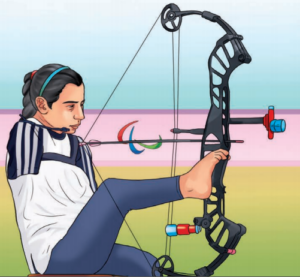
I. This is a picture of Sheetal Devi, a para- archer who was honoured with the Arjuna Award in January 2024.
Question 1.
Look at the picture carefully and share your observations with your classmates and teacher.
Answer:
In the picture, Sheetal Devi is seen practising archery with great focus and determination. She is using her feet to hold and shoot the bow, which shows her exceptional skill and adaptability. Her posture reflects strong concentration and confidence. The setting appears to be a sports arena, indicating that she is a trained athlete. The image highlights her courage and dedication despite physical challenges.
Question 2.
Does this personality inspire you? Explain how.
Answer:
Yes, this personality truly inspires me. Sheetal Devi shows that physical limitations do not define one’s abilities. Her determination, hard work and positive attitude motivate me to face my own challenges with courage. She teaches us that perseverance and self-belief can help us achieve our goals despite difficulties.
Question 3.
Give a caption for this picture.
Answer:
“Strength Beyond Limits”
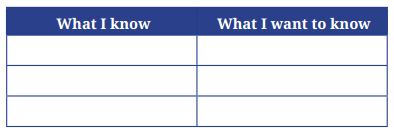
II. Complete the table given below about Paralympics. Share your responses with your classmates and teacher.
Answer:
| What I know | What I want to know |
| The Paralympics is an international sports event for athletes with disabilities. | How are athletes selected for different Paralympic events? |
| It includes various sports like athletics, swimming, and archery. | What kind of training do para-athletes undergo? |
| India has won several medals in the Paralympics. | How can more awareness about Paralympics be spread in society? |
[Note: The above answers are given as reference. Students are expected to write the answers on their own.]
Check Your Understanding
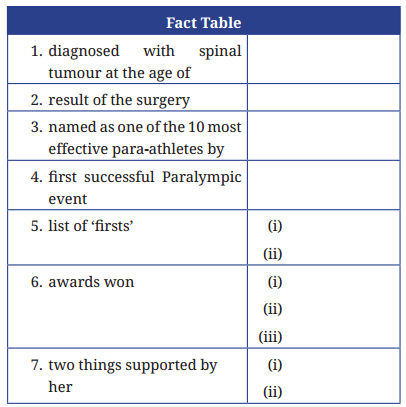
I. Fill in the fact table given below based on the interview with Dr. Deepa Malik. Discuss your answers with your classmates and teacher.
Answer:
| Fact Table | Answer | |
| 1. | diagnosed with spinal tumour at the age of | 29 years |
| 2. | result of the surgery | She was paralysed waist down and bound to a wheelchair for the rest of her life |
| 3. | named as one of the 10 most inspirational women para-athletes by | the International Paralympic Committee |
| 4. | first successful Paralympic events | 2016 Rio Paralympic Games (silver medal in shot-put) |
| 5. | list of ‘firsts’ | i. First Indian female para-athlete to win an Asian Games ii. India’s first female Paralympic medalist |
| 6. | awards Won | i. KheI Ratna ii. Arjuna Award iii. Padma Shri |
| 7. | two things supported by her | i. Empowering women through outdoor sports and adventure activities ii. Supporting persons from lower socio-economic strata and providing equipment to para sportspersons |
II. Read the two sets of sentences given below. Choose whether the given statements display: fact-opinion or cause-effect.
Question 1.
i. In the 2016 Rio Paralympic Games, I secured the silver medal in the shot-put event.
ii. I feel it was a moment of personal victory and a step forward in changing perceptions.
Answer:
Fact-Opinion
Explanation:
- Statement (i) reports a verifiable achievement of Deepa Malik, so it is a fact.
- Statement (ii) expresses the speaker’s personal interpretation and feelings, so it is an opinion.
Question 2.
i. I was diagnosed with a tumour in my spine.
ii. I had a surgery and was told that I would be bound to a wheelchair for the rest of my life.
Answer:
Cause-Effect
Class 9 English Kaveri Chapter 5 Question Answer
III. Work in pairs to identify which of these
pairs of sentences show:
- cause-effect
- fact-opinion
Write 1 or 2 in the boxes given.
i. Dr. Deepa Malik was a member of the Working Group for the Formulation of Twelfth Five Year Plan (2012-17).
It is believed that she contributed greatly to create better sports policies for the persons with disabilities.
Answer:
2(fact-opinion)
ii. Paralympics showcases incredible talent and determination of para-athletes.
The global perception on disabilities shifts, inspiring para-athletes to purse their dreams.
Answer:
1(cause-effect)
Critical Reflection
I. Read the extracts given below and answer the questions that follow.
1. I had two choices—squander my life in remorse or transform it to a world of limitless possibilities.
love sports and had been a swimmer too, so I decided to switch to para-athletics. This is how my Paralympics journey began. My breakthrough moment came in the 2016 Rio Paralympic Games, when I secured the silver medal in the shot-put event. In hindsight, I feel it was a moment of personal victory and a step forward in changing perceptions.
i. Give a reason for the following statement. The speaker’s decision to transform her life can be likened to the concept of a caterpillar transforming into a butterfly.
Answer:
Like a caterpillar transforming into a butterfly, the speaker overcame difficulties and emerged stronger and more confident by choosing to transform her life.
ii. Why could the speaker switch to para- athletics quite comfortably?
Answer:
The speaker could switch to para-athletics comfortably because she already loved sports and had earlier been a swimmer.
iii. Complete the sentence with an appropriate reason.
The speaker calls 2016 Rio Paralympic Games as a ‘breakthrough moment’ because ____ .
Answer:
she won a silver medal in the shot-put event and helped change societal perceptions about disability.
iv. Select the correct option to complete the sentence.
The phrase ‘in hindsight’ indicates the speaker is __________.
(A) curious
(B) reflective
(C) determined
(D) courageous
Answer:
(B) reflective
v. The speaker uses the phrase ‘changing perceptions’. List one likely perception the speaker might have changed.
Answer:
She might have changed the perception that persons with disabilities are weak or incapable and cannot succeed in competitive sports.
2. Honestly, I feel sports, especially Paralympics, have the extraordinary ability to challenge stereotypes and change attitudes towards disability. When people witness the strength, skill, and competitive spirit of para-athletes, it breaks down preconceived notions. Paralympics has given me a new lease of life and helped me push boundaries.
i. Choose the option that lists the words to describe the tone of the speaker.
A. appreciative
B. moralistic
C. sentimental
D. optimistic
E. defensive
(A) A and D
(B) B, D, and E
(C) B and C
(D) A, C, and E
Answer:
(A) A and D
ii. Complete the analogy given below with a word from the extract.
ability: potential: preconceived notions: _____.
Answer:
stereotypes
iii. State whether the following sentence is true or false.
Paralympics is a platform that not only showcases the remarkable abilities of para- athletes but also questions stereotypes.
Answer:
True
iv. What does ‘helped me push boundaries’ tell us about the speaker?
Answer:
The phrase shows that the speaker became more confident and determined to go beyond her limitations and achieve greater success.
v. Which phrase from the extract suggests that the speaker was able to transform her life?
Answer:
‘a new lease of life’
II. Answer the following questions.
Question 1.
Explain how Dr. Malik’s achievements challenge societal perceptions.
Answer:
Dr. Malik’s achievements strongly challenge societal perceptions about disability by proving that physical limitations do not define a person’s potential. Despite being paralysed waist down at the age of 29 due to a spinal tumour, she showed determination and achieved success in para-athletics, including winning a silver medal at the 2016 Rio Paralympics. Her journey reflects courage and resilience, as she chose to “transform it to a world of limitless possibilities” instead of giving up. Her accomplishments demonstrated the strength, skill and competitive spirit of persons with disabilities and helped break 1 stereotypes about their abilities. Through her belief in ‘ability beyond disability’ and her advocacy for inclusivity, she inspired society to recognise their capabilities and change its attitudes towards disability.
Question 2.
What can be the long-term impact of involving youth in schools and colleges in advocacy with respect to disability?
Answer:
Involving youth in advocacy related to disability can help build a more inclusive and aware society in the long term. When students participate in awareness programmes, they begin to question stereotypes and develop respect for the abilities of persons with disabilities. Early exposure to the strength and achievements of para-athletes like Deepa Malik helps them overcome preconceived notions and adopt positive attitudes. As future citizens and decision-makers, they can promote accessibility and equal opportunities in education, workplaces, and public spaces. Over time, such engagement contributes to creating a more empathetic, responsible, and inclusive society that values dignity, participation, and equal opportunities for all.
Question 3.
Rationalise the appropriateness of the title of this text with reference to Dr. Deepa Malik’s attitude and achievements.
Answer:
The title ‘The World of Limitless Possibilities’ is highly appropriate as it reflects Dr. Deepa Malik’s positive attitude and remarkable achievements despite physical challenges. After being paralysed waist down, she chose determination over despair and began her journey in para- athletics. Her silver medal at the 2016 Rio Paralympics and her role as a strong advocate for inclusivity demonstrate that physical limitations cannot restrict one’s potential. Through her belief in ‘ability beyond disability,’ she challenged stereotypes and inspired others to overcome obstacles with confidence. Thus, the title effectively captures her journey of resilience, courage, and the message that strong willpower can transform challenges into opportunities.
Question 4.
“Every setback is an opportunity to prove your strength”. How might this be a life lesson for every individual, and not just sportspersons?
Answer:
This statement highlights a universal life lesson that applies to everyone, not just sportspersons. Like Dr. Malik, who refused to squander her life in remorse and instead chose to rise above her challenges, individuals can treat setbacks as opportunities for growth and self-improvement. Difficult situations often help people discover their inner strength and resilience. When one faces hardships with determination and a positive attitude, it becomes possible to push boundaries and achieve success. This lesson is relevant in academics, careers, and personal life. By learning from failures and remaining confident, individuals can turn obstacles into stepping stones and create ‘a new lease of life.’
Question 5.
Examine how Dr. Deepa Malik’s recognition as one of the 10 most inspirational para-athletes globally contributes to the larger discourse on gender equality in sports.
Answer:
Dr. Deepa Malik’s recognition as one of the 10 most inspirational women para-athletes globally contributes significantly to the discourse on gender equality in sports by challenging both gender and disability related stereotypes. Her achievements prove that women, including those with disabilities, can excel at the highest levels of sport and deserve equal recognition and opportunities. By demonstrating strength, skill, and competitive spirit, she questioned the limited roles often assigned to women in sports and inspired many young girls to participate confidently. Her recognition also highlights the need for greater representation and inclusivity, encouraging society to support equal participation and respect for women athletes in all sporting fields.
Question 6.
How might Dr. Deepa Malik’s thought, ‘ability beyond disability’, serve as a guideline for success for all future para- athletes?
Answer:
Dr. Deepa Malik’s thought “ability beyond disability” serves as an inspiring guideline for future para-athletes by encouraging them to focus on their strengths rather than their physical limitations. Her own journey from paralysis to winning a silver medal at the 2016 Rio Paralympics shows that determination, confidence, and hard work can help overcome challenges. This belief motivates para-athletes to develop resilience and push their limits in sports and life. It also helps them challenge stereotypes and build a positive identity based on their abilities. Thus, her philosophy inspires future para- athletes to pursue excellence with courage and self-belief and achieve success despite obstacles.
Question 7.
What have you learnt from this interview, and how can you implement these learnings in your life?
Answer:
From this interview, I have learnt the importance of resilience, self-belief, and maintaining a positive attitude while facing challenges. Dr. Deepa Malik’s determination to overcome paralysis and achieve success in para-athletics shows that difficulties can be transformed into opportunities through courage and perseverance. I also learnt the value of focusing on abilities rather than limitations and promoting inclusivity in society. I can implement these lessons in my life by staying confident during failures, working consistently towards my goals, and developing a strong mindset. I will also respect others’ abilities and support equal opportunities so that I can contribute to building a more positive and inclusive environment.
Vocabulary and Structures in Context
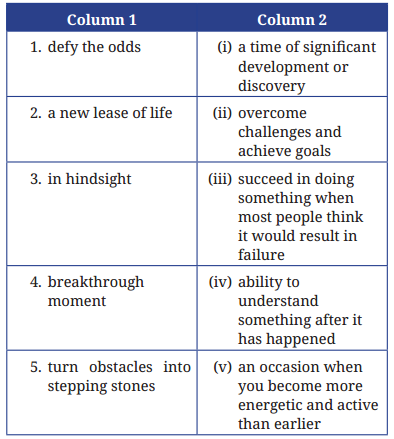
I. Work in pairs. Match the given phrases in Column 1 with their meanings in Column 2 Use the phrases in sentences of your own.
Answer:
1 – (iii), 2 – (v), 3 – (iv), 4 – (i), 5 – (ii)
Sentences
- Defy the odds: She managed to defy the 1 odds and win the race despite her injury.
- A new lease of life: After recovering from illness, he felt he had a new lease of life.
- In hindsight: In hindsight, I realise that I should have prepared better for the examination.
- Breakthrough moment: The scientist experienced a breakthrough moment after years of research.
- Turn obstacles into stepping stones: Successful people learn how to turn obstacles into stepping stones toward success.
II. Arrange the words on the word cline in increasing order of pace from the slowest to the fastest. Some examples have been done for you.
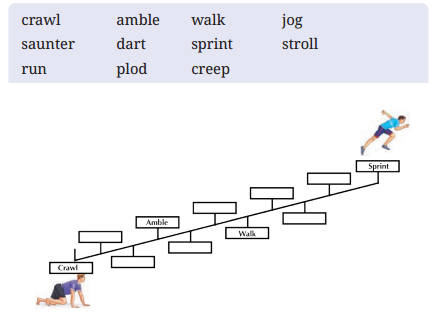
Answer:
crawl → creep → plod → amble → stroll → saunter → walk → jog → run → dart → sprint
III. Match the highlighted verbs in Column 1 with their functions in Column 2. There are two extra functions that you do not need.
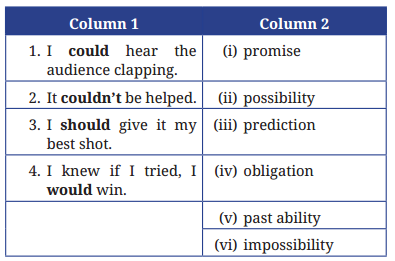
The verbs in bold are called modal auxiliaries. Each of these modal verbs can perform various functions based on the situation in which they are used.
Answer:
| Column 1 | Column 2 | ||
| 1. | I could hear the audience clapping. | v. | past ability |
| 2. | It couldn’t be helped. | vi. | impossibility} |
| 3. | I should give it my best shot. | iv. | obligation, |
| 4. | I knew if I tried, I would win. | iii. | prediction |
IV. Make sentences with the modal verbs given in the table above with each function of the modal verbs. Mention the function in brackets.
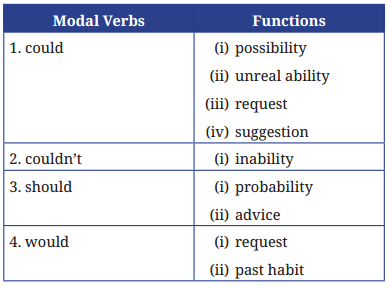
Answer:
1. Could
- You could finish the project by tomorrow if you focus, (possibility)
- If I had more time, I could learn another language, (unreal ability)
- Could you lend me your notes for revision? (request)
- We could go for a walk after school. (suggestion)
2. Couldn’t
- She couldn’t solve the puzzle without any hints, (inability)
3. Should
- They should arrive by evening if the train is on time, (probability)
- You should revise your answers before submitting the paper, (advice)
4. Would
- Would you mind closing the window, please? (request)
- When we were younger, we would visit our grandparents every summer, (past habit)
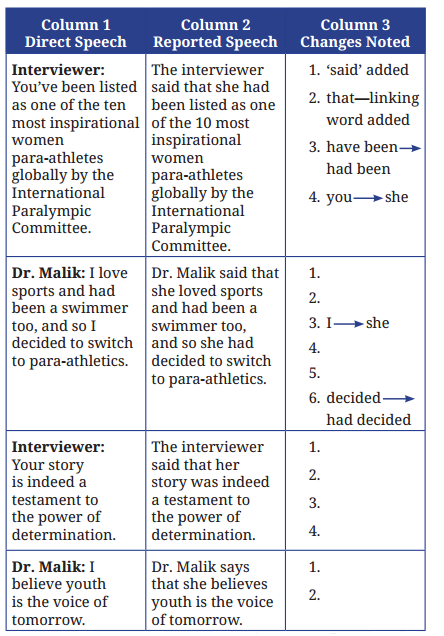
V. Read the following sentences.
Interviewer: You’ve been listed as one of the 10 most inspirational women para- athletes globally by the International Paralympic Committee.
Dr. Malik: I love sports and had been a swimmer too, so I decided to switch to para- athletics.
The sentences given above are in ___________. (Direct Speech/Reported Speech)
Answer:
Direct Speech
The sentences given above are ___________ sentences.
(declarative/interrogative/exclamatory/imp erative)
Answer:
Declarative
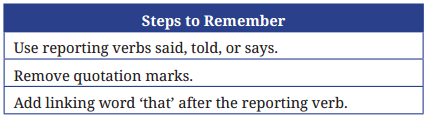
Now, work in pairs. Observe the changes from Column 1 to Column 2. Note these changes in Column
3. One example has been done for you.
VI Read the conversation given below.
Siya I watched a Documentary on the para equestrian event on television last night.
Tarun I didn’t know paralympics has equestrian events.

Siya It does. It was so interesting to watch.
Tarun That’s wonderful. So, para equestrians must be training for months for this.
Siya They also have to fid and develop their own style of communication with their horse.
Tarun I will watch this documentary the next weekend.
Change the conversation given above to reported speech.
Siya said that she 1. ________________________________________ . Tarun replied that he hadn’t known that Paralympics had equestrian events. Siya added that 2. ____________________ _________________________________. Tarun remarked that it was wonderful and that para equestrians must be training for months for that. Siya replied that 3. _________________________ ___________________________. Tarun said that 4. ________________ .
Answer:
Siya said that she 1. had watched a documentary on the para equestrian event on television the previous night. Tarun replied that he hadn’t known that Paralympics had equestrian events. Siya added that 2. it did and thatit had been very interesting to watch. Tarun remarked that it was wonderful and that para equestrians must be training for months for that. Siya replied that 3. they also had to find and develop their own style of communication with their horse. Tarun said that 4. he would watch that documentary the following weekend.
Listen and Respond
I. You will listen to an announcement for special assembly in school. As you listen, fill in the blanks with one or two exact words. (Transcript for teacher on page 268).
1. The venue for the special assembly is the ______________.
2. A presentation on inclusion will be made by the ________________.
3. The dance performance will focus on the themes of ___________ and ____________.
4. A _______________ will be conducted by experts who support inclusion.
5. The celebration will end with a _______________ to encourage team work.
Answer:
1. The venue for the special assembly is the school auditorium.
2. A presentation on inclusion will be made by the Interact Club.
3. The dance performance will focus on the themes of diversity and acceptance.
4. A panel discussion will be conducted by experts who support inclusion.
5. The celebration will end with a song to ’ encourage team work.
Writing Task
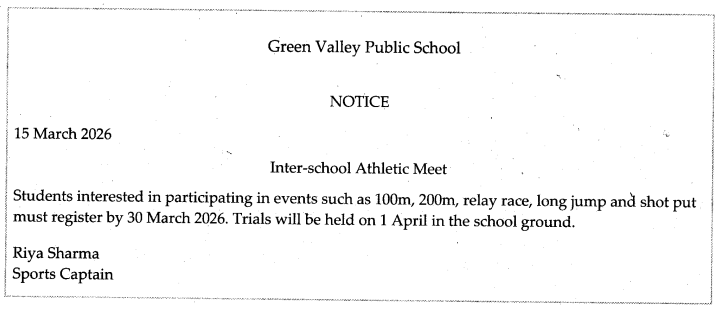
I. The Sports Club of your school is organising an Inter-school Athletic Meet. As the Sports Captain, draft a notice in not more than 50 words asking interested students to register themselves for selection in different events. Add all necessary details. Do not forget to design your notice within a box.
The World of Limitless Possibilities Class 9 Extra Questions and Answers
The World of Limitless Possibilities Short Question Answer
Question 1.
Explain the significance of the Paralympic Games as presented in the lesson.
Answer:
The Paralympic Games are described as a celebration of resilience and extraordinary talent that highlights the abilities of athletes with disabilities. They challenge stereotypes and help change attitudes towards disability by encouraging society to s recognise strength, determination, and capability rather than focusing on physical limitations.
Question 2.
Explain when Bharat first participated in the Paralympics and when it won its first medal.
Answer:
Bharat first participated in the Paralympics in 1968. The country won its first Paralympic medal in 1972 in swimming. This marked an important milestone and the beginning of India’s journey towards achieving recognition and success in international para-sports competitions.
Question 3.
Explain the major medical condition that changed Dr. Deepa Malik’s life and its impact on her life.
Answer:
Dr. Deepa Malik was diagnosed with a spinal tumour at the age of 29, which resulted in paralysis and confined her to a wheelchair for life. This condition changed her personal and professional journey and later motivated her to pursue success in para-athletics.
Question 4.
Explain the choice Dr. Malik faced after her paralysis and the decision she made.
Answer:
After her paralysis, Dr. Malik faced the choice of either living in despair or rebuilding her life with determination. She chose a positive outlook and began her journey in para- athletics, transforming challenges into , opportunities for meaningful achievements.
Question 5.
Explain Dr. Deepa Malik’s achievement at the 2016 Rio Paralympics and its significance.
Answer:
Dr. Deepa Malik won a silver medal in the shot-put event at the 2016 Rio Paralympics, becoming the first Indian woman to win a Paralympic medal. This achievement marked a historic milestone and inspired many. people by demonstrating determination and courage.
Question 6.
Why is Dr. Malik described as leaving an ‘indelible mark’?
Answer:
Dr. Malik is described as leaving an indelible mark because her achievements and inspiring journey have influenced many people to overcome limitations and believe in their potential. Through her success in para-athletics and advocacy for inclusivity, she challenged stereotypes and motivated others to pursue their goals with confidence.
Question 7.
What challenge did Dr. Malik face from society during her journey?
Answer:
Dr. Malik faced the challenge of societal underestimation during her journey, as many people doubted her abilities after her paralysis. She overcame these negative perceptions through determination and resilience, proving that disability does not limit a person’s potential or achievements in sports and life.
Question 8.
What initiatives does Dr. Malik undertake to promote inclusivity?
Answer:
Dr. Malik promotes inclusivity by organising disability awareness programmes in schools and colleges and supporting persons with disabilities through advocacy initiatives. She also empowers women through outdoor sports activities and provides equipment to para sportspersons from lower socio-economic backgrounds to encourage equal opportunities and participation.
Question 9.
What types of disabilities are highlighted in the Paralympics?
Answer:
The Paralympics include athletes with locomotor, sensory, and intellectual disabilities. These categories represent different physical and cognitive challenges and highlight the importance of equal opportunities in sports while promoting inclusivity, diversity, and respect for persons with disabilities worldwide.
Question 10.
What does the term ‘fortitude’ imply in Dr. Malik’s journey?
Answer:
‘Fortitude’ refers to Dr. Malik’s inner i strength and courage, which enabled her to face difficulties with determination and continue striving towards her goals despite physical challenges and societal barriers during her journey in para-athletics.
Question 11.
What role do awareness sessions in schools play in Dr. Malik’s mission?
Answer:
Awareness sessions in schools help educate students about disability, challenge stereotypes, and promote empathy towards persons with disabilities. They encourage inclusive attitudes from an early age and support Dr. Malik’s mission of building a more respectful and accepting society.
The World of Limitless Possibilities Long Question Answer
Question 1.
Analyse how Dr. Deepa Malik’s life reflects the idea of resilience and transformation.
Answer:
Dr. Deepa Malik’s life clearly reflects the ideas of resilience and transformation through her response to a life-changing spinal tumour that left her paralysed waist down at the age of 29. Instead of losing hope, she chose to rebuild her life with determination and courage. Her decision to enter para-athletics marked a turning point in her journey and demonstrated her strong willpower. Winning a silver medal at the 2016 Rio Paralympics, becoming the first Indian woman to win a Paralympic medal, further highlighted her strength and perseverance. Beyond personal success, she actively worked to promote inclusivity and support persons with disabilities. Her journey shows that resilience involves accepting challenges positively and transforming them into opportunities for growth, achievement, and social contribution.
Question 2.
Discuss how societal attitudes emerge as a major challenge in Dr. Malik’s journey.
Answer:
Societal attitudes emerge as a major challenge in Dr. Malik’s journey because people often underestimated her abilities after her paralysis. Such stereotypes about disability created barriers that were sometimes more limiting than her physical condition itself. Overcoming these perceptions required not only physical strength but also mental resilience and self-confidence. Through her participation in para-athletics and her achievement at the 2016 Rio Paralympics, she challenged these preconceived notions and proved that persons with disabilities can excel at the highest levels. Her success helped shift public perception from sympathy to respect and recognition. Her journey highlights that the real obstacle often lies in society’s mindset, and meaningful change can happen only when attitudes begin to value ability rather than disability.
Question 3.
Analyse how Dr. Malik uses sports as a tool for empowerment and identity formation.
Answer:
Sports played a transformative role in Dr. Malik’s life by helping her rebuild her confidence and develop a strong sense of identity after her paralysis. She described the Paralympics as giving her a “new lease of life” and helping her push boundaries beyond her perceived limitations. Through para-athletics, she proved that physical disability does not define a person’s potential and went on to achieve remarkable success, including winning a silver medal at the Rio Paralympics. Her achievements allowed her to redefine herself from a patient to a champion and role model. Sports also provided her with a platform to advocate inclusivity and inspire others facing similar challenges. Thus, sports became a powerful means of personal empowerment as well as social transformation in her life.
Question 4.
Evaluate how the Paralympic Games help in redefining ability rather than focusing on disability.
Answer:
The Paralympic Games play an important role in redefining ability by highlighting the strength, determination, and achievements of athletes with disabilities at an international level. They provide a platform where athletes demonstrate exceptional skill and competitive spirit, challenging stereotypes associated with disability. When audiences witness these performances, they begin to shift their focus from limitations to capabilities. The success of athletes like Dr. Deepa Malik further strengthens this message by showing that disability does not prevent excellence. The Paralympics also encourage inclusive participation in sports and inspire persons with disabilities to pursue their ambitions confidently. By promoting awareness and changing public attitudes, the Paralympic Games contribute significantly to building a more inclusive society that recognises ability rather than disability.
Question 5.
Evaluate the role of advocacy in bringing real change for persons with disabilities.
Answer:
Advocacy plays a vital role in bringing real1 change for persons with disabilities by addressing both awareness and accessibility challenges in society. Dr. Deepa Malik emphasises that advocacy is central to her mission, as she works to strengthen emotional well-being and promote inclusivity through awareness programmes in schools and colleges. She also supports para sportspersons by providing equipment and encourages women and individuals from economically disadvantaged backgrounds to participate in sports. Such initiatives help challenge stereotypes and create opportunities for equal participation. Advocacy also influences policies and improves public understanding of disability-related issues. Therefore, sustained advocacy efforts are essential for ensuring dignity, equal opportunities, and meaningful participation of persons with disabilities in all areas of life.
Question 6.
How do societal attitudes towards disability reflect larger issues of equality and justice in society? Explain with reference to Dr. Deepa Malik’s journey.
Answer:
Societal attitudes towards disability often reveal deeper issues of inequality and injustice, as they are shaped by stereotypes, underestimation, and limited opportunities. Research shows that such attitudes lead to discrimination, lack of resources, and restricted participation, reflecting systemic inequality rather than individual limitation . In Dr. Deepa Malik’s journey, she faced being underestimated, which highlights how society often denies equal recognition to persons with disabilities. However, her achievements challenge these biases and. demand a shift towards fairness and inclusion. Her success emphasises that true justice lies in providing equal opportunities and respecting dignity, proving that societal barriers—not disabilities—are the real obstacles to equality.
Question 7.
What lessons can individuals learn from Dr. Malik’s journey?
Answer:
Dr. Malik’s journey teaches individuals valuable lessons about resilience, determination, and self-belief in the face of adversity. Despite being paralysed after a spinal tumour, she chose not to give up but to rebuild her life through sports and hard work. Her success in the Paralympics demonstrates that physical limitations do not define one’s potential. She also inspires people to maintain a positive attitude and remain confident while facing challenges in life. Her belief in “ability beyond disability” encourages individuals to focus on their strengths rather than weaknesses. By following her example, people can learn to overcome setbacks with courage and perseverance and work towards achieving their goals with confidence and dignity.
Question 8.
How can individuals apply Dr. Malik’s advice when facing setbacks?
Answer:
Dr. Malik’s advice encourages individuals to view setbacks as opportunities for growth rather than obstacles to success. Her statement that every setback is an opportunity to prove one’s strength highlights the importance of resilience and a positive mindset. Individuals can apply this lesson by remaining determined during difficult situations and continuing to work towards their goals with confidence. Building a strong support system and maintaining motivation also play an important role in overcoming challenges. Her belief that disability is a unique strength waiting to be recognised reminds people to focus on their abilities instead of limitations. By adopting these values, individuals can transform setbacks into stepping stones towards personal development and success.