Class 9 SST Chapter 3 Atmosphere and Climate Question Answer
The Big Questions (Page No. 39)
Question 1.
What is the composition of the atmosphere?
Answer:
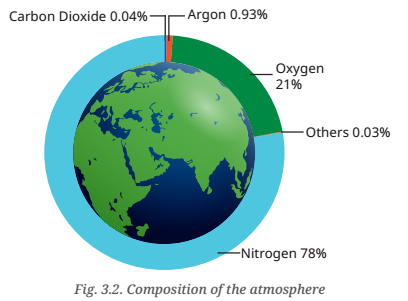
The atmosphere is a mixture of gases surrounding the Earth. It is composed mainly of nitrogen (about 78%) and oxygen (about 21%). The remaining 1% consists of gases such as argon, carbon dioxide, neon, helium, hydrogen, ozone and water vapour. These gases support life, regulate temperature and protect the Earth from harmful solar radiation.
Question 2.
How do the different layers of the atmosphere affect the planet Earth?
Answer:
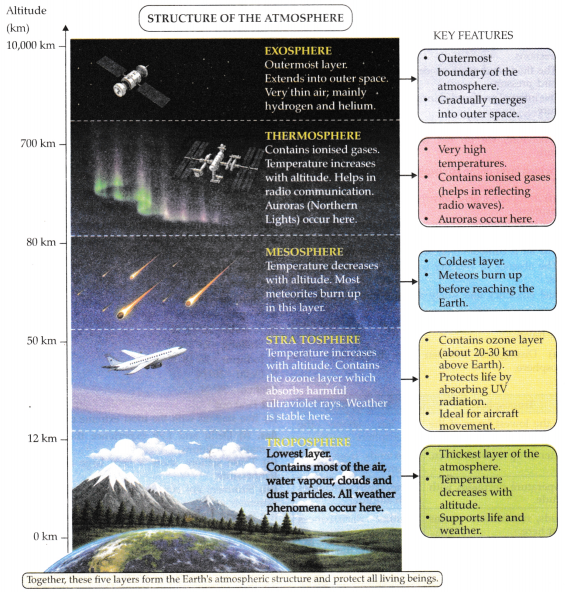
The atmosphere is divided into several layers, namely the troposphere, stratosphere, mesosphere, thermosphere and exosphere. The troposphere is the layer where weather phenomena occur and where living organisms survive. The stratosphere contains the ozone layer, which absorbs harmful ultraviolet rays from the Sun. The mesosphere burns up most meteoroids before they reach the Earth’s surface. The thermosphere helps in radio communication and contains the ionosphere, while the exosphere forms the outer boundary of the atmosphere. Together, these layers protect life and maintain suitable conditions on Earth.
Question 3.
What is the mechanism of monsoon?
Answer:
The monsoon is a seasonal wind system caused by the differential heating and cooling of land and water. During summer, the land heats up more quickly than the surrounding oceans, creating a low-pressure area over the land and a high-pressure area over the sea. Moisture-laden winds blow from the oceans towards the land, bringing heavy rainfall. During winter, the land cools faster than the sea, reversing the pressure conditions and causing winds to blow from land to sea. This seasonal reversal of winds is known as the monsoon mechanism.
Question 4.
How can we reduce our carbon footprint?
Answer:
We can reduce our carbon footprint by using public transport, cycling, walking and carpooling instead of relying on private vehicles. Conserving electricity, using energy-efficient appliances, switching to renewable energy sources and reducing the use of fossil fuels also help lower carbon emissions. Planting trees, reducing waste, recycling materials and adopting sustainable lifestyles further contribute to reducing our carbon footprint and combating climate change.
Think About It (Page-39)
Question 1.
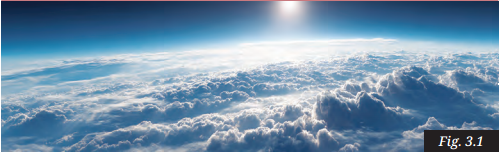
Can you imagine what would happen if there were no atmosphere?
Answer:
(i) In case of no atmdsphere, the Earth would not have oxygen required for the survival of living organisms. Harmful ultraviolet rays from the Sun would directly reach the Earth’s surface. There would be extreme temperatures during the day and night. Weather phenomena such as clouds, rainfall and winds would not occur. Therefore, life on Earth would not be possible without the atmosphere.
Let’s Recall (Page-40)
Question 1.
How is nitrogen useful for plants?
Answer:
- Nitrogen is an essential nutrient required for the healthy growth of plants.
- It helps in the formation of proteins, enzymes and chlorophyll.
- Chlorophyll enables plants to prepare food through photosynthesis.
Think About It (Page-45)
Question 1.
You might have noticed that sometimes the wind is so strong that it is difficult to walk against it. Can you think of some other times when strong winds have caused problems for you?
Answer:
Strong winds can create several problems in daily life. They may uproot trees and damage houses, electric poles and other structures. Strong winds can make travelling difficult and sometimes disrupt road, rail and air transport services. Dust storms caused by high-speed winds reduce visibility and increase the risk of accidents. Farmers may also suffer losses when strong winds damage standing crops and fruit-bearing trees. During cyclones and storms, strong winds can lead to power outages, communication disruptions and damage to property. Therefore, strong winds can significantly affect human activities and cause economic losses.
Let’s Explore (Page-46)
Question 1.
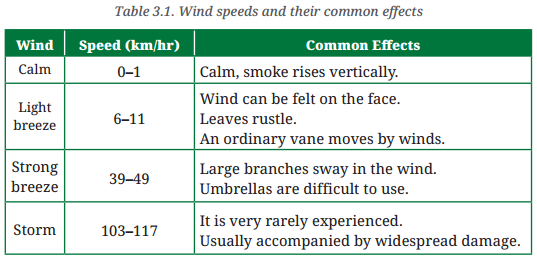
Find out other categories of wind based on speed and their common effects.
Answer:
- Gentle breeze (12-19 km/h): Leaves and small twigs move continuously; light flags flutter.
- Moderate breeze (20-28 km/h): Dust and loose paper may be lifted; small branches sway.
- Fresh breeze (29-38 km/h): Larger branches move and walking against the wind becomes difficult.
- Strong wind (50-61 km/h): Small trees sway and weak structures may be damaged.
- Gale (62-88 km/h): Twigs break off trees and minor structural damage may occur.
- Cyclone/Hurricane (119 km/h and above): Causes severe damage to buildings, trees, crops and infrastructure.
Let’s Analyse (Page-47)
Question 1.
Note down the weather report from a local newspaper for two weeks and observe the changes occurring in the weather.
Answer:
- Weather conditions change from day to day depending on temperature, humidity and rainfall.
- Some days may be sunny, while others may be cloudy or rainy.
- Wind speed and atmospheric pressure also vary over time.
- These observations show that weather is a short-term atmospheric condition.
- Students should record observations based on their local newspaper reports.
Think About It (Page-48)
Question 1.
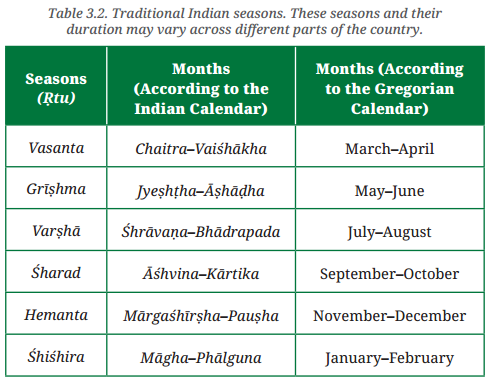
Hindustani Classical music associates certain ragas with specific seasons. Find out which ragas are connected to each season with the help of your elders and teachers.
Answer:
Examples of ragas traditionally associated with different seasons include:
- Spring (Vasanta): Raga Basant and Raga Bahar.
- Summer (Grishma): Raga Deepak is traditionally associated with the summer season.
- Monsoon (Varsha): Raga Megh and Raga Miyan ki Malhar are associated with the monsoon season.
- Some seasons, such as Sharad and Hemanta, do not have universally recognised ragas. Students may mention regionally or traditionally accepted examples.
- These ragas reflect the moods and characteristics traditionally associated with different seasons.
(Answers may vary)
Let’s Explore (Page-52)
Question 1.
Describe in your own words how monsoon affects the lives of the people around you.
Answer:
- The monsoon plays a very important role in the lives of people around us as it provides the rainfall needed for agriculture.
- Farmers depend on monsoon rains for sowing crops such as rice, maize and pulses.
- Rainfall helps fill rivers, lakes, ponds and reservoirs, ensuring water availability for drinking and irrigation.
- The monsoon brings relief from the intense heat of summer and makes the weather cooler and more pleasant.
- However, excessive rainfall may sometimes cause floods, waterlogging and disruption of transport and daily activities.
- Many occupations, businesses and economic activities are directly or indirectly influenced by the monsoon.
- Festivals, food habits and seasonal activities are also often linked with the arrival of the rainy season.
- Therefore, the monsoon greatly influences the social, economic and environmental life of the people around us.
Let’s Explore (Pages-53-54)
Question 1.
My Carbon Footprint
Step 1: My Daily Habits
Tick the options that best describe you.
A. Transport
- I usually walk/use a cycle. (Low impact)
- I use public transport/carpool. (Medium impact)
- I travel by private cars even for short distances. (High impact).
- I take flights more than twice a year. (Very high impact)
B. Electricity Use
- I always switch off electrical appliances (lights, fans, etc.) when not in use. (Low impact)
- I sometimes forget to switch off electrical appliances (lights, fans, etc.). (Medium impact)
- I leave electrical appliances (lights, fans, etc.) on frequently. (High impact)
C. Water Use
- I use water judiciously, for example, just one bucket of water for bathing. (Low impact)
- I sometimes waste water (leaving the tap running/ more buckets of water for a bath/long showers).
- I rarely think about saving water. (High impact)
D. Waste and Plastics
- I reuse, recycle and avoid single-use plastics. (Low impact)
- I sometimes use disposable plastics (bottles/bags/ straws). (Medium impact)
- I often throw away plastic and do not recycle. (High impact)
Step 2: Score Yourself
- Low impact choices = 1 point
- Medium impact choices = 2 points
- High impact choices = 3 points
- Very high impact choices = 4 points
Now add up your total score: ……… points
Step 3: My Climate Action Pledge
Think about two simple changes you can make to reduce your score and write them down below.
1. …………………………………………..
2. …………………………………………..
Answer:
This is a self-assessment activity. Students should: Step 1: Tick the options that best describe their daily habits.
Step 2: Calculate the total score using the given scoring system.
Step 3: Write two practical actions they will follow to reduce their carbon footprint.
Classroom Discussion (Page-56)
Question 1.
To what extent did natural factors cause these floods compared to human activities?
Answer:
Floods are often caused by natural factors such as heavy rainfall, cloudbursts, cyclones and the overflowing of rivers. However, human activities have significantly increased the frequency and severity of floods in many regions. Deforestation reduces the land’s ability to absorb rainwater, while the encroachment of river floodplains and wetlands obstructs the natural flow of water. Rapid urbanisation, poor drainage systems and unplanned construction further worsen flooding by preventing water from draining efficiently. Therefore, although natural factors may trigger floods, human activities often magnify their impact and lead to greater damage.
Question 2.
Do you think better planning could have reduced the damage? How?
Answer:
Yes, better planning could have greatly reduced the damage caused by floods. Proper land-use planning can prevent construction in flood-prone areas and along riverbanks. Well-maintained drainage systems help remove excess water during heavy rainfall, ‘while embankments and flood-control structures can > reduce the risk of inundation. Effective early warning systems allow people to evacuate in time and protect their belongings. In addition, afforestation, wetland conservation and public awareness programmes can help communities become more resilient to floods. Therefore, careful planning and preparedness are essential for reducing both human and economic losses.
Question 3.
What are the guidelines for the management of floods according to the National Disaster Management Authority (NDMA)?
Answer:
According to the National Disaster Management Authority (NDMA), flood management should focus on preparedness, prevention, mitigation and effective response. The NDMA recommends the use of accurate flood forecasting and early warning systems, preparation of flood hazard maps and identification of vulnerable areas. It also emphasises regulating construction in flood-prone zones, maintaining drainage systems and embankments and promoting community awareness programmes. During floods, efficient rescue, relief and rehabilitation measures should be implemented. These guidelines aim to minimise the loss of life, property and livelihoods while improving the overall resilience of communities to flood disasters.
Question 4.
What role can students and youth play in helping with disaster preparedness?
Answer:
Students and youth can play an important role in disaster preparedness by spreading awareness about disaster risks and safety measures within their schools and communities. They can participate in mock drills, learn first aid and emergency response skills and assist in community preparedness programmes. During emergencies, they can help disseminate accurate information, support relief activities and encourage people to follow safety guidelines. Young people can also promote environmental conservation practices, such as tree plantation and waste management, which help reduce disaster risks. Through active participation and responsible action, students and youth can contribute significantly to building safer and more resilient communities.
Questions and Activities (Page No. 57-59)
Question 1.
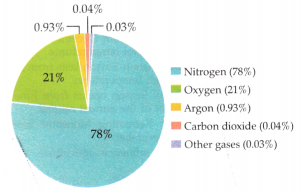
What is atmosphere? Explain its composition with the help of a pie diagram.
Answer:
- The atmosphere is the blanket of air that surrounds the Earth and is held in place by gravity.
- It is essential for life because it provides oxygen for respiration and carbon dioxide for photosynthesis.
- The atmosphere also protects the Earth from harmful solar radiation and regulates temperature.
- Nitrogen is the most abundant gas and forms about 78% of the atmosphere.
- Oxygen constitutes about 21% and is necessary for the survival of living organisms.
- Argon makes up about 0.93%, while carbon dioxide accounts for about 0.04%.
- Small quantities of gases such as helium, neon, hydrogen and ozone are also present.
- Water vapour and dust particles are important components that influence weather and climate.
Composition of the Atmosphere
Question 2.
Draw a labelled diagram of the structure of atmosphere.
Answer:
Question 3.
Which are the four main seasons of India?
Answer:
- According to the Indian Meteorological Department, India experiences four major seasons.
- The Winter Season extends from December to early April and is characterised by cool temperatures.
- The Summer or Pre-Monsoon Season lasts from April to June and experiences high temperatures.
- The Monsoon or Rainy Season occurs from June to September and brings most of the annual rainfall.
- The Post-Monsoon or Retreating Monsoon Season extends from October to December.
- These seasons greatly influence agriculture, water availability and daily life.
- Seasonal changes are mainly controlled by the monsoon system.
- Together, these seasons shape India’s tropical monsoon climate.
Question 4.
Why do you not feel the pressure of the atmosphere?
Answer:
- The atmosphere exerts pressure on all objects present on the Earth’s surface.
- Atmospheric pressure acts equally on our bodies from all directions.
- The fluids and gases inside our body exert an equal outward pressure.
- This internal pressure balances the external atmospheric pressure.
- As a result, there is no net force acting on our body.
- Therefore, we do not normally feel atmospheric pressure.
Question 5.
In which layer of the atmosphere do aeroplanes fly and why?
Answer:
- Aeroplanes generally fly in the lower part of the stratosphere.
- This layer is almost free from clouds, storms and other weather disturbances.
- The air is comparatively stable and less turbulent.
- The absence of weather activities ensures smoother flights.
- Fuel efficiency and safety are also improved in this layer.
- Therefore, the lower stratosphere is considered ideal for air travel.
Question 6.
(a) Distinguish between the Troposphere and Stratosphere.
Answer:
| Troposphere | Stratosphere |
| It is the lowest layer of the atmosphere. | It lies above the troposphere. |
| It extends up to about 12 km. | It extends from about 12 km to 50 km. |
| Temperature decreases with altitude. | Temperature increases with altitude. |
| Clouds, rainfall and storms occur here. | Weather disturbances are almost absent. |
| It contains most of the atmospheric water vapour. | It contains the ozone layer. |
| Human life and weather activities are concentrated here. | Aeroplanes generally fly in this layer. |
(b) Distinguish between the south-west monsoon and north-east monsoon.
| South-West Monsoon | North-East Monsoon |
| It occurs from June to September. | It occurs from October to February. |
| Winds blow from sea to land. | Winds blow from land to sea. |
| It is caused by low pressure over the heated landmass. | It is caused by high pressure over the cooled landmass. |
| It brings most of India’s annual rainfall. | It mainly brings rainfall to Tamil Nadu and the south-eastern coast. |
| It is known as the advancing monsoon. | It is known as the retreating monsoon. |
| It strongly influences agriculture across India. | Its effect is limited to specific regions. |
7.1 (Page-57)
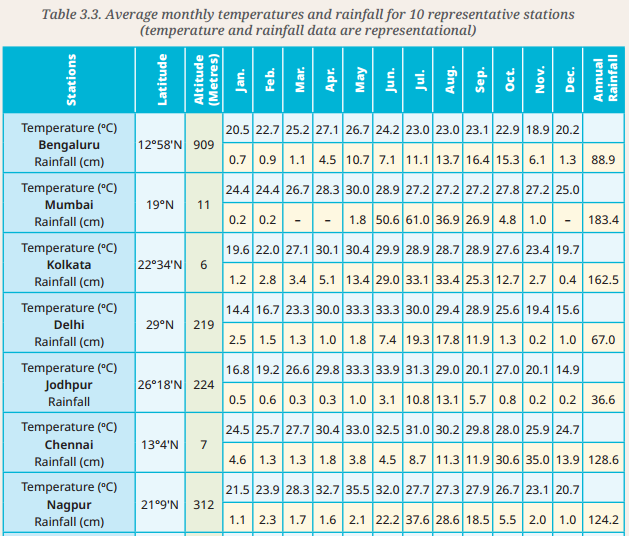
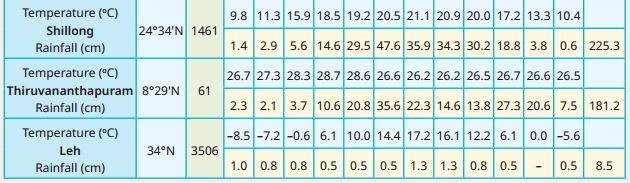
7. Do it yourself: Table below shows the average monthly temperatures and rainfall amounts for 10 representative stations. Study these figures on your own and convert them into ‘temperature and rainfall’ graphs. The visual representations will help you grasp their similarities and differences at a glance. One such graph (Refer NCERT Fig. 3.14) is already prepared for you. See if you can arrive at some broad generalisations about out diverse climatic conditions.
Question 7.1.
Now look at Table. Re-arrange the 10 stations according to their distance from the equator.
Answer:
The 10 stations arranged from nearest to the Equator to farthest from the Equator are:
- Thiruvananthapuram – 8°29′ N
- Bengaluru – 12°58’ N
- Chennai – 13°4′ N
- Mumbai – 19° N
- Nagpur – 21°9’ N
- Kolkata – 22°34′ N
- Shillong-24°34’N
- Jodhpur – 26°18′ N
- Delhi – 29° N
- Leh – 34° N
7.2. Find out
Question (a).
Two stations with the most extreme climate.
Answer:
- Delhi and Leh experience the most extreme climatic conditions.
- These stations show a very large annual range of temperature.
- Summers are comparatively hot, while winters are extremely cold.
- Therefore, they are examples of continental or extreme climate.
Question (b).
Two stations influenced by retreating monsoons.
Answer:
- Chennai and Thiruvananthapuram are influ¬enced by the retreating monsoon.
- They receive rainfall during October and November.
- This rainfall is associated with the North-East Monsoon winds.
- Therefore, these stations receive substantial post-monsoon rainfall.
Question (c).
The two hottest stations in the months of:
(i) February
Answer:
- Chennai and Thiruvananthapuram are among the hottest stations in February.
- Their coastal location helps maintain relatively high temperatures.
(ii) June
Answer:
- Jodhpur (33.9°C) and Delhi (33.3°C) are among the hottest stations in June.
- They experience intense summer heat before the onset of monsoon rains.
7.3 Now find out
Question (a)
Why does Shillong experience more rainfall than Kolkata?
Answer:
- Shillong is situated in a hilly region and receives heavy orographic rainfall.
- Moisture-laden monsoon winds are forced to rise over the Khasi Hills.
- Rising air cools rapidly and causes condensation.
- This results in very heavy rainfall throughout the monsoon season.
- Kolkata lies on the plains and receives comparatively less orographic rainfall.
- Therefore, Shillong records much higher rainfall than ‘ Kolkata.
Question (b).
Why does Delhi receive more rainfall than Jodhpur?
Answer:
- Delhi receives stronger monsoon influence than Jodhpur because it lies farther east and receives more moisture-laden monsoon winds.
- Jodhpur is located near the Thar Desert where moisture availability is lower.
- Monsoon winds lose moisture as they move inland.
- The desert climate further reduces rainfall in Jodhpur.
- Therefore, Delhi receives more rainfall than Jodhpur.
7.4 Now Think Why
Question (a) .
Why does Thiruvananthapuram have an equable climate?
Answer:
- Thiruvananthapuram is located close to the Arabian Sea.
- The sea has a moderating influence on temperature throughout the year.
- Summers are not excessively hot, and winters are not very cold.
- The annual range of temperature remains very small.
- Humidity remains comparatively high because of its coastal location.
- Therefore, Thiruvananthapuram experiences an equable or moderate climate.
Question (b).
Why does Chennai receive more rainfall after the monsoon season?
Answer:
- Chennai lies on the Coromandel Coast of south-eastern India.
- It receives rainfall mainly from the North-East Monsoon.
- During October and November, retreating monsoon winds cross the Bay of Bengal.
- These winds collect moisture from the sea before reaching the coast.
- The moisture-laden winds bring significant rainfall to Chennai.
- Therefore, Chennai receives more rainfall after the South-West Monsoon season.
Question (C).
Why does Leh have moderate precipitation almost throughout the year?
Answer:
- Let is situated in the rain-shadow region of the Himalayas.
- The high mountain ranges block moisture-laden monsoon winds from reaching the area.
- As a result, the region receives very little rainfall throughout the year.
- Most precipitation occurs in the form of light snowfall during winter.
- The cold desert conditions limit the amount of moisture available in the atmosphere.
- Therefore, Leh receives very little precipitation throughout the year because it lies in the rain-shadow region of the Himalayas. Most of its precipitation occurs as light snowfall during winter.
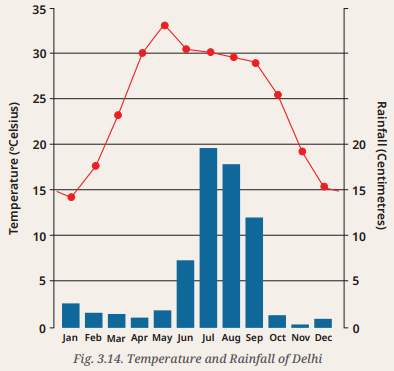
7.5 Despite these differences across regions, can you observe any substantial evidence to conclude that the monsoons provide a very strong framework, lending overall climatic unity to the whole country?
Answer:
- Yes, the monsoon system provides a strong framework of climatic unity across India.
- Most parts of the country receive rainfall from the South-West Monsoon during the same season.
- Agricultural activities in different regions largely depend on monsoon rainfall.
- Rivers, reservoirs and groundwater sources afe. replenished by monsoon rains.
- Seasonal festivals, cropping patterns and economic activities are closely linked with the monsoon.
- Even though the amount of rainfall varies from place to place, the monsoon influences the entire country.
- The arrival and retreat of monsoon winds affect the lives of people throughout India.
- Therefore, the monsoon acts as a unifying climatic factor and provides overall climatic unity to the country.
Question 8.
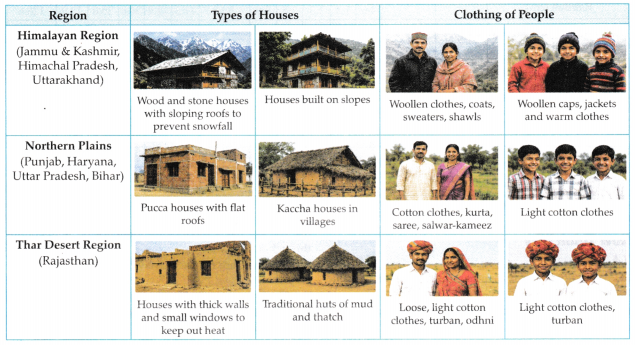
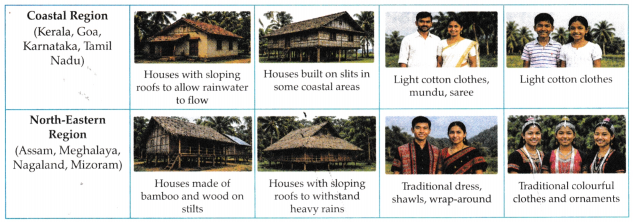
Collect pictures of houses and clothing of people from different regions of India. Examine whether they reflect any relationship with the climatic conditions or the relief of those regions.
Answer:
Houses and Clothing of People from Different Regions in India
Atmosphere and Climate Class 9 Extra Questions and Answers
Atmosphere and Climate Class 9 Very Short Question Answer
Question 1.
What are the major elements of weather and climate?
Answer:
- The major elements of weather and climate are temperature, humidity, precipitation, atmospheric
pressure, and wind. - These elements influence human life and determine the weather conditions of a place.
Question 2.
What is insolation? How does it affect temperature distribution on the Earth?
Answer:
- Insolation is the incoming solar energy received by the Earth from the Sun.
- Since insolation decreases from the Equator towards the poles, temperature also decreases in the same direction.
Question 3.
What is humidity? Mention one effect of high humidity on daily life.
Answer:
- Humidity is the amount of water vapour or moisture present in the air.
- High humidity causes sweat to evaporate slowly, making people feel uncomfortable and causing clothes to
dry slowly.
Question 4.
Why is rain important for human life and agriculture?
Answer:
- Rain is the most common form of precipitation and is the main source of groundwater.
- It supports agriculture and helps maintain water availability for human use.
Question 5.
Name the four seasons recognised by the India Meteorological Department (IMD).
Answer:
The four seasons recognised by the IMD are:
- Winter (December to early April)
- Summer or Pre-Monsoon (April to June/July)
- Monsoon or Rainy Season (June to September)
- Post-Monsoon or Retreating Monsoon (October to December)
Question 6.
Why would the Indian monsoon be weaker if the Tibetan Plateau did not heat up intensely during summer?
Answer:
The intense heating of the Tibetan Plateau during summer creates a strong low-pressure area and vertical air currents. If the plateau did not heat up, this low pressure of moisture-laden winds from the Indian Ocean and therefore a weaker monsoon.
Question 7.
A farmer in Tamil Nadu depends more on rainfall during October-December than June-September. Which monsoon is responsible and why?
Answer:
The farmer depends on the Northeast Monsoon, which occurs from October to December. These winds pick up moisture from the Bay of Bengal and bring rainfall mainly to the Coromandel Coast, including Tamil Nadu.
Question 8.
What is meant by the term monsoon and from which language is the word derived?
Answer:
Monsoon refers to seasonal winds that reverse direction with the change of seasons and bring rainfall. The word monsoon is derived from the Arabic word “Mausim,” meaning season.
Question 9.
What is climate change?
Answer:
- Climate change refers to long-term changes in weather patterns such as temperature, rainfall, and wind.
- It is mainly caused by human activities like burning fossil fuels, deforestation, and industrial pollution.
Question 10.
What is a carbon footprint?
Answer:
- A carbon footprint is the total amount of greenhouse gases released into the atmosphere through human activities.
- Activities such as transportation, energy use, and production of goods contribute to carbon footprints.
Question 11.
Mention any two ways to reduce carbon footprints.
Answer:
- Using public transport, walking, and cycling instead of private vehicles.
- Saving electricity and water and reusing and recycling materials.
Question 12.
State any two effects of the Punjab floods of 2025.
Answer:
- Thousands of people were displaced, and many lost their lives.
- Crops, livestock, roads, bridges, and other infrastructure were severely damaged.
Atmosphere and Climate Class 9 Short Question Answer
Question 1.
Explain how temperature varies across different regions of the Earth.
Answer:
- Temperature varies between day and night and across different seasons.
- Insolation is the main factor affecting temperature distribution on the Earth.
- Since the Equator receives more direct sunlight than the poles, temperatures decrease from the Equator towards the poles.
Question 2.
What is precipitation? Mention the different forms of precipitation.
Answer:
- Precipitation occurs when water vapour condenses and falls to the Earth due to gravity.
- The different forms of precipitation include drizzle, rain, snow, sleet, and hail.
- Rain is the most common form and is important for maintaining groundwater supplies.
Question 3.
During summer, a city experiences cloudy skies and frequent rainfall, while a nearby hill station has clear and sunny weather. Explain how temperature and atmospheric pressure are responsible for these differences.
Answer:
- High temperatures cause air to become lighter and rise, creating low-pressure areas.
- Low-pressure areas are associated with cloudy and wet weather.
- Low temperatures make air heavier, causing it to sink and form high-pressure areas with clear skies.
Question 4.
During the summer season, a city experiences cloudy skies and frequent rainfall. Explain how atmospheric pressure and temperature are responsible for this weather condition.
Answer:
- High summer temperatures heat the air, causing it to rise and create a low-pressure area.
- Low-pressure areas attract moist air and are associated with cloudy skies and rainfall.
- The rising air cools and condenses, leading to precipitation and wet weather conditions.
Question 5.
Explain the main features of the summer or pre-monsoon season in India.
Answer:
- The summer or pre-monsoon season lasts from April to June, or up to July in north-western India.
- April is the hottest month in western and southern India, while May is the hottest month in northern India.
- The average temperature in most inland regions remains above 32-40°C during this season.
Question 6.
Heavy rainfall during the southwest monsoon helps farmers in many parts of India, but excessive rainfall can also create problems. Explain the importance of the monsoon and one challenge associated with it.
Answer:
- The southwest monsoon provides most of the rainfall required for agriculture in India and supports crop production.
- It helps replenish rivers, reservoirs, wells, and other water resources.
- However, excessive monsoon rainfall can cause floods, damage crops, and disrupt the daily lives of people.
Question 7.
Suppose the Southern Oscillation causes higher pressure over the Indian Ocean than usual. How might this affect rainfall in India?
Answer:
Higher pressure over the Indian Ocean would weaken the pressure gradient between ocean and land. This would reduce the strength of monsoon winds and lead to below-normal rainfall in India, possibly causing drought-like conditions.
Question 8.
Differentiate between the Southwest Monsoon and Northeast Monsoon.
Answer:
| Basis | SW monsoon | NE monsoon |
| Direction | Blow from southwest to northeast | Blow from northeast to southwest |
| Nature of winds | Warm, humid, onshore winds | Cool, dry, offshore winds |
| Rainfall | Bring widespread rainfall across India | Bring rainfall mainly to the Coromandel Coast |
Question 9.
Explain the major causes and effects of climate change.
Answer:
- Climate change is mainly caused by burning fossil fuels, deforestation, and industrial pollution.
- These activities increase greenhouse gases, leading to global warming.
- Its effects include floods, droughts, melting glaciers, rising sea levels, and loss of biodiversity.
Question 10.
Explain the importance of reducing carbon footprints.
Answer:
- Reducing carbon footprints helps lower greenhouse gas emissions and combat climate change.
- It promotes the use of renewable energy and sustainable lifestyles.
- Individual actions such as saving electricity and using public transport contribute to environmental protection.
Question 11.
Explain the natural and human-made causes of the Punjab floods of 2025.
Answer:
- Heavy monsoon rainfall and western disturbances caused rivers like the Satluj, Beas, and Ravi to overflow.
- Weak embankments and silt accumulation reduced the capacity of rivers to carry excess water.
- Encroachment near riverbanks and delayed flood warnings increased the severity of the floods.
Question 12.
A student decides to cycle to school, switch off unused appliances, and avoid single-use plastics. Explain how these actions help reduce climate change.
Answer:
- Cycling reduces fuel consumption and green¬house gas emissions from vehicles.
- Saving electricity lowers energy use and carbon emissions.
- Avoiding single-use plastics reduces waste and promotes sustainable living, helping to combat climate change.
Atmosphere and Climate Class 9 Long Question Answer
Question 1.
Differentiate between the Southwest Monsoon and the Northeast Monsoon in India.
Answer:
| SW Monsoon | NE Monsoon | ||
| (i) | They blow from SW to NE from June to September. | They blow from NE to SW in the month of October to February. | |
| (ii) | These are onshore humid winds because they blow from sea to land. | These are offshore dry winds because they blow from land to sea. | |
| (iii) | These are warm winds as they come from lower latitudes near the equator. | These are cool winds. | |
| (iv) | These warm and humid winds cause widespread rainfall. | These cold and dry offshore winds give no rains to India except on the Coromandel Coast. | |
| (v) | These winds are known for their uncertainties. | They do not suffer from uncertainties. | |
Question 2.
Analyse the factors affecting the climate of India.
Answer:
- Latitude: India lies between 8°N and 37°N, so it receives high solar energy and experiences generally warm temperatures.
- Distance from the sea: Coastal areas have moderate climates due to the influence of the sea, while interior regions experience extreme temperatures.
- Relief (Physiography): The Himalayas block cold winds from Central Asia and influence rainfall patterns across the country.
- Altitude: Temperature decreases with increasing height, which is why hill stations are cooler than plains.
- Pressure and Winds: Seasonal pressure differences and monsoon winds bring rainfall to most parts of India.
Question 3.
A student travelling from Mumbai to Delhi notices that Mumbai has humid but moderate weather, while Delhi experiences extreme heat in summer and cold in winter. Using geographical factors affecting climate, explain the reasons for this difference.
Answer:
- Distance from the sea: Mumbai’s coastal location results in a maritime climate with moderate temperatures and high humidity.
- Delhi is located inland and experiences a continental climate with extreme seasonal variations.
- Humidity: Coastal regions have high moisture content in the air, making temperatures feel warmer.
- Temperature variation: Inland regions heat and cool faster than coastal areas.
- These differences occur because the sea absorbs and releases heat slowly, regulating coastal climate.
Question 4.
A tourist plans to visit different parts of India throughout the year and wants to understand how the seasons vary across the country. Explain the major seasons in India and their characteristics.
Answer:
- India has a tropical monsoon climate, and the IMD recognises four distinct seasons.
- The winter season lasts from December to early April, with December and January being the coldest months.
- The summer or pre-monsoon season extends from April to june/July, with high temperatures across most inland regions.
- The monsoon season from June to September is dominated by the south-west monsoon winds, bringing most of India’s rainfall.
- The post-monsoon season lasts from October to December, while the Himalayan states additionally experience spring and autumn due to their temperate climate.
Question 5.
“The Indian monsoon is often described as a complex system rather than a simple seasonal wind”. Analyse the factors responsible for this.
Answer:
The Indian monsoon is complex due to the interaction of several geographical and atmospheric factors:
- Differential heating of land and water creates seasonal pressure differences.
- Shift of ITCZ determines wind direction and rainfall zones.
- Tibetan Plateau heating intensifies low pressure and strengthens winds.
- Jet streams influence the onset and withdrawal of the monsoon.
- Southern Oscillation affects pressure conditions between oceans, influencing monsoon strength.
Because all these factors work together and vary each year, the monsoon becomes irregular and unpredictable.
Question 6.
Imagine you are a disaster management officer in coastal India. How would your planning differ during the Southwest and Northeast Monsoon?
Answer:
Different planning is needed because the two monsoons affect different regions and have different rainfall patterns.
During Southwest Monsoon:
- prepare for floods, landslides and heavy rainfall.
- Strengthen drainage systems and early warning systems.
- Monitor river levels and coastal erosion.
During Northeast Monsoon:
- Focus planning mainly on the Coromandel Coast, which receives heavy rainfall.
- Prepare for cvdones and storm surges in the Bay of Bengal region.
- Ensure relief supplies are pre-positioned in Tamil Nadu and nearby areas.
Question 7.
A group of sailors travelling from Arabia to India in ancient times planned their journey according to the seasonal reversal of winds. Explain why monsoon winds change their direction during the year and discuss their importance for India.
Answer:
- Monsoon refers to the seasonal reversal of wind direction during a year and is derived from the Arabic word mausim, meaning season.
- During summer, the Indian landmass heats up faster than the surrounding oceans, creating low pressure over
the land and high pressure over the sea. Moist southwest monsoon winds blow towards India and bring rainfall. - During winter, the land cools faster than the oceans, creating high pressure over the land and low pressure
over the sea. The northeast monsoon winds blow from land to sea. - The northeast monsoon brings rainfall mainly to Tamil Nadu and parts of south-eastern India after passing over the Bas’ of Bengal.
- Monsoons support agriculture, water resources, transport. employment, and the overall economy of India.
Question 8.
Explain the causes, effects, and measures to tackle climate change.
Answer:
- Climate change is caused by burning fossil fuels, deforestation, and industrial pollution.
- These activities increase greenhouse gases such as carbon dioxide and methane, leading to global warming.
- Climate change results in floods, droughts, melting glaciers, rising sea levels, and biodiversity loss.
- It affects agriculture, human health, livelihoods, and vulnerable groups like women and children.
- Using renewable energy, protecting forests, reducing carbon footprints, and adopting sustainable lifestyles can help address climate change.
Question 9.
Describe the Punjab floods of 2025 with reference to their causes and effects.
Answer:
- The Punjab floods of 2025 were caused by heavy rrtphsoon rainfall and western disturbances, which led to the overflowing of the Satluj, Beas, and Ravi rivers.
- Human factors such as weak embankments, silt accumulation, and encroachment near riverbanks worsened the situation.
- Many villages, farmlands, houses, roads, and bridges were damaged.
- Thousands of people were displaced, and crops and livestock suffered heavy losses.
- The floods also caused water-borne diseases, sanitation problems, and major economic losses.
Question 10.
Explain the concept of carbon footprint and suggest measures to reduce it.
Answer:
- A carbon footprint is the total amount of greenhouse gases released due to human activities such as transportation, energy use, and production.
- High carbon footprints contribute to climate change and global warming.
- Walking, cycling, and using public transport help reduce fuel consumption.
- Saving electricity and water and using renewable energy lower carbon emissions.
- Reusing, recycling, and protecting forests support sustainable development and environmental conservation.
Atmosphere and Climate Class 9 Competency Based Questions
Question 1.
A pilot prefers to fly long-distance commercial aircraft in the stratosphere rather than the troposphere. Explain why the stratosphere is more suitable for air travel.
Answer:
- The stratosphere is free from most weather disturbances such as clouds, storms and turbulence that occur in the troposphere.
- The air in this layer is more stable and less dense, allowing aircraft to fly more smoothly and efficiently.
- Less friction and turbulence help aircraft travel more efficiently and safely.
Question 2.
A farmer in northern India closely monitors reports about western disturbances during the winter season. Explain why these weather systems are important for agriculture in this region.
Answer:
- Western disturbances bring winter rainfall to the northern plains of India.
- This rainfall provides essential moisture for rabi crops like wheat and mustard.
- However, excess rainfall or hailstorms associated with strong disturbances may damage standing crops.
Question 3.
Two cities in India experience very different climates. One city located near the sea has moderate temperatures throughout the year, while another inland city experiences very hot summers and cold winters. Explain the reason behind this difference.
Answer:
- Coastal areas are influenced by the moderating effect of the sea, which keeps temperatures relatively stable throughout the year.
- Water heats and cools more slowly than land, preventing extreme temperature variations.
- Inland areas are far from the sea and experience a continental climate, leading to extreme seasonal temperature variations.
Question 4.
During a geography project, students observed that Tamil Nadu receives significant rainfall during October- December, even when most parts of India remain relatively dry. Using your understanding of monsoon systems, explain this phenomenon.
Answer:
- During October-December, northeast monsoon winds blow from land to sea.
- They pick up moisture from the Bay of Bengal before reaching the south-eastern coast.
- As a result, the Coromandel Coast and Tamil Nadu receive rainfall during the retreating monsoon season.
Question 5.
The table below shows the annual rainfall received by four Indian cities.
| City | Annual Rainfall (cm) |
| Jaisalmer | 16 |
| Delhi | 80 |
| Mumbai | 220 |
| Cherrapunji | 1100 |
Based on the data, analyse the rainfall pattern and answer the following:
(a) Identify the city that receives the highest rainfall and explain one geographical reason for it.
(b) Identify the city that receives the least rainfall and explain one reason for it.
(c) Explain why rainfall varies greatly across different regions of India.
Answer:
(a) Cherrapunji receives the highest rainfall (1100 cm) because it lies in Meghalaya on the windward side of hills where moisture-laden monsoon winds cause heavy orographic rainfall.
(b) Jaisalmer receives the least rainfall (16 cm) because it lies in the Thar Desert, far from the sea and in the rain- shadow region with dry climatic conditions.
(c) The data shows that rainfall in India varies greatly due to factors such as relief, distance from the sea and monsoon winds.
Question 6.
A coastal city and an inland city are located at the same latitude, but the inland city experiences much higher temperatures in summer. Explain the reason behind this difference.
Answer:
- Coastal areas are influenced by the moderating effect of the sea, which prevents extreme temperature changes.
- Water heats and cools more slowly than land, helping coastal regions maintain moderate temperatures.
- Inland areas experience continental climate, leading to very hot summers and colder winters.
Question 7.
A school launched a “Green Campus Initiative” where students are encouraged to cycle to school, switch off lights when not in use, and use reusable water bottles instead of single-use plastics. Explain how these actions help in reducing carbon footprints.
Answer:
- Cycling to school reduces the use of fuel-powered vehicles and lowers greenhouse gas emissions.
- Switching off lights and electrical appliances saves energy and reduces carbon emissions from electricity generation.
- Using reusable bottles minimises plastic waste and promotes sustainable living, thereby helping to reduce one’s carbon footprint.
Question 8.
A town located near a river experiences severe flooding after heavy rainfall and rapid urban development. Suggest practical measures that the town authorities can adopt to reduce flood risk.
Answer:
- Improve drainage systems and construct embankments or levees to control river overflow.
- Promote afforestation and protect natural vegetation to reduce surface runoff.
- Restrict construction in flood-prone areas and develop flood forecasting systems.
Question 9.
Climate change is increasing the frequency of floods in many parts of India. Evaluate the importance of preventive measures in reducing the impact of floods.
Answer:
- Flood control structures such as dams, embank-ments and levees help regulate river flow and prevent overflow.
- Afforestation and proper drainage systems reduce surface runoff and water accumulation.
- Flood forecasting and avoiding construction in flood- prone areas can significantly reduce damage to lives and property.
Question 10.
Mumbai receives very heavy rainfall while Pune receives very little rainfall. Analyse the geographical conditions behind this difference.
Answer:
- Moist southwest monsoon winds from the Arabian Sea first strike the Western Ghats near Mumbai.
- These winds are forced to rise over the mountains, causing orographic rainfall on the windward side, resulting in heavy rainfall in Mumbai.
- After crossing the Western Ghats, the winds lose much of their moisture, creating a rain-shadow effect, so Pune receives comparatively less rainfall.
Question 11.
Read the passage given below and answer the questions that follow:
“The Indian monsoon is a seasonal wind system that plays a vital role in the climate of the Indian subcontinent. During summer, intense heating of the land creates a low-pressure area over northern India, while high pressure exists over the surrounding oceAnswer: Moist winds from the Indian Ocean move towards the land, bringing heavy rainfall between June and September. However, the monsoon is not uniform across the country. Some regions receive very heavy rainfall, while others receive much less due to factors such as relief, distance from the sea and the direction of winds.”
Question 1.
What causes the formation of low pressure over northern India during summer?
Answer:
Intense heating of the land during summer causes the formation of low pressure over northern India.
Question 2.
Between which months does India receive most of its monsoon rainfall?
Answer:
India receives most of its monsoon rainfall between June and September.
Question 3.
Explain two reasons why rainfall is not uniform across India.
Answer:
- Relief: Mountain ranges like the Western Ghats and Himalayas cause orographic rainfall on the windward side while creating rain-shadow areas.
- Distance from the sea: Coastal areas receive more rainfall due to moist winds, while inland regions receive \ comparatively less rainfall.