Class 9 SST Chapter 5 State and Society Up to 1000 CE Question Answer
The Big Questions (Page No. 95)
Question 1.
How did society and state organise themselves prior to 1000 CE?
Answer:
Before the year 1000 CE, people lived in a society that had varnas, jatis, families, villages and towns. Most people worked in agriculture. They did trade or they did crafts.
The state was ruled by kings. These kings made sure everyone followed the law, and they collected taxes. They also protected the kingdom. The kings had help from ministers and officials.
In the villages, people had their local assemblies. These assemblies helped manage the things that happened in the village.
Question 2.
How did states and societies emerge and spread to different parts of the Indian subcontinent?
Answer:
States and societies started to form as farming, trade and villages grew.
Small villages turned into towns, then into kingdoms. Strong leaders established their kingdoms.
As people traded, moved to new places and shared their beliefs and thoughts, societies and states spread across the Indian subcontinent.
The growth of farming, trade and villages helped states and societies to emerge.
The Indian subcontinent saw changes as kingdoms and societies grew and expanded.
Question 3.
How did the ideas of dharma and chakravarti samrat help create unity in social values and governance, and promote the idea of the Indian subcontinent as one political entity?
Answer:
The idea of dharma helped people follow moral values and do the right thing.
The concept of a chakravarti samrat promoted the idea of one leader ruling the whole of India.
These ideas together helped bring people on the same page about what is right and wrong, how to govern and the idea of India as one country.
Question 4.
How did different social, administrative and occupational groups take shape over time and come together culturally?
Answer:
People from different backgrounds, like farmers, traders and craftsmen, started to form their own groups as farming and trading grew. As time went on, these groups of people interacted with each other through things like trade, migration, religion and sharing culture, which helped create a common culture that many people across the Indian subcontinent have in common.
Let’s Explore (Page-96)
As you read the chapter, follow the timeline at the bottom of each page. Notice the important events, changes and connections across time. Think about which event interests you the most and why. By the end of the chapter, share one event you would like to explore further and document:
Event Chosen: The reign of Emperor Ashoka
Question 1.
What happened?
Answer:
After the Kalinga War, Emperor Ashoka gave up war and adopted dharma. He promoted peace, non-violence, justice and welfare through his edicts.
Question 2.
When did it happen?
Answer:
Around 261 BCE, after the Kalinga War.
Question 3.
Why do you think it matters?
Answer:
This event is important because it shows how a ruler chose peace over war. Ashoka’s ideas of dharma, good governance and public welfare helped unite people and influenced the Indian subcontinent for many years.
Let’s Recall (Page-100)
Question 1.
In previous grades, you have read that the name ‘Bharata’ first appears in the Rig Veda. It is used in reference to the ‘Bharata jana’, or the people who were ruled by the family of the Bharatas. What does this tell us about how early communities identified themselves and their rulers?
Answer:
The name ’Bharata’ in the Rig Veda refers to the Bharata jana, a community ruled by the Bharata family. This tells us that early communities often identified themselves by the name of their ruling clan or tribe, showing a close connection between the people and their rulers.
Think About It (Page-101)
Question 1.
In modern democracies, heads of government exercise power but are bound by constitutions and parliaments, which function as representative bodies that check the powers of elected leaders. Do the roles of the raja and the assemblies in Vedic times suggest a similar principle? Can we say that systems of governance in Indian history— since their early institutionalised forms—were guided by the idea of ensuring people’s participation in the political process?
Answer:
Yes. In Vedic times, the king was helped by groups like the Sabha and Samiti. These groups gave advice to the king and helped him make decisions. They were not like the governments we have today. They did, however, show that the king listened to people and asked for their opinions. This was the start of letting people have a say in how the country was run in Indian history. The king and the people, like the Sabha and Samiti, worked together to make decisions, which is like the beginnings of participatory governance in India. The Sabha and Samiti played a role in this.
Let’s Analyse (Page-102)
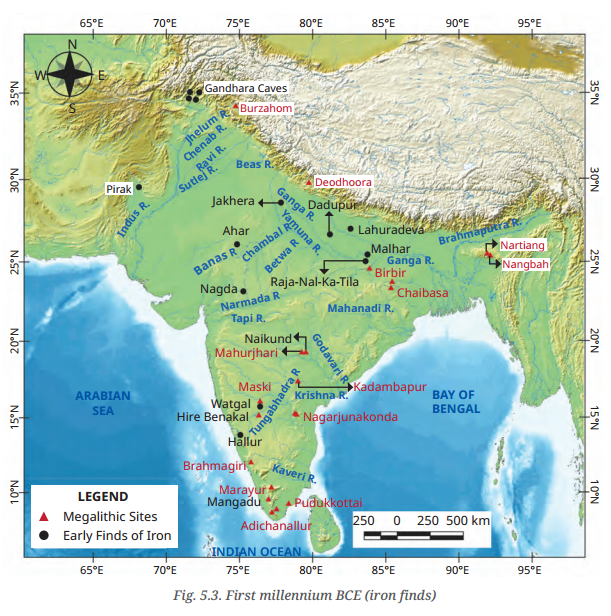
Question 1.
If you visualise the maps of the Indian subcontinent of the second and first millennium BCE, you will find more settlements concentrated in the Gangetic region in the latter map. Archaeological findings from this region during the first millennium BCE provide increasing evidence of the use of iron implements, a wider variety of grain and the characteristic PGW pottery. Further, in the second half of the first millennium BCE, particularly in the middle Gangetic region (from present-day Prayagraj to eastern Bihar), there is evidence of a refined ‘deluxe ware’ called NBPW, known for its smooth, glossy black surface. Archaeologically, this phase marks the emergence of a richer, more advanced material culture. Literary sources from this period also contain numerous references to expanding agricultural activities, increased grain output, greater crop variety—particularly paddy—and the use of iron implements. Can you identify the crucial factors behind this change?
Answer:
The main factors behind this change were the use of iron tools, which made farming easier for people. The expansion of agriculture was also important. People started to cultivate varieties of crops, especially paddy. The growth of settlements, trade and advanced pottery like PGW and NBPW were also factors. All these developments led to a more advanced material culture for the people. The use of iron tools, the expansion of agriculture, including the cultivation of varieties of crops, especially paddy and the growth of settlements, trade and advanced pottery, like PGW and NBPW, made life better.
Think About It (Page-108)
Texts such as the Mahabharata and the Arthashastra describe the king’s duties as protecting people and ensuring justice. Why do you think it was important for rulers to protect people and ensure justice? What do these descriptions tell us about ideas of governance and the relationship between rulers and subjects during that period?
Answer:
It was important for kings to keep people safe and make sure they were treated fairly. This helped to maintain peace and made the kingdom stable.
- A king’s job was not just to rule; it was also to help his people.
- The king had to take care of his people, which showed that he was responsible for their well-being.
- He had to protect them and make sure they were treated fairly, which helped keep the peace.
- This showed that the king and his people had a relationship where he looked out for them, and they trusted him.
- The king’s job was to serve his people, not to boss them around.
- He had to make sure they were safe and happy, and that made the kingdom a better place.
- This helped keep everything running smoothly and made sure everyone was treated fairly.
Think About It (Page-111)
Question 1.
Why do you think different rulers chose to record their inscriptions on the same stone instead of a new one? Discuss your answers with your classmates.
Answer:
The rulers wanted to ensure people remembered them, so they wrote their names on stones that other rulers had already used. This way, they could show that they were connected to the rulers who came before them. It was also an idea because it saved a lot of work. They did not have to build a monument because people already knew about the old stone. The rulers could just add their names to the stone, and people would still respect them. The old stones were important because they had the names of rulers on them. Different rulers used the stone to preserve the earlier records of the rulers who came before them.
Think About It (Page-112)
Question 1.
How would dividing a kingdom into provinces, districts and villages have helped rulers manage their empires? What similarities can you identify between these administrative divisions and the system of governance in iAdia today?
Answer:
Dividing a kingdom into provinces, districts and villages was a way for rulers to manage their kingdom. They could collect taxes, maintain law and order and govern the people more effectively.
India is also divided into states, districts and villages. There are officials at each level who manage the administration in India. They do this work in states, districts and villages of India.
Let’s Explore (Page-118 )
Question 1.
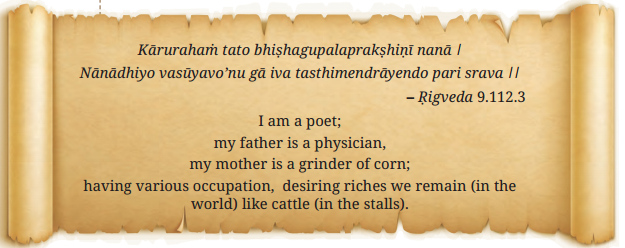
Read the verse given above and discuss it in groups. As you do so, think like historians—look for clues in the source and use them to understand what life may have been like. While discussing, keep these questions in mind:
i. What does the source tell us? (Evidence)
- The verse mentions a family with different occupations.
- The speaker is a poet, the father is a physician and the mother is a grinder of corn.
- It shows that people worked in different professions and wished for prosperity.
ii. What can we understand from it? (Interpretation)
- Families could have members with different occupations.
- Society valued different kinds of work.
- People earned their livelihood through various professions and hoped for a better life.
iii. What might it not tell us? (Limits of the source)
- It does not describe the lives of all people in society.
- It does not explain how occupations were chosen or how society was organised.
- It gives only one example, so it cannot represent the entire Vedic society.
Now answer the following:
Question 1.
What occupations are mentioned in the family described in the verse? What does this indicate about the nature of occupations in Vedic society?
Answer:
The occupations mentioned are those of a poet, physician and grinder of corn. This indicates that different occupations existed within the same family, showing occupational diversity in Vedic society.
Question 2.
How does the above verse challenge the idea that social status and occupation were fixed by birth?
Answer:
The verse shows that members of the same family had different occupations, suggesting that occupations were not always fixed by birth and people could follow different professions.
Question 3.
What different occupations do you find in contemporary society?
Answer:
Some occupations today include teachers, doctors, engineers, farmers, soldiers, police officers, lawyers, scientists, businesspersons, artisans and software professionals.
Question 4.
Did all groups interpret the source in the same way? What does this tell us about how historians use evidence to understand the past?
Answer:
No, different groups may have interpreted the source differently. This shows that historians study the same evidence from different perspectives and compare it with other sources before concluding on the past.
Let’s Explore (Page-126)
Question 1.
Compare your school life with the life of a student in a gurukula in early India. Think about aspects such as daily routine, subjects studied, relationship with teachers, discipline and living arrangements. What advantages and challenges do you think each system of education might have for students?
Answer:
Comparison of School Life and Gurukula
| Aspect | Modern School | Gurukula (Early India) |
| Daily routine | Fixed school hours, then students return home | Students lived with the guru and followed a disciplined daily routine |
| Subjects studied | Science, Mathematics, Languages, Social Science, Computers, etc. | Vedas, philosophy, grammar, mathematics, warfare and moral values |
| Relationship with teachers | Respectful, but mainly in the classroom | Very close, as students lived with and learned directly from the guru |
| Discipline | School rules and regulations | Strict discipline with emphasis on selfcontrol and obedience |
| Living arrangements | Students usually live at home | Students stayed in the gurukula with the guru |
Advantages and Challenges
Modern School
- Advantages: Wide range of subjects, modern technology, sports and extracurricular activities.
- Challenges: Less personal attention and more academic pressure.
Gurukula
- Advantages: Close teacher-student relationship, strong moral values and practical learning.
- Challenges: Limited subjects, fewer educational resources and students had to live away from their families.
Think About It (Page-129)
Question 1.
Why do you think irrigation structures like dams and canals were considered so important that their construction was recorded in inscriptions?
Answer:
Irrigation structures, such as dams and canals, were really important. They supplied water for agriculture. This was important because it helped increase crop production. Irrigation structures also supported people’s livelihoods.
The people in charge built these irrigation structures. They wanted everyone to know about them. So, they recorded the construction of dams and canals in inscriptions. This was done to show the rulers’ achievements and the good things they did for the people, like welfare measures and good governance. Irrigation structures, like dams and canals, were a part of this.
Questions and Activities (Pages No. 134-135)
Question 1.
How did political organisation change from the Vedic period to the age of large empires such as the Mauryas and the Guptas? Explain the administrative system of the early Indian states.
Answer:
The political organisation in India changed a lot from the Vedic period to the time of the Mauryas and the Guptas.
- During the Vedic period, people were divided into tribes and each tribe had a king. The king was helped by a group of people who made decisions together, like the Sabha and Samiti.
- As time went on, these tribes became bigger and more powerful. They turned into big states called mahajanapadas.
- Later, when the Mauryas and the Guptas were in power, big empires were formed with a central government, a good system of collecting taxes, a permanent army and many officials to help run things. Administrative system of the early Indian states
- The king was in charge of everything.
- The empire was divided into parts like provinces, districts, towns and villages, so it was easier to govern.
- There were governors and officials who took care of things like collecting taxes, keeping the peace and making sure people followed the law.
- In the villages, local people made decisions about things.
- The money collected from taxes was used for things like running the government, defending the country, building roads and helping people.
- This system really helped the rulers control their areas and keep everything peaceful and orderly. The political organisation of the Mauryas and the Guptas was very effective. It helped the rulers of the time to maintain peace and order in their empires, which were the major political organisations of the time. The political organisation in India during this time was very strong. It played a big role in the development of the country, just like the political organisation of the Vedic period.
Question 2.
Describe the role of the king, important officers and the methods used to govern large territories.
Answer:
The king was the head of the state.
- He protected the kingdom, maintained law and order, ensured justice, collected taxes and looked after the welfare of the people.
- Important officers, such as ministers, governors, military commanders and tax officials, assisted the king in administration.
- Large territories were governed by dividing the empire into provinces, districts, towns and villages. Local officials managed these areas, collected taxes, maintained records and reported to the central government, ensuring efficient administration.
Question 3.
After studying this chapter, what do you think were the most important features of the state and society in India before 1000 CE?
Answer:
The most important features of the state and society in India before 1000 CE were:
- Society was organised into families, villages, jatis and varnas.
- Agriculture, trade and crafts were the main occupations.
- Kings ruled with the help of ministers and officials and ensured law, justice and security.
- Large kingdoms were divided into provinces, districts and villages for efficient administration.
- Dharma guided moral values and governance.
- Religion, education, literature, art and architecture flourished, contributing to a rich cultural heritage.
Question 4.
What do early texts such as the Rig Veda, Arthashastra and the Mahabharata reveal about political and social life?
Answer:
The early texts like the Rig Veda, the Arthashastra and the Mahabharata tell us that the kings had help from ministers and assemblies when they ruled.
- The main job of the king was to keep people safe, make sure everyone followed the rules and collect the taxes from people.
- People lived in groups like varnas, jatis, families and villages.
- The Rig Veda, Arthashastra and the Mahabharata also say that farming, buying and selling things and having jobs were very important.
- These early texts, the Rig Veda, Arthashastra and the Mahabharata, talked about how people should behave, how the government should work and how to take care of the people, which is what they called dharma or doing the right thing.
Question 5.
What can we learn from early Indian society about varna and the role of women?
Answer:
In the beginning, Indian society was divided into four groups. These groups were the Brahmins, the Kshatriyas, the Vaishyas and the Shudras. The Indian society was divided like this because of the work that the Indian people did and the jobs they had. As time went on, many smaller groups formed. These smaller groups were like the people who did the same kind of work.
Role of Women: Women in society took part in learning, religious activities and family life. Some women were very smart. People respected them, but the way people treated women was different at different times and in different places. Indian women, like the Brahmin, Kshatriya, Vaishya and Shudra women, had different lives.
Question 6.
Explain how assemblies like sabha and samiti limited the power of the raja. Which modern institutions perform similar functions today?
Answer:
The Sabha and Samiti used to guide the king, talk about issues and help him make decisions. They made sure the king didn’t make all the choices by himself and encouraged him to listen to others before making decisions.
Now the Parliament, which includes the Lok Sabha and Rajya Sabha, State Legislatures and the Judiciary, performs similar functions. They make sure the government doesn’t have much power and that it is answerable to the people.
Question 7.
What do the terms varna and jati refer to in early Indian society? How were they different, and what factors may have contributed to the formation of various jatis?
Answer:
The term varna is used to talk about the four groups of people in society: Brahmins, Kshatriyas, Vaishyas and Shudras. These groups are based on the kind of work people do.
- Varna is like a category that includes many people.
- Jati is different from varna. Jati refers to groups of people who do the same kind of work or live in the same place.
- The main difference between Varna and Jati is that varna was a broad classification with only four categories, whereas jati consisted of many different groups based on occupation, region and customs.
- Many jatis came into existence over time. This happened because new jobs were created and people started doing different kinds of work. People also moved to new places and started new businesses. Regional customs also played a role in the creation of jatis.
Question 8.
Why do you think education in early India emphasised both knowledge and moral values? How might this have benefited society?
Answer:
Education in India was all about teaching people knowledge and also helping them become good people.
- It was not about learning; it was also about teaching students to be disciplined, honest and respectful. They also learned about doing the right thing, which is called dharma.
- This was really good for the community because it helped people become responsible citizens.
- Education in India promoted good character and people got along with each other.
- It also taught people to be responsible and to follow the rules, which is important for a country to be run properly.
- Education in India was very important for the people and for society.
Question 9.
Look at the major trade routes of early India (Fig. 5.12 NCERT Page 130). How do you think these routes helped people in the exchange of goods, skills, beliefs and cultural practices?
Answer:
The big trade routes in India were really helpful in enabling people to exchange things like spices, clothes, metals and precious stones.
- These routes also helped spread skills, ideas, religions and languages and things like that. People like traders, travellers and scholars would talk, and that is how all these things were shared.
- This helped the economy to grow. It also helped people from different places to get to know each other and share their customs.
- The trade routes of India were really good for the’ economy, for people to learn about other cultures, and’ for people in different regions to be more united.
Question 10.
What might have been the advantages and challenges of ruling a large empire in the absence of modern communication systems?
Answer:
Advantages:
- Large empires had more resources, wealth and trade.
- They provided better security and promoted cultural unity across regions.
Challenges:
- Without modern communication, it was difficult to send messages quickly.
- Rulers found it hard to control distant areas, collect taxes, maintain law and order and respond rapidly to rebellions or emergencies.
Question 11.
Many ideas about governance come from texts composed by scholars and advisors of the king. What might be some limitations of relying only on such sources?
Answer:
Relying on texts written by scholars and royal advisors has limitations.
- They often present the king’s point of view and praise the ruler.
- These texts may not tell us about the lives and opinions of people.
- This includes women, farmers, artisans and other groups.
- So, historians use other sources.
- These sources include inscriptions, archaeological evidence, coins and more.
- They help historians understand the past better.
- They give a complete picture of history.
Question 12.
Read the source and answer the questions:
The Nashik cave inscription (2nd century CE) of Ushavadata records: “Ushavadata, son of Dinika, son- in-law of king Nahapana has bestowed this cave on the Samgha generally; he has also given a perpetual endowment, three thousand—3000 kahapanas, which, for the members of the Samgha of any sect, and any origin dwelling in this cave, will serve as cloth money and money for outside life (kushana); and those kahapanas have been invested in a weavers’ guild dwelling at Govadhana—2000 in a weavers’ guild, interest one pratika (monthly) for the hundred, and 1000 in another weaver’s guild, interest three quarters of a padika (monthly) for the hundred.”
a. What does this source tell us about the economic role of guilds?
Answer:
The source shows that guilds acted as financial institutions. They accepted money deposits, invested them and paid interest, which was used to support the monastery and its members.
b. Why were guilds trusted with money deposits?
Answer:
Guilds were trusted because they were well- organised, stable and managed money responsibly. They could safely invest funds and provide regular interest.
C. Identify the donor and the donees from the given source.
Answer:
- Donor: Ushavadata, son of Dinika and son-in-law of King Nahapana.
- Donees: The Samgha (Buddhist monastic community) living in the cave, regardless of sect or origin.
Question 13.
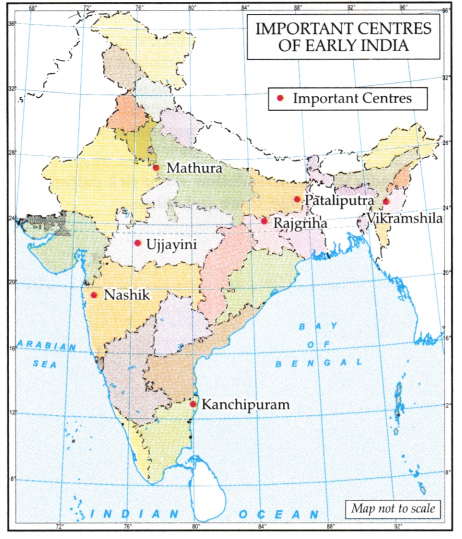
Mark and locate on the map of India the following important centres:
Pataliputra, Nashik, Ujjayini, Vikramshila, Kanchipuram, Mathura, Rajgriha.
Answer:
Question 14.
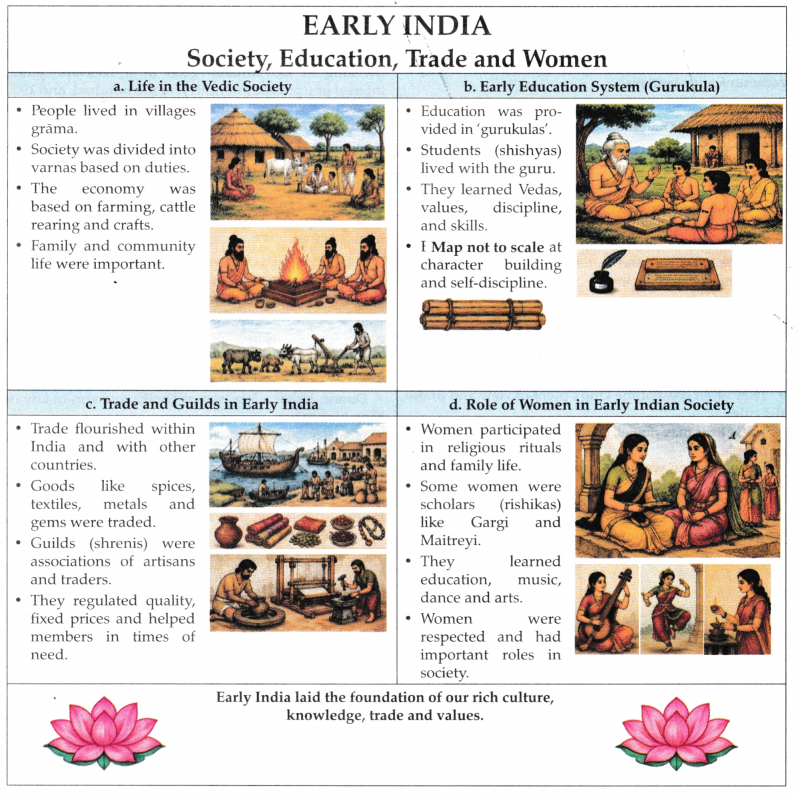
Prepare a short presentation or poster on one of the following:
a. Life in Vedic society
b. Early education system (gurukula)
c. Trade and guilds in early India
d. Role of women in early Indian society
Answer:
Poster
State and Society (Up to 1000 CE) Class 9 Extra Questions and Answers
State and Society (Up to 1000 CE) Class 9 Very Short Question Answer
Question 1.
What is the difference between ‘society’ and ‘state’?
Answer:
Difference between ‘society’ and ‘state’ are as follows:
A society is a system of social relationships regulated by customs and practices, built around shared territory, culture, and belonging.
A State is an organised political system based on formal rules and laws, with defined rights and duties of rulers and subjects, and institutions to enforce law and order.
Question 2.
What were janas in the Vedic period?
Answer:
Janas were clans or groups of people bound together by kinship ties in early Vedic society.
The Rig Veda mentions about thirty such janas, five of which — the Yadu, Turvasha, Puru, Anu, and Druhyu — were collectively known as the panchajana or ‘five peoples’.
Question 3.
What was the role of the raja in the Vedic period?
Answer:
The raja functioned primarily as a clan chief rather than a powerful king in the modern sense.
His main responsibilities were to lead the group in warfare and ensure the protection of the members of his jana. His authority was not absolute and was limited by assemblies.
Question 4.
Why are Vedic texts important for the study of history?
Answer:
Vedic texts are used by historians to understand the times and geographies in which they were composed, providing information on social structures, political systems, economic pursuits, and religious practices.
As one of the earliest texts in India, they are regarded as foundational to Indian culture and traditions, and supplement archaeological evidence with literary insights.
Question 5.
Name the four parts of each Vedic text and state their purpose briefly.
Answer:
Samhita — Contains hymns for invoking deities and offering oblations in yajnas.
Brahmana — Prose texts that explain ritual performances. Aranyaka — Philosophical speculations by forest¬dwelling sages.
Upanishads — Inquiry into the nature of the Self (Atman) and the Ultimate Universal Being (Brahman).
Question 6.
What is the difference between a janapada and a mahajanapada?
Answer:
A janapada was a territorial unit that emerged when Vedic janas transitioned from kinship-based identity to territorial identity, roughly between 1000 BCE and 600 BCE.
A mahajanapada was a larger and more complex political unit that developed from around 600 BCE onwards. Historical sources mention sixteen such mahajanapadas, with Magadha being the most powerful among them.
Question 7.
What were the seven constituents (Saptamga) of the state according to Kautilya?
Answer:
Kautilya identified the seven constituents as: the king (swami), the ministers and officials (amatya), the territory and population (janapada), the fortified towns (durga), the treasury (kosha), the army (danda), and the allies (mitra).
The state could function effectively only when all seven constituents remained properly integrated with one another.
Question 8.
What was the role of the mantri-parishad in early Indian administration?
Answer:
The mantri-parishad (council of ministers) was a small body of elder statesmen whose primary role was to advise and support the king in governance.
It generally included the treasurer, chief tax collector, chief legal advisor, and commander-in-chief. An Ashokan inscription shows the council could even take independent decisions in public interest during the emperor’s absence.
Question 9.
What does the term ‘chakravarti kshetra’ mean and how was it expressed in Indian history?
Answer:
Chakravarti kshetra refers to the “domain of a universal paramount ruler” the ideal of exercising political authority over the entire Indian subcontinent, defined in the Arthashastra as the area between the Himalayas and the sea.
This ideal was expressed repeatedly Ashoka referred to changes across Jambudvipa, the Chera king Nedunjeral Adan extended conquests to the Himalayas, and Chola ruler Rajendra I adopted the title Gangaikonda to commemorate his northern conquests.
Question 10.
What were variyams and agraharams? Name the dynasties associated with each.
Answer:
Variyams were small committees within village assemblies of the Pallava dynasty that managed specific local tasks like irrigation, gardens, and temple management in Brahmadeya (tax-free) villages. Agraharams were land grants given by the Chalukyas to Brahmin settlements. Some, such as those at Aihole and Badami, gradually developed into prominent centres of learning.
Question 11.
What is rita and what is its significance in Vedic thought?
Answer:
Rita is described in the Rig Veda as an all-pervading cosmic order representing harmony and balance in both nature and human society.
It regulates the forces of nature, upholds moral values, and maintains the underlying balance of the universe making it the foundation of ethical and natural order in Vedic thought.
Question 12.
What were the four purusharthas?
Answer:
The fourpurusharthas were: dharma (righteousness), artha (material well-being), kama (fulfilment of desires), and moksha (liberation from worldly ties).
Dharma and moksha held special ethical significance, and even the pursuit of artha was expected to be guided by dharma and aligned with social welfare.
Question 13.
How did jati differ from varna?
Answer:
The varna system had a fixed fourfold structure based on functional and occupational roles in society.
Jati emerged later due to intermarriage among varnas, endogamous migrating communities, and territorial differences. Unlike varnas, there was no restriction on the number of jatis; they multiplied as new social groups and occupations developed.
Question 14.
What was the significance of the gurukula system?
Answer:
The gurukula placed the teacher’s home at the centre of learning; students lived with the guru, followed a disciplined life, and were treated as family members. The guru-shishya parampara was considered sacred. Education was holistic, covering academic subjects, yoga, meditation, arts, and moral conduct making it a complete preparation for life, not just a career.
Question 15.
Name any four major ports of early India and state their significance.
Answer:
Major ports included Muziris, Kaveripattinam, Arikamedu, and Masulipatnam.
These ports attracted both Indian and foreign traders, facilitating maritime trade across the Indian Ocean and connecting India with Mesopotamia, the Persian Gulf, Rome, and other regions through coastal and long-distance sea routes.
State and Society (Up to 1000 CE) Class 9 Short Question Answer
Question 1.
Describe the three Vedic assemblies and their functions.
Answer:
The Sabha was a smaller body composed of select elites that primarily served a judicial function, dealing with legal and dispute-related matters.
The Samiti was a larger assembly that focused on policy decisions and political affairs and represented the broader population, giving it a more democratic character.
The Vidhata was a popular gathering attended by members of the community (janas) and functioned as a forum for discussions on warfare and other political matters.
Together, these assemblies show that even in early Vedic times, governance involved a degree of collective participation, somewhat similar to modern representative institutions.
Question 2.
Elaborate on the evolution from early kin-based societies to empires?
Answer:
Early Vedic society was organised into janas — small, kin-based clans held together by family ties and led by a raja who served as a clan chief.
Over time, these simple units evolved into larger, territory-based political units called janapadas and then mahajanapadas, as populations grew and governance became more complex.
Eventually, these developed into full-fledged empires such as the Mauryas and Guptas in the north and the Cholas in the south with sophisticated administrative systems, laws, and institutions.
Question 3.
Explain the significance of the Rig Veda as a historical source.
Answer:
The Rig Veda is the oldest surviving Veda, containing 1,028 hymns (suktas) that reflect on deities, creation, birth, death, and universal themes, making it one of the world’s oldest surviving poetic compositions.
It was composed in the Sapta-Sindhu region and provides valuable information about the geography, social organisation, political institutions, and cultural practices of early India.
The Rig Veda mentions about thirty janas and refers to assemblies like the Sabha, Samiti, and Vidhata, giving us direct evidence of early Vedic political life and community organisation.
Question 4.
How do the four Vedas differ from one another in their content and purpose?
Answer:
The Rig Veda is the oldest and contains hymns praising deities and reflecting on universal themes; it is the foundational text for all other Vedas.
The Yajur Veda elaborates on the performative aspects of yajnas and explains the hymns of the Rig Veda in both verse and prose, making it more ritual-focused.
‘The Sama Veda arranges hymns from the Rig Veda for musical recitation, and its chanting tradition is the foundation of the seven svaras of Indian classical music. The Atharva Veda has a distinct character — it contains hymns to ward off evil and addresses the treatment of physical and mental ailments, reflecting a more everyday, practical dimension of Vedic life.
Question 5.
Explain how early Indian empires were administratively organised from the highest to the lowest level.
Answer:
Early Indian empires followed a clear hierarchical structure the kingdom was divided into provinces, which were subdivided into divisions, then districts, then groups of villages, and finally individual villages as the smallest unit.
Regional terminology differed: provinces were called bhuktis in the north and mandates in the south; districts were adhishthana in the north and nadu in the south; village groups were vithis in the north and pattala/kuram in the south.
The village was always the smallest and most autonomous unit, largely self-reliant in functions like infrastructure, social welfare, education, and local dispute resolution, regardless of which empire governed the region.
Question 6.
Describe the duties and ideals expected of a king in early India according to various textual sources.
Answer:
According to Kautilya’s Arthashastra, a king must be personally energetic and active, as his officers would only follow his lead if he himself set an example of diligence and commitment.
The Yajur Veda’s coronation oath advised the king to judge the strong and weak impartially, protect the country from calamities, and work for the welfare of his people while the Shanti Parva of the Mahabharata provided detailed guidance on ethical conduct and responsibilities towards subjects.
The king was expected to protect subjects from external threats and internal disorder, administer justice in cases of crime, and impose appropriate punishments sometimes even capital punishment for grave offences while kingship, though generally hereditary, was not always absolute, as kings could also be elected or expelled.
Question 7.
How did the Gupta period administration differ from or build upon earlier administrative systems?
Answer:
The Guptas retained much of the earlier Kautilyan framework the mantri headed civil administration, supported by the commander-in-chief, general, and chief of palace guards, showing strong continuity with previous systems.
However, the Guptas introduced new elements — a sandhivigrahika (minister of peace and war) was a new office, and the amatyas of Kautilya’s time evolved into kumaramatyas, who served as administrators at local and provincial levels.
At the district level, the Damodarpur copper plates from the reign of Kumaragupta I mention a five-member district administrative board comprising the district officer (Visayapati), the chief banker (Nagarasresthin), the chief caravan trader (Sarthavaha), the chief artisan (Prathama Kulika), and the chief scribe (Prathama Kayastha), indicating a well-organised and consultative system of local administration.
Question 8.
What was the significance of the village as an administrative unit in early Indian polities?
Answer:
Across all early Indian empires and kingdoms from the Satavahanas to the Imperial Cholas the village consistently served as the smallest and most fundamental administrative unit, led by a headman (gramika in the Satavahana period).
Village assemblies were highly autonomous and self- reliant, handling a wide range of functions including revenue collection, land management, irrigation, road construction, dispute settlement, and even education and social welfare without depending on the central government.
This pattern of local self-governance through village assemblies was a defining feature of Indian administration, seen from the Pallava variyams to the Chola village councils, showing a remarkable continuity 6f grassroots governance across centuries.
Question 9.
Explain the connection between ethics and governance in early India with examples.
Answer:
Early Indian texts consistently linked ethics with political authority — Kamandaka’s Nitisara and Banabhatta’s Kadambar both contain advice on ethical kingship, reinforcing that moral conduct was inseparable from governance.
Ashoka’s edicts promoted dhamma by emphasising non-violence, compassion, and moral behaviour showing how state power was used to propagate ethical values across Jambudvipa.
The Uttaramerur inscription (10th century CE) specified that election candidates must have honest earnings and purity of mind proving ethical standards in public life were institutionally enforced even at the grassroots level.
Question 10.
Describe the role and functions of guilds in the early Indian economy.
Answer:
Guilds (shrenis) were organised associations of traders and artisans that regulated quality of goods and fixed prices to protect consumers. Member conduct was supervised through guild courts enforcing professional standards and discipline.
Beyond trade, guilds functioned as banks, financiers, and trustees; the Nashik cave inscription records deposits made with guilds at fixed interest rates, used to maintain Buddhist monasteries.
The Jataka literature refers to eighteen types of guilds, confirming they were well-established institutions that gained particular importance after the rise of the mahajanapadas in the 6th century BCE.
Question 11.
How does evidence from inscriptions and literature suggest social mobility in early India?
Answer:
Several major dynasties the Nandas, Mauryas, Shungas, Satavahanas, and Guptas had rulers from diverse social backgrounds, showing political power was not restricted to any one varna.
The Mandsaur Stone Inscription (473 CE) records silk weavers who were also skilled in archery and astrology demonstrating both geographical and occupational mobility within a social group.
The Pattinappalai describes merchants, fishermen, artisans, and warriors interacting actively, suggesting society was organised more on occupation and economic function than on rigid varna classification.
Question 12.
Discuss the development of trade and commerce in early India with reference to routes and ports.
Answer:
By the 6th century BCE, two major land routes Uttarapatha and Dakshinapatha connected inland regions with coastal ports, integrating overland and maritime trade across the subcontinent.
Major ports like Muziris, Kaveripattinam, Arikamedu, and Masulipatnam developed as significant trade centres attracting Indian and foreign merchants. By early centuries CE, India’s trade with Rome expanded through sea routes and Central Asian overland connections.
The state actively supported trade by ensuring safety of routes, regulating commodities like salt, and preventing adulteration of goods to protect consumers.
Question 13.
What subjects and values did early Indian education focus on?
Answer:
Early Indian education cultivated inner values like truth, humility, control of senses, and reverence for all beings. Students were trained to live according to dharma, fulfilling duties towards parents, teachers, and society.
The curriculum covered Vedas, grammar, logic, philosophy, mathematics, medicine, astronomy, music, dance, painting, archery, and physical education along with daily yoga and meditation.
The gurukula system structured this holistic education, producing great institutions like Takshashila, Nalanda (427 CE), and Vallabhi (480 CE) that attracted students from across India and beyond.
State and Society (Up to 1000 CE) Class 9 Long Question Answer
Question 1.
Discuss the political institutions of the Vedic period. How did they reflect early ideas of governance and participation?
Answer:
Early Vedic society was organised into janas — kin- based clans bound by family ties. The Rig Veda mentions about thirty such janas, five of which were known collectively as the pahchajana.
The raja in this period was not an absolute monarch but primarily a clan chief whose key roles were leading the group in warfare and ensuring the protection of its members. His authority was therefore limited and functional in nature.
Governance was further checked by three assemblies — the Sabha (judicial body of elites), the Samiti (larger policy-making body representing the broader population), and the Vidhata (a popular gathering for discussions on warfare and political matters).
The existence of these assemblies shows that even in early times, Indian governance was not purely autocratic there were institutionalised spaces for collective decision-making and representation.
This reflects a foundational principle in Indian political history that rulers were expected to govern in consultation with others, a principle that has parallels with modern democratic ideas of checks and balances on executive power.
Question 2.
Why are the Vedas considered foundational to Indian culture and history? Discuss with reference to their structure and content.
Answer:
The Vedas are the earliest known corpus of Indian literature and have been regarded as foundational because of their continuity of influence on Indian culture, religion, philosophy, and social practices over thousands of years.
Each Veda has a clear four-part structure — the Samhita (hymns), Brahmana (ritual explanations), Aranyaka (philosophical speculations), and Upanishads (inquiry into the nature of Self and Ultimate Reality) — showing a progression from ritual to deep philosophical thought. The four Vedas together cover a wide range of human concerns: the Rig Veda addresses universal questions of creation and existence; the Yajur Veda organises ritual practice; the Sama Veda contributes to Indian music through its chanting tradition; and the Atharva Veda addresses everyday concerns like health and protection from evil.
As historical sources, the Vedas especially the Rig Veda provide evidence about the geography, social organisation, political institutions, and cultural practices of early India, supplementing archaeological evidence where written records are otherwise absent.
The Vedic texts thus serve a dual purpose they are both sacred religious texts and primary historical documents that help us reconstruct the social and political world of early India.
Question 3.
“The evolution of the Indian state was a gradual process from simple kin-based units to complex empires.” Explain this statement with examples.
Answer:
In the earliest phase, Indian society was organised into janas-small, kin-based clans where authority rested with the raja as a clan chief, and governance was informal, supported by assemblies like the Sabha and Samiti.
Over time, as populations grew and communities settled into fixed territories, these clans evolved into janapadas territory-based political units that were more structured and stable than earlier clan-based groups.
Janapadas further developed into mahajanapadas (600-300 BCE) large, powerful kingdoms with more complex administrative systems, fixed capitals, standing armies, and taxation systems.
The next major stage was the formation of empires most notably the Mauryan Empire (founded by Chandragupta Maurya in 321 BCE), which unified large parts of the subcontinent under centralised rule, with Ashoka later spreading the Philosophy of Dhamma during his reign (272-232 BCE).
In southern India, the Cheras, Cholas, and Pandyas of Tamilakam (300 BCE-300 CE) represent a parallel process of state formation, showing that political evolution was happening across the subcontinent and not just in the north.
Question 4.
Trace the evolution of political organisation in ancient India from janapadas to empires, with suitable examples.
Answer:
The earliest Vedic society was organised into janas — kin-based clans. Over time, as people developed a sense of belonging to a territory, these evolved into janapadas (roughly 1000-600 BCE), where territorial identity became as important as kinship.
From around 600 BCE, janapadas further consolidated into mahajanapadas — sixteen larger, more complex political units. These included both monarchical states (rajyas) and republican states (ganas or samghas), showing political diversity in this period.
Among the sixteen mahajanapadas, Magadha rose to dominance due to its fertile plains, strategic location, and capable rulers. Its expansion eventually led to the formation of the Mauryan Empire (321 BCE), one of the largest and most powerful empires in early Indian history.
In the Deccan, the Satavahana Empire succeeded the Mauryas and lasted nearly 500 years. Further south, the Cholas, Pandyas, Cheras, and Satiyaputras formed distinct polities in peninsular India, reflecting parallel state formation in the south.
By 300-800 CE, the period was markedby decentralisation, with power distributed across provinces, districts, and autonomous village assemblies- a system perfected by the Imperial Cholas, whose village assemblies handled all local governance independently.
Question 5.
Discuss the pan-Indian political ideal in early Indian history. How was it expressed by rulers across different periods and regions?
Answer:
Early Indian rulers held a pan-Indian geopolitical awareness; their ambition extended beyond their own kingdoms to sovereignty over the entire Indian subcontinent, expressed through concepts like Jambudvipa, Bharatavarsha, Prithivi, and chakravarti kshetra.
The Arthashastra defines Prithivi as “the area between the Himalayas and the sea” and equates it with the chakravarti kshetra, the domain of a universal paramount ruler giving this ideal a formal political and philosophical basis.
Ashoka expressed this awareness in his edicts by referring to spiritual changes across Jambudvipa. Rituals like the ashvamedha yajna and rajasuya yajna were performed by kings to assert their claim to pan-Indian sovereignty.
In southern India, the Chera king Nedunjeral Adan extended his conquests to the Himalayas during the Sangam period. Later, the Chola king Rajendra I adopted the title Gangaikonda in the 11th century CE to commemorate his northern conquests along the Ganga. Thus, across centuries and regions, the aspiration to exercise authority- over the Indian subcontinent was a recurring and enduring ideal in Indian political history, connecting rulers of very different periods through a shared vision of sovereignty.
Question 6.
Compare the administrative systems of the Pallavas and the Imperial Cholas, highlighting both similarities and differences.
Answer:
Both the Pallavas (c. 275-897 CE) and the Imperial Cholas (9th-llth century CE) combined centralised monarchy with decentralised local governance, where the king remained the supreme head but practical administration was distributed across provinces, districts, and villages.
In both empires, the village was the smallest and most autonomous unit. Pallava villages had assemblies with committees called variyams managing irrigation, gardens, and temples. Chola village assemblies similarly handled revenue collection, land management, irrigation, and road construction all independently, without government patronage.
A key difference lies in land grants: the Pallavas gave tax- free Brahmadeya villages to support local communities, while the Cholas organised their empire into mandalams → valanadus → nadus → urs, with a more systematic and layered revenue administration considered particularly efficient.
The Chola administrative system is regarded as more institutionally advanced — their village assemblies were formally constituted bodies with defined responsibilities, representing one of the finest examples of local self-governance in ancient India.
Both systems demonstrate a consistent principle of Indian administrative tradition that effective governance required strong central authority combined with robust, self-reliant local institutions, ensuring stability across vast and diverse territories.
Question 7.
“The village was the backbone of early Indian administration.” Justify this statement with evidence from ,at least three different empires or dynasties.
Answer:
Across all major empires of early India, the village consistently served as the smallest, most fundamental, and most autonomous administrative unit making it the true backbone of Indian governance at every level.
In the Satavahana Empire, villages were administered by a headman called the gramika, who operated below the ahara (administrative division) level.
District officers made decisions after consulting important local residents like bankers and artisans, showing how rooted administration was in village-level realities.
Under the Pallavas, villages functioned relatively independently of royal administration. Brahmadeya villages were tax-free, and village assemblies managed local affairs through variyams committees for irrigation, temples, and gardens without interference from the central government.
The Imperial Cholas perfected this model most thoroughly. Their village assemblies handled revenue collection, land management, irrigation, road construction, and record maintenance entirely independently. These assemblies were not dependent on government patronage, making them genuinely self- reliant institutions.
The Gurjara-Pratiharas, Palas, and Rashtrakutas also maintained the village as the smallest administrative unit, with villages remaining largely self-reliant in infrastructure, social welfare, and education.
Thus, regardless of dynasty, region, or period, the village assembly model of local self-governance remained a defining and enduring feature of Indian administration — demonstrating that effective central empires were always built on a foundation of strong, independent local units.
Question 8.
Discuss the varna system in early India — its origins, functions, flexibility, and evolution into the jati system.
Answer:
The earliest reference to the four varnas appears in the Purushasukta (Rig Veda, Book 10). Early Vedic texts show social identity was shaped by occupation, geography, and gotra not birth with occupations remaining flexible.
The four varnas had specific functional roles brahman as (teaching, rituals), kshatriyas (warfare, justice), vaishyas (trade, agriculture), shudras (assisting others). The system valued knowledge highest, followed by political power and wealth making it functionally organised.
Evidence of flexibility includes the Sutta Nipata: “No brahmana is such by birth but only by his deeds.” The Pattinappalai describes dynamic interaction among merchants, fishermen, and warriors showing society was organised on occupation, not rigid varna.
Jati emerged gradually due to intermarriage, endogamous migrating communities, and territorial differences. Unlike the fixed four varnas, jatis multiplied without restriction as new groups and occupations developed, and social flexibility gradually reduced. Thus, varna began as a functional framework but evolved into the more rigid jati system driven by changing social, demographic, and economic realities across the subcontinent.
Question 9.
“Ethics formed the foundation of both individual life and state governance in early India.” Discuss.
Answer:
From the earliest texts, Indian civilisation placed ethics at the centre of personal and political life. Concepts like samatva, rita, satya, and dharma governed both individual conduct and state governance. The Bhagavad Gita emphasised knowledge, faith, and virtue as essential to ethical living.
Dharma-duty, obligation, and righteousness- was the central ethical principle. Ashoka’s edicts promoted dhamma through non-violence, compassion, and moral behaviour. The Mahabharata’s Shanti Parva provided ‘ detailed ethical guidance for rulers.
Ethics extended to literary tradition Kamandaka’s Nitisara and Banabhatta’s Kadambari both advised kings on moral governance, reinforcing the inseparable connection between ethics and political authority across centuries.
At the grassroots level, the Uttaramerur inscription (10th century CE) required assembly candidates to have honest earnings and purity of mind showing ethical governance was institutionally enforced even locally. Thus, from Vedic cosmic concepts to Chola-era inscriptions, ethics consistently shaped individual conduct and political authority making it one of the most enduring defining features of early Indian civilisation.
Question 10.
Discuss the role of women in early Indian society from the Vedic period to the Chola period.
Answer:
In the Vedic period, women held a high position participating in scholarly learning, rituals, and the sabha. Rig Vedic hymns are attributed to women sages like Apala, Ghosha, and Lopamudra. Goddesses Usha and Aditi were deeply revered in Vedic culture.
Over time, women’s positions fluctuated and sometimes declined. Yet the Manu-smriti affirmed: “Where women are honoured, there gods rejoice” showing the ideal of respecting women persisted as a cultural value.
In the Gupta-Vakataka period, Prabhavati Gupta ruled as regent and issued land grants independently. Women appeared as donors in post-Mauryan votive inscriptions, showing continued agency in public and religious life. Sangam literature portrays women actively engaged in agriculture, fishing, salt production, and garland selling. Celebrated poetesses like Awaiyar contributed significantly to Tamil literary culture.
During the Chola period, royal women like Sembiyan Mahadevi patronised temple building. Thus, despite fluctuations, women consistently contributed to intellectual, economic, and religious life throughout early Indian history.
Question 11.
Describe the agricultural economy of early India, covering land revenue, irrigation, and crops.
Answer:
The Mauryan state developed an elaborate system to regulate agriculture the primary revenue source. Land was divided into individual holdings; the basic tax was one-sixth of produce. Kautilya classified land into cultivated, wasteland, fallow, sown fields, and groves for revenue assessment.
A wide variety of crops were cultivated: rice, pulses, wheat, linseed, mustard, saffron, and sugarcane. Post- Mauryan, Deccan’s black soil supported increased cotton cultivation. Sangam texts describe the Chera region as rich in jackfruit, pepper, turmeric, ragi, and sugarcane. Irrigation was crucial; the state actively invested in reservoirs, canals, and dams. The Junagadh inscription records Pushyagupta constructing a dam on Sudarshana Lake under Chandragupta Maurya highlighting direct state involvement in irrigation infrastructure.
The Milindapanho describes eight stages of agricultural operations from field preparation to harvesting showing systematic farming knowledge. The Amarakosha includes a dedicated chapter on crops, forests, and manure. Agriculture remained the backbone of the early Indian economy throughout this period, sustaining rural livelihoods, state revenue, and the broader prosperity that supported trade and cultural development.
State and Society (Up to 1000 CE) Class 9 Competency Based Questions
Question 1.
Which of the following literary sources is regarded as the earliest and supplements archaeological evidence for early Indian history?
(A) Arthasastra
(B) Rig Veda
(C) Mahabharata
(D) Ramayana
Answer:
Option (B) is correct.
Explanation: The Rig Veda is the earliest literary source that provides valuable information about the social, political, and cultural life of early India.
Question 2.
What does the term ‘j anapada’ literally mean?
(A) Land ruled by a king
(B) Place where people first set their feet
(C) Land of merchants
(D) Territory surrounded by forts
Answer:
Option (B) is correct.
Explanation: The word janapada signifies the transition from kinship-based communities to territorial settlements.
Question 3.
Which Vedic assembly primarily performed judicial functions?
(A) Samiti
(B) Vidhata
(C) Sabha
(D) Gana
Answer:
Option (C) is correct.
Explanation: The Sabha was a smaller body of selected elites that mainly dealt with judicial matters.
Question 4.
Read the case carefully and answer the questions that follow.
King Vikram ruled a large kingdom with the help of a council of ministers (mantri-parishad). The council included the treasurer, chief tax collector, chief legal advisor, and the commander-in-chief of the army, who advised and supported the king in governing the kingdom. During the king’s absence, a severe flood affected several villages. The council met, discussed the situation and independently decided to release funds, organise relief measures and maintain law and order. An Ashokan inscription records that in exceptional situations, the council of ministers could take decisions independently in the public interest.
(i) What was the primary role of the mantri-parishad in ancient Indian administration?
(A) To elect the king
(B) To advise and support the king in governance
(C) To collect taxes from neighbouring kingdoms
(D) To supervise religious ceremonies
Answer:
Option (B) is correct.
Explanation: The mantri-parishad functioned as an advisory body that assisted the king in administration and governance. It did not elect the king or perform religious duties.
(ii) Which of the following officials was NOT generally a member of the council of ministers?
(A) Treasurer
(B) Chief legal advisor
(C) Commander-in-chief of the army
(D) Village headman
Answer:
Option (D) is correct.
Explanation: The council of ministers included high- ranking officials such as the treasurer, chief tax collector, chief legal advisor, and commander-in-chief. A village headman looked after village administration and was not a member of the central council.
(iii) The council’s decision to organise flood relief during the king’s absence shows that it:
(A) Replaced the king permanently
(B) Could take independent decisions in exceptional situations for public welfare
(C) Functioned only during wars
(D) Collected taxes without the king’s approval
Answer:
Option (B) is correct.
Explanation: Historical evidence, including Ashokan inscriptions, shows that the council could act independently in the public interest when the king was absent. This ensured continuity in administration during emergencies.
(iv) Which historical source provides evidence that the council of ministers could make decisions during the emperor’s absence?
(A) Rig Veda
(B) Arthasastra
(C) Ashokan inscription
(D) Manusmriti
Answer:
Option (C) is correct.
Explanation: An Ashokan inscription specifically records that the council of ministers was authorised to take decisions independently during the emperor’s absence, highlighting the efficiency of ancient Indian administration.
Question 5.
Describe the role of the three Vedic assemblies—Sabha, Samiti, and Vidhata—in the governance of early Vedic society.
Answer:
Sabha was a small assembly of selected elders that mainly performed judicial functions.
Samiti was a larger assembly representing the people and discussed policy decisions and political matters. Vidhata was a popular gathering where community members discussed warfare and other public affairs, encouraging people’s participation in governance.
Question 6.
Explain Kautilya’s Saptanga Theory of the State. Why was it important for effective administration?
Answer:
Kautilya described the State as consisting of seven constituents (Saptanga)—the King (Swami), Ministers (Amatya), Territory (Janapada), Fort (Durga), Treasury (kosha), Army (Danda), and Allies (Mitra).
Each constituent performed a specific function in governance.
According to Kautilya, the State could function efficiently only when all seven constituents worked together in harmony.
Question 7.
A newly formed settlement expands agriculture, controls trade routes, and develops an organised administration. Which stage of political development does this best represent?
(A) Jana
(B) Janapada
(C) Vedic clan
(D) Tribe
Answer:
Option (B) is correct.
Explanation: Janapadas emerged as territorial units where control over land, agriculture, and trade became important.
Question 8.
During a ruler’s absence, a council of ministers independently organises flood relief and maintains law and order. Which feature of ancient administration does this illustrate?
(A) Absolute monarchy
(B) Independent functioning of the council in public interest
(C) Military dictatorship
(D) Rule by village assemblies
Answer:
Option (B) is correct.
Explanation: Historical evidence, including Ashokan inscriptions, shows that the council of ministers could take decisions independently in exceptional situations.
Question 9.
A teacher asks students to compare the Sabha with a modern court because both mainly perform which function?
(A) Revenue collection
(B) Judicial decision-making
(C) Religious ceremonies
(D) Military administration
Answer:
Option (B) is correct.
Explanation: The Sabha mainly performed judicial functions, similar to how courts resolve disputes today.
Question 10.
Which statement best explains why Magadha emerged as the most powerful mahajanapada?
(A) It had the largest population alone.
(B) It possessed fertile plains, a strategic location, and capable rulers.
(C) It was surrounded only by mountains.
(D) It relied entirely on maritime trade.
Answer:
Option (B) is correct.
Explanation: Magadha’s geographical advantages and strong leadership enabled it to expand and eventually become the core of the Mauryan Empire.
Question 11.
Which conclusion can be drawn from the existence of the Sabha, Samiti, and Vidhata during the Vedic period?
(A) The king exercised unlimited authority.
(B) Governance included participation and consultation through assemblies.
(C) Only priests governed society.
(D) Political decisions were taken only by warriors.
Answer:
Option (B) is correct.
Explanation: These assemblies advised the ruler and reflected early traditions of collective participation in governance.
Question 12.
A historian argues that the growth of agriculture, use of iron tools, and expansion of trade led to stronger states. Which political development best supports this argument?
(A) Emergence of janapadas and mahajanapadas
(B) Decline of settled life
(C) Disappearance of kingdoms
(D) End of agriculture
Answer:
Option (A) is correct.
Explanation: Increased agricultural production, iron technology, and trade created the economic base for larger and better-organised political units such as the janapadas and mahajanapadas.
Question 13.
A large school has a principal, vice-principals, teachers, accountants, security staff, and student representatives. How does this organisation help you understand Kautilya’s idea of the State? Explain with any three points.
Answer:
- Like the King, the principal provides overall leadership.
- Different officials perform specialised duties, just as ministers, treasury officials, and army officers did in ancient administration.
- The smooth functioning of the school depends on cooperation among all members, similar to the Saptanga Theory, where every constituent of the State is essential.
Question 14.
A village today has an elected Panchayat that manages roads, water supply, sanitation, and resolves local disputes. How is this similar to village administration in ancient India? Give any three points.
Answer:
- Villages were the smallest administrative units in ancient India.
- Local officials and village assemblies managed day-to-day affairs and resolved local issues.
- Like modern Panchayats, ancient village institutions promoted local self-governance and reduced the burden on the central administration.
Question 15.
Analyse the evolution of political organisation in ancient India from kin-based communities to large empires. How did this transformation influence governance and administration?
Answer:
- Early Vedic society was organised into kin-based groups (janas and kulas).
- These gradually evolved into janapadas and later mahajanapadas due to the growth of agriculture, trade, and settled life.
- Powerful empires such as the Mauryas, Guptas, and Cholas developed organised administrative systems with provinces, districts, and villages.
- Ministers, governors, and local officials ensured efficient governance across large territories.
- This transformation strengthened political stability, improved administration, and promoted economic and cultural development.
Question 16.
Ancient Indian rulers believed that good governance depended on justice, efficient administration, and the welfare of the people. Evaluate this statement with suitable examples.
Answer:
- Kings were expected to protect their subjects, maintain law and order, and ensure justice.
- The mantri-parishad (Council of Ministers) advised the king and could take decisions in the public interest during the ruler’s absence.
- Kautilya’s Saptanga Theory emphasised that a strong state required efficient administration, a sound treasury, an army, and capable ministers.
- The Guptas and Cholas developed well-organised administrative systems with decentralised local governance.
- These examples show that ancient Indian governance focused on both effective administration and public welfare, rather than solely on the ruler’s authority.
Question 17.
Read the passage carefully and answer the questions that follow.
Ancient Indian society was more flexible than is often assumed. Varna and jati were not always rigid social categories, and there was considerable social and occupational mobility. Several ruling dynasties, including the Nandas, Mauryas, Shuiigas, Satavahanas, Vakatakas, Guptas, and Pushyabhutis, came from diverse social backgrounds. The Mandsaur Stone Inscription (473 CE) records a guild of silk weavers who migrated from Lata (Gujarat) to Dashapura (Madhya Pradesh). Besides weaving, they were skilled in archery and astrology. Similarly, the Karitalai Copper Plate Inscription mentions brahmanas serving as land managers, indicating flexibility in occupations.
1. Name the inscription that records the migration of the guild of silk weavers.
Answer:
The Mandsaur Stone Inscription (473 CE) records the migration of the guild of silk weavers.
2. What does the Karitalai Copper Plate Inscription reveal about brahmanas?
Answer:
It reveals that brahmanas served as land managers, showing that occupations were not always fixed.
3. Explain how the given passage proves that early Indian society was socially and occupationally flexible. Give any two points.
Answer:
Several ruling dynasties, such as the Mauryas and Guptas, came from diverse social backgrounds, indicating that social status was not completely rigid. The Mandsaur Stone Inscription and Karitalai Copper Plate Inscription show that people practised multiple occupations, such as silk weavers skilled in archery and astrology, and brahmanas working as land managers, demonstrating occupational mobility.
Question 18.
Read the passage carefully and answer the questions that follow.
The Nashik Cave Inscription (2nd century CE) of the Shaka king Nahapana and his son-in-law Ushavadata highlights the important economic role of guilds (shrenis) in early India. It records that monetary donations were deposited with professional guilds, which paid a fixed rate of interest on these funds. The interest earned was used to maintain Buddhist monasteries and caves. This shows that guilds were not only associations of craftspersons and traders but also acted as banking and credit institutions, investing funds securely and generating a regular income.
1. Which inscription provides evidence of the economic role of guilds in early India?
Answer:
The Nashik Cave Inscription (2nd century CE) provides evidence of the economic role of guilds in early India.
2. What was the interest earned by the guilds mainly used for?
Answer:
The interest earned by the guilds was used for the maintenance of Buddhist monasteries and caves.
3. Explain any two economic functions performed by guilds in early India based on the passage.
Answer:
Guilds functioned as banking and credit institutions by accepting monetary deposits and paying a fixed rate of interest.
They generated a regular income from these investments, which was used to support public and religious institutions such as Buddhist monasteries and caves.