The Pot Maker Class 9 Question Answer
Reflect and Respond
Question 1.
Look at the pictures given below and identify the vocations. Now, list at least five more vocations.
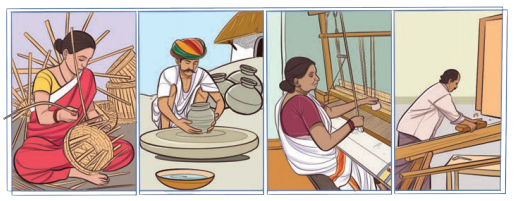
Answer:
The pictures show the following vocations: Basket maker, potter, weaver and carpenter. Five more vocations are: Blacksmith, tailor, fisherman, farmer, goldsmith.
Question 2.
Work in pairs. Discuss the following questions and share your answers with your classmates and teacher.
i. What is common among these pictures?
Answer:
All the pictures show people engaged in traditional skill-based work such as basket making, pottery, weaving and carpentry. In each picture, the workers are using their hands and specialised skills to create useful objects. These objects require practice, patience and special skills.
ii.We refer to such skill-based work as V _ _ a _ _ o _ s.
Answer:
Vocations
iii. Mention a few differences between handmade and machine-made products.
Answer:
Handmade products are made by people ! using their hands and traditional tools, whereas machine-made products are produced using machines in factories.
Some important differences are:
- Uniqueness: Handmade products look slightly different from each other, while machine-made products are usually identical.
- Production speed: Handmade goods take more time to be produced, whereas machines can produce large quantities quickly.
- Cost: Handmade items are often more expensive, while machine-made products are usually cheaper.
[Note: The above answers are given for reference. Students are expected to do these activities on their own.]
Check Your Understanding
Question 1.
Do you think pot making is easy? If yes, why? If no, why not?
Answer:
No, pot making is not easy. It requires a lot of physical effort, skill and patience. The clay ! has to be collected from far away, prepared j carefully, shaped properly, and then heated in a kiln to make it strong. As Arenla says in l the story, she has to ‘carry the heavy load j uphill’ and that ‘pounding the stubborn clay…is also tedious’. Even a small mistake during the process can spoil the entire batch of pots.
Question 2.
Would Sentila be able to fulfil her dream of becoming a pot maker? Explain.
Answer:
Yes, Sentila may be able to fulfil her dream, She shows great interest and determination in learning the craft. She secretly watches expert potters at work and carefully observes their techniques, which shows her strong desire to become a pot maker.
Question 3.
Do you think Mesoba and Arenla would support Sentila? Give a reason.
Answer:
Mesoba seems willing to support Sentila as he tells the village elders, “You will soon see Sentila making the best pots in the village”. Although Arenla is reluctant at first, the elders remind the family that such traditional skills should be passed on to the next generation, as well as to anyone who wishes to learn, so she may eventually support Sentila.
Class 9 English Kaveri Chapter 2 Question Answer
Question 4.
Do you think Onula’s support helped Sentila? If yes, why? If no, why not?
Answer:
Yes, Onula’s support helped Sentila. She encouraged Sentila and taught her how to work with confidence and composure. Her guidance helped Sentila understand the method of shaping the clay.
Question 5.
Sentila observes her mother making pots. What does this tell us about her?
Answer:
This shows that Sentila is eager to learn and very observant. She pays close attention to her mother’s techniques so that she can improve her own skills.
Question 6.
Arrange the following events of the story in the correct sequence. Share your answer with your classmates and teacher.
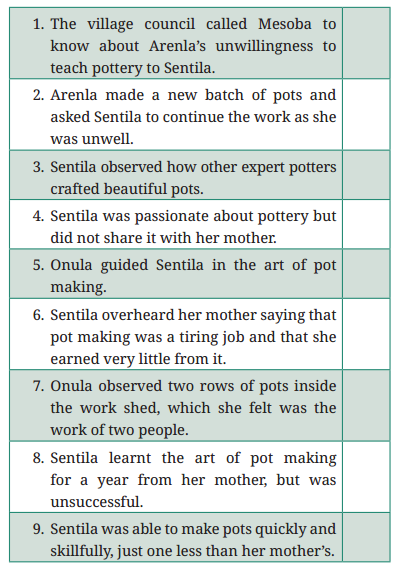
Answer:
| i. | The village council called Mesoba to know about Arenla’s unwillingness to teach pottery to Sentila. | iv |
| ii. | Arenla made a new batch of pots and asked Sentila to continue the work as she was unwell. | vii |
| iii. | Sentila observed how other expert potters crafted beautiful pots. | iii |
| iv. | Sentila was passionate about pottery but did not share it with her mother. | i |
| V. | Onula guided Sentila in the art of pot making. | vi |
| vi. | Sentila overheard her mother saying that pot making was a tiring job and that she earned very little from it. | ii |
| vii. | Onula observed two rows of pots inside the work shed, which she felt was the work of two people. | ix |
| viii. | Sentila learnt the art of pot making for a year from her mother, but was unsuccessful. | V |
| ix. | Sentila was able to make pots quickly and skillfully, just one less than her mother’s. | viii |
Critical Reflection
I. Read the extracts given below and answer the questions that follow.
1. Pounding the stubborn clay inside bamboo cylinders to soften it, is also tedious. So many times I’ve dropped the mould out of sheer exhaustion and have had to start all over again. It takes months to bring out a batch of pots after so much labour. And the reward? A few rupees. But if Sentila learns weaving, she can make much more money besides providing enough cloth for the family. Weaving is not messy like pot making and can be done indoors in all seasons. Also, the time spent on weaving one shawl is much less and the return is handsome.
i. Choose the correct reason for the given assertion.
(A): The effort in making pots is far greater than the returns.
(A) The process of pot making is quite tiresome and long, and one hardly earns much.
(B) The process of pot making is exhausting, takes a long time, yet gives a sense of satisfaction.
Answer:
(A) The process of pot making is quite tiresome and long, and one hardly earns much.
ii. Why does Arenla want Sentila to learn weaving?
Answer:
Arenla wants Sentila to learn weaving because it earns more money, requires less effort, and can be done indoors in all seasons.
iii. State one advantage that weaving has over pot making, as per the extract.
Answer:
Weaving takes less time and gives better returns than pot making.
iv. Choose the sentence that uses the word ‘handsome’ in the same way as in the extract.
(A) My father is a handsome man.
(B) They will make a handsome profit selling this property.
Answer:
(B) They will make a handsome profit selling this property.
v. ‘And the reward?’ What is the author’s purpose of using a question mark here?
Answer:
The question mark is used to show Arenla’s disappointment and frustration about the very small reward she receives after so much hard work.
2. Onula saw her taking out some clay and the implements from her basket quietly. She watched Sentila’s clumsy efforts to make a pot and noticed that Sentila was too tense. As a result, the clay seemed unable or unwilling to yield the right shape. When Sentila wearily let the misshapen lump fall flat on the ground, Onula went to her and said, “Don’t worry, little one, I shall teach you how to make a perfect pot.” Sentila watched in amazement as Onula fashioned a beautiful pot and asked her to try again.
i. Complete the sentence with an appropriate reason.
Onula feels Sentila’s effort at making a pot is clumsy because _____________.
Answer:
she is too tense and lacks confidence while shaping the clay
ii. Choose the correct option to complete the following sentence.
‘Don’t worry, little one, I shall teach you how to make a perfect pot.’ This shows that Onula was ________.
(A) sincere and generous
(B) forgiving and thoughtful
(C) thoughtful and generous
(D) forgiving and sincere
Answer:
(C) thoughtful and generous
iii. Which among the following is the effect of a cause?
(A) As a result, the clay seemed unable or unwilling to yield the right shape.
(B) Onula saw her taking out some clay and the implements from her basket quietly.
Answer:
(A) As a result, the clay seemed unable or ; unwilling to yield the right shape.
iv. ‘Onula fashioned a beautiful pot.’ Here, the word ‘fashioned’ means ______. (created/styled)
Answer:
created
v. How might Sentila have felt when she saw the misshapen lump fall flat on the ground’?
Answer:
Sentila might have felt disappointed, frustrated and discouraged because her attempt at making a pot had failed.
II. Answer the following questions.
Question 1.
Describe the process of pot making followed by expert pot makers, as observed by Sentila.
Answer:
Sentila observed that pot makers first mixed clay with water and pounded it to soften it. Then they shaped the clay carefully using j their hands and a spatula while rotating it. After shaping, the pots were refined, sun-dried, and finally fired in a kiln to make them strong and durable.
Question 2.
What warning was given to Mesoba by the village council?
Answer:
The village council warned Mesoba that Arenla must teach Sentila the skill of pot ; making, as it was a traditional craft passed down through generations. They reminded him that such skills belong to the community and must be shared with those j who wish to learn.
Question 3.
How did Sentila feel when she failed at pot making even after a year of training with her mother?
Answer:
Sentila felt ashamed and frustrated when she failed to learn pot making even after a year of practice with her mother.
Question 4.
‘Onula stood there for a long time as if trying to absorb a new phenomenon’. Explain.
Answer:
Onula saw two identical rows of pots in the shed and realised that Sentila had finally mastered the craft. She was amazed because the pots made by Sentila were as perfect as those made by Arenla, showing that Sentila had truly become a skilled pot maker.
Question 5.
‘The tradition and history of the people did not belong to any individual,’ what does this symbolise?
Answer:
The above statement symbolises that traditional knowledge and skills are part of a community’s heritage. They should be shared and passed on to future generations, rather than being kept by one person.
Question 6.
What is the significance of the concluding line of the story, ‘A new pot maker was born’?
Answer:
The line means that Sentila had finally mastered the craft of pot making. It also shows that the tradition of pottery will continue through the next generation.
Question 7.
What is the role of perseverance in pursuing one’s dreams? Elaborate with reference to Sentila.
Answer:
Perseverance plays an important role in achieving one’s dreams. Sentila faced many difficulties and failed several times while learning pot making. However, she did not give up and continued to observe, practise and learn. Her determination finally helped her become a skilled pot maker.
Vocabulary and Structures
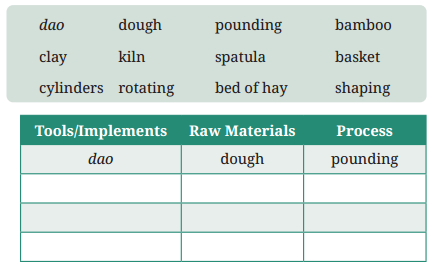
I. Classify the words/phrases given in the box as shown in the table below. One example for each category has been done for you.
II Notice the use of the following words in the text.

Answer:
| Tools / Implements | Raw Materials | Process |
| dao | dough | pounding |
| spatula | clay | shaping |
| basket | bamboo | rotating |
| cylinder | bed of hay | |
| kiln |
II. Work in pairs and find the meanings of the following words related to economy. You may refer to a dictionary.
Now, frame sentences using each word.

Answer:
Bankrupt
Meaning: Unable to pay one’s debts; having no money left to run a business.
Sentence: The company went bankrupt after suffering heavy losses.
Credit
Meaning: Money that a bank or lender allows someone to borrow and pay back later.
Sentence: She bought the laptop on credit and will repay the money in installments.
Currency
Meaning: The system of money used in a country.
Sentence: The Indian currency is the rupee.
Debt
Meaning: Money that a person or organisation owes to someone else.
Sentence: The farmer worked hard to repay his debt.
Fiscal
Meaning: Related to government money, taxes, and financial matters.
Sentence: The government introduced new fiscal policies to improve the economy.
Inflation
Meaning: A rise in the prices of goods and services over time.
Sentence: Due to inflation, the cost of living has increased.
Investment
Meaning: Money put into a business or activity in order to earn profit.
Sentence: He made an investment in a small pottery business.
Interest
Meaning: A percentage-based charge paid for the use of borrowed money or the return (amount of money) earned from invested capital.
Sentence: My brother earned interest on his bank savings account. He will use it to pay interest on his home loan.
Question 1.
Complete the following sentences with suitable noun clauses.
Answer:
- The elders emphasised that traditional skills should be preserved by the younger generation.
- Mesoba explained why Arenla was reluctant to let Sentila learn pottery.
- Onula’s promise was that she would teach Sentila the art of pot making.
- Sentila observed her mother carefully when she was shaping the mouth of the pot, which helped her understand the technique better.
- The kiln, where the pots were fired/loaded, required careful attention to prevent over- or-under firing.
Question 2.
Read the following sentences from the text. Underline the main clause and circle the subordinate clause.
i. Arenla took Sentila to the riverbank where the grey and red clay was found.
ii. She started on the next one, and like a sprinter who had suddenly found momentum…
iii. …. skills such as pot making, which not only catered to the needs of the people…
Answer:
i. Main clause: Arenla took Sentila to the riverbank
Subordinate clause: where the grey and red clay was found
ii. Main clause: She started on the next one
Subordinate clause: who had suddenly found momentum
iii. Main clause: skills such as pot making
Subordinate clause: which not only catered to the needs of the people
Question 3.
Complete the following sentences with suitable relative clauses.
i. Sentila, whose ________ practised the craft diligently.
ii. The village council, where _______, sought an explanation for Arenla’s reluctance.
iii. The potter’s hands, which ________, shaped the clay into beautiful creations.
iv. Arenla, her mother, wanted her to learn weaving, which _______.
v. Mesoba went home and discussed the matter with Arenla, who ___________.
Answer:
i. curiosity about pottery grew every day
ii. the elders gathered to discuss important matters
iii. moved skillfully over the clay
iv. was considered a respectable craft in the village
v. listened to him patiently
Question 4.
Find out some more determiners from the text.
Answer:
some, many, the, a, another, these
Question 5.
Fill in the banks with suitable determiners. The first two blanks have been done for you.
(A) The florist arranged five bouquets for her clients, that were displayed in ______ elegant floral shop.
B. The carpenter crafted ____________ unique tables, and _____________________ became the centrepiece in ____________________ furniture collection.
C. ____________ of ____________ apprentices in ____________ culinary class demonstrated ____________ knife skills during the intense cooking session.
D. ____________ of ____________ sculptures were displayed at _______________ art exhibition, showcasing ___________ diverse artistic skills.
Answer:
(A) The florist arranged five bouquets for her clients, that were displayed in an elegant floral shop.
(B) The carpenter crafted several unique tables, and each became the centrepiece in his furniture collection.
(C) Each of the apprentices in the culinary class demonstrated their knife skills during the intense cooking session.
(D) Several/Many of the sculptures were displayed at the art exhibition, showcasing their diverse artistic skills.
Listen and Respond
I. You will listen to a man speak about stone statues. As you listen, complete the given paragraph by filling in the blanks with the exact words you listen to. (Transcript for teacher on Textbook page 261)
Answer:
A statue is carved to create a shape that is
1. visually interesting three-dimensional. Among the many things stone is used for making stone
2. sculptures is one of them. India has some of the most
3. fascinating and mesmerising stone sculptures, as is obvious from its many stone monuments across the country.
II. You will now listen to the man speaking about some steps involved in making stone statues. As you listen, select the six correct steps out of the nine given.
1. carve to remove large unwanted portions of the stone
2. set up the different tools
3. measure the weight and dimensions of the statue
4. leave the statue in water to firm up overnight
5. refine the creation within the stone
6. choose the stone
7. begin carving from the centre
8. detach the creation from the stone as the final statue
9. work to bring out the imagined shape
Answer:
The correct steps are as follows:
6, 3,1, 9, 5, 8
Speaking Activity
Work in pairs and choose two characters from the story—Sentila and one other character [Arenla, Mesoba, Onula, or a village elder].
Prepare to speak from the chosen character’s perspective based on information from the story and the understanding of the intentions of the characters.
Prepare a role-play between Sentila and the chosen character. The conversation between the characters should cover the following points.
- Sentila’s desire to learn pot making
- the challenges she faces
- the advice or perspective the other character offers.
Students can use direct quotes from the story and creatively expand on the characters’ thoughts and feelings.

You may use the following sentence prompts.
- I feel/felt __________ because…
- I wish/wished __________ because…
- When you said/did __________, it made me feel/think __________ because…
Answer:
Characters: Sentila and Onula
Sentila: I feel very happy when I see people making pots because I have always wanted to become a pot maker like my mother and grandmother.
Onula: I understand how you feel, Sentila. Pot making requires patience and confidence, but with practice you will surely learn it.
Sentila: I feel disappointed because even after trying many times, I cannot shape the j clay properly.
Onula: That happens to everyone in the beginning. When you work with clay, you must stay calm and believe in yourself.
Sentila: I wish my mother would believe that I can become a good pot maker because it is my dream.
Onula: Your mother only worries because pot making is difficult work. But if you keep practising and observing carefully, you will improve.
Sentila: When you showed me how to shape the pot, it made me feel confident because finally understood what I was doing wrong.
Onula: I am glad to help you. Remember, patience and perseverance are the keys to mastering any skill.
[Note: Taking reference from the above role-play, students are expected to enact a role-play of their own]
Writing Task
Reflctive Writing – Identifying Skills and Passion
Reflctive writing encourages introspection and thoughtful exploration of personal experiences, skills, and aspirations. It helps individuals gain deeper insights into themselves and their goals through structured reflction.
I. Follow the steps given below to create a write-up about your skills and passions.
Step 1: Introduction
Reflect on your passions and the skills you currently possess or are developing. Consider why these activities or interests are meaningful and enjoyable to you.
Step 2: Describing Skills
Describe specific activities or practices you engage in to nurture your skills. This could include hobbies, classes (art, music, coding, etc.), workshops, or personal projects.
Step 3: Passion into profession
Identify which of these skills you believe have the potential to turn your passion into a profession. Explain why you think these skills are crucial or advantageous in your chosen field.
Step 4: Examples and reflction Provide examples or anecdotes that illustrate how your skills and passions complement each other. Reflect on how these experiences have shaped your career aspirations and personal growth.
Step 5: Conclusion
Summarise your reflections. Discuss any insights gained about yourself, your skills, and your career ambitions through this exercise.
Answer:
Everyone has certain interests and abilities that make them feel happy and motivated. One of my greatest passions is drawing and j creative art. I enjoy expressing my ideas through colours and designs. Art helps me relax and allows me to think creatively. Over time, I have realised that this interest is not just a hobby but also a skill that I can continue to develop.
To improve my drawing skills, I practise sketching regularly in my free time. I also watch online tutorials and observe different styles of art to learn new techniques. Sometimes, I participate in school art competitions and exhibitions. These activities help me improve my creativity, patience, and attention to detail.
I believe that my passion for art can one day become my profession. Many careers today require creativity, such as graphic design, animation, and illustration. These fields value people who can think creatively and express ideas visually. Therefore, developing my artistic skills can help me pursue a career related to art in the future. For example, last year I designed a poster for a school event. My teacher appreciated my work and encouraged me to continue practising. Experiences like this boost my confidence and motivate me to improve further. They also help me understand how my passion and skills can work together to achieve my goals.
Through this reflection, I realised that identifying and developing our skills is very important. When we work on something we truly enjoy, it becomes easier to improve and succeed. My passion for art has helped me grow more creative and confident, and I hope to continue developing this skill in the future.
Learning Beyond the Text
Question 1.
Find out about the different styles of indigenous pottery of your region and other regions of our country.
Answer:
Bankura Pottery — West Bengal
Description: A world-renowned terracotta craft centered in the village of Panchmura.
Key Features: Best known for the Bankura Horse, characterised by its unique elongated neck, erect ears, and highly stylised. symmetrical form.
Artistic Style: The work is defined by traditional folk motifs and hand-modellebi figurines rather than simple utility shapes.
ii. konyak Pottery — Nagaland
Description: A traditional trifal craft primarily practiced by Konyak Naga women.
Technique: Uniquely hand-shaped using the coil or pinch method without the use of a potter’s wheel.
Texture and Use: Features a characteristically coarse, earthy texture. It was traditionally used for cooking and grain
storage, though the practice is currently in decline due to modern alternatives.
(Note: The above answer is given for reference. Students are expected to do this on their own)
Question 2.
Match the pictures with the pottery it represents.
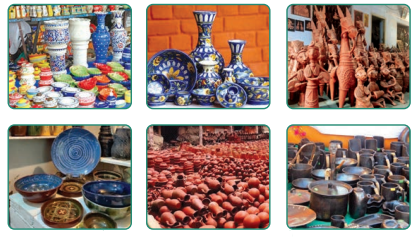
Answer:
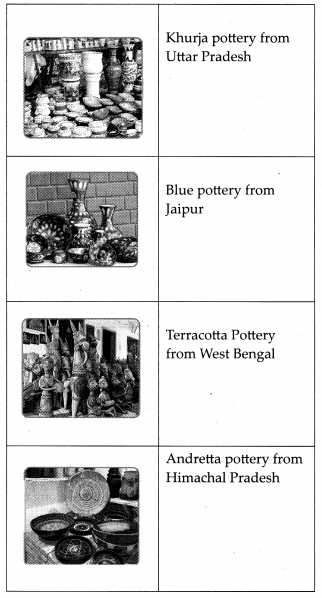
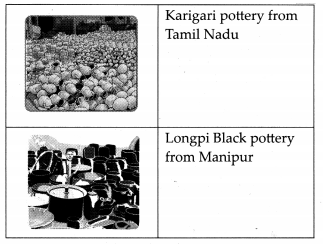
Question 3.
Read the story ‘Quality’ by John Galsworthy. Write its review and make a presentation highlighting the decline of traditional crafts and skills vs. industrialisation and mass-produced goods.
Answer:
Review: ‘Quality’ by John Galsworthy
- The story by John Galsworthy centres on Mr. Gessler, a dedicated German bootmaker.
- He believes in perfection and creates high- quality handmade boots.
- His small shop struggles because his work is time-consuming and costly.
- Industrialisation introduces cheap, machine- made boots that attract more customers.
- Despite hardship, he refuses to compromise on quality.
- He eventually dies due to overwork and poverty.
- The story highlights the conflict between craftsmanship and mass production.
- It emphasises that true quality requires patience, skill, and dedication.
Presentation:
Decline of Traditional Crafts and Skills vs. Industrialisation and mass-produced goods:
Slide 1 – Introduction
- Traditional crafts are inherited skills requiring time and effort
- Industrialisation changed production methods
Slide 2 – Traditional Craftsmanship
- Handmade, unique and high-quality products
- Craftsmen take pride in their work E.g. Mr. Gessler’s boots
Slide 3 – Industrialisation
- Machine-made goods are fast and affordable
- Focus on quantity and profit
Slide 4 – Impact
- Artisans lose customers
- Handmade crafts decline
- Skills begin to disappear
Slide 5 – Message
- Quality and dedication matter
- Craftsmanship needs patience and passion
- Support traditional artisans
Slide 6 – Conclusion
- Industrialisation offers convenience
- Traditional crafts must be preserved
- Value quality over quantity
[Note: The above pointers are given for reference. Students are expected to do this activity on their own.]
The Pot Maker Class 9 Extra Questions and Answers
The Pot Maker Short Question Answer
Question 1.
Why is pottery considered an important cultural tradition in the story?
Answer:
Pottery represents the skills and heritage of the community. The elders believe that such traditional crafts connect people to their history and identity. Therefore, they encourage Sentila’s family to continue teaching the craft.
Question 2.
How does the story show respect for traditional craftsmanship?
Answer:
The story portrays pot making as a valuable art that requires dedication and skill. It highlights how such crafts are passed down through generations and deserve appreciation and preservation.
Question 3.
Why do you think Arenla left Sentila alone in the shed to continue making pots? Give a reason based on the story.
Answer:
It appears that Arenla left Sentila alone intentionally so that she could practise independently. By asking her to continue working despite her hesitation, Arenla may have wanted her to develop confidence, coordination, and mastery through self-effort.
Question 4.
Both Arenla and Onula play important roles in Sentila’s learning. Compare their ways of teaching and explain how each contributes to Sentila’s growth as a pot maker.
Answer:
Arenla teaches through restraint and silent demonstration, her reluctance subtly shaping Sentila’s learning through observation and perseverance. In contrast, Onula’s supportive guidance and encouragement nurture Sentila’s confidence. Together, these contrasting approaches foster both technical skill and inner assurance, enabling Sentila’s transformation into a skilled pot maker.
Question 5.
State any three themes explored in the story “The Pot Maker”. Briefly support each with an example from the text.
Answer:
The story highlights perseverance through Sentila’s repeated efforts to learn pot making. It reflects dignity of labour in Arenla’s hard work despite low earnings. It also shows cultural continuity, as the village stresses passing traditional skills to the next- generation.
The Pot Maker Long Question Answer
Question 1.
Explain how the story portrays the relationship between tradition and learning.
Answer:
The story beautifully illustrates how traditional skills are preserved through generations. Sentila dreams of becoming a pot maker like her mother and grandmother, showing that crafts are passed down within families. Although her mother Arenla initially resists teaching her, the village elders firmly remind Mesoba that such skills belong not to individuals but to the entire community. Sentila’s learning journey is gradual — she first observes expert potters, then receives guidance from Onula, and finally practises under her mother’s supervision. Despite repeated failures, her persistence eventually leads to mastery. Through Sentila’s journey, the story conveys that learning traditional skills is not merely acquiring a craft but becoming part of a living cultural legacy that connects generations.
Question 2.
Analyse the role of community values in shaping Sentila’s learning experience.
Answer:
The community plays an important role in preserving traditional skills in the story. The village elders firmly believe that crafts like pottery are not merely individual occupations but a reflection of the people’s shared history and cultural heritage. When Arenla shows reluctance to teach Sentila, the village council summons Mesoba and reminds him that it is the duty of every skilled artisan to pass on their knowledge — not only to their own children but to anyone who wishes to learn. This intervention by the elders eventually persuades Arenla to begin teaching Sentila. Furthermore, Onula’s kind and patient guidance provides Sentila with the confidence and encouragement she needs to succeed. Thus, the story clearly shows that community values and collective responsibility play a vital role in ensuring that traditional knowledge and cultural skills are carried forward from one generation to the next.
Question 3.
How do different characters in the story influence Sentila’s journey of learning pottery? Discuss with examples.
Answer:
Several characters play an important role in Sentila’s journey of learning pottery. Arenla, her mother, initially discourages her from learning the craft because she believes pottery is difficult and does not earn much money. However, she eventually begins teaching ‘Sentila the basic skills. Mesoba supports Sentila and believes she can become a skilled pot maker. The village elders remind the family that traditional crafts should be passed on to the next generation. Onula plays a particularly important role by encouraging Sentila and guiding her patiently when she feels discouraged. Together, these characters influence Sentila’s learning and help her eventually succeed in mastering the craft.
Question 4.
How did Sentila’s feelings change from the beginning to the end of the story?
Answer:
At the beginning, Sentila feels curious and deeply determined to learn pot making, even secretly observing the potters despite her mother’s disapproval. As she begins training, repeated failures leave her frustrated and disheartened. However, Onula’s gentle guidance restores her confidence and helps her understand the process better. Gradually, through careful observation of her mother and persistent, practice, Sentila gains control and skill. When she finally works with speed and dexterity, she experiences a breakthrough and a sense of achievement. This moment of success, however, is immediately overshadowed by grief when she discovers her mother’s death, making her emotions shift from joy to sorrow, yet marking her transformation into a true pot maker.
Question 5.
What does Sentila mean when she says, “I did not wish it to happen this way; it simply came to me. Please forgive me.”? Analyse how this line selects both her achievement and her emotional conflict in the story.
Answer:
When Sentila says the above line, she expresses that her ability to make pots developed naturally after long observation and practice, without a conscious realisation of when she mastered it. This marks her achievement, as she finally attains the skill she had long desired. However, this moment is filled with emotional conflict. She feels guilty because her success coincides with her mother’s death, making her believe that her learning has come at a painful cost. Her plea for forgiveness reflects her deep love, respect, and dependence on her mother. Thus, the line captures both her transformation into a skilled pot maker and the sorrow that accompanies this realisation.
Question 6.
Imagine you are a member of Sentila’s village. Explain why traditional crafts should be protected.
Answer:
Traditional crafts represent the culture, history, and identity of a community. They show the creativity and skills of people who have practised these crafts for generations. If such traditions disappear, an important part of our heritage will be lost. Protecting these crafts also supports artisans who depend on them for their livelihood. By encouraging young people like Sentila to learn these skills, communities can ensure that these traditions continue in the future. While encouraging them, I would acknowledge the struggles that artisans have to face and come up with ideas like showcasing their craft and holding monthly exhibitions for people to buy their handicrafts.
Question 7.
Evaluate Arenla’s decision to discourage Sentila from learning pottery. Do you think she was right? Give reasons.
Answer:
Arenla’s decision to discourage Sentila from learning pottery was practical to some extent. She knew from her own experience that pot making involved hard physical labour, long hours of effort, and very little financial reward. She wanted her daughter to choose weaving, which was easier and more profitable. However, Arenla overlooked Sentila’s strong interest and passion for pottery. By not supporting her initially, she made Sentila struggle and l&arn the craft secretly. While her concern for her daughter’s well-being was understandable, her decision was not entirely right, as it ignored Sentila’s dreams and natural inclination towards the craft.
Question 8.
Imagine Sentila had stopped trying after failing for a year. How would the story have been different? Write your answer in 3-4 lines.
Answer:
If Sentila had stopped trying after failing for a year, she would never have learned the art of pot making. Her dream of becoming a potter would have remained unfulfilled, and she might have been forced to take up weaving despite her lack of interest. The valuable skill passed down through generations in her family might not have continued, especially if no one else chose to learn it. She would also have missed the opportunity to grow stronger through perseverance and self-belief. The story would then convey a message of giving up rather than determination, and the powerful idea that patience and practice lead to success would have been lost.