Winds of Change Class 9 Question Answer
Reflect and Respond
I. Does anyone in your family use a hand fan? What do you call it in your language? What is it made of?
Answer:
My grandparents have wide range of hand fans which they often use during summer or when there’s a light cut. We call it ‘Bena’. It is generally made of bamboo, palm leaves, clothes and vetiver grass.
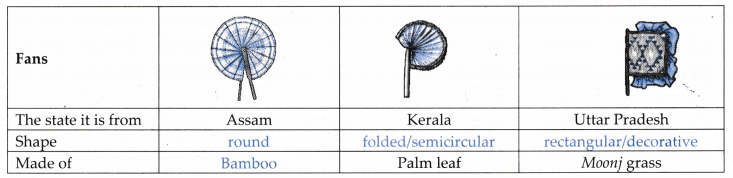
II. Work in pairs. Study the pictures given below carefully and complete the information. Discuss your answers with your classmates and teacher.
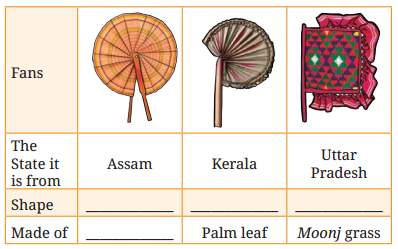
Answer:
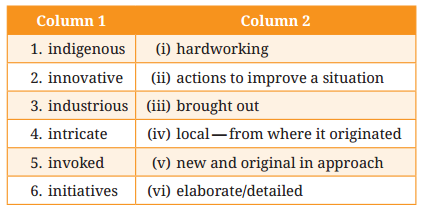
III. Work in pairs. Match the underlined words in Column 1 with their meanings in Column 2 given below. Share your answers with your classmates and teacher.
I visited the crafts fair yesterday. It was a wonderful experience. Each indigenous artefact was an innovative creation of industrious craftspersons with its intricate design. It invoked a sense of respect for the initiatives taken by the government to showcase them.
Answer:
(1 – iv), (2 – v), (3 – i), (4 – vi), (5 – iii), (6 – ii)
Check Your Understanding
Question 1.
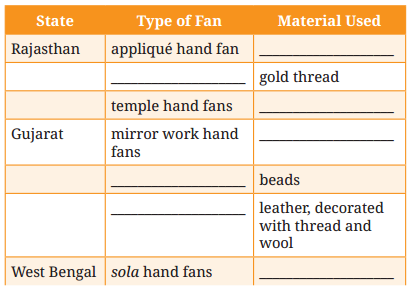
Work in pairs to complete the table on pankha. Share your answers with your classmates and teacher.
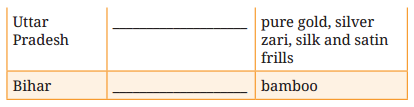
Answer:
| State | Type of Fan | Material Used |
| Rajasthan | applique hand fan | fabric |
| zardozi hand fan | gold thread | |
| temple hand fans | brass | |
| Gujarat | mirror work hand fans | cotton |
| beads hand fan | beads | |
| leather hand fans | leather, decorated with thread and wool | |
| West Bengal | sola hand fans | sola (pith) |
| Uttar Pradesh | phadh hand fans | pure gold, silver zari, silk and satin frills |
| Bihar | bamboo hand fans | bamboo |
Class 9 English Kaveri Chapter 3 Question Answer
Critical Reflection
I. Read the extracts given below and answer the questions that follow.
Question 1.
Over tune, pankhas became significant cultural goods distributed through trade routes. They were considered exotic and stylish. Although there was substantial commonality in their use across India, different villages and towns developed their own varieties of traditional pankhas. Each place developed pankhas with distinct materials or a variety of intricate designs, that set them apart from one another.
i. State whether the following sentence is true or false.
Pankhas were one of the most popular items ! of commerce.
Answer:
False
Hint: Pankhas are mentioned to be significant cultural goods of trade however the comparative part about being ‘one of the most popular items of commerce’ cannot be inferred in the extract.
ii. Why has the word ‘traditional’ been used to describe pankhas?
Answer:
The word ‘traditional’ is used because pankhas have been used in India for a long ! time. They are part of cultural practices ; passed down through generations.
iii. Complete the following statement.
The sentence ‘They were considered exotic and stylish’ is an opinion and not a fact because ___________.
Answer:
terms like ‘exotic’ and ‘stylish’ are based on personal perception and may vary from person to person
iv. Infer one reason for commonality in the use of pankhas across India.
Answer:
Pankhas were commonly used across India due to the hot climate and need for cooling.
v. Select which one of the two statements is the correct assertion for the given reason.
Reason: Pankhas were made of indigenous materials, unique to the region, with elaborate designs.
(A) Each kind of pankha could be distinguished from the other.
(B) Pankhas were used by many people.
Answer:
(A) Each kind of pankha could be distinguished from the other.
Question 2.
With time and the advent of technology and innovative creations, the beautiful culture of pankhas runs the risk of slowly losing its presence among Indians. Once made for personal use, over time this handicraft has transformed into a commercial business and now provides some form of livelihood to India’s artisans. The slight increase in popularity and demand is significantly factored by the different versions of the pankha being crafted.
i. Infer one negative impact of technological advancement on pankha.
Answer:
Technological advancement has reduced the use of traditional pankhas, leading to a decline in their cultural importance.
ii. Complete the statement with an appropriate reason.
The writer refers to ‘pankhas’ not just as an object but as a ‘culture’ because _____.
Answer:
pankhas represent traditions, craftsmanship, and the cultural identity of different regions.
iii. Select a line from the extract which depicts how the role of the pankha has changed over the years.
Answer:
“Once made for personal use, over time this handicraft has transformed into u commercial business.”
iv. List one way in which the increase in demand of pankhas might benefit artisans,
Answer:
Increased demand provides artisans with more income and employment opportunities.
v. Select the factor that has contributed to the commercialisation of pankhas.
(A) cultural preservation
(B) economic demand
(C) technological advancements
(D) artisan initiative
Answer:
(B) economic demand
II. Answer the following questions.
Question 1.
How does the title ‘Winds of Change’ capture the essence of the chapter?
Answer:
The title ‘Winds of Change’ reflects both the literal and symbolic role of pankhas. Traditionally used for cooling, pankhas now represent cultural heritage and evolving craftsmanship. The chapter shows how their use has shifted from daily utility to decorative and commercial purposes, highlighting changes in lifestyle, technology and cultural values.
Question 2.
Support the following statement with any two relevant examples from the chapter.
“The structure and design of pankhas are testimony to the cul tural identity of the region’.
Answer:
The design of pankhas reflects regional identity. For example, Rajasthan’s zardozi fans use gold thread and rich embroidery, showing royal heritage. Gujarat’s mirror work fans display local craft traditions and vibrant culture. These examples show how each region expresses its identity through materials and design.
Question 3.
The chapter mentions pankhas running the risk of slowly losing their presence among Indians. Evaluate how the balance between preserving traditional craftsmanship and incorporating innovative designs in the creation of pankhas will help in this regard.
Answer:
Balancing tradition and innovation can help preserve the art of pankha-making. Traditional designs maintain cultural identity, while modern styles attract new buyers. Innovative designs can increase demand without losing authenticity. This balance ensures that the craft remains relevant and continues to support artisans.
Question 4.
How might initiatives such as pankha- making workshops contribute to the preservation of this traditional craft?
Answer:
Pankha-making workshops preserve the craft by transferring traditional skills to younger generations, preventing them from being lost. They build cultural awareness and appreciation among participants, create livelihood opportunities for artisans, and generate renewed public interest, ensuring the craft remains relevant and alive in modern times.
Question 5.
The writer mentions celebrating pankhas in the concluding part of the chapter. Assess how this could be beneficial to artisans and the craft.
Answer:
Celebrating pankhas increases public awareness and appreciation of the craft, boosting demand for handmade products. This directly improves artisans’ income and ensures their livelihood. It also helps preserve regional cultural heritage, encourages younger generations to take up the craft, and motivates people to consciously value handmade artistry over mass-produced alternatives.
Question 6.
How does the restriction of the use of pankha for decorative purposes reflect the changing cultural role of these traditional fans in modern India?
Answer:
The shift of pankhas from functional cooling tools to decorative items reflects how modern technology has replaced their practical role. However, they now serve as cultural symbols, representing regional identity and artistic heritage. While electric fans have taken over, pankhas continue preserving tradition by embodying India’s rich craft culture and diverse regional aesthetics.
Vocabulary and Structures in Context
I. Read the following pairs of words from the text. Classify the pairs of words given in the following categories. One example has been done for you.
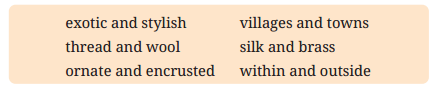
1. Classify the pairs of words given above in the following categories. One example has been done for you.
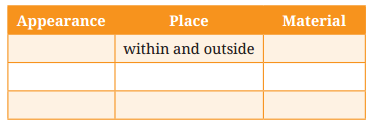
Now, fid more such word pairs from the text and share them with your classmates and teacher.
Answer:
| Appearance | Place | Material |
| exotic and stylish | within and outside | thread and wool |
| ornate and encrusted | villages and towns | silk and brass |
shapes and sizes, beads and stones
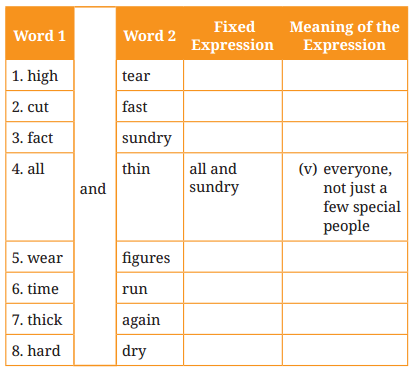
II. Find the word pairs for the following fixed expressions. Write the meanings of these expressions by selecting them from the box given in the textbook Now, match the following meanings with the correct word pairs created. One example has been done for you.
Some common expressions with ‘and’ have a fiedorder which cannot be changed. The shortest expression comes fist. For example, bread and butter (*not butter and bread)
Answer:
| Word 1 | and | Word 2 | Fixed Expression | Meaning of the Expression |
| 1. high | tear | high and dry | i. in a difficult situation, without help or money | |
| 2. cut | fast | cut and run | vii. to make a quick or sudden escape | |
| 3. fact | sundry | fact and figures | iii. accurate and detailed information | |
| 4. all | thin | all and sundry | v. everyone, not just a few special people | |
| 5. wear | figures | wear and tear | ii. damage to an object due to normal use | |
| 6. time | run | time and again | vi. often; on many or all occasions | |
| 7. thick | again | thick and thin | iv. even when there are problems or difficulties | |
| 8. hard | dry | hard and fast | fixed or strict |
Read the following word combinations from the text.
- sustainable livelihood
- aesthetically pleasing
- appreciating the culture
The given phrases are conventional combinations just like fixed expressions. Such combinations are called collocations.
III. Choose the appropriate word collocations for the following sentences.
i. The students have to (take/give) the English exam tomorrow.
Answer:
take
ii. The interviewer asked the candidate to (take/have) a seat.
Answer:
have
iii. My scooter (dashed against/ran into) a car.
Answer:
ran into
iv. I must (take/own) responsibility for my success.
Answer:
take
v. I would like to (tone up/improve) my grammar.
Answer:
improve
IV. Read the following sentences. Underline the verbs.
Question 1.
In modern times, pankhas have become traditional craft items in India.
Answer:
In modern times, pankhas have become traditional craft items in India.
Question 2.
Gujarat’s industrious home-based women workers have worked tirelessly in the handicraft of pankha-making.
Answer:
Gujarat’s industrious home-based women workers have worked tirelessly in the handicraft of pankha-making.
Question 3.
Many tribes in India have adopted this handicraft.
Answer:
Many tribes in India have adopted this handicraft.
Question 4.
Once made for personal use, this handicraft has transformed into a commercial business.
Answer:
Once made for personal use, this handicraft has transformed into a commercial business.
Fill in the blanks with the present perfect form of verbs in the following paragraph. One example has been done for you.
Puppets have long fascinated (fascinate) audiences worldwide. Puppeteers (i) ______ (create) intricate characters and captivating stories with their skillful artistry. They (ii) __________ (master) the delicate movements that bring these lifeless fiures to life, entertaining both children and adults. Over the years, puppetry
(iii) ___________ (evolve), using modern technology while preserving traditional techniques. Many puppeteers (iv) __________ (pass) down their craft through generations, ensuring its continuity. They (v) ________ (perform) in theatres, on television, and at festivals, conveying important cultural narratives.
Answer:
Puppets have long fascinated (fascinate) audiences worldwide. Puppeteers (i) have created (create) intricate characters and captivating stories with their skillful artistry. They (ii) have mastered (master) the delicate movements that bring these lifeless figures to life, entertaining both children and adults. Over the years, puppetry (iii) has evolved (evolve), using modern technology while preserving traditional techniques. Many puppeteers (iv) have passed (pass) down their craft through generations, ensuring its continuity. They (v) have performed (perform) in theatres, on- tele vision, and at festivals, conveying important cultural narratives.
Listen and Respond
I. You will listen to a dialogue between a boy and a girl discussing which type of pankha they should choose as a gift. As you listen, choose four statements out of seven that are true from 1-7 given below. (Transcript for teacher on Textbook page 263)
- Rohan thinks Grandma prefers heavier items because they feel more substantial.
- Priya suggests getting a pankha that can be easily moved around.
- Rohan believes Grandma enjoys sitting in the verandah during the evenings.
- Priya knows Grandma likes to keep special items close to her.
- Rohan thinks a pankha with intricate designs would be too delicate for Grandma’s liking.
- Priya suggests choosing between a bamboo pankha with beadwork or an embroidered pankha with mirror work.
- Rohan decides they should buy the pankha without consulting their mom.
Answer:
2, 3, 4, 6 – These are the four true statements.
Speaking Activity
I. Work in groups of four. Look at the pictures of the four different kinds of fans given below.
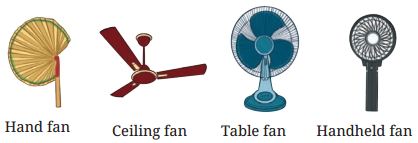
- Each of you in the group will pick one kind of fan.
- Imagine yourself to be that fan.
- Use the points given in the box in the textbook.
Answer:
I am a mirror work fan from Gujarat. I am colourful and decorated with small mirrors. I am lightweight and easy to carry. I like my bright design that attracts attention. My weakness is that I am delicate. I am unique because reflect traditional Gujarati craftsmanship.
[Note: The above answer is given for reference. Students are expected to do this activity on their own.]
V Writing Task
I. Describe an artefact you have made in your craft class or learnt from someone.
Begin with collection and organisation of the facts with the help of the pointers given in textbook. Do not include your opinion in the factual description.
Answer:
I learnt to make a clay diya in my art and craft class. The process begins with collecting materials like fine clay, water, and a wooden tool. First, the clay is kneaded until it becomes smooth and easy to shape. It is then carefully moulded into a small round bowl, with a slight curve on the edge to hold the cotton wick. After shaping, the diya is dried in the sun until it becomes firm. Once dry, it is painted with bright colours to enhance its appearance. The diya is small and lightweight, making it easy to use during festivals. Its design allows it to hold oil and support a wick. However, being sun- dried clay, it can break easily. Each diya is unique due to its handmade design.
[Note: The above answer is given for reference. Students are expected to do this activity on their own.]
Learning Beyond the Text
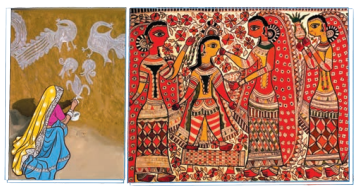
I. Identify any art or craft item from your region and make a presentation describing its features, materials, and process involved in making it, its usage, etc. You may refer to the points given in the textbook.
Name of the object and its physical characteristics-appearance, shape, size, colour, etc.
What is it made up of?
Which region does it belong to? How has it been used traditionally?
Is there an origin story associated with it? How has it evolved over time?
How can it be used effectively and safely in today’s time?
Answer:
Warli painting is a traditional art form from Maharashtra. It uses simple geometric shapes and natural colours. It was traditionally used to decorate walls during festivals. Over time, it has gained popularity worldwide. It is now used in modern art and design.
[Note: The above answer is given for reference. Students are expected to do this activity on their own.]
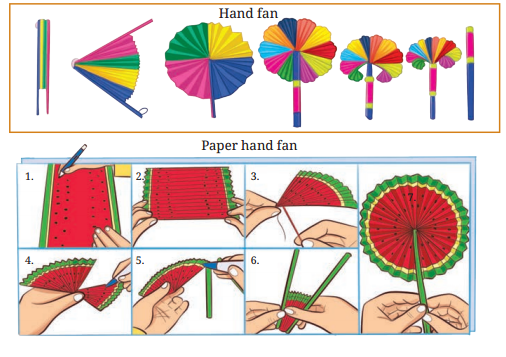
II. You can also make your own hand fan. Take ideas from the pictures given below and in groups of four, make your own hand fan. Display the hand fans in the class and describe the process used to make it.
Answer:
In our group, we made a hand fan using simple materials.
Materials used: coloured paper, cardboard, ice-cream sticks, glue, scissors, sketch pens, and decorative items like glitter and stickers.
Steps followed:
- First, we took a rectangular sheet of coloured paper and folded it in a zigzag (accordion) pattern from one end to the other.
- Then, we folded the paper into half and glued the inner edges together to form a semicircular fan shape.
- Next, we cut a small piece of cardboard and pasted it at the base to make the fan strong.
- We attached two ice-cream sticks at the bottom to act as handles and provide support.
- After assembling the fan, we decorated it using sketch pens, glitter, and stickers to make it attractive.
[Note: The above answer is given for reference. Students are expected to do this activity on their own.]
Winds of Change Class 9 Extra Questions and Answers
Winds of Change Short Question Answer
Question 1.
Why do different regions in India use different materiaLs to make pankhas?
Answer:
Different regions use locally available materials such as bamboo, palm leaves, or fabric. influenced by their climate, natural resources, and cultural traditions. This results in uniquely designed pankhas that authentically reflect the identity, environment, and artistic heritage of each individual region.
Question 2.
How do psnkhaa reflect the skills of artisans?
Answer:
Pankhas showcase artisan creativity through intricate designs, detailed embroidery, and thoughtful use of regional materials. Every fan reflects the maker’s skill, pahence. and attention to detall, making each piece entirely unique, culturally significant and a true testament to the artisans craftsmanship and dedication.
Question 3.
Why are pankhas considered more than just functional objects?
Answer:
Pankhas go beyond mere cooling tools They signify culture, tradition, and artistic expreselon. Their designs and materials vary across regions. making than powerful symbols of local heritage and identity, deeply rooted in history rather than serving as just sïmple everyday household objects.
Question 4.
How has the purpose of pankhas changed in modern times?
Answer:
Originally made purely for personal cooling, pankhas have gradually transformed into decorative and commercial products. Today they serve as symbols of cultural heritage, artistic expression, and regional identity, while simultaneously providing artisans with a sustainable livelihood through growing domestic and commercial market demand.
Question 5.
Why do you think pankhas were used in royal courts and temples?
Answer:
Pankhas were used in royal courts and temples not only for comfort but also as symbols of respect and status. In temples, they formed part of rituals, while in courts, they reflected luxury and grandeur.
Question 6.
Have you ever seen or used a handmade craft item? Describe your experience. How does it relate to pankhas mentioned in the chapter?
Answer:
Yes, I’ve seen handmade clay pots and wall hangings at fairs. Each featured unique, intricate designs reflecting careful effort. Like the pankhas in the chapter, these crafts are handmade using regional materials and
Question 7.
How would you feel if a traditional craft from your region slowly disappeared? Relate it to the decline of pankha culture.
Answer:
I would feel concerned as we lose part of our cultural identity and heritage. The chapter highlights how modem technology has caused a decline in pankha culture. Preserving these crafts is essential to ensure future generations can appreciate our history and the indigenous skills of local craftspersons.
Question 8.
Imagine you are visiting a handicraft exhibition. What would you observe about the pankhas there? How does this connect to the chapter?
Answer:
I would observe diverse designs, colours, and materials like embroidery or mirror work. This connects to the chapter’s description of how different states create unique pankhas. Such exhibitions showcase the innovative artistic value and regional diversity of these traditional crafts, helping to keep the indigenous heritage alive.
Winds of Change Long Question Answer
Question 1.
Discuss how pankhas represent India’s cultural diversity.
Answer:
Pankhas are perhaps one of the most eloquent expressions of India’s cultural diversity, for as the chapter itself states, “the structure of each fan reflects the cultural core of the region that crafts it.” Rajasthan alone offers the applique hand fan, stitched with ornamental needlework, the zardozi fan encrusted with glittering gold threadwork, and the engraved brass temple fan with a long handle. Gujarat brings cotton fans embellished with mirror work, colourful bead craft with silver handles, and Kutch’s hand-stitched leather fans. Bengal offers the delicate sola pankha and the Tal Patar Pankha, perpetually kept as an article of possession in Bengali households. Uttar Pradesh adorns its Phadh fans with pure gold, silver zari, silk, and satin frills, while Bihar crafts sturdy bamboo fans. Despite these regional differences, the shared purpose of the pankha beautifully captures India’s unity in diversity.
Question 2.
Explain how pankha-making supports the livelihood of artisans.
Answer:
The journey of the pankha from a personal household object to a commercial craft item is, in itself, a story of survival. What was once made for everyday cooling has gradually found a new purpose as a decorative and cultural product. This shift has opened economic pathways for artisan communities across India. The growing variety of pasikhas being crafted has played a significant role in sustaining demand, proving that a craft willing to adapt can continue to provide for those who practise it. Nowhere is this more visible than in Gujarat, where home-based women workers have channelled generations of skill into producing embroidered fans of emarkable beauty. Beyond individual effort, collective platforms such as handicraft exhibitions and pankha-making workshops have created spaces where artisans can both demonstrate their craft and earn from it. When people choose to appreciate and buy handmade pankhas, they participate, often without realising it, in keeping an entire tradition
economically alive.
Question 3.
Evaluate the importance of preserving traditional crafts like pankha-making in today’s world.
Answer:
Preserving traditional crafts like pankha- making is essential for safeguarding both cultural heritage and the livelihoods of countless artisans. The chapter reminds us that pankhas carry centuries of history, with evidence of their existence found in Buddhist wall paintings at Ajanta dating back to the 2nd century CE. They were once used in temples to fan deities and in royal courts to fan kings, reflecting their deep cultural and ritual significance. With the advent of technology and innovative creations, however, this beautiful culture runs the risk of slowly losing its presence among Indians. Preserving it requires celebrating pankhas and appreciating the culture, stories, and artistry that this handicraft invokes. This allows contemporary pankha makers to demonstrate their craft, regain its popularity, and create a sustainable livelihood. Therefore, preservation is not merely a cultural act but also an economic and moral responsibility towards future generations.
Question 4.
Explain the historical and cultural significance of pankhas in India.
Answer:
The word pankha originates from pankh, meaning the feather of a bird, and its history stretches back to ancient India. Evidence of the pankhi, a small plumed fan, can be found in Buddhist wall paintings at Ajanta, dating back to the 2nd century CE. Further representations appear in embroidery work, sculptures, and carvings. In ancient times, pankhas were used in temples to fan deities and in royal courts to fan kings, highlighting their ritual and ceremonial importance. Over time, they became significant cultural goods distributed through trade routes and were considered exotic and stylish. Although there was substantial commonality in their use across India, different villages and towns developed their own varieties using distinct materials and intricate designs. In modem times, their use has been restricted largely to decorative purposes, yet they continue to reflect the ‘cultural core’ of the regions that craft them.
Question 5.
Discuss how pankha-making reflects both tradition and innovation.
Answer:
Pankha-making is a craft that beautifully holds tradition and innovation in balance. Its roots. run deep, with historical evidence found in the Buddhist wall paintings at Ajanta from the 2nd century CE, and its traditional forms have been shaped by locally available materials such as bamboo, cane, palm leaf, silk, brass, leather, and silver, along with decorative beads and stones chosen according to geography, culture, and traditional rituals. Each region developed its own variety with distinct designs, reflecting long-standing artistic practices. At the same time, innovation is clearly at work. As the chapter notes, the slight’increase in the popularity and demand for pankhas is significantly factored by the different versions being crafted. What was once made for personal use has transformed into a commercial craft item. This evolution shows that tradition and innovation need not oppose each other but can together ensure the survival of a craft.
Question 6.
How do workshops and exhibitions help in reviving traditional crafts?
Answer:
Workshops and exhibitions help in reviving traditional crafts by spreading awareness about the beauty and importance of pankha- making in India’s culture. They allow contemporary pankha makers to demonstrate their craft and showcase their work. This helps them regain popularity and appreciation for their artistry. Such initiatives also provide artisans with a commercial platform to create a sustainable livelihood. By celebrating pankhas and appreciating the culture, stories, and artistry associated with them, these activities play an important role in preserving the essence of 1 this traditional craft.
Question 7.
Both “The Pot Maker” and “Winds of Change” suggest that preserving a craft tradition requires both individual passion and community effort. Discuss how each text presents this idea, drawing on specific ’ details from the chapters.
Answer:
In “The Pot Maker”, Sentila is shown passionate about pottery, quietly observing village potters and learning on her own. Yet when her mother Arenla refuses to each her, individual passion proves insufficient. The village elders intervene, reminding her father that traditional skills belong to the whole community and must be passed down. Their support enables Sentila to shape her first successful TOW of pots — a moment made possible by both personal determination and community backing. “Winds of Change” mirrors this through the pankha. Skilled artisans across India have kept this craft alive for centuries, each community developing distinct styles using local materials. However, electric fans now threaten their livelihood. The chapter urges people to attend craft workshops and purchase handmade pankhas, ensuring artisans receive both income and recognition. Both chapters affirm that passion starts a craft, but community effort sustains it.
| Aspect | Before PEHCHAN (Traditional) | With PEHCHAN (Modem Change) |
| Recognition & Inclusion | Invisible, unrecognised and part of the informal sectqr | Formally recognised artisans; part of the formal economy |
| Opportunities & Growth | Limited access to training, support, and government schemes | Equal access to schemes, training, and development programmes |
| Market & Security ‘ | Restricted markets and no structured safety net | Better exposure and access to welfare schemes |
When artisans have limited visibility and access to opportunities, inequality can persist. The PEHCHAN initiative, along with other government schemes, helps bridge this gap by providing recognition and access to support. This enables artisans to grow with dignity and fairness, while also preserving cultural heritage.