How I Taught My Grandmother to Read Class 9 Question Answer
Reflect and Respond
I. Complete the given word web.
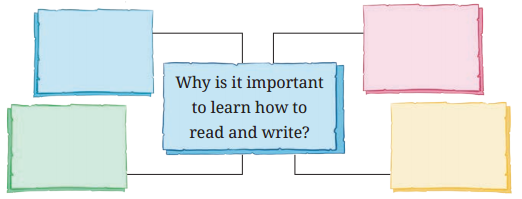
Ans:
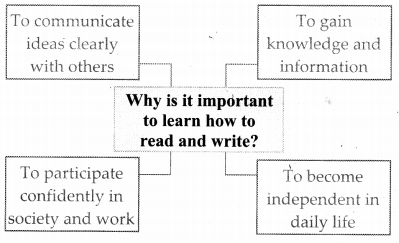
II. Read the questions given below and share your answers with your classmates and teacher.
Question 1.
Which language(s) do your grandparents or elderly relatives speak?
Answer:
My grandparents speak Marathi, which is our mother tongue. They also understand and speak Hindi and English.
Question 2.
How do they spend their time? How do you spend time with them?
Answer:
They usually spend their time reading newspapers, watching television and talking with neighbours and family members. I spend time with them by listening to their stories, helping them with small tasks and sometimes watching television with them.
Question 3.
What is your favourite experience with them?
Answer:
My favourite experience with them is listening to stories about their childhood and learning about how life was different in the past. ,
Question 4.
What is something that the elderly in your family cannot do easily but enjoy watching you do?
Answer:
They cannot use mobile phones or computers easily, but they enjoy watching me use technology and sometimes ask me to show them how it works.
III. Read the passage given in the textbook. Match the highlighted words with their meanings given in the box below.
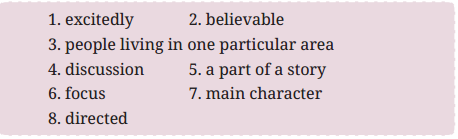
Answer:
1. excitedly – (vi) eagerly
2. believable – (vii) convincing
3. people living in one particular area – (iv) community
4. discussion – (ii) debate
5. a part of a story – (iii) episode
6. focus – (v) concentration
7. main character – (i) protagonist
8. directed – (viii) guided
Class 9 English Kaveri Chapter 1 Question Answer
Check Your Understanding
I. Complete the cause and effect table given below based on Part I of the story. Share your answers with your classmates and teacher.
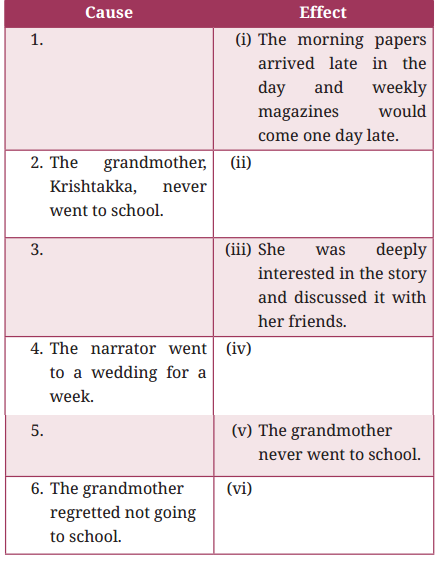
Answer:
| Cause | Effect |
| 1. The transport system in the village was not very good. | i. The morning papers arrived late in the day and weekly magazines would come one day late. |
| 2. The grandmother, Krishtakka, never went to school. | ii. She could not read the magazine herself and depended on the narrator to read it to her. |
| 3. The grandmother listened to the serial Kashi Yatre every week and identified herself with its protagonist | iii. She was deeply interested in the story and discussed it with her friends. |
| 4. The narrator went to a wedding for a week; | iv. The grandmother could not read the next episode of the story and felt helpless. |
| 5. hi those days people did not consider education necessary for girls. | v. The grandmother never went to school. |
| 6. The grandmother regretted not going to school. | vi. She made sure her children and grandchildren studied well. |
II. Do you think the narrator expected to see her grandmother in tears when she returned to the village? If yes, why? If no, why not?
Answer:
No, the narrator did not expect to see her grandmother in tears. She was surprised because she had never seen her grandmother cry even during difficult situations. The grandmother was likely upset because she could not read the latest episode of Kashi Yatre while the narrator was away and felt helpless and dependent.
III. How might the narrator help her grandmother to fulfil her desire to learn to read and write?
Answer:
The narrator could help her grandmother by teaching her the Kannada alphabet and guiding her step by step in reading and writing. By providing regular practice in reading, writing, and recitation, the narrator can help her grandmother gain -the confidence to read independently.
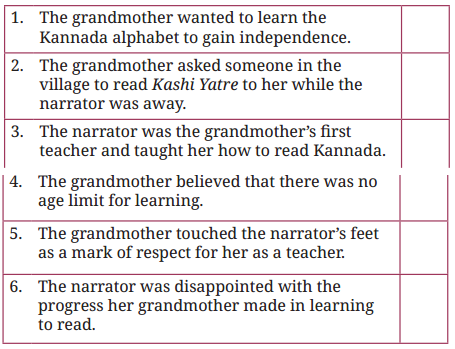
I. State whether the following sentences are true or false. Share your answers with your classmates and teacher.
Answer:
1. The grandmother wanted to learn the Kannada alphabet to gain independence. – True
2. The grandmother asked someone in the village to read Kashi Yatre to her while the narrator was away. – False
3. The narrator was the grandmother’s first teacher and taught her how to read Kannada. – True
4. The grandmother believed that there was no age limit for learning. – True
5. The grandmother touched the narrator’s feet as a mark of respect for her as a teacher. – True
6. The narrator was disappointed with the progress her grandmother made, in learning to read. – False
Critical Reflection
I. Read the extracts given below and answer the questions that follow.
Question 1.
When I came hack to my village, I saw my grandmother in tears. I was surprised, for I had never seen her cry even in the most difficult situations. What had happened? I was worried. ‘Avva, is everything all right? Are you okay?’
I used to call her Avva, which means mother in the Kannada spoken in north Karnataka. She nodded but did not reply. I did not understand and forgot about it. In the night, after dinner, we were sleeping in the open terrace of our house. It was a summer night and there was a full moon. Avva came and sat next to me. Her affectionate hands touched my forehead.
i) Complete the following sentence with the appropriate option. The phrase ‘never seen her cry in the most difficult situations’ tells us that the grandmother was ________.
(A) strong-willed
(B) understanding
(C) considerate
(D) bold
Answer:
(A) strong-willed
ii) Complete the following with the correct option from those given in the brackets. Grandmother did not reply when the narrator asked if she was alright because she might have been too _________ (emotional/tired) to respond.
Answer:
emotional
iii) Identify the clue from the extract that indicates a rural setting with traditional customs.
Answer:
The line “we were sleeping in the open terrace of our house” indicates a rural setting with traditional customs.
iv) Which lines of the extract establish a tender atmosphere?
Answer:
“Avva came and sat next to me. Her affectionate hands touched my forehead.”
v) Which of the following aspect is NOT emphasised in the given extract?
(A) the emotional turmoil of the grandmother
(B) the affectionate bond between the narrator and her grandmother
(C) the grandmother’s regret over her lack of education
(D) the narrator’s concern for her grandmother
Answer:
(C) the grandmother’s regret over her lack of education
Question 2.
‘I have decided I want to learn the Kannada alphabet from tomorrow onwards. I will work very hard. I will keep Saraswati Puja day during Dassara as the deadline. That day I should be able to read a novel on my own. I want to be independent.’
I saw the determination on her face. Yet I laughed at her.
Avva, at this age of sixty-two you want to learn the alphabet? All your hair is grey, your hands are wrinkled, you wear spectacles and you work so much in the kitchen…’
Childishly I made fun of the old lady. But she just smiled.
‘For a good cause if you are determined, you can overcome any obstacle. I will work harder than anybody but I will do it. For learning there is no age bar.’
i) What does the grandmother’s statement, “I want to be independent,” reveal about her character?
(A) She wanted to be literate.
(B) She desires self-sufficiency.
(C) She wants to prove her intelligence to others.
(D) She feels pressured by society to learn.
Answer:
(B) She desires self-sufficiency.
ii) Fill in the blank with the appropriate option from those given in the brackets.
The grandmother’s determination shows that learning has no ________. (age limit/gender bias/cultural barriers)
Answer:
age limit
iii) Complete the following with a suitable reason.
The narrator laughs at her grandmother’s decision to learn the alphabet at the age of sixty-two because _________.
Answer:
she thinks that her grandmother is too old to. begin learning and may find it difficult.
iv) List any two qualities displayed by the grandmother.
Answer:
Two qualities displayed by the grandmother are determination and confidence.
v) How can we say that the narrator is making assumptions about her grandmother?
Answer:
The narrator is making assumptions because she links her grandmother’s grey hair, wrinkled hands, spectacles and household responsibilities with an inability to learn, despite noticing her determination.
II. Answer the following questions.
Question 1.
Why do you think the grandmother felt embarrassed to ask someone else to read to her while the narrator was away?
Answer:
The grandmother felt embarrassed because she did not want others to know that she was illiterate. Although she thought of asking someone in the village to read the magazine to her, she did not do so because she felt ashamed of her inability to read. She says she felt “so very dependent and helpless” when she could not understand the magazine. Her reluctance shows her self¬respect and her discomfort in revealing her illiteracy to others.
Question 2.
Why does the narrator initially laugh at her grandmother’s determination to learn at the age of sixty-two?
Answer:
The narrator initially laughs because she believes that learning at such an advanced age is unusual and difficult. She says, “Avva, at this age of sixty-two you want to learn the alphabet?” and points out her grandmother’s grey hair and wrinkled hands. This shows her childish assumption that education is mainly meant for the young.
Question 3.
What significance does the story of Kashi Yatre have in both the grandmother’s life and the story?
Answer:
The story of Kashi Yatre plays a crucial role in both the grandmother’s life and the narrative of the story. It is the serial novel that the narrator reads aloud to her every week, and she listens to it with great interest, eagerly waiting to know what happens next. She even identifies herself with the novel’s protagonist and discusses the episodes with ! her friends in the temple courtyard. For her, the story is not just entertainment but also an emotional connection and a part of her daily life. When the narrator is away and she cannot read the latest episode herself, she feels helpless and disappointed. This experience becomes a turning point in her life and motivates her to learn the Kannada alphabet so that she can read independently, Thus, Kashi Yatre becomes the inspiration behind her decision to become literate and helps drive the central theme of the story.
Question 4.
What does the grandmother’s desire to learn the Kannada alphabet reflect about her?
Answer:
The grandmother’s desire to learn the j Kannada alphabet reflects her determination, self-respect and strong wish to become independent. She clearly expresses this when she says, “I want to be independent.” She sets a clear goal for herself and decides that by Saraswati Puja during Dassara she should be able to read a novel on her own. Her dedication to practising reading and writing shows that she values education deeply and believes that learning has no age limit.
Question 5.
What lessons can we infer from the grandmother’s action of touching the narrator’s feet?
Answer:
The grandmother’s action of touching the narrator’s feet teaches important lessons about humility, gratitude, and respect for teachers and knowledge. In Indian culture, touching someone’s feet is a traditional sign of respect, especially towards elders and teachers. In this situation, the grandmother explains that she is touching the feet of a teacher, not her granddaughter. Through this gesture, she acknowledges the narrator’s role in helping her become independent through education. It also shows that true respect is given to knowledge, regardless of age differences, Her action reflects her deep appreciation for learning and her willingness to accept the, narrator as her teacher. This moment highlights the cultural value of honouring education and reminds us that we should always remain grateful to those who guide us in our learning journey.
Question 6.
What does the following line tell us about the broader theme of the story?
“For a good cause if you are determined, you can overcome any obstacle.”
Answer:
The line highlights the broader theme that determination and a strong sense of purpose can help a person overcome obstacles. The grandmother expresses this idea when she confidently says that she will learn the Kannada alphabet despite being sixty-two years old. She even sets a deadline, deciding that by Saraswati Puja during the Dassara festival she should be able to read a novel on her own. This moment shows that age, lack of formal schooling, and difficulty cannot stop someone who is truly determined. Her words also reflect her self-respect and her wish to become independent rather than depend on others. The story therefore suggests that perseverance, discipline, and dedication can lead to personal growth and success. It conveys the powerful message that learning is possible at any age when a person has the courage to try and the will to continue.
Question 7.
How effectively does the story highlight the value of education in supporting personal independence?
Answer:
The story strongly highlights the value of education in supporting personal independence and self-respect. The grandmother realises the importance of literacy when she cannot read the magazine herself and feels “so very dependent and helpless.” This experience motivates her to learn the Kannada alphabet so that she can read independently. Through her determination and hard work, she eventually succeeds in reading the novel on her own before the deadline she has set for herself. Her achievement shows that education empowers individuals and frees them from dependence on others. It also gives a person confidence, dignity, and a sense of achievement. The story therefore presents education not merely as a school based skill, but as a lifelong source of freedom and self-reliance. It reminds readers that learning can transform a person’s life at any age.
Vocabulary and Structures in Context
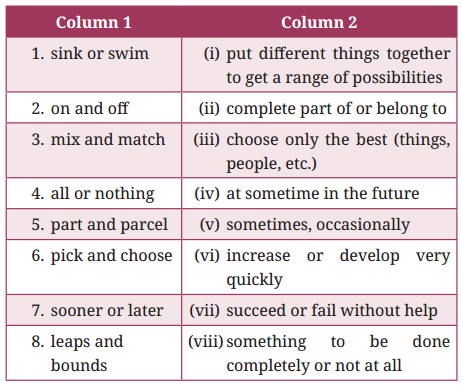
I. Match the binomials in Column 1 with their meanings in Column 2.
Answer:
(1 — vii), (2 — v), (3 — 1), (4 — viii), (5 — ii), (6 — iii), (7 — iv), (8 — vi)
Now, use any five of the above binomials in sentences of your own.
Answer:
i. In the competition, we had to sink or swim without any help from our teacher.
ii. She practises the piano on and off during the week.
iii. You can mix and match different colours to create your own style.
iv. The team decided it was all or nothing in the final match.
v. Learning from mistakes is part and parcel of growing up.
vi. The students were allowed to pick and choose the books they wanted to read.
vii. Sooner or later, hard work always brings success.
viii. With regular practice, his reading skills improved by leaps and bounds.
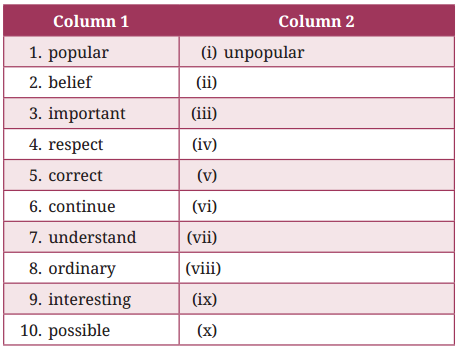
II. Make words by adding the suitable prefixes given in the box to the words from the text in Column 1. Write the prefixed words in Column 2. One example has been done for you.
Answer:
| Column 1 | Column 2 | ||
| 1. | popular | i. | unpopular |
| 2. | belief | ii. | disbelief |
| 3. | important | iii. | unimportant |
| 4. | respect | iv. | disrespect |
| 5. | correct | v. | incorrect |
| 6. | continue | vi. | discontinue |
| 7. | understand | vii. | misunderstand |
| 8. | ordinary | viii. | extraordinary |
| 9. | interesting | ix. | uninteresting |
| 10. | possible | x. | impossible |
III. Identify any five words with prefixes from the story and make sentences using each.
Answer:
i. unhappy – The child felt unhappy when his favourite toy broke.
ii. independent – After finishing her studies, she wanted to become financially independent.
iii. unfortunately – Unfortunately, the match was cancelled because of heavy rain.
iv. unusual – It is unusual to see snow in this region during summer.
v. irrespective – The rule applies to everyone irrespective of their position,
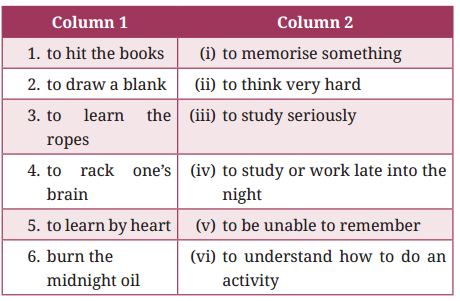
IV. Now, match the idioms related to ‘learning’ given in Column 1 with their meanings in Column 2.
Answer:
(1 – iii), (2 – v), (3 – vi), (4 – ii), (5 – i), (6 – iv)
Now, use these idioms in sentences of your own.
Answer:
i. I need to hit the books because my exams are starting next week.
ii. I tried to remember the answer but I drew a blank during the test.
iii. It took me some time to learn the ropes at my new job.
iv. She racked her brain to solve the difficult puzzle.
v. The students had to learn the poem by heart for the recitation competition.
vi. He had to burn the midnight oil to finish his project on time.
V. Read the given sentences from the text and underline the verbs.
1. Secretly, I bought Kashi Yatre which had been published as a novel by that time.
2. I knew, then, that my student had passed with fling colours.
Answer:
1. Secretly, I bought Kashi Yatre which had been published as a novel by that time.
2. I knew, then, that my student had passed with flying colours.
i) Fill in the blanks with the simple past and past perfect tense forms of the verbs given in brackets.
Answer:
A. When the delegates arrived (arrive) at the conference, the keynote speaker had already begun (already begin) the session.
B. After the students had learnt (learn) how to identify fake news online, they started (start) verifying information before sharing it.
C. Before Kiran started (start) using digital payment platforms, she had ensured (ensure) her understanding of online fraud prevention.
D. By the time Varun recognised (recognise) the importance of budgeting, he had exhausted (exhaust) most of his savings.
E. When Raghu logged in (log in) to the cybersecurity webinar, the instructor had already discussed (already discuss) the importance of strong passwords.
ii) Fill in the blanks with the correct form of the verbs given in brackets.
Answer:
Last year, my parents and I took (take) a financial planning course. When we reviewed (review) our expenses, we realised we had spent (spend) too much on unnecessary purchases. After my parents had discussed (discuss) ways to save, I opened (open) a savings account.
By the time we set (set) our budget, the course had already introduced (already introduce) investment strategies. We hurried (hurry) to take notes, but many participants had completed (complete) their financial plans. Despite that, we enjoyed (enjoy) learning how to manage money wisely.
Listen and Respond
I. I You will listen to a speaker talk about digital literacy. As you listen, complete the following sentences with one to three exact words that you hear. (Transcript for teacher on page 259)
1. Literacy these days includes the ability to use _____________.
2. Digital literacy is also about protecting _____________.
3. Digital literacy enables the elderly to ______________.
4. Digital literacy encourages using the internet safely by helping us recognise ______________ and _______________.
5. The National Digital Literacy Mission helps people across the country by imparting ______________.
Answer:
1. Literacy these days includes the ability to use digital tools.
2. Digital literacy is also about protecting personal data.
3. Digital literacy enables the elderly to stay connected.
4. Digital literacy encourages using the internet safely by helping us recognise misinformation, scams and cyber threats.
5. The National Digital Literacy Mission helps people across the country by imparting IT training.
Speacking Activity
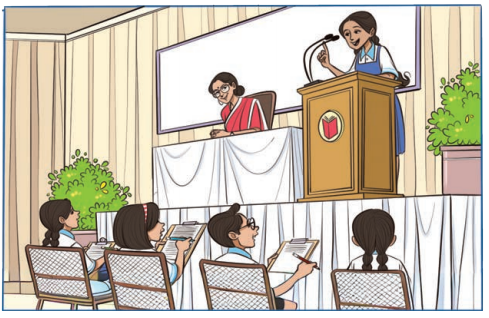
I. Choose your topic and speak Tor’ and ‘against for not more than one minute each.
Topic 1: It is important to learn a new language apart from your mother tongue.
Topic 2: Learning can happen only when you are young.
Answer:
1.
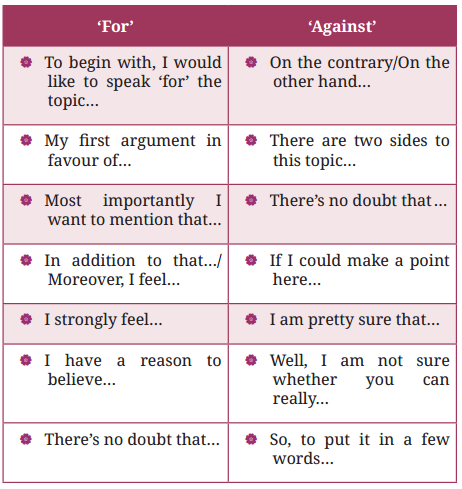
| For | Against |
| To begin with, I would like to speak for the topic. Learning a new language helps us communicate with more people and understand different cultures. | On the contrary, learning another language , may not always be necessary for everyone. Many people can manage well using their mother tongue and a common language like English. |
| My first argument in favour of learning another language is that it improves our thinking and memory skills. | There are two sides to this topic. Learning a new language can take a lot of time and effort, which some students may prefer to spend on other subjects. |
| Most importantly I want to mention that knowing more than one language can help us in future careers and travel. | There’s no doubt that languages are useful, but sometimes students may feel pressured to learn too many languages at once. |
| In addition to that, learning a new language also helps us appreciate the traditions and literature of other cultures. Moreover, I feel it builds confidence in communication. | If I could make a point here, I would say that not everyone has the same interest or ability to learn languages. |
| I strongly feel that learning another language makes us more open-minded and globally connected. | I am pretty sure that focusing deeply on one language may sometimes be more beneficial than learning many languages superficially. |
| I have a reason to believe that multilingual people often get better opportunities in education and jobs. | Well, I am not sure whether you can really expect every student to master multiple languages effectively. |
| There’s no doubt that learning another language apart from our mother tongue enriches our knowledge and broadens our horizons. | So, to put it in a few words, learning another language can be useful, but it may not be essential for everyone. |
2.
| For | Against |
| To begin with, I would like to speak for the topic. Many people believe that learning happens best when we are young. | On the contrary, learning does not happen only when we are young. People can learn at any stage of life. |
| My first argument in favour of this idea is that young minds are more flexible and can understand new concepts quickly. | There are two sides to this topic. Adults often have more life experience, which helps them understand ideas in a deeper way. |
| Most importantly, children, usually have fewer responsibilities, so they have more time to focus on learning. | There’s no doubt that children learn quickly, but many adults successfully learn new skills later in life. |
| In addition to that, young learners can easily adapt to new languages, technology and ideas. | If I could make a point here, I would say that motivation and determination are more important than age. |
| I strongly feel that starting to learn at a young age helps build a strong foundation for the future. | I am pretty sure that learning is a lifelong process and does not stop after childhood. |
| I have a reason to believe that early learning helps children develop good habits and curiosity about knowledge. | Well, I am not sure whether we can say that older people cannot learn, because many adults continue studying and improving themselves. |
| There’s no doubt that learning at a young age has many advantages and prepares us well for life. | So, to put it in a few words, learning can happen at any age if a person has interest and determination. |
Writing Task
I. As a socially responsible citizen, you strongly believe that students can contribute significantly in promoting adult literacy. Write a letter to the Editor of a local newspaper emphasising the importance of student participation in adult literacy camps conducted by various organisations. Discuss the benefits of such initiatives for both students and society. Suggest effective ways to spread awareness and encourage more students to volunteer for this noble cause.
Answer:
Riya Sharma
Student, Class IX
45 Green Park Colony Pune – 411001
12 July 2026
The Editor
The Daily Herald
Pune-411001
Subject: Promoting Student Participation in Adult Literacy Camps.
Sir/Madam,
This is with reference to the article about adult literacy programmes dated 10 July 2026 in your newspaper. As a concerned citizen, I would like to draw your attention towards the importance of student participation in adult literacy camps ; organised in many parts of the country.
The issue at hand affects a large section of society I as many adults still lack basic reading and writing J skills. It is imperative that more awareness is | created about adult literacy initiatives. Such ! programmes help adults become independent and j confident in their daily lives. By engaging in these \ programmes, students also develop empathy, ! responsibility and communication skills while \ contributing positively to society.
A possible solution to this issue could be ; encouraging schools and colleges to motivate j students to volunteer in literacy campaigns. One effective way to address this might be organising awareness drives, workshops and community learning sessions where students can teach basic reading and writing skills. Authorities could consider implementing structured volunteer programmes so that more young people participate in this noble cause.
I trust this matter will be considered seriously for the benefit of all. I hope this letter gets published in the columns of your esteemed daily.
Yours truly,
Riya Sharma
Learning Beyond the text
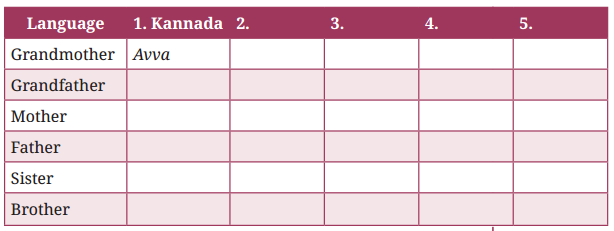
I. India has 22 major languages according to the Eighth Schedule of the Indian Constitution. Each language has its own unique identity. Talk to your classmates and teacher and complete the given table with words from any five Indian languages.
Answer:
| Language | 1. Kannada | 2. Hindi | 3. Bengali | 4. Marathi | 5. Tamil |
| Grandmother | Avva | Dadi / Nani | Thakuma / Didima | Aaji | Paati |
| Grandfather | Ajja | Dada / Nana | Dadu | Ajoba | Thaatha |
| Mother | Amma | Maa | Ma | Aai | Amma |
| Father | Appa | Papa / Pitaji | Baba | Baba | Appa |
| Sister | Akka | Behen / Didi | Bon | Tai / Bahin | Akka |
| Brother | Anna | Bhai | Bhai | Bhau | Anna |
How I Taught My Grandmother to Read Class 9 Extra Questions and Answers
How I Taught My Grandmother to Read Short Question Answer
Question 1.
How – did the limited transport system affect the arrival of newspapers and magazines in the village?
Answer:
The village had poor transport facilities, so newspapers and magazines arrived late. The morning paper reached in the afternoon and the weekly magazine came a day late. Because of this delay, villagers eagerly waited for the bus that brought newspapers, magazines and letters.
Question 2.
What made Triveni a popular writer among Kannada readers?
Answer:
Triveni became popular because her writing style was simple and convincing. Her stories dealt with complex psychological problems in the lives of ordinary people, making them relatable and interesting for readers. Even after her early death, her novels continued to be appreciated.
Question 3.
How did the grandmother’s interest in Kashi Yatre influence her weekly routine?
Answer:
The grandmother eagerly waited for the weekly magazine every Wednesday. When the narrator read the next episode aloud, she would forget her household work and listen with great concentration. The story became an important part of her routine and she looked forward to every new episode.
Question 4.
Why was the grandmother able to repeat the story even though she could not read?
Answer:
The grandmother listened very carefully whenever the narrator read the story aloud. Her strong interest and concentration helped her remember the events and dialogues of the story. Because of this attentive listening, she could later repeat the entire episode from memory.
Question 5.
Why did the narrator not understand the debates about the story at first?
Answer:
At that time, the narrator was still young and mainly interested in playing games with other children. Because of her age and limited experience, she did not fully understand why the elders were so deeply involved in discussing the events of the story.
Question 6.
Why was the narrator surprised to see her grandmother crying when she returned to the village?
Answer:
The narrator was surprised because she had never seen her grandmother cry before, even during difficult situations. Seeing her in tears made the narrator worried and curious. She could not understand what had upset her grandmother so deeply and felt concerned about her well-being.
Question 7.
How did the narrator initially react to her grandmother’s decision to learn the alphabet, and why?
Answer:
At first, the narrator laughed at her grandmother’s decision because she thought learning at the age of sixty-two was unusual. She noticed her grandmother’s grey hair, wrinkled hands and busy household work, and believed that learning the alphabet at such an age was difficult.
Question 8.
How did the grandmother prove that determination can overcome difficulties in learning?
Answer:
The grandmother worked extremely hard as a student. She practised reading, writing, repeating and reciting regularly and completed all her homework seriously. Her dedication helped her learn quickly and successfully read a novel on her own within the time she had set.
Question 9.
What did the narrator realise when the grandmother read the title of the book confidently?
Answer:
When the grandmother read the title of the book confidently, the narrator realised that her grandmother had successfully learned to read. This moment showed that her effort and determination had paid off, and the narrator felt proud that her first student had passed with flying colours.
Question 10.
How does the story reflect the status of women’s education in earlier times in India?
Answer:
The story shows that in earlier times, especially in rural India, girls were not encouraged to go to school. Education was not considered important for them. This reflects the social conditions of that period, where gender inequality was common and women had limited opportunities for education.
Question 11.
The concept of pilgrimage to Kashi is mentioned in the story. Explain its cultural and religious significance.
Answer:
Kshi (Varanasi) is considered one of the holiest cities in Hindu tradition. it is believed that visiting Kashi and worshipping Lord Vishweshwara brings spiritual merit (pun ya). The story highlights the deep faith people have in such religious journeys.
Question 12.
Triveni’s stories deal with psychological problems. How is this connected to the study of Psychology?
Answer:
Triveni’s stories explore human emotions, struggles and inner conflicts. This connects to Psychology, which studies human behaviour and mental processes. Her writing helps readers understand the emotional lives of ordinary people.
Question 13.
In many societies, education opportunities were historically unequal for men and women. How does the grandmother’s experience in the story reflect this social issue?
Answer:
The grandmother explains that during her childhood girls were often not sent to school because education was not considered necessary for them. This reflects a social system where women had fewer opportunities for learning. Her later decision to study shows how education can challenge these traditional limitations.
Question 14.
Have you ever helped someone learn something new? Describe your experience. How does it relate to the narrator teaching her grandmother?
Answer:
Yes, I once helped my younger sibling learn how to read simple words. I felt happy and responsible. This is similar to the narrator teaching her grandmother, as both experiences involve patience, care, and the joy of helping someone gain knowledge.
Question 15.
How would you feel if you were unable to read something important? Relate it to the grandmother’s feelings.
Answer:
I would feel helpless and dependent on others. Similarly, the grandmother felt sad because she could not read the story on her own. This made her realise the importance of education.
Question 16.
Imagine you missed an important part of a story or event. How would you react? Compare it with the grandmother’s reaction.
Answer:
I would feel disappointed and curious to know what happened. The grandmother also felt upset when she missed an episode of the story, which made her emotional and’ ‘ eager to learn reading.
How I Taught My Grandmother to Read Long Question Answer
Question 1.
The novel Kashi Yatre plays an important ! role in the grandmother’s life. In what way ; does the novel symbolise more than just a j story for her?
Answer:
The novel Kashi Yatre symbolises much more than just a story for the grandmother because it becomes the reason that inspires her desire to become literate. She listens
eagerly as the narrator reads each weekly episode and becomes deeply involved in the story. She even identifies herself with the novel’s protagonist, an old woman who longs to go to Kashi. When the narrator is ; away and the grandmother cannot read the latest episode herself, she feels “so very dependent and helpless.” This experience makes her realise the importance of j education and motivates her to learn the Kannada alphabet. Thus, the novel becomes a symbol of her determination, independence and lifelong desire for ! learning, rather than merely a source of entertainment.
Question 2.
In the story, touching the feet of elders is described as a mark of respect. What cultural values are reflected through this practice?
Answer:
Touching the feet of elders reflects important cultural values such as respect, humility and gratitude. In many Indian traditions, this gesture is a way of honouring elders and teachers and acknowledging their wisdom and guidance. It symbolises a learner’s willingness to receive knowledge and blessings from those who are older or more experienced. In the story, the grandmother touches the narrator’s feet not because she is younger, but because she recognises her as her teacher who helped her learn to read. This act shows that knowledge deserves respect regardless of age or status. It also highlights the cultural belief that teachers hold a special place in society and should be honoured for guiding others.
Question 3.
The relationship between the grandmother and the narrator reverses traditional roles of teaching and learning. What does this reversal suggest about learning?
Answer:
The reversal of roles between the grandmother and the narrator suggests that learning is not limited by age and that anyone can be both a teacher and a learner. Although the grandmother is much older, she becomes the student, while the young narrator becomes her teacher. This unusual situation highlights the idea that , knowledge can come from any source. The grandmother’s willingness to learn at the age of sixty-two shows her determination and respect for education. At the same time, the narrator learns patience and responsibility while teaching her. This reversal emphasises that learning is a Lifelong process and that curiosity, effort and dedication are more important than age in the pursuit of knowledge.
Question 4.
How does the narrator’s attitude towards her grandmother change during the course of the story?
Answer:
At the beginning of the story, the narrator’s attitude towards her grandmother is somewhat playful and slightly dismissive. When the grandmother decides to learn the Kannada alphabet at the age of sixty-two, the narrator laughs and says, “Avva, at this I age of sixty-two you want to learn the alphabet?” This reaction shows that she initially believes her grandmother is too old to begin learning. However, as the grandmother studies with dedication and ; determination, the narrator’s attitude gradually changes. She begins to admire and respect her grandmother’s ; commitment to learning. By the end of the j story, when the grandmother successfully reads the novel and touches the narrator’s feet as a mark of respect, the narrator feels j proud and deeply moved by her grandmother’s achievement.
Question 5.
What does the grandmother’s childhood j reveal about the social conditions for girls’ education during that time?
Answer:
The grandmother’s childhood reveals that girls’ education was not considered important during that period. She explains that after her mother died, there was no one to guide or support her education. Moreover, she says that “in those days people never considered education essential for girls,” which shows the prevailing social attitude. As a result, she never had the opportunity to go to school. Instead, she was married at a young age and soon became busy with household duties and family responsibilities. This reflects the social conditions of the time, when many girls were denied formal education because of traditional beliefs and expectations. The grandmother’s later desire to learn also highlights how deeply she regretted missing that opportunity.
Question 6.
How does the grandmother’s inability to read the story become a turning point in the story?
Answer:
The grandmother’s inability to read the latest episode of Kashi Yatre becomes a turning point in the story because it makes her realise how dependent she is on others. When the narrator is away, she receives the magazine but cannot understand what is written. She feels “helpless and dependent,” which deeply affects her. This moment makes her recognise the importance of education. As a result, she decides to learn the Kannada alphabet and sets a goal to read a novel on her own by Saraswati Puja during the Dassara festival. Her decision marks the beginning of her journey towards 1iteracy, self-confidence and independence.
Question 7.
How does the ijithor show the strong emotional bond 11tween the narrator and her grandmother?
Answer:
The author shows the strong emotional bond between the narrator and her grandmother through their close interactions and mutual care. The narrator regularly reads the weekly episodes of Kashi Yatre to her grandmother, who listens with great interest and concentration. This shared activity brings them closer and creates a special connection between them. When the narrator returns from the wedding and sees her grandmother in tears, she becomes worried and tries to comfort her, showing her affection and concern. Later, the narrator patiently teaches her grandmother the Kannada alphabet, demonstrating love and responsibility. The grandmother’s deep trust in her granddaughter and her emotional gratitude, expressed when she touches the narrator’s feet, clearly highlight the strong and respectful bond they share.
Question 8.
How does the story highlight the themes of education, independence, and respect?
Answer:
The story strongly highlights the themes of education, independence, and respect. The grandmother cannot read the magazine on her own and feels helpless when the narrator is away. This moment makes her realise the value of literacy. She decides to learn the Kannada alphabet so that she can read independently. Her determination shows that education gives a person confidence and dignity. The story also shows respect in a very meaningful way. The grandmother, after learning to read, touches the narrator’s feet and acknowledges her as her teacher. This gesture shows humility and gratitude. The story therefore teaches that education is not only about reading and writing; it is also about self-reliance, self-respect, and human values. It beautifully shows that orie can learn at any age if one is sincere and determined.
Question 9.
In the story, people eagerly waited for newspapers and magazines to arrive by bus. Compare this with how people receive news and stories today through digital platforms and the internet. What changes in communication and access to information do you observe? Write in 120-150 words.
Answer:
In the story, people depended on physical transportation for communication. Newspapers and magazines arrived by bus, so information travelled slowly and villagers had to wait eagerly to receive news and stories. Today, digital media has transformed the way people access information. News, books and stories are available instantly through smartphones, computers and the internet. People can read online newspapers, watch videos, listen to podcasts and follow live updates on social , media platforms. This has made communication faster, wider and more convenient. However, digital media also requires users to think critically about the reliability of information. Unlike earlier times, when communities gathered to share news together, today information is often accessed individually through personal digital devices.