Words Class 9 Question Answer
Reflect and Respond
I. Why are words important? Can we communicate without words? How? Share your answers with your classmates and teacher.
Answer:
- Words are the most powerful tools human beings possess, allowing us to express feelings, build relationships, and pass
knowledge across generations. A single word, spoken at the right moment, can comfort, inspire, or even change the course of a life, giving shape to our inner world and allowing others to truly know us. - Yes, we can communicate without words. There are many powerful and meaningful ways to do it such as:
- Facial expressions – A smile, a frown, or a look of concern can convey feelings instantly and across all language barriers.
- Body language – A warm hug, a firm handshake or a gentle pat on the shoulder communicates care and connection without a single syllable.Silence – A deliberate, shared silence can express grief, respect or understanding more profoundly than any speech.
- Art and music – A painting, a melody, or a dance can communicate complex emotions and ideas that words often fail to capture.
- Actions – Helping someone carry a heavy bag, sitting beside a friend who is upset, or simply showing up when someone needs you speak louder than any words ever could.
- [Note: The above answer is given for reference. Students are expected to do this activity on their own.]
II. Use the given sentences as clues to find words from the grid and fill the blanks. One example has been done for you.
My mother summoned me to introduce her friends.
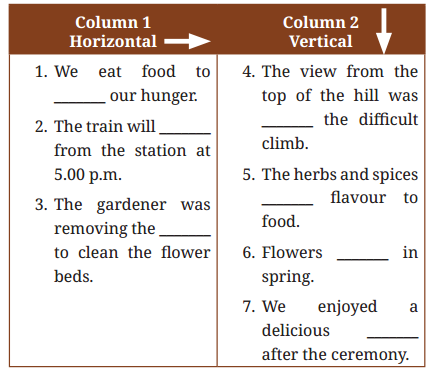
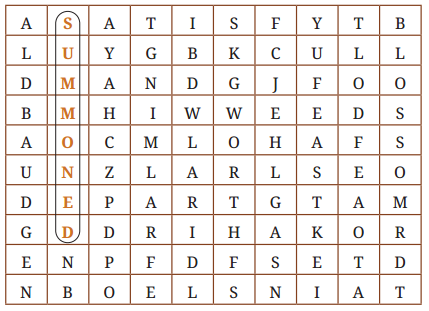
Answer:
| Column 1 Horizontal: | Column 2 Vertical: | ||
| 1. | We eat food to satisfy our hunger. | 4. | The view from the top of the hill was worth the difficult climb. |
| 2. | The train will depart from the station at 5.00 p.m. | 5. | The herbs and spices summoned flavour to food. |
| 3. | The gardener was removing the weeds to clean the flower beds. | 6. | Flowers blossom in spring. |
| 7. | We enjoyed a delicious feast after the ceremony. |
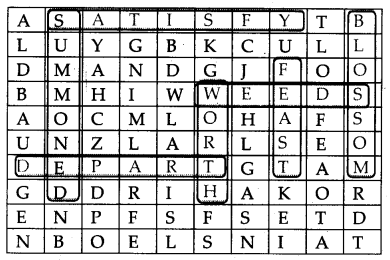
[Note: The grid supports most answers; one word can be identified using the clue alone.]
Class 9 English Words Poem Question Answer
Check Your Understanding
I. Fill in the blanks with one word from the poem. One example has been done for you.
In this poem, the poet reflects that words fail to truly satisfy what the heart wants to convey. Words are compared to summer birds who 1. __________, leaving nothing behind. The heart, is equated to a 2. __________ who fids that words are as worthless as 3. __________ when needed. He feels that a few sincere words can bring more 4. __________ than many meaningless ones. He adds that a voice that brings happiness to a 5. __________ place does not say much, but the few words it does, are very precious. Moreover, if words could satisfy us, the 6. __________ would celebrate but words often fail to do that. The poem ends on the note that empty words may look impressive with lots of flowers, but they cannot produce anything valuable, like a 7. __________.
Answer:
In this poem, the poet reflects that words fail to truly satisfy what the heart wants to convey. Words are compared to summer birds who 1. depart, leaving nothing behind. The heart, is equated to a 2. pilgrim who finds that words are as worthless as 3. weeds when needed. He feels that a few sincere words can bring more 4. joy than many meaningless ones. He adds that a voice that brings happiness to a 5. lonely place does not say much, but the few words it does, are very precious. Moreover, if words could satisfy us, the 6. world would celebrate but words often fail to do that. The poem ends on the note that empty words may look impressive with lots of flowers, but they cannot produce anything valuable, like a 7. fruit.
II. Let us appreciate the poem.
Question 1.
Read the poem again. Find any four sets of rhyming words and also write the rhyme scheme of the poem.
Answer:
Four sets of rhyming words from the poem: heart/depart, care/air, needs/weeds, say/way
The rhyme scheme of each stanza is ABAB – the first and third lines rhyme with each other, and the second and fourth lines rhyme with each other.
Question 2.
Read the following phrases and sentences taken from the poem. Identify the poetic device in each of them and explain what the poet wants to communicate through their usage.
[Note: Refer to the phrases and sentences in the textbook]
Answer:
- Simile. Words are compared to summer birds using ‘like’. Just as migratory birds arrive briefly and depart with the season, words are transient and unreliable as they come and go without leaving anything truly meaningful behind.
- Metaphor. The heart is directly compared to a pilgrim, a wanderer on a sacred journey. The poet communicates that the human heart is always searching for genuine meaning and connection.
- Simile. Words are compared to weeds, unwanted, valueless, and crowding the space where something meaningful might grow. The poet communicates that hollow words do not just fail to help but actively crowd out genuine communication.
- Repetition and Irony. The conditional phrase ‘if words could satisfy’ is repeated to reinforce the poet’s central argument. The irony lies in the fact that words which exist precisely to communicate and connect most often fail completely when truly needed.
- Hyperbole and Imagery. The idea that the entire world would celebrate is an exaggeration used to suggest the grand promise that words appear to make. The image of a feast creates a vivid picture of abundance and joy which the poet then immediately deflates by showing that words fail to deliver on this promise.
- Simile and Imagery. Words are compared to plants that produce a spectacular but * hollow display of blossoms. The poet communicates that some words are visually and acoustically impressive but like these showy plants, they have no real substance beneath their attractive surface.
- Symbolism. The inability to grow even one particle of fruit symbolises the complete failure of empty words to produce any , genuine meaning, lasting comfort, or real connection. Fruit represents true value and nourishment, everything that hollow words can never provide.
Question 3.
Which words are repeated in the poem? Why does the poet use repetition?
Answer:
The words most notably repeated in the poem are ‘words’ and ‘satisfy.’ The phrase ‘If words could satisfy’ is repeated at the beginning of the first and fifth stanzas, creating a circular structure that reinforces the poem’s central argument. The poet uses repetition deliberately for two purposes. First, it creates a rhythmic, emphatic quality that drives the message deeper into the reader’s mind with each recurrence. Second, the repetition of ‘satisfy’, the very thing words fail to do highlights the gap between what language promises and what it delivers, making the poem’s critique of empty speech even more powerful and memorable.
Question 4.
The stanzas 4,5, and 6 end with exclamation mafks. Choose the option that displays the emotions being expressed through them.
(i) 4. disillusionment
5. admiration and
6. frustration
(ii) 4. frustration
5. admiration and
6. disillusionment
(iii) 4. admiration
5. frustration and
6. disillusionment
(iv) 4. frustration
6. admiration
5. disillusionment and
Answer:
(iii) 4. admiration 5. frustration and 6. disillusionment
III. Identify examples of hyperbole from the given lines.
If words could satisfy the chest,
The world might hold a feast.
Answer:
The hyperbole in the given lines is: ‘The world might hold a feast’ – the idea that the entire world would hold a celebratory feast is a deliberate exaggeration used to highlight how grand the promise of words appears to be, making their ultimate failure all the more striking.
Work in pairs. Complete the sentences given in textbook with hyperboles. Use the hints given in the brackets.
1. I have ______________ things to do on this weekend. (lots of/tonnes of)
2. The player missed the basket by ______________. (a mile/ an inch)
3. My mother is so tired that she can sleep for a ______________. (night/decade)
4. I will be back in ______________. (fie minutes/two seconds)
Answer:
1. I have tonnes of things to do on this weekend.
2. The player missed the basket by a mile.
3. My mother is so tired that she can sleep for a decade.
4. I will be back in two seconds.
IV. Listen to the teacher read the poem. As you listen, underline the syllables that are stressed in all the lines of the poem. Share your answers with the teacher.
If words could sa tis fy the heart,
The heart might find less care;
But words, like sum mer birds, de part,
And leave but emp ty air.
Answer:
Stanza 1:
If words could sa-tis-fy the heart,
The heart might find less care:
But words, like sum-mer birds, depart.
And leave but emp-ty air.
Stanza 2:
The heart, a pil-grim up-on earth.
Finds of-ten, when it needs.
That words are of as lit-tle worth
As just so ma-ny weeds.
Stanza 3:
A lit-tle said, and tru-ly said,
Can dee-per joy im-part
Than hosts of words, which reach the head.
But ne-ver touch the heart.
Stanza 4:
The voice that wins its sun-ny way.
A lone-ly home to cheer.
Hath oft the few-est words to say;
But, oh! those few, how dear!
Stanza 5:
If words could sa-tis-fy the chest.
The world might hold a feast:
But words, when sum-moned to the
test. Oft sa-tis-fy the least!
Stanza 6:
Like plants that make a gau-dy show,
All blos-som to the root;
But whose poor na-ture can-not grow,
One par-ti-cle of fruit!
[Note: The above activity is given for reference. Students are expected to do this activity on their own.]
Critical Reflection
I. Read the following lines and answer the questions.
Question 1.
The heart, a pilgrim upon earth.
Finds often, when it needs,
That words are of as little worth
As just so many weeds.
i) Why has the poet referred to the heart as ‘a pilgrim’?
Answer:
The poet calls the heart a pilgrim because it constantly searches for something true and meaningful like a traveller on a sacred journey.
ii) When would a heart ‘need’ words?
Answer:
A heart would need words during its most vulnerable and emotionally intense moments like grief, loneliness, fear, confusion or deep personal struggle.
iii) Complete the sentence with an appropriate reason.
The words are like weeds because ________.
Answer:
they are plentiful, unwanted and completely without value.
iv. Mention two emotions the heart might be experiencing when it finds words to be of ‘little worth’.
Answer:
The two emotions the heart might be experiencing are: disappointment and loneliness.
v) What do these lines suggest about the nature of communication?
Answer:
These lines imply that most communication is ineffective as words offer little value and so genuine communication rarely takes place.
Question 2.
If words could satisfy the chest,
The world might hold a feast;
But words, when summoned to the test,
Oft satisfy the least!
i) How can words ‘satisfy the chest’?
Answer:
Words can ‘satisfy the chest’ by being sincere, warm, and comforting, creating a sense of emotional connection and contentment.
ii) How can words be ‘summoned to the test’?
Answer:
Words can be ‘summoned to the test’ during moments of true emotional need, such as grief or loneliness.
iii) What does ‘the world’ holding ‘a feast’ imply?
Answer:
The image of ‘the world holding a feast’ is a hyperbole suggesting universal rejoicing and fulfilment when words truly meet the heart’s deepest needs.
iv) Complete the sentence with an appropriate reason.
The poet mentions that words satisfy the least because ______ .
Answer:
they often fail to provide genuine comfort when they are most needed.
v) Select the word that does not mean the same as ‘oft’.
(A) always
(B) usually
(C) frequently
(D) often
Answer:
(A) always
II. Answer the following questions.
Question 1.
What is the comparison that the poet draws between words and ’empty air’?
Answer:
The poet compares words to empty air to show that hollow speech, though it fills space, leaves nothing meaningful behind. Like air, words cannot hold or offer comfort, creating only an illusion of communication without real connection or understanding coming out of it.
Question 2.
According to the poet meaningful words are more precious than a lot of them. Explain.
Answer:
The poet shows that a few sincere words can » bring deeper joy than many empty ones, as they touch the heart rather than just the mind. He emphasises that true value lies in quality of words rather than the quantity because even a few, sincere words can comfort and create genuine connection.
Question 3.
Do you agree that the poet presents contrasting ideas related to ‘words’ in the. poem? If yes, why? If no, why not?
Answer:
Yes, the poet presents contrasting ideas about words. While they have the power to comfort and satisfy, he shows that they often fail, proving empty or ineffective. He highlights the contrast between many hollow words and a few sincere ones, emphasising that true value lies in genuine expression.
Question 4.
The theme of loneliness hovers over the poem. Support this statement with examples from the text.
Answer:
Loneliness runs quietly through the poem as a persistent theme. The heart as ‘a pilgrim’ suggests solitary wandering and a lack of true connection. The line ‘finds often, when it needs’ highlights moments of emotional need, while the image of ‘a lonely home’ reinforces the deep despair that only sincere words can truly comfort.
Question 5.
How does the poet convey the superficial nature of words? What ought to be done to address this?
Answer:
The poet conveys the superficial nature of words through vivid comparisons. He compares them to summer birds that are pleasant but fleeting, to weeds that are plentiful but worthless, and to gaudy plants that bloom brightly but bear no fruit. These images collectively highlight how words without sincerity may appear impressive on the surface but lack any real substance beneath. To address this, the poet suggests speaking less but with greater thoughtfulness and sincerity. He believes that words must stem from ‘ genuine feeling rather than mere habit or obligation. Even a few honest and heartfelt words, he argues, carry the power to offer true comfort and forge meaningful human connection.
Vocabulary in Context
I. The poet has used some figurative phrases. Match the phrases in Column 1 with their correct meanings in Column 2. Use each phrase in a sentence of your own.
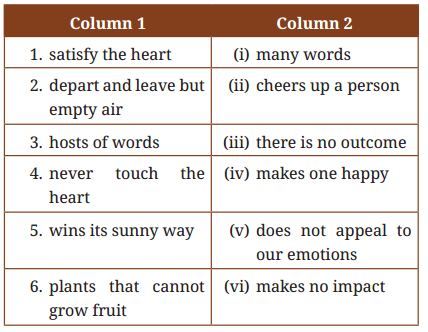
Answer:
| Column 1 | Column 2 | ||
| 1. | satisfy the heart | iv. | makes one happy |
| 2. | depart and leave but empty air, | vi. | makes no impact |
| 3. | hosts of words | i. | many words |
| 4. | never touch the heart | v. | does not appeal to our emotions |
| 5. | wins its sunny way | ii. | cheers up a person |
| 6. | plants that cannot grow fruit | iii. | there is no outcome |
Sentences:
1. A kind and sincere apology can truly satisfy the heart in ways that no amount of expensive gifts ever could.
2. His long farewell speech seemed to depart and leave but empty air, for no one felt truly moved by a single word he said.
3. The guest speaker filled his address with hosts of words, yet by the end, no one could recall a single meaningful promise he had made.
4. A speech that only appeals to logic and reason will never touch the heart of an audience that is searching for genuine comfort and understanding.
5. Her warm and gentle voice wins its sunny way into every room she enters, making even the most anxious person feel instantly at ease.
6. His repeated promises were like plants that cannot grow fruit, beautiful to hear in the moment but never followed through with any real action.
II. Create a ‘Word Map’ for each of the words from the poem given in the box.

To complete the word map include:
1. Meaning (in your own words)
2. Synonyms of the word
3. Antonyms of the word
4. Sentence using the word
5. A quick sketch or symbol that represents the word
One example has been done for you. [Note: Refer to the example given in textbook]
Answer:
WORD MAP
| Word | Meaning | Synonyms | Antonyms | Sentence | Symbol / Picture |
| Cheer | to give a loud shout of approval or encouragement | comfort | sadden | The audience cheered her for great performance. | Picture of sunshine, sunflower, or a smiling face |
| Depart | to leave a place or go away from somewhere | leave, go, exit, withdraw, set off | arrive, come, return, stay, remain | The last train will depart from the platform at midnight, so we must hurry. | (Icon or picture of a person walking away or plane taking off) |
| Pilgrim | a person who travels on a long, often spiritual journey in search of something meaningful | wanderer, traveller, seeker, voyager, wayfarer | settler, resident, homebody, dweller | The pilgrim searched for a shelter after travelling all day. | (Picture of a traveller on a long road) |
| Word | a single unit of language used to express meaning or communicate with others | expression, utterance, term, statement, remark | silence, quietness, muteness, speechlessness | She shared words of inspiration with her students. | (Icon of a speech bubble) |
| Sunny | bright, warm, and full of cheerfulness; also used to suggest a gentle, hopeful, and comforting quality | bright, warm, cheerful, radiant, pleasant | gloomy, dark, dull, cold, overcast | People appreciate Nina for her sunny disposition in every situation. | (Icon of a bright sun emerging from clouds) |
| Satisfy | to fulfil a need, desire, or expectation completely and leave nothing wanting | fulfil, content, please, gratify, appease | disappoint, frustrate, dissatisfy, displease, fail | To satisfy someone’s standards, you need to be satisfied first. | (Icons of a tick mark beside a contented face) |
| Heart | the centre of a person’s emotions, feelings, and deepest inner life | soul, spirit, core, feeling, emotion | indifference, coldness, apathy, detachment | His sincere farewell words at farewell touched every heart in the room | (Icon of a heart) |
Listen and Respond
I. You will listen to a conversation between a girl and a boy. As you listen, mark four statements from 1-6 that are true. (Transcript for teacher on Textbook page 273)
1. The girl was excited to participate True in the declamation contest.
2. The boy was doubtful about the True suitability of the topic chosen for the contest topic chosen for the contest.
3. The girl explained that people False prefer to keep their personal experiences to themselves.
4. The boy was unaware of the role. True played by body language in reflecting the speaker’s confidence.
5. According to the girl, body False language had an insignificant role to play in communication.
6. The girl had issued the book on True body language earlier from the library.
Answer:
1. True
2. True
3. False
4. True
5. False
6. True
Speaking Activity
I. Read the following quotations and select the one you like the most. Explain the quotation and share the reason for your choice with your classmates and teacher. You may talk about a connected personal experience too.
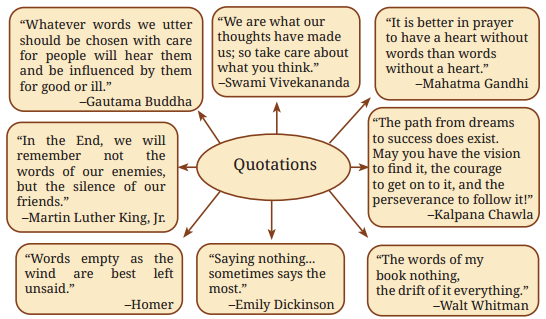
You may use the cues given below to state your choice and the reason.
- I chose_____ because…
- I selected _____ since…
- I decided on _____due to…
- I picked _____as…
- I settled for _____ because…
[Note: Refer to the cues given in the textbook for reference]
Answer:
Selected Quotation:
“Whatever words we utter should be chosen with care for people will hear them and be influenced by them for good or ill.” — Gautama Buddha
Explanation of the Quotation
- Words have the power to influence people’s feelings and thoughts.
- Careful speech can encourage and uplift others.
- Careless words can hurt and leave a lasting impact.
- Therefore, we should always speak thoughtfully and aim to create a positive effect.
Reason for My Choice
- I chose this quotation because it teaches an important life lesson about responsible I communication.
- We often speak without thinking, both at school and at home.
- I selected this idea since it reminds me that being a good person includes being mindful of my words.
- I decided on this thought due to the fact that thoughtful speech helps build strong relationships and prevents unnecessary conflicts.
Personal Experience
- I picked this idea as it connects with a personal experience during a group project.
- During a group project, a classmate made a casual remark about my idea.
- Although unintentional, it affected my confidence and made me hesitant to share ideas;-
- Later, my teacher encouraged me by appreciating my thinking.
- This restored my confidence and showed the impact of kind words.
- I settled for this quotation because it reflects how words can either hurt or heal, making it important to use them with care.
[Note: The above pointers are given for one of the quotations as a reference. Students are expected to do this activity on their own.]
Writing Task
I. Write an essay on any one quotation from speaking activity. Follow the guidelines given in textbook while drafting the essay.
Answer:
Among all the quotations, I chose Gautama Buddha’s words because they capture a truth we often overlook in daily life. This essay explains why choosing words carefully is an important responsibility.
The quotation suggests that words are never neutral. Every word leaves an impact on the listener’s mind and heart. The phrase ‘for good or ill’ shows that words can either heal or harm. For instance, a teacher’s encouragement can build confidence, while a careless remark can create lasting self- doubt. This idea also connects with the poem ‘Words’, WhiCh shows that only sincere words truly touch the heart. Thus, both highlight the importance of thoughtful expression.
In today’s world of instant communication, this message is even more relevant. Through social media and messaging, words spread quickly and influence many people. Encouraging words can build confidence and resilience, while careless ones can harm a person’s self-image.
Some may feel that this idea restricts free expression. However, it is not about fear but awareness. Choosing words carefully simply means thinking before speaking.
In conclusion, Gautama Buddha’s quotation conveys a timeless truth. Words are powerful and must be used responsibly. Meaningful and sincere words can create a lasting positive impact.
[Note: The above answer is given for reference. Students are expected to do this activity on their own.]
Words Class 9 Extra Questions and Answers
Words Short Question Answer
Question 1.
What does the poet suggest about the relationship between the quantity of words and their emotional impact?
Answer:
The poet suggests that quantity of words and their emotional impact are inversely related. A large number of words does not guarantee genuine feeling or connection with people. In fact, ‘a little said, and truly said’ creates far deeper joy than ‘hosts words’ said without any thought.
Question 2.
What is the central irony regarding the poet’s use of language in the poem?
Answer:
The central irony is that the poet skillfully uses a multitude of carefully chosen ‘words’, complex rhymes, and rich poetic devices to argue that ‘language’ is ultimately inadequate, transient and inferior to simple, silent emotional sincerity.
Question 3.
How does the imagery of the “sunny way” in the third stanza contrast with the “empty air” in the first stanza?
Answer:
“Empty air” creates a cold, disappointing image of words vanishing without a trace. In contrast, the “sunny way” evokes warmth, light, and permanence, highlighting the enduring comfort and positive atmosphere created by a few sincere, heartfelt words.
Question 4.
How does the closing image of plants without fruit serve as a fitting conclusion to the poem’s central message?
Answer:
The image of plants that blossom but bear no fruit mirrors the poem’s argument. These plants offer visual beauty without nourishment, like hollow words that sound impressive without meaning. The image provides a vivid symbol that concludes the poem’s central idea: outward show without substance is ultimately worthless.
Question 5.
The poet compares worthless words to ‘so many weeds’. In today’s digital age, what might represent these weeds, and why?
Answer:
In the digital age, ‘weeds’ could represent mindless social media comments, emojis, or forwarded messages. Like weeds, they are abundant, require no real effort to produce, and lack the nourishing substance of a genuinely thoughtful, personal interaction.
Words Long Question Answer
Question 1.
The poem ‘Words’ argues that the value of communication lies not in abundance but in sincerity. Discuss this view with reference to the poem, using at least three examples of poetic devices to support your answer.
Answer:
Charles Swain builds his central argument that sincerity matters more than abundance in communication through carefully chosen poetic devices. The simile ‘words, like summer birds, depart’ shows how empty words vanish without leaving anything meaningful behind. The metaphor ‘hosts of words, which reach the head, but never touch the heart’ distinguishes between intellectual and emotional communication, firmly valuing the latter.
The symbolism of flowering plants that bear no fruit provides a lasting image of how impressive-sounding words without genuine feeling are ultimately hollow and worthless. Together, these devices reinforce the poet’s conviction that a few words spoken with truth and warmth will always carry more power than any quantity of empty, decorative language.
Question 2.
Charles Swain relies heavily on natural imagery to critique human communication, Analyse how the metaphors of ‘summer birds’, ‘weeds’, and ‘fruitless plants’ collectively build the poem’s central theme.
Answer:
Swain masterfully uses nature to illustrate the deceptive and transient nature of superficial words. ‘Summer birds’ signify fair-weather comfort that vanishes when the harshness of life arrives. ‘Weeds’ represent the abundant but useless nature of insincere words conveyed to a struggling ‘pilgrim’, the heart or the emotional centre of a person.
Finally, the ‘gaudy’ plants that blossom completely but yield not ‘one particle of fruit’ powerfully symbolise people who, speak impressively but offer no practical help. Collectively, these natural metaphors assert that true value lies in quiet, nourishing sincerity rather than in colourful, beautified displays. The poet establishes that the emotional quality of our communication is of utmost importance than its sheer volume.
Question 3.
The poet describes the heart as “a pilgrim upon earth”. Based on this metaphor, evaluate the struggles this pilgrim faces with the language of others, and what it ultimately seeks to find.
Answer:
A pilgrim suggests a traveller on a difficult, sacred, and often lonely journey seeking spiritual or emotional peace. In the poem, this pilgrim’s struggle is navigating a world full of noise but devoid of substance. When the heart is weary and in desperate need of solace, it is met with words that are as worthless as weeds. The pilgrim is not looking for the superficial displays or series of words that merely stimulate the intellect. Instead, the journeying heart seeks a warm voice—a rare, genuine connection that offers deep resonance. The poem suggests the pilgrim’s true destination is not found in grand speeches, but in the quiet, comforting sanctuary of sincere emotional connection.
Question 4.
Flowers and blossoms serve as powerful symbols in both poems. Analyse how Charles Swain’s “Words” and Maya Anthony’s “Canvas of Soil” use these natural images differently to express contrasting ideas about beauty and substance.
Answer:
In the poem “Words”, Charles Swain uses the image of flowering plants as a symbol of hollow impressiveness. He describes plants that make a gaudy show, blooming brilliantly yet bearing no fruit, representing words that appear meaningful but lack sincerity or substance. The blossom here is a warning, a reminder that outward beauty without inner worth is ultimately empty. In contrast, Maya Anthony’s “Canvas of Soil” presents blossoms as a celebration of life, creativity and natural artistry.
She portrays blooming flowers as brushstrokes on a living canvas, where beauty and purpose coexist harmoniously. Here, the blossom is not deceptive but deeply fulfilling. Thus, while Swain uses floral imagery to caution against superficiality, Anthony employs it to honour the genuine beauty found in nature and human endeavour, offering two strikingly contrasting perspectives on the same natural image.
Question 5.
What lesson does the poem teach about everyday speech in homes, schools, and relationships?
Answer:
The poem teaches that everyday speech should be thoughtful, honest, and gentle. In homes, schools, and friendships, people are often affected more by the sincerity of words than by how many words are spoken. A kind sentence can make someone’s day and brighten their lives while careless speech can cause lasting damage to their mind. The poem’s message remains relevant today, when people often speak quickly and without reflection. The poet reminds us that words should not merely fill silence; they should be carried with care, truth, and warmth. In this way, speech becomes a force that can truly help others and build stronger human bonds.
Question 6.
The poem ‘Words’ was written in the nineteenth century, yet its message feels entirely relevant to the world today. Do you agree that in an age of constant communication, social media, and information overload, the poet’s warning about empty words has become more urgent than ever? Justify your answer with evidence from the poem and examples from contemporary life.
Answer:
Swain’s warning feels not only quite relevant today but also more urgent than at any point in human history. We live in an age where words are produced in quantities the poet could never have imagined. Social media posts, instant messages, comments, and notifications pour into our lives every minute of the day. Yet for all this abundance of language, genuine connection has arguably become rarer and more difficult to find. Swain’s image of words that ‘satisfy the least’ when put to the test is a perfect description of a world where communication is constant but meaning is scarce.
His concluding symbol of plants that blossom brilliantly but bear no fruit captures the essence of the online communication – visually impressive, widely shared, but ultimately empty of real nourishment. The poem reminds us that what the human heart truly needs has never changed – not more words, but truer ones.
Question 7.
What do you think will lead to effective and meaningful conversations? Do you agree with Charles Swain’s views in the poem “Words”? If yes, why? If no, why not?
Answer:
Effective and meaningful conversations are built on the pillars of empathy, active listening, and conscious responses. By ‘weighing’ our words, as suggested in the poem, we ensure our speech serves a purpose rather than just filling the silence. I strongly agree with Charles Swain’s view that the quality of communication outweighs quantity. His metaphors of fruit and sunlight remind us that sincere, brief interactions often provide more genuine comfort than elaborate, hollow rhetoric. Ultimately, conversations become meaningful when we prioritise the listener’s heart over our own intellectual display.
Question 8.
Imagine you attended a formal event where a guest spoke for a long time using complex language, yet the audience remained uninterested. Shortly after, a different speaker shared just two sincere sentences that immediately connected with everyone, resulting in a standing ovation.
Write a Diary Entry in 120-150 words describing this experience. In your writing, reflect on the following:
- Compare the impact of a host of words versus the fewest words spoken with heart.
- Discuss the difference between a flashy show of language and communication that bears fruit.
- Explain what this taught you about why sincerity is more powerful than the length of a speech.
Answer:
Saturday, 28th February 2026
10:00 PM
Dear Diary,
Today’s event taught me a vital lesson about the true weight of communication. It was National Science Day—a day I love to celebrate—but the first speaker was a disappointment. Although he spoke with high fluency and used complex jargon, his words didn’t resonate at all. It felt like a flashy show of intellect that lacked any real fruit or substance. I found myself completely zoned out, as his speech was just empty air to me.
Next came a speaker who immediately caught my attention. She simply declared her love for science and asked us all to put our science glasses on! We laughed with her, and suddenly, I was fully engaged. It felt like a genuine dialogue rather than a one-way lecture. Her words and sincere intent taught me that to engage meaningfully, one must speak from the heart. I was so inspired that I’ve already signed up for her next seminar. I’m definitely adding sincere engagement to my list of productive habits!
Prerna
[Note: The above answer is given for reference. Students are expected to do this activity on their own.]