I Cannot Remember My Mother Class 9 Question Answer
Reflect and Respond
I. Work in pairs. Discuss the memories from your childhood that you remember. List them and share with your classmates and teacher.
Answer:
[Note: Some common childhood memories students
may recall and share include:
- the smell of food being cooked at home
- being carried to bed after falling asleep
- hearing a familiar voice calling their name
- a lullaby or bedtime rhyme
- someone holding their hand while crossing the road
- celebrating festivals with family
- being comforted after getting hurt
- the smell of a grandparent’s home
- a favourite toy from childhood
- the sound of rain while staying safe indoors]
II. Discuss how children’s relationship with their mother can influence their emotions and memories.
Answer:
[Note: Students may discuss the following points:
- A mother is often a child’s first source of love, care, and emotional security.
- Her presence helps shape a child’s feelings of comfort and confidence.
- Daily experiences with the mother often become strong and lasting childhood memories.
- Children may remember their mother through familiar sounds, smells, or routines associated with her.
- Even in her absence, the emotional bond with the mother continues to influence a child’s thoughts and memories.]
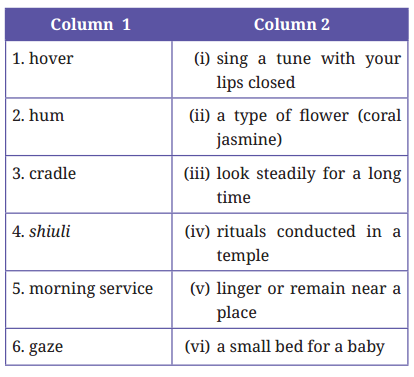
III. Match the words given in Column 1 with their meanings in Column
Answer:
(1 – v), (2 – i), (3 – vi), (4 – ii), (5 – iv), (6 – iii)
Class 9 English I Cannot Remember My Mother Poem Question Answer
Check Your Understanding
I. Fill in the blanks with appropriate words. Stanza 1
1. The poet remembers his mother while he ______.
2. The poet remembers the ________ but not the
Setting: (outdoor/indoor)
Stanza 2
1. The poet remembers his mother in the _______ season.
2. The poet remembers his mother by the smell of _____.
Setting: (outdoor/indoor)
Stanza 3
1. The poet feels that his mother at him from the ______.
Setting: _______ (outdoor/indoor)
Answer:
Stanza 1
1. plays
2. tune; words
Setting: Indoor
Stanza 2
1. autumn
2. shiuli flowers
Setting: Outdoor
Stanza 3
1. gazes/looks
2. sky
Setting: Indoor
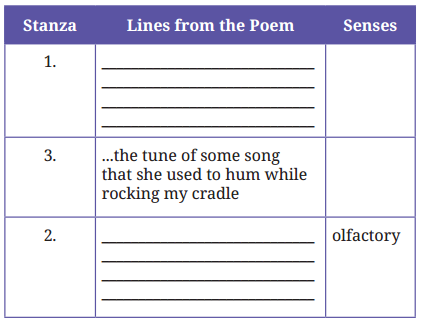
II. The senses of olfactory (smell), auditory (hearing), and visual (sight), are three of the five basic senses in humans. Give examples of references to senses from the poem. Complete the table given below.
Answer:
| Stanza | Lines from the Poem | Senses |
| 1. | a tune seems to hover over my playthings, the tune of some song that she used to hum while rocking my cradle | Auditory |
| 2. | the smell of the shiuli flowers floats in the air, the scent of the morning service in the temple comes to me as the scent of my mother | Olfactory |
| 3. | when from my bedroom window I send my eyes into the blue of the distant sky, the stillness of my mother’s gaze on my face has spread all over the sky | Visual |
III. Read the poem silently once again and complete the following.
Question 1.
Two examples of alliteration from the poem are (i) _____ and (ii) ________.
Answer:
- some song (repetition of the s sound)
- smell of the shiuli (repetition of the s sound)
- morning my mother (repetition of the m sound)
- stillness … spread … sky (repetition of the s sound)
[Note: Students are expected to write any two examples.]
Question 2.
An example of onomatopoeia is _______.
Answer:
hum
Question 3.
The poem uses imagery extensively. Explain.
Answer:
The poem uses imagery extensively by appealing to three different senses in its three stanzas. The auditory image of a hovering tune, the olfactory image of the fragrance of shiuli flowers, and the visual image of the distant blue sky create vivid sensory impressions. These images help the reader experience the child’s memories of his mother through sound, smell, and sight.
Question 4.
Although the poem does not have a rhyme scheme, it is enjoyable because ______.
Answer:
of its gentle rhythm, repetition of the refrain, and vivid sensory imagery that create a soft and emotional effect.
Question 5.
What is the tone of the poet? Why do you say so?
Answer:
The tone of the poem is tender, reflective and melancholic. The poet repeatedly admits that he cannot remember his mother, yet each stanza reveals how deeply her presence is felt through sensory memories. This creates a quiet sadness mixed with warmth and longing.
Question 6.
What impact does the title of the poem have on the overall mood of the poem?
Answer:
The title immediately establishes a mood of loss and longing. By beginning with the words “I cannot remember,” the poet sets an honest and vulnerable tone that prepares the reader for a deeply personal and emotionally gentle poem about absence, memory and lasting emotional connection.
Question 7.
The poet uses ‘I cannot remember my mother’ as a refrain because _______.
Answer:
it emphasises his inability to recall her clearly while highlighting his deep longing and the continued presence of his mother through sensory memories.
Question 8.
The poet uses symbolism to indicate the memory of his mother’s presence. Identify the symbols used in the poem.
Answer:
The poet uses the tune, the fragrance of shiuli flowers, the scent of the morning temple service, and the vast, still sky as symbols to indicate the memory of his mother’s presence. The tune symbolises her nurturing care, the fragrance of shiuli flowers and the temple scent suggest her purity and devotion, and the vast, still sky represents her calm, loving and ever-present gaze.
Critical Reflection
I. Read the extracts given below and answer the questions that follow.
Question 1.
I cannot remember my mother
only sometimes in the midst of my play
a tune seems to hover over my playthings,
i) Complete the following sentence appropriately. The poet is reminded of his mother during his _________.
Answer:
playtime/ play
ii) What is the primary emotion conveyed by the line ‘a tune seems to hover over my playthings’?
(A) It enhances the joy of play.
(B) It disrupts the playtime atmosphere.
(C) It activates memories of the mother.
(D) It symbolises the carefree nature of childhood.
Answer:
(C) It activates memories of the mother.
iii) In the context of the poem, what role does the hovering tune play during the speaker’s playtime?
Answer:
The hovering tune connects the speaker’s playtime with the memory of his mother and suggests her comforting presence returns quietly during his play.
iv) State whether the following sentence is true or false.
The poet experiences the tune lingering over playthings only occasionally during playtime.
Answer:
True
v) How could the poet feel his mother’s presence, even though she isn’t there?
Answer:
The poet feels his mother’s presence through the tune that seems to hover over his playthings, which reminds him of the song she used to hum for him.
Question 2.
I feel that the stillness of
my mother’s gaze on my face
has spread all over the sky.
i) What does the poet suggest about the stillness of his mother’s gaze spreading
over the sky?
(A) The mother’s gaze is physically present in the sky.
(B) The sky is a symbolic extension of the mother’s presence.
(C) The sky mirrors the mother’s emotions.
(D) The stillness is fleeting and unrelated to the mother.
Answer:
(B) The sky is a symbolic extension of the mother’s presence.
ii) What emotion does the poet associate with the ‘stillness’ of his mother’s gaze?
(A) a sense of grief
(B) a sense of anticipation
(Q a sense of nostalgia
(D) a sense of serenity
Answer:
(D) a sense of serenity
iii) State whether the following sentence is true or false.
The poet suggests that the mother’s gaze has a tangible and visual effect on the sky.
Answer:
False. (The poet’s comparison is symbolic. He does not suggest that the mother’s gaze physically affects the sky.)
iv) What is the purpose of likening the mother’s gaze to the sky?
Answer:
The poet likens his mother’s gaze to the sky to suggest that her love is vast, calm, all encompassing and always present around him.
v) Complete the sentence appropriately.
The tone of the poet in the given extract is because .
Answer:
serene and reflective; he feels comfort and peace in the memory of his mother’s gentle gaze rather than grief.
II. Answer the following questions.
Question 1.
What is the emotional impact of the refrain, ‘I cannot remember my mother’?
Answer:
The refrain creates a deep sense of loss, longing and sadness. Its repetition shows the poet’s pain at being unable to recall his mother clearly. At the same time, it suggests that her presence still lives on in his memories, feelings and sensory impressions.
Question 2.
Interpret the connection between the poet’s mother and the following:
i) shiuli flowers
ii) humming tune
Answer:
i) shiuli flowers: The fragrance of shiuli flowers reminds the poet of his mother. As these flowers are associated with morning temple worship, they symbolise her purity, devotion and gentle presence.
ii) humming tune: The humming tune reminds the poet of his mother’s nurturing love and care. It brings back the feeling of her comforting presence during his playtime.
Question 3.
What role does nature play in the poet’s description of the memory of his mother?
Answer:
Nature plays a central role in the poet’s description of his mother’s memory. Elements such as the fragrance of shiuli flowers and the vast blue sky help him feel her presence. Along with the tune he hears, these sensory experiences act as carriers of memory. They allow the poet to reconnect with his mother emotionally, even though he cannot remember her clearly.
Question 4.
What can be inferred about the poet’s perception of the mother-child relationship?
Answer:
The poet suggests that the mother-child relationship is one of the deepest and most lasting emotional bonds in human life. Even though he cannot clearly remember his mother’s face, her presence continues to shape his feelings and memories, through sound, smell and sight. The hovering tune, the fragrance of shiuli flowers, and the vast blue sky help him experience her love and care in different ways. This shows that a mother’s influence does not disappear with time or absence. Instead, her love becomes part of the child’s inner world and remains a source of comfort, guidance and emotional strength throughout life.
Vocabulary in Context
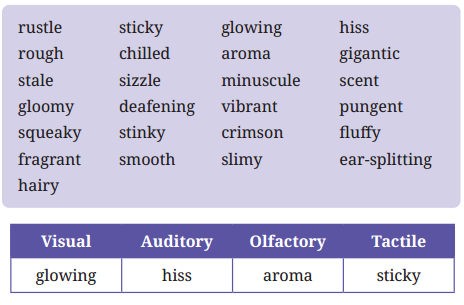
I. Work in pairs to classify the sensory words given in the box below. One example has been done for you.
Answer:
| Visual | Auditory | Olfactory | Tactile |
| glowing | hiss | aroma | sticky |
| vibrant | rustle | fragrant | rough |
| crimson | squeaky | stale | chilled |
| gigantic | sizzle | stinky | smooth |
| minuscule | deafening | pungent | slimy |
| gloomy | ear- splitting | scent | fluffy |
| hairy | hairy |
II. Fill in the blanks with sensory words in the box for the following passage written by Sarojini Naidu. There are two extra words.
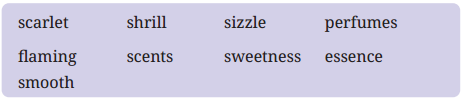
Come and share my exquisite March morning with me: this sumptuous blaze of gold and sapphire sky; these 1. _____________ lilies that adorn the sunshine; the voluptuous 2. _____________ of neem and champak and serisha that beat upon the languid air with their implacable 3. _____________; the thousand little gold and blue and silver breasted birds bursting with the 4._____________ ecstasy of life in nesting time. And, do you know that the scarlet lilies are woven petal by petal from my heart’s blood, these little quivering birds are my soul made incarnate music, these heavy 5. _____________ are my emotions dissolved into aerial 6. _____________, this 7. _____________ blue and gold sky is the ‘very me’…
Answer:
Come and share my exquisite March morning with me: this sumptuous blaze of gold and sapphire sky; these 1. scarlet lilies that adorn the sunshine; the voluptuous 2. scents of neem and champak and serisha that beat upon the languid air with their implacable 3. sweetness; the thousand little gold and blue and silver breasted birds bursting with the 4. shrill ecstasy of life in nesting time. And, do you know that the scarlet lilies are woven petal by petal from my heart’s blood, these little quivering birds are my soul made incarnate music, these heavy 5. perfumes are my emotions dissolved into aerial 6. essence, this 7. flaming blue and gold sky is the ‘very me’…
III. Write numbers against each picture with the phrases that describe them with their sensorial associations. One example has been done for you.
1. beats of music echo in air
2. melody of soothing scent, dancing in the air
3. fragrant breeze of blooming buds
4. gentle lullaby, a soft melody
5. colourful sky, painting a lively sight
6. attractive canvas painting the horizon

Answer:
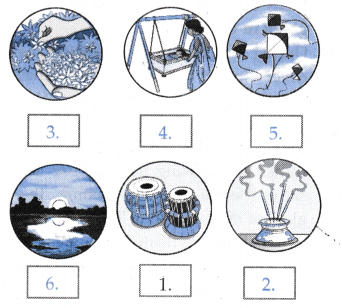
Listen and Respond
I. You will listen to four short extracts of people expressing their childhood memories. As you listen, match each statement 1-6 to each speaker (i)-(iv). There are two statements that you do not need. (Transcript for teacher on textbook page no. 266)

Answer:
| Statement | Speaker |
| 1. The precious memories by the seaside are not the same anymore. | (iv) |
| 2. My grandfather’s encouragement influences me in moments of difficulty. | (i) |
| 3. The school days are a source of recollection to stay in touch. | Not needed |
| 4. Childhood days are about freedom and ordinary pleasures in outdoor activities. | (ii) |
Speaking Activity
I. Work in pairs. Think of an object, song, or a place that is memorable for you. Take turns to speak about it using the prompts given in the textbook.
- Introduce it briefly
- Describe it in detail including sensory details
- Narrate the specifi memory associated with it
- Explain how it has impacted your life
- Summarise why this memory is meaningful to you even now
You may use the following phrases.
- During my childhood…
- Growing up, I fondly remember…
- Recalling those early years, I can’t forget…
- In my younger days, I used to…
- I have a clear memory of…
- A routine activity in my childhood involved…
- A cherished part of my childhood includes…
- As a child, I was fond of…
- One of my favourite childhood moments is…
- Thinking about my early years, I recall…
- A common occurrence during my youth was…
Answer:
During my childhood, one object that I can never forget is my grandmother’s old wooden radio. It sat in the comer of her room, dark brown and slightly scratched, with a round dial that clicked softly when you turned it. Growing up, I fondly remember sitting beside it every evening, the warm glow of its tiny orange light filling the room as old film songs floated through the speaker. Recalling those early years, I can’t forget the particular smell of that room, a mix of sandalwood, old wood, and the faint scent of mustard oil from my grandmother’s hair. The songs were soft and unhurried, and her voice would hum along quietly, almost without realising it.
I have a clear memory of one rainy evening when the power went out and only the radio worked. My grandmother and I sat in the dim room, listening to a song she said her own mother used to sing. She held my hand and said nothing, and I somehow understood that the music was carrying her somewhere far away.
A cherished part of my childhood includes those quiet evenings, and they have impacted my life deeply. Even today, when I hear an old Hindi song on the radio, something in me slows down and softens. Thinking about my early years, I recall that the radio was never just an object. It was a bridge between generations, a keeper of memories, and a reminder that the most meaningful moments in life are almost always the quietest ones.
[Note: The above speech is given as reference. Students are expected to attempt the activity on their own.]
Writing Task
I. Imagine you had been on a school trip to a scenic place which appealed to all your senses. Write a diary entry describing the place and why it was a memorable experience.
Answer:
Thursday, January 10, 2026
8:45 PM
Dear Diary,
Today was one of the most memorable days of my life. Our school took us on a trip to Rishikesh, and the experience appealed to all my senses from the very beginning.
The first thing I noticed was the sound of the Ganga. The rushing water was louder than I had imagined and filled the air with energy. When I stood at the ghaat and dipped my fingers into the river, I felt how cold and powerful the water was. The air carried a pleasant smell of incense from nearby temples mixed with the freshness of the river and wet stones. Later, we tasted local food, and the warm, spicy flavours made the experience even more enjoyable.
In the afternoon, we walked across the Lakshman Jhula. The bridge swayed gently as we crossed it, and I felt both excited and nervous while looking at the flowing river below.
In the evening, the sky turned beautiful shades of orange and pink. During the aarti, I watched small lamps floating on the river. Their soft light made the moment calm and magical.
Reflecting on the trip, I realised that the sounds of the river, the fragrance of incense, the cool water, local food taste and the beautiful sights made this journey unforgettable. I will always cherish this special experience.
Goodnight.
Learning Beyond the Text
I. You read about the shiuli flowers from the poem.
Gather more information on unique flowers of India — where they are found, how they look, what smell they emit, and what the historical significance is, if any. [For example, Kurinji or Neelakurinji that blooms once in twelve years.] Add more flowers to this list.
Shiuli Flowers:
- known as Parijat, Parijata, and Harsingar
- revered and used for various ceremonial purposes
- release a sweet fragrance
- associated with numerous Indian legends
- bloom exclusively during the night
- Answer:
Unique Flowers of IndiaKurinji / Neelakurinji (Strobilanthes kunthiana):
- found in the Western Ghats, especially in Kerala and Tamil Nadu
- bluish-purple flowers covering hillsides
- blooms once every twelve years
- attracts tourists and botanists during its rare flowering cycle
- symbolises the beauty and uniqueness of India’s biodiversity
Brahma Kamal (Saussurea obvallata):
- found in the high-altitude Himalayan regions of Uttarakhand, Himachal Pradesh, and Sikkim
- large white flower surrounded by purple- brown papery bracts
- emits a mild fragrance that becomes stronger at night
- considered sacred and offered at Kedamath and Badrinath temples
- blooms only at night and wilts before dawn
- state flower of Uttarakhand
Kadamba (Neolatnarckia cadamba):
- found across India, especially in West Bengal, Assam, and Kerala
- round, bright orange-yellow flower with a honey-like fragrance
- closely associated with Lord Krishna
- mentioned in classical Sanskrit literature and the Bhagavata Purana
- blooms during the monsoon season
[Note: The above information is given as reference. Students are expected to attempt the activity on their own.]
I Cannot Remember My Mother Class 9 Extra Questions and Answers
I Cannot Remember My Mother Short Question Answer
Question 1.
What does the poet’s inability to remember his mother visually suggest about the nature of early childhood memory?
Answer:
The poet’s inability to remember his mother visually suggests that early childhood memories are often sensory rather than detailed or clear. Even without remembering her face, he recalls her presence through sound, smell, and sight, showing how emotional impressions remain strong over time.
Question 2.
Why does the poet use a tune as the first memory of his mother?
Answer:
The poet uses a tune because it reflects the emotional closeness he shared with his mother during infancy. The lingering sound reminds him of her care and affection and shows how music can preserve memories even when clear visual recollections are absent.
Question 3.
What can be inferred about the poet’s age when he lost his mother?
Answer:
It can be inferred that the poet lost his mother at a very young age. He cannot remember her clearly but recalls her presence through sensory experiences like a tune, fragrance and gaze. This suggests his memories were formed during early childhood.
Question 4.
Why does the poet mention the ‘early autumn morning’ while describing the fragrance of shiuli flowers?
Answer:
The early autumn morning creates a calm and peaceful atmosphere in which shiidi flowers bloom and spread their fragrance. This quiet setting helps the poet recall his mother’s presence and reflects the gentle and reflective mood of the poem.
Question 5.
What does the repeated use of the word ‘only’ reveal about the poet’s memories of his mother?
Answer:
The repeated use of the word ‘only’ shows that the poet’s memories of his mother are limited but meaningful. Although he cannot remember her clearly, the few sensory impressions he recalls remain precious and help him feel emotionally connected to her presence.
Question 6.
What does the vast, still sky symbolise in the poem?
Answer:
The vast, still sky symbolises the calm and boundless presence of the poet’s mother. It suggests that her loving gaze continues to surround and comfort him even though she is no longer physically present, showing that her emotional presence remains strong and lasting.
Question 7.
How does the poet’s memory of his mother expand from the beginning to the end of the poem?
Answer:
The poet’s memory develops from a tune heard during play to the fragrance of flowers and finally to the vast sky. This progression shows how his mother’s presence becomes wider and more meaningful as he connects her memory with nature around him.
Question 8.
Why does the poet connect his memories of his mother with natural elements like flowers and the sky?
Answer:
The poet connects his memories of his mother with natural elements like flowers and the sky because they help him feel her presence through sensory experiences. Nature becomes a medium through which he recalls her love and affection even though he cannot remember her clearly.
Question 9.
The poem ends with the image of the mother’s gaze spread across the sky rather than a feeling of grief or longing. What does this ending suggest about the poet’s relationship with his loss?
Answer:
The ending suggests that the poet accepts his mother absence with calmness and I understanding. Instead of expressing grief, he finds comfort in imagining her loving j gaze spread across the sky, showing that her presence continues to remain part of his emotional life.
Question 10.
What does the poet feel when he looks at the distant blue sky?
Answer:
When the poet looks at the distant blue sky from his bedroom window, he feels that the stillness of his mother’s loving gaze has spread across it. This makes him feel comforted and connected to her presence even though she is no longer with him.
Question 11.
The poem shows how small everyday ; experiences can keep memories alive. : Describe one such experience from your life.
Answer:
Listening to old songs reminds me of the time I spent with my parents during family trips. Whenever I hear those songs again, I feel happy and nostalgic. These simple everyday experiences help me relive those special moments and keep my memories of those joyful journeys alive.
Question 12.
Think of a festival or family routine that reminds you of someone special. Describe how it keeps their memory alive.
Answer:
Celebrating festivals with my family reminds me of my grandparents, who always organised these celebrations with great care and joy. Even today, we follow the same traditions at home. These routines help me feel their presence and keep their love and guidance alive in my memories.
I Cannot Remember My Mother Long Question Answer
Question 1.
Explain how the poet uses the three senses of hearing, smell and sight to express his memory of his mother. How do these sensory impressions help convey his emotional connection with her?
Answer:
The poet expresses his memory of his mother through the three senses of hearing, smell, and sight rather than through clear visual recollection. First, he remembers a tune she used to hum while rocking his cradle. This auditory image reflects her nurturing care and emotional closeness during his early childhood. Next, the fragrance of shiuli flowers and the scent of the morning temple service remind him of her gentle and spiritual presence. These olfactory impressions create a calm and devotional atmosphere associated with her memory.
Finally, the stillness of the vast blue sky represents her loving gaze spread around him, suggesting her constant and protective presence. Through these sensory impressions, the poet shows that although he cannot remember his mother’s face, her love continues to live in his feelings, surroundings, and emotional world.
Question 2.
Analyse how the poet uses the setting in each stanza to show the expansion of his mother’s presence in his memory across the poem.
Answer:
The poet uses the setting of each stanza to reflect how his memory of his mother changes and expands rather than disappears. In the first stanza, the setting is indoors among his playthings, suggesting a 1 close and personal memory connected with childhood. In the second stanza, the setting shifts to an early autumn morning filled with the fragrance of shiuli flowers and temple prayers, showing that his mother’s presence extends into the natural and spiritual world around him.
In the final stanza, the setting becomes the vast blue sky seen from his bedroom window. This wide and open space symbolises the boundless nature of his mother’s loving gaze. Thus, the movement from indoors to the open sky shows that although he cannot remember her clearly, her presence grows wider and continues to surround him everywhere.
Question 3.
The poet does not express anger or bitterness about losing his mother. How does this restraint influence the tone and emotional impact of the poem?
Answer:
The poet’s restraint in expressing anger or bitterness creates a calm and reflective tone throughout the poem. Instead of describing grief directly, he remembers his mother through gentle sensory impressions such as a hovering tune, the fragrance of shiuli flowers, and the stillness of the vast sky. These quiet memories suggest his longing in a subtle and natural way rather than through strong emotional statements.
As a result, the poem feels sincere and deeply touching. The poet’s calm acceptance of his loss also shows that his mother’s presence continues to comfort him even in her absence. This restraint makes the emotional impact of the poem stronger, as the reader experiences his feelings through suggestion and imagery rather than direct expression of sorrow.
Question 4.
The repeated line “I cannot remember my mother” appears at the beginning of each stanza. Explain how this refrain shapes the theme of memory and identity in the poem.
Answer:
The repeated line “I cannot remember my mother” emphasises the poet’s inability to recall her clearly and creates a sense of emotional absence at the beginning of each stanza. However, each repetition is followed by a sensory impression—a tune, the fragrance of shiuli flowers, and the stillness of the vast sky—that reveals her continuing presence in his life.
This contrast shows that memory is not limited to visual recollection but can exist through sound, smell, and sight. The refrain also shapes the theme of identity by suggesting that early childhood experiences continue to influence the poet’s emotional world even without clear memories. It shows that his mother’s presence remains deeply rooted in his inner life and shapes how he connects With the world around him.
Question 5.
Comment on the poet’s use of free verse in the poem. How does the absence of a fixed rhyme scheme support the theme of memory and reflection?
Answer:
The poet uses free verse without a fixed rhyme scheme, which gives the poem a natural and reflective flow. This structure makes the poem sound like personal thoughts rather than formal poetic expression. The absence of a strict rhyme pattern supports the theme of memory because memories often return gently and without order. Instead of rhyme, the poet uses repetition of the line “I cannot remember my mother” to create rhythm and emotional continuity.
This repetition helps connect the three stanzas while highlighting the contrast between forgetting and remembering. The simple and calm structure allows readers to focus on the poet’s sensory experiences of sound, smell, and sight. As a result, the free verse style strengthens the poem’s intimate tone and effectively expresses how the memory of the poet7 s mother returns through everyday moments.
Question 6.
Do you agree that the poem suggests a mother’s love remains present even when clear memories fade? Support your answer with references from the poem.
Answer:
Yes, the poem suggests that a mother’s love remains present even when clear memories fade. Although the poet cannot remember his mother’s face, he continues to feel her presence through a hovering tune, the fragrance of shiuli flowers, and the stillness of the vast sky. These sensory impressions show that her love survives in his emotions and surroundings. The poem highlights that early childhood bonds do not disappear with time or absence. Instead, they remain alive through sound, smell, and sight. By connecting his mother’s presence with elements of nature, the poet suggests that her love has become a lasting part of his inner world. Thus, the poem shows that emotional memory can remain strong even when visual memory fades.
Question 7.
Compare the poet’s way of remembering his mother through nature with how people today preserve memories through photographs and videos. Which creates a deeper emotional connection? Give reasons.
Answer:
The poet remembers his mother through natural sensory experiences such as a tune, the fragrance of shiuli flowers, and the stillness of the vast sky. These impressions make her presence feel alive and emotionally close to him. Today, people often preserve memories through photographs and videos, which help recall a person’s appearance and voice clearly.
However, memories connected with nature and the senses often create a deeper emotional connection because they return naturally in everyday situations. The poet’s memories do not depend on objects but arise from his surroundings and feelings. As a result, his connection with his mother feels more personal and lasting. This suggests that sensory memories can sometimes create stronger emotional bonds than recorded images.
Question 8.
Describe the tone of the poem and support your answer with examples from the text.
Answer:
The tone of the poem is gentle, reflective, and tender. Instead of expressing grief directly, the poet remembers his mother through calm sensor}7 impressions such as a hovering tune, the fragrance of shiuli flowers, and the stillness of the vast sky. These soft and peaceful images create a sense of emotional closeness rather than sadness. The repeated line “I cannot remember my mother” adds to the reflective mood by showing both his sense of loss and his continuing emotional connection with her. The poet’s memories are expressed quietly through nature and1 everyday experiences, which makes the tone sincere and comforting. Thus, the poem presents the mother’s presence as lasting and reassuring even though she is no longer physically with him.
Question 9.
Describe how the poet’s surroundings help him remember his mother.
Answer:
The poet’s surroundings play an important role in helping him remember his mother through sensory experiences. While playing indoors, a hovering tune reminds him of her nurturing presence. In the early autumn morning, the fragrance of shiuli flowers and the scent of the temple service bring back memories of her gentle and spiritual nature. Later, when he looks at the distant blue sky from his bedroom window, he feels her loving gaze spread around him.
These everyday surroundings help him remain emotionally connected to his mother even though he cannot remember her face clearly. The poem shows that nature and familiar experiences can preserve early childhood memories and keep emotional bonds alive even in the absence of clear visual recollection.
Writing Task
I. You are sitting by an open window on a quiet afternoon when a familiar smell drifts in from somewhere outside, perhaps it is the scent of rain on dry earth, freshly made food, an old book, or a flower from your childhood garden. For a moment, everything around you disappears and a memory surfaces: a person, a place, or a feeling you had almost forgotten.
Write a letter to that memory.
Address it directly – not to a person, but to the memory itself. Tell it where you were when it found you, what it felt like when it arrived, and what it reminded you of. Use sensory details to bring both the present moment and the remembered moment to life.
Your letter must include:
- An opening that describes the exact moment the memory arrived and what triggered it
- At least two sensory details from the present moment (what you saw, heard, smelled, or felt sitting by the window)
- A description of what the memory showed you, written as though you are reliving it
- An honest reflection on why this memory still matters to you
- A closing line that speaks directly to the memory, telling it what you would like it to do – stay, return, or let you go
Remember: You are not writing about a person. You are writing to a memory. Give it a voice. Treat it as something that visits you, not something you go looking for, just as the poet found his mother not in photographs or conscious thought, but in a tune, a fragrance, and the stillness of the sky.
Answer:
Letter to a Memory
Thursday, 14 August 2025 4:15 PM
Dear Memory,
This afternoon, I was sitting quietly beside my window when the soft smell of rain on dry earth drifted in from outside. The sky looked grey and still, and I could hear gentle raindrops tapping on the leaves near the window. The cool breeze touched my face, and suddenly you arrived without warning.
You took me back to my school playground during the first rain of the season. I could see my friends running across the wet ground and hear our laughter echoing around us. My shoes were muddy and my uniform was soaked, but I remember feeling completely free and happy. For a few moments, it felt as if I was living that moment again.
You still matter to me because you remind 1 me of a time when life felt simple and full of small joys. Even today, whenever I smell the rain, I feel calm and comforted.
Dear Memory, please keep visiting me whenever the rain returns, because each time you come back, you bring happiness with you.
Yours lovingly,
A Friend Who Remembers