Gifts of Grace: Honouring Our Vocations Class 9 Question Answer
Reflect and Respond
I. Given below are four riddles. Read and identify who these people are.
Question 1.
In furrows deep, secrets I sow, As time passes, I watch them grow.
Who am I?
Answer:
A Farmer
Question 2.
From wheel to kiln, my skill is born, Step by step, an art takes form.
Who am I?
Answer:
A Potter
Question 3.
I lay foundations, brick by brick, to build a house, it’s me you pick.
Who am I?
Answer:
A Mason
Question 4.
I work with pots, pans, and spice, creating dishes that taste so nice.
Who am I?
Answer:
A Cook
II. What is the role and relevance of the people you identified in the riddles. How do they contribute to the society? Discuss with your classmates and teacher.
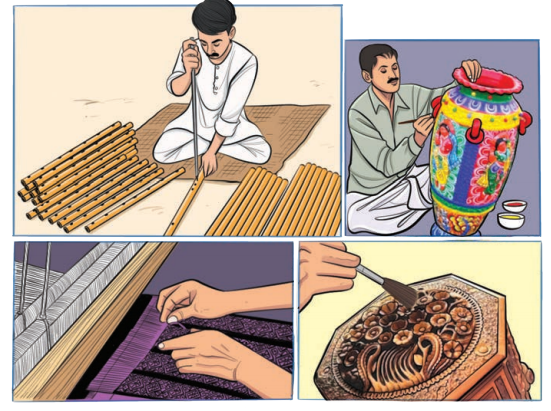
Answer:
Each of these four people represents an essential pillar of everyday life.
The farmer feeds the nation. Without the farmer’s patience and labour, there would be no food on our tables. Every grain we eat begins in the farmer’s hands.
The potter carries forward an ancient craft. From simple clay, the potter creates useful vessels for daily life and helps preserve a tradition that connects us to our cultural roots. The mason builds the spaces where we live, learn, and work. Every school, home, and hospital stands because someone laid its foundation brick by brick. The mason’s work supports the development of society.
The cook turns raw ingredients into nourishment and comfort. Whether in a home, school or community kitchen, the cook helps maintain people’s health, strength and well-being.
[Note: The above answer is given as reference. Students are expected to write the answer on their own.]
Class 9 English Gifts of Grace: Honouring Our Vocations Poem Question Answer
Check Your Understanding
I. Based on your understanding of the poem, state whether the following statements are true or false. Also, rectify the false statements.
1. The poem highlights the skilled work of craftsperson.
2. The poet shares that musicians express emotions through their instruments.
3. The carpenters in the poem are admired for their logical work.
4. The electricians in the poem are recognised for their crucial role in lighting up lives.
5. The poem pays homage to shoemakers who manufacture quality footwear.
6. The poem celebrates the patriotism of the people of Bharat.
7. The poet feels that each vocation deserves to be respected.
Answer:
1. True
2. True
3. False – The carpenters are admired for their mathematical precision in shaping wood and creating useful objects.
4. True
5. True
6. False – The poem celebrates the dignity of labour and diverse professions, not specifically patriotism.
7. True
II. Let us appreciate the poem.
Question 1.
Rhyme Scheme and Lineation
i) Does the poem strictly adhere to a rhyme scheme, or is it in free verse?
ii) What is the impact of the varying length of lines in the poem?
iii) What is the pattern in the structure of most lines of the poem?
Answer:
i) The poem is written in free verse. It does not follow a regular rhyme scheme.
ii) The varying length of lines:
a. creates a natural conversational rhythm
b. reflects the diversity of vocations
c. makes the poem sound like a flowing celebration of voices across Bharat
iii) Most lines follow a pattern of identifying a specific worker, describing their action/tool, and then stating the value/impact of their work.
Question 2.
Speaker
i) Who appears to be the speaker and what is her/his role here?
Answer:
The speaker appears to be an observer and admirer of the workers of Bharat. The speaker listens carefully to their voices and celebrates their dedication, creativity and contributions to society.
Question 3.
Tone and Mood
i) Fill in the blanks with suitable options from the box given below.
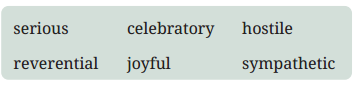
A. The tone is _______ and ________, depicting a sense of admiration and respect for the artisans and craftspersons.
B. There is a ________ mood throughout the poem, capturing the vibrancy and richness of cultural traditions and skills.
Answer:
A. celebratory and reverential
B. joyful
Question 4.
Imagery
i) Select any two descriptions from the poem that evoke visual images.
Answer:
a. woven with colours and myriad hues
b. The carpenters celebrating; they create anything out of wood with mathematical precision
c. The electricians humming; they get ready for work, work with cables and wires to brighten our lives
d. The boatmen gathering their nets from the shore, sailing
e. return to tell the tales of life at sea
f. The shoemakers affirming the quality of their work, for the feet that walk, dance, run, jump, return home
g. The delicious singing of the cook
h. the rhythm of designer, mason
[Note: Students can write any two descriptions.]
ii) Fill in the blanks with suitable phrases.
The poem includes auditory imagery through mentions of artisans with lutes, _______, and ________, emphasising the sounds associated with each vocation.
Answer:
electricians humming; boatmen singing
Question 5.
Metaphor
i) State whether the following sentence is true or false.
The mention of ‘delicious singing’ of the cook is a metaphor because it implies that the quality of the singing is so enjoyable or pleasing that it can be equated to the experience of tasting something delicious.
Answer:
True
Question 6.
Personification
i) Select the line that tells us that the poet personifies vocations by attributing humanlike qualities to them.
Answer:
The voice of their vocation is the voice of their identity.
Here, vocation is given the human quality of having a voice.
Question 7.
Repetition
i) Why might the poet have begun and ended with the same line — ‘I hear Bharat celebrating, the varied vocations I hear!’?
Answer:
The poet might have begun and ended with the same line to emphasise the central idea of celebrating diverse professions and create a rhythmic effect.
Question 8.
Alliteration
i) Identify two examples of alliteration from the poem.
Answer:
“voice of their vocation” (repetition of the V sound), “woven with” (repetition of the ’w’ sound).
Question 9.
Symbolism
i) Each vocation in the poem symbolises something more than just a job. What does it symbolise?
Answer:
Each vocation symbolises:
a. personal identity
b. dignity of labour
c. creativity and skill
d. contribution to society
e. the unity and diversity of Bharat’s working community
Critical Reflection
I. Read the extract given below and answer the questions that follow.
The shoemakers affirming the quality of their work, for the feet that walk, dance, run, jump, return home.
The delicious singing of the cook, or the rhythm of of designer, mason, each celebrating what belongs to them and to none else,
Question 1.
The poet says that the shoemakers ‘affirm’ the quality of their work. What does ‘affirm’ refer to here?
i) to make adjustments in
ii) to declare with confidence
iii) to label the goods
iv) to justify the efforts
Answer:
ii) to declare with confidence
Question 2.
What do quality shoes help with, according to the poet?
Answer:
According to the poet, quality shoes support the feet in all daily activities such as walking, dancing, running, jumping, and returning home safely.
Question 3.
What does ‘return home’ symbolise besides the literal act of returning?
Answer:
Besides its literal meaning, ‘return home’ symbolises safety, comfort, completion of daily efforts, and a sense of belonging in life’s journey.
Question 4.
Identify the phrase that tells us that every worker’s contribution is distinct.
Answer:
‘Each celebrating what belongs to them and to none else.’
Question 5.
Complete the following with suitable words. …for the feet that walk, dance, run, jump, return home refers to _______.
Answer:
the entire journey of human life and the diverse activities that make up our daily existence.
II. Answer the following questions.
Question 1.
Why does the poet say, ‘I hear Bharat celebrating, the varied vocations I hear’?
Answer:
The poet says this to show that people across Bharat are proudly engaged in different kinds of work. Each worker contributes through their skills and dedication. By repeating this line, the poet highlights the dignity of labour and expresses admiration for the diversity of professions that help society function smoothly.
Question 2.
What does the electrician ‘humming’ while getting ready for work suggest?
Answer:
The ‘humming’ suggests a sense of contentment and enthusiasm. It shows that the electrician is not just working for a paycheck; they are mentally and emotionally engaged. It reflects a positive attitude toward labour, where the worker finds a rhythmic peace in their daily routine, ready to ‘brighten lives’ with a cheerful spirit.
Question 3.
Explain the significance of the line, ‘The voice of their vocation is the voice of their identity.’
Answer:
This line means that a person’s profession reflects who they are. It means that a person’s work defines who they are and gives them identity. A carpenter’s ‘voice’ is found in their precision. A cook’s ‘voice’ is in their flavours.
Question 4.
Do you think the role of all the people belonging to different vocations is important in our daily lives? Support your answer with a reason.
Answer:
Yes, the role of people from different vocations is very important in our daily lives because each profession supports society in a unique way. For example: electricians provide light and power, carpenters make useful furniture, shoemakers make comfortable footwear, cooks prepare food.
Without these workers, daily life would become difficult and incomplete.
Question 5.
Why is the poet celebrating all the vocations in the poem? Explain by giving examples from your context.
Answer:
The poet celebrates all vocations to show that every type of work deserves respect. Each worker contributes to the well-being of society. In our daily life too teachers guide students, doctors treat patients, farmers grow food, drivers help people travel safely.
These examples show that every vocation plays an important role in building a strong and supportive community.
Question 6.
How does the poet use sensory imagery to bring out the beauty of everyday work?
Answer:
The poet uses sensory imagery to make the description of work lively and engaging.
i) Auditory Imagery: The ‘humming’ of the electrician, the ‘singing’ of the cook, and the ‘echoing’ lutes create a soundscape of productivity.
ii) Visual Imagery: Descriptions like ‘myriad hues’ of the craftsperson and the ‘nets from the shore’ allow us to see the colours and textures of labour.
Vocabulary in Context
I. People of different vocations are being described in the poem. Match the vocations given in the box below with the descriptions that follow.

1. A person who studies or grows garden plants: _______
2. A trained female community health worker: _______
3. A producer of raw silk: _______
4. A person whose job is making or selling sweets and chocolates: _________
5. A metalworker who specialises in working with precious metals: _______
6. A person who fuses materials together: _______
Answer:
1. Horticulturist
2. ASHA worker
3. Sericulturist
4. Confectioner
5. Goldsmith
6. Welder
II. Identify the word from Column 2 that is not the synonym of the words given in Column 1.
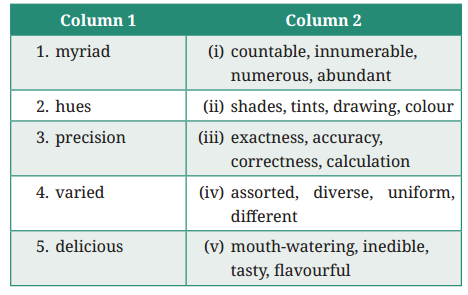
Answer:
| Column 1 | Column 2 | ||
| 1. | myriad | i. | countable |
| 2. | hues | ii. | drawing |
| 3. | precision | iii. | calculation |
| 4. | varied | iv. | uniform |
| 5. | delicious | v. | inedible |
Listen and Respond
I. You will listen to two friends, a boy and a girl discussing the occupations of their parents. As you listen, answer the following question in two to three words only. (Transcript for teacher on textbook page 262)
What does the boy use to understand the details of the tools?
Answer:
toy cars
II. You will listen to the girl and the boy once again. As you listen, answer the questions by selecting the correct option.
Question 1.
The girl is _________ about taking food for her mother at the factory.
(A) happy
(B) boastful
(C) unsure
Answer:
(A) happy
Question 2.
The boy thinks that the job of the girl’s mother carries a lot of ______.
(A) luck
(B) risk
(C) responsibility
Answer:
(C) responsibility
Question 3.
The girl why the boy is good at science exhibitions.
(A) wonders
(B) questions
(C) realises
Answer:
(C) realises
Question 4.
The girl shares her __________ about joining the weekend discussion on tools.
(A) doubts
(B) wish
(C) ideas
Answer:
(B) wish
Speaking Activity
The poet speaks of several occupations in the poem. Create groups of five. Allot the role of any five vocations that the poet talks about. Each student in the group will represent one vocation.
Each student speaks for 1-2 minutes about their vocation — who they are, what they do, where they work, what kind of experiences they have at work, what problems they face and a message for all.

Answer:
1. Carpenter: Hello everyone! I am a carpenter. I work with wood and create useful things like doors, tables, chairs, and cupboards with mathematical precision. I usually work in workshops, homes, and construction sites. My work requires careful measurement, patience, and skill. I feel proud when people use the furniture I make every day. However, my work can be tiring and sometimes risky because I use sharp tools and heavy materials.
My message: Respect skilled workers, because our work helps build comfortable homes and better lives.
2. Electrician: Good morning everyone! I am an electrician. I work with cables and wires to provide electricity and help brighten your lives. I work in houses, offices, schools, and factories.
My work requires technical knowledge and safety awareness. I feel happy when I solve electrical problems and restore light and comfort to people’s homes. However, my job can be dangerous if safety rules are not followed.
My message: Electricity makes modern life possible—please value the workers who make it safe and available.
3. Boatman: Hello friends! I am a boatman. I gather my nets from the shore, sail across rivers and seas, and return with stories and experiences from the water. I work near rivers, lakes, and coastal areas.
My work connects people with nature and helps provide food and transport. I enjoy the beauty of the sea, but I also face challenges like rough weather and long journeys.
My message: Respect nature and the workers who depend on it for their livelihood.
4. Shoemaker: Good morning everyone! I am a shoemaker. I make strong and comfortable footwear for the feet that walk, dance, run, jump, and return home. I work in workshops, markets, and small shops.
My work supports people in their daily activities. I feel satisfied when people walk comfortably using the shoes I make. However, my work requires long hours and careful attention to detail.
My message: Every step you take becomes easier because of someone’s effort—respect all workers.
5. Cook: Hello everyone! I am a cook. I prepare food that brings health, energy, and happiness to people. My work is described as the delicious singing of the cook in the poem. I work in homes, schools, restaurants, and community kitchens.
Cooking requires creativity, patience, and care. I enjoy serving food that makes people feel satisfied and joyful. However, cooking for many people can be tiring and demanding. My message: Food is a gift of care—always respect the hands that prepare it.
[Note: The above speech is given as reference. Students are expected to attempt the activity on their own.]
Writing Task
I. Your school will be organising a ‘Career Mela’ in which students are to be made familiar with the different career options. Complete the poster for the event given below.
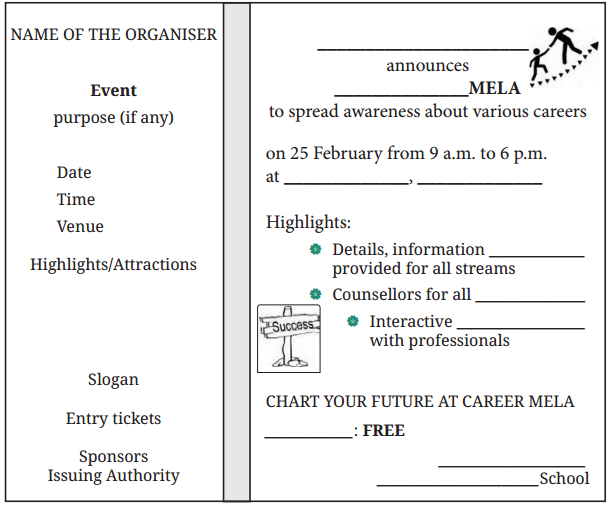
Answer:

II. Visit the website https://www.msde.gov.in/ ;
Collect information on any one vocation of your choice. Prepare a presentation explaining the following.
- Reason for your choice
- How is it helpful to the society and self?
Answer:
A good choice for presentation could be the vocation of Healthcare Assistant (General Duty Assistant), offered under the Ministry of Skill Development and Entrepreneurship. It is highly relevant today because it supports hospitals, clinics, and patients while also providing secure employment opportunities.
Vocation: General Duty Assistant (Healthcare)
- Reason for choice
- I choose this vocation because healthcare assistants support doctors and nurses and play an important role in patient care.
- How it helps society
- They assist patients, support hospitals and clinics, and help during emergencies and basic care needs.
How it helps the individual (Self)
This vocation provides employment opportunities, develops healthcare skills, and gives personal satisfaction through service to others.
Presentation Structure
- Introduction – Briefly explain what a General Duty Assistant is.
- Reason for Choice – Highlight why healthcare is important and why you selected this vocation.
- Contribution to Society – Show how GDAs support patients and healthcare institutions.
- Benefits to Self – Emphasize career stability, skill development, and personal growth.
- Conclusion – End with a message of pride in contributing to India’s healthcare system.
[Note: Above information is given as reference. Students can pick a profession of their choice and create the presentation on their own.]
III. A Japanese Haiku
Create a Haiku poem and share with your classmates and teacher.
Answer:
Soft breeze in the trees (5)
Leaves whisper secrets so low (7)
Nature sings at peace (5)
Gifts of Grace: Honouring Our Vocations Class 9 Extra Questions and Answers
Gifts of Grace: Honouring Our Vocations Short Question Answer
Question 1.
Explain how the poet presents unity through different professions.
Answer:
The poet presents unity by bringing together various professions like carpenters, electricians, and boatmen, all ‘celebrating’ their work. Despite differences, they form a harmonious society. This is reinforced by the line ‘I hear Bharat celebrating, the varied voices I hear!’ which shows collective unity.
Question 2.
What role do sounds (like humming, singing, rhythm) play in the poem?
Answer:
Sounds bring the poem to life and make work feel joyful rather than burdensome. Through phrases like ‘electricians humming’ and ‘the delicious singing of the cook,’ the poet shows that labour has its own music and energy. These sounds together create a sense of a nation buzzing with energy, where every worker finds happiness and pride in what they do.
Question 3.
Describe the contribution of boatmen as depicted in the poem.
Answer:
Boatmen are shown as hardworking and experienced. They ‘gather their nets,’ sail, and ‘sing while at work,’ and later ‘return to tell the tales of life at sea.’ This highlights both their labour and storytelling role. The boatmen represent both physical hardship and the spirit of storytelling. The poet shows them as people whose contribution goes beyond catching fish as they bring back experiences and narratives that enrich the community around them.
Question 4.
How does the poet highlight the uniqueness of each profession?
Answer:
The poet highlights the uniqueness of each profession by describing their distinct actions and skills. For example, carpenters create with precision, shoemakers affirm quality and designers work with rhythm. The line ‘each celebrating what belongs to them and to none else’ captures it best. No two vocations are the same, and the poet treats each one as irreplaceable and worthy of celebration.
Question 5.
Why does the poet use the word ‘celebrating’ repeatedly?
Answer:
The repetition of the word ‘celebrating’ emphasises the dignity and importance of every profession. It shows that no work is ordinary or lesser. By repeating this word, the poet highlights the joy, pride,” and collective contribution of workers that strengthen the spirit of Bharat.
Question 6.
What does the phrase ‘return home’ suggest in the poem?
Answer:
The phrase ‘return home’ suggests safety, comfort, and a sense of belonging at the end of daily activities. It shows that the shoemaker’s work supports people throughout their journeys, highlighting that work is not only about earning but also about enabling comfort and everyday living.
Question 7.
In what way is the cook’s work described differently from others?
Answer:
The cook’s work is described through a blending of the senses of taste and sound in the phrase ‘the delicious singing of the cook.’ Unlike other workers described through their actions or tools, the cook is presented through sensory imagery, making the description more imaginative and expressive.
Question 8.
What overall impression of Bharat does the poem create?
Answer:
The poem paints Bharat as a land alive with the sounds and rhythms of honest work. From carpenters to boatmen to cooks, every worker contributes something unique. The repeated line ‘I hear Bharat celebrating’ leaves us with an impression of a nation that is diverse, energetic and deeply proud of the people who build it every single day.
Question 9.
How does the poem connect different professions with various areas of knowledge such as art, science, environment and society? Explain with examples from the poem.
Answer:
The poem connects professions with different areas of knowledge by showing how each vocation contributes to society in unique ways. Artisans represent creativity and art, carpenters reflect mathematical precision and practical skills, electricians show scientific application, and boatmen connect with nature and environment. Together, they highlight the multidisciplinary importance of work in society.
Question 10.
Observe any worker in your neighbourhood and explain what skills you noticed in their work.
Answer:
I observed a carpenter working in my neighbourhood. He carefully measured and shaped wooden pieces before assembling furniture. His work required patience, accuracy and planning. This observation helped me understand the importance of precision and skill in everyday professions.
Question 11.
Describe one profession mentioned in the poem that you would like to learn more about and explain why.
Answer:
I would like to learn more about the work of electricians because their role is essential in providing electricity and ensuring safety. Their technical skills support daily life. Understanding their work will help me appreciate how technology improves our living conditions.
Gifts of Grace: Honouring Our Vocations Long Question Answer
Question 1.
Analyse how the poet creates a sense of movement and liveliness across different professions in the poem. Support your answer with references.
Answer:
The poet creates a strong sense of movement and liveliness by presenting each profession in action across the poem. Craftspersons are described as working with ‘colours and myriad hues’ suggesting creativity and activity. Artisans with ‘lutes’ are ‘hailing varied emotions’ and ‘celebrating dreams,’ adding musical energy to the scene.
Carpenters ‘create anything out of wood with mathematical precision,’ showing careful craftsmanship in motion. Electricians are ‘humming’ as they ‘work with cables and wires to brighten our lives.’ Boatmen are ‘sailing, and singing while at work,’suggesting rhythm and continuity. Shoemakers support ‘the feet that walk, dance, run, jump,’ reflecting constant human movement. The repeated phrase ‘I hear’ adds a musical quality and reinforces the lively atmosphere, presenting work as energetic, joyful and meaningful.
Question 2.
Examine how the poet connects different professions to human life and daily experiences. Give examples from the poem.
Answer:
The poet connects different professions to human life and daily experiences by showing how each vocation supports society in practical and meaningful ways. Craftspersons are described as working with ‘colours and myriad hues,’ highlighting creativity that enriches daily surroundings. Artisans with ‘lutes’ express emotions and dreams, adding beauty and cultural depth to life. Carpenters create objects with ‘mathematical precision,’ supporting everyday needs like furniture and shelter.
Electricians ‘brighten our lives,’ making modem living comfortable and convenient. Shoemakers support ‘the feet that walk, dance, run, jump, return home,’ symbolising human activity and movement. Boatmen gather their nets and share ‘tales of life at sea,’ connecting work with experience and storytelling. Even the cook’s ‘delicious singing’ links food with care and joy. Thus, the poet shows that professions are closely connected to daily life and human experience.
Question 3.
Discuss how the poet blends practicality and creativity in the portrayal of different vocations. Use evidence from the poem.
Answer:
The poet blends practicality and creativity by presenting each vocation as both useful and expressive. Craftspersons are described as working with ‘colours and myriad hues,’ highlighting artistic creativity in their work. Artisans with ‘lutes’ express emotions and dreams, showing the musical and imaginative side of labour. Carpenters demonstrate practicality through ‘mathematical precision,’ reflecting careful planning and skill. Electricians perform technical tasks but are described as ‘humming,’ adding a rhythmic quality to their work.
Similarly, the cook’s work is expressed as ‘the delicious singing of the cook,’ combining usefulness with sensory pleasure. Designers and masons are associated with ‘rhythm,’ suggesting structured yet creative effort. Through these examples, the poet shows that all professions involve both practical usefulness and creative expression, making work meaningful and dignified.
Question 4.
Evaluate how the poet builds the idea of identity through work in the poem. Support your answer with textual references.
Answer:
The poet builds the idea of identity through work by showing that each vocation reflects a person’s individuality and contribution to society. This idea is clearly expressed in the, line ‘The voice of their vocation is the voice of their identity.’ Craftspersons working with ‘colours and myriad hues’ and artisans with ‘lutes’ show how creativity expresses personal identity.
Carpenters create with ‘mathematical precision,’ while boatmen return with ‘tales of life at sea,’ reflecting their experience and connecti with nature. Workers are also described as ‘celebrating what belongs to them and to none else,’ highlighting ownership and pride in their skills. Through these examples, the poet suggests that work is not merely a means of livelihood but an expression of who people are and how they contribute meaningfully to society.
Question 5.
How does the poem encourage respect for unseen or less-recognised work? Illustrate with examples and real-life application.
Answer:
The poem encourages respect for unseen or less-recognised work by highlighting the contributions of workers such as shoemakers, boatmen and masons. Shoemakers are shown ‘affirming the quality of their work,’ while boatmen return with ‘tales of life at sea,’ showing both effort and experience. Even masons contribute quietly through their skilled labour.
By presenting these professions with dignity, the poet shows that every role is important in society. In real life, we can practise this value by appreciating workers such as cleaners, helpers and drivers and recognising their contribution to our daily comfort. The poem teaches that respecting all kinds of work helps build empathy, equality and a more supportive society.
Question 6.
‘Joy in work leads to excellence.’ Discuss this idea in the context of the poem with suitable references.
Answer:
The poem shows that joy in work leads to excellence by presenting workers as happy and engaged in their tasks. Craftspersons are ‘celebrating their craft’ and artisans with ‘lutes’ express emotions and dreams, showing creative satisfaction. Carpenters work with ‘mathematical precision,’ reflecting dedication and skill. Electricians are ‘humming,’ and boatmen are ‘singing while at work,’ which suggests enjoyment in their labour. The cook’s work is described as ‘the delicious singing of the cook,’ combining effort with pleasure. These examples show that when people take pride and joy in their work, they perform it with care and excellence. The poem suggests that joy and dedication go together, leading to better results and a sense of fulfilment in one’s work.
Question 7.
Analyse how the poem presents Bharat as a collective identity shaped by its people. Support your answer with references.
Answer:
The poem presents Bharat as a collective identity formed by its diverse workforce. The repeated line ‘I hear Bharat celebrating’ suggests that the nation’s spirit lies in its people. Different professions: artisans, carpenters, electricians, boatmen and others represent various sections of society. Their combined efforts create ‘varied voices,’ symbolising unity in diversity. The idea that each vocation contributes uniquely reinforces that Bharat is not defined by one group but by all. Thus, the poem portrays the nation as vibrant, inclusive and dynamic, shaped by the effort and dedication of its people.
Question 8.
How do ‘Gifts of Grace: Honounng Our Vocations’ and ‘Bharat Our Land’ together show that Bharat’s identity is shaped by both the work of its people and its cuitural heritage?
Answer:
Both ‘Gifts of Grace: Honouring Our Vocations’ and ‘Bharat Our Land’ show that Bharat’s identity is shaped by both the work of its people and its cultural heritage. In ‘Bharat Our Land’, Subramania Bharati celebrates the nation’s sacred and cultural wealth through references to the Himalayas, the Ganga, the Upanishads and Dhamma. These images show Bharat as a land of wisdom, strength and spiritual greatness. In ‘Gifts of Grace’, Bharat is shown as a living nation built by workers such as craftspersons, carpenters, electricians, boatmen, shoemakers, cooks, designers and masons. Their skills and labour support daily life and give meaning to society. Together, the poems show that Bharat’s identity comes from both its glorious heritage and the continuing contribution of its hardworking people.
Question 9.
The poem highlights the interdependence of professions. Explain this idea and suggest how students can practise this value in real life.
Answer:
The poem highlights the interdependence of professions by showing how different workers support various aspects of daily life.
Craftspersons add beauty through ‘colours and myriad hues,’ carpenters create useful objects with ‘mathematical precision,’ electricians ‘brighten our lives,’ and shoemakers support ‘the feet that walk, dance, run, jump, return home.’ Boatmen also contribute through their work and ‘tales of life at sea.’ These examples show that no profession exists in isolation and that all workers contribute to society’s well-being. The poem teaches us the importance of cooperation, respect for all professions, and teamwork. In real life, we can practise this value by appreciating workers around us, working collaboratively with others, and recognising that collective effort helps society function smoothly.
Writing Task
Question 1.
School Newsletter Article
You have read the poem that celebrates various professions. Imagine you are the editor of your school newsletter. Write an article titled:
‘Celebrating Every Profession: Pride in Our Work.’
[Students can use below instructions to attempt the activity.
- Begin with an engaging introduction that explains why every profession is important in your school or community.
- Include examples of professions mentioned in the poem.
- Explain how these professions contribute to daily life and student/community experiences.
- Highlight a value from the poem (e.g., respect for work, teamwork, or joy in responsibilities).
- Conclude with a call-to-action encouraging students to appreciate and take pride in all work.]
Question 2.
i) Choose any five professions from the poem (e.g., artisans, carpenters, boatmen, electricians, shoemakers).
ii) For each profession, research and summarise:
[Students can use below instructions to attempt the activity.
History: How was it practised in the past?
Geography/Environment: Which regions in India are known for it?]