Class 9 SST Chapter 7 Elections Question Answer
The Big Questions (Page No. 161)
Question 1.
Why are elections essential to a democratic system?
Answer:
Elections are essential because they allow citizens to choose their representatives and the government.
Question 2.
How do electoral systems and rules shape political representation and fairness?
Answer:
Electoral systems and rules ensure that elections are conducted fairly and transparently. They provide equal opportunities to political parties and candidates, protect voters’ rights and help ensure that people are fairly represented in the government.
Question 3.
What roles do institutions and laws play in ensuring free and fair elections?
Answer:
Institutions like the Election Commission of India and election laws ensure that elections are conducted honestly and peacefully. They prepare voter lists, enforce election rules, prevent unfair practices and ensure that every eligible citizen can vote freely.
Question 4.
What challenges do elections face in practice, and how can these challenges affect democracy?
Answer:
Elections may face challenges such as fake news, money power, misuse of social media, voter intimidation and low voter awareness. These challenges can influence voters unfairly, reduce public trust and weaken democracy if not properly addressed.
Let’s Explore (Page-165)
Different democracies use different electoral systems. Make groups of 5-6 students. Each group will select six countries from different continents. Prepare and present a case study on the type of electoral system(s) operating in those countries and discuss their latest election results of those countries.
Answer:
| Country (Continent) | Type of Electoral System | Latest Election Result |
| India (Asia) | First-Past-the-Post (FPTP) | In the 2024 Lok Sabha Elections, the National Democratic Alliance (NDA) formed the government and Narendra Modi became Prime Minister for a third term. |
| United Kingdom (Europe) | First-Past-the-Post (FPTP) | In the 2024 General Election, the Labour Party won a majority and Keir Starmer became Prime Minister. |
| United States (North America) | Electoral College System | In the 2024 Presidential Election, Donald Trump won the election and became the President. |
| Brazil (South America) | Two-Round Voting System | In the 2022 Presidential Election, Luiz Inacio Lula da Silva (Lula) won and became President. |
| South Africa (Africa) | Proportional Representation (PR) | In the 2024 General Election, the African National Congress (ANC) remained the largest party and formed a coalition government. |
| Australia (Australia/ Oceania) | Preferential Voting (Ranked Chpice) | In the 2025 Federal Election, the Australian Labour Party retained power under Anthony Albanese. |
Comparison of Electoral Systems
| Electoral System | Countries Using It | Main Feature |
| First-Past-the-Post (FPTP) | India, United Kingdom | The candidate with the highest number of votes wins, even if he/she does not secure an absolute majority. |
| Electoral College | United States | Citizens vote for electors, who then elect the President. |
| Two-Round System | Brazil | If no candidate gets more than 50% of the votes, a second round of voting is held. |
| Proportional Representation (PR) | South Africa | Seats are distributed among political parties according to the percentage of votes they receive. |
| Preferential Voting | Australia | Voters rank candidates in order of preference. If no candidate gets a majority, preferences are redistributed until one candidate wins. |
Observations
- Different countries use different electoral systems based on their Constitution and political traditions.
- India and the United Kingdom use the First-Past-the- Post (FPTP) system.
- South Africa follows Proportional Representation, giving smaller parties better representation.
- Australia uses Preferential Voting, ensuring the winning candidate has majority support.
- The United States elects its President through the Electoral College, while Brazil uses a Two-Round Voting System.
Don’t Miss Out (Page-166)
Article 82 of the Constitution of India mandates the establishment of a Delimitation Commission. India has had four Delimitation Commissions-in 1952, 1963, 1973 and 2002. Can you find out the reason for the long interval between 1973 and 2002 with the help of your teacher?
Answer:
The long interval occurred because Parliament froze the number of constituencies for many years to promote population control and maintain fair representation among the states.
Think About It (Page-168)
You will turn 18 in a few years. As a responsible citizen, you should register yourself as a voter. Find out the various steps of the procedure for registration and the list of required documents for the same. Discuss, with anyone who has just turned 18 and has registered as a voter, the ease or difficulty faced in the voter registration process.
Answer:
(Answers may vary):
Voter Registration Process in India: Steps for Voter Registration:
- Visit the Voter Helpline App, the National Voters’ Service Portal (NVSP), or the Electoral Registration Officer’s office.
- Fill in Form 6 to apply for inclusion in the electoral roll.
- Submit the required documents.
- Your application will be verified by the Election Commission.
- After successful verification, your name will be added to the electoral roll ard you will receive a Voter ID (EPIC).
Documents Required:
- Proof of age (Birth Certificate/Class 10 Certificate/ Aadhaar Card)
- Proof of address (Aadhaar Card, Passport, Electricity Bill, etc.)
- One recent passport-size photograph (if required)
Discussion (Sample Response): A newly registered voter shared that the online registration process was simple and convenient. The main difficulty was uploading the correct documents and waiting for the verification process. Overall, the experience was smooth and easy.
Let’s Explore (Page-168)
Do you know what ETPBS is? ETPBS stands for Electronically Transmitted Postal Ballot System. It enables service voters to cast their vote on an electronically received postal ballot from their preferred location, which is outside their originally assigned voting t constituency.
Find out who are classified as service voters and who can vote using ETPBS?
Answer:
Service voters are:
- Members of the Indian Armed Forces (Army, Navy and Air Force).
- Members of the Armed Police Forces serving outside their home state.
- Government employees posted outside India.
- Their spouses, if they are eligible under the election rules.
Eligible service voters and, where permitted under election rules, their eligible spouses can vote using the Electronically Transmitted Postal Ballot System (ETPBS). Thjs system allows them to receive their postal ballot electronically and cast their vote even when they are posted away from their home constituency.
Let’s Map (Page-173 )
Question 1.
Choose any three states (including yours). Find the symbols of state parties belonging to those states and plot them on the given map of India. List down their major agenda, as mentioned in their manifesto in the latest Lok Sabha/ Vidhan Sabha/Local Body Elections.
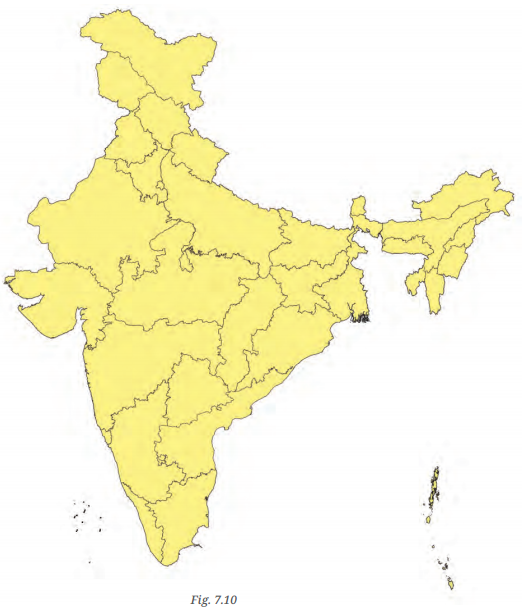
Answer:
Map is for reference purpose (Answer may vary)
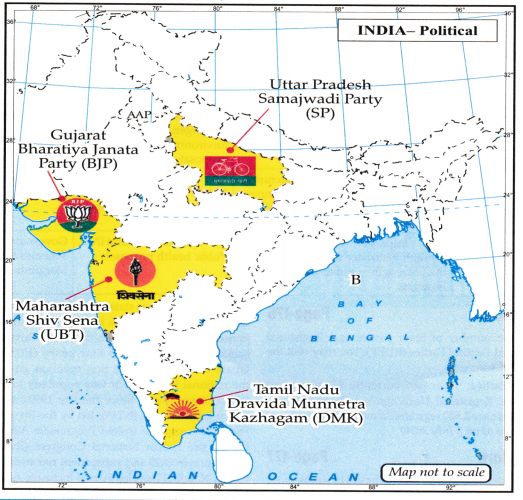
| State | State Party | Election Symbol | Major Agenda (Latest Election Manifesto) |
| Uttar Pradesh | Samajwadi Party | Bicycle | Conduct a caste census, provide legal guarantee for MSP to farmers, expand women’s welfare schemes, improve education and healthcare and promote rural development. |
| Tamil Nadu | Dravida Munnetra Kazhagam | Rising Sun ☉ | Strengthen federalism, oppose NEET and CAA, expand welfare schemes, promote social usage and support economic development and employment generation. |
| Maharrashtra | Shiv Sena (Uddhav Balasaheb Thackeray) | Flaming Torch | Create jobs0 support farmers, reduce GST on agricultural inputs, strengthen urban infrastructure and promote women’s representation. |
Question 2.
Form groups of 4-6 students. Identify and compare the policy preferences on the following parameters for two political parties in the last Lok Sabha Elections using credible sources like party manifestos, newspapers, etc. Present the points of comparison in a poster using bullet points, symbols, colour coding etc.
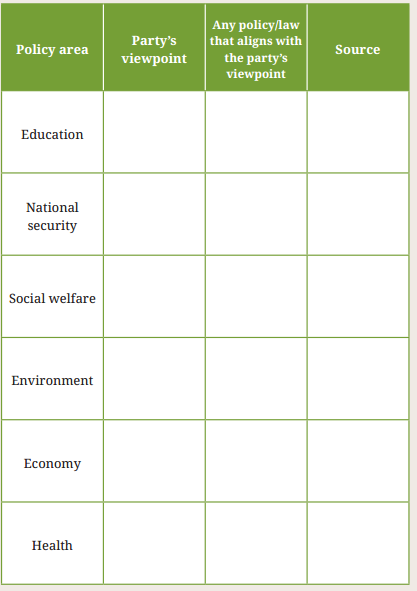
Answer:
| Policy Area | Party’s Viewpoint | Any Policy/Law that aligns with the Party’s Viewpoint | Source |
| Education | BJP: Improve the quality of education through technology and skill development. INC: Increase investment in public education and improve access for all. | BJP: National Education Policy (NEP) 2020 INC: Right to Education (RTE) Act | Party Manifestos |
| National Security | BJP: Strengthen defence and border security. INC: Modernise defence while promoting peace and diplomacy. | BJP: Agnipath Scheme INC: Defence modernisation proposals | Party Manifestos |
| Social Welfare | BJP: Welfare schemes for women, farmers and poor families. INC: Expand social welfare and employment programmes. | BJP: PM-KISAN, PM Awas Yojana INC: MGNREGA | Government Schemes & Party Manifestos |
| Environment | BJP: Promote renewable energy and clean environment. INC: Focus on climate action and environmental protection. | BJP: National Green Hydrogen Mission INC: Environmental protection proposals | Party Manifestos |
| Economy | BJP: Promote manufacturing, entrepreneurship and digital economy. INC: Create jobs and support MSMEs and farmers. | BJP: Make in India, Digital India INC: Employment and MSME support proposals | Party Manifestos |
| Health | BJP: Improve healthcare access through insurance and health centres. INC: Strengthen public healthcare and hospitals. | BJP: Ayushman Bharat INC: Public health proposals | Government Schemes & Party Manifestos |
Let’s Explore (Page-176)
Find out the number of State parties and Registered Unrecognised Political Parties (RUPP). You may visit the website of ECI.
Answer:
State Parties: There are currently 67 recognised State Parties. Registered Unrecognised Political Parties (RUPP): There are 2,520 registered unrecognised political parties. (Data as on 1 July 2026)
Let’s Explore (Page-177)
The year 1967 witnessed an end to the era of single-party dominated elections in India and an era of alliances began.
Even though various states witnessed politics of alliance starting from 1967, it was in 1977 that various political parties formed an alliance as the Janata Party against the backdrop of the National Emergency (1975-1977). The Janata Party formed the first coalition government at the national level, which was popularly known as the Janata Government. Since the late 1990s, the National Democratic Alliance (NDA), led by the Bharatiya Janata Party (BJP) and the United Progressive Alliance (UPA), led by the Indian National Congress (INC) until its dissolution in 2023 and subsequent reconstitution as the Indian National Developmental Inclusive Alliance, have been the major political alliances in Indian elections. Find out the name and the composition (number and name of the national and state parties) of the alliances that won in the following elections to the Lok Sabha.
Answer:
| Year | Alliance Won | National Parties | State Parties |
| 1977 | Janata Party Alliance (Janata Government) | 1 – Janata Party | 0 |
| 1999 | National Democratic Alliance (NDA) | 2 – Bharatiya Janata Party (BJP)
|
11 – Shiv Sena, Telugu Desam Party (TDP), Shiromani Akali Dal (SAD), Biju Janata Dal (BJD), AIADMK allies (in some states), Trinamool Congress (AITC), National Conference (NC), MDMK, PMK, INLD, Sikkim Democratic Front (SDF) Janata Dal (United) [JD(U)] |
| 2004 | United Progressive Alliance (UPA) | 2 – Indian National Congress (INC), Nationalist Congress Party (NCP) | 8 – Dravida Munnetra Kazhagam (DMK), Rashtriya Janata Dal (RJD), Jharkhand Mukti Morcha (JMM), Telangana Rashtra
Samithi (TRS), Pattali Makkal Katchi (PMK), Lok Janshakti Party (LJP), Marumalarchi DMK (MDMK), Indian Union Muslim League (IUML) |
| 2009 | United Progressive Alliance (UPA) | 2 – INC, NCP | 6 – DMK, Trinamool Congress (AITC), National Conference (NC), IUML, Jammu & Kashmir National Panthers Party
(support), Kerala Congress (M) |
| 2014 | National Democratic Alliance (NDA) | 2-BJP | 8 – Shiv Sena, Telugu Desam Party (TDP), Shiromani Akali Dal (SAD), Apna Dal, Swabhimani Paksha, Naga People’s Front (NPF), PMK, Sikkim Democratic Front (SDF) |
| 2019 | National Democratic Alliance (NDA) | 2-BJP | 16 – Shiv Sena, AIADMK, Apna Dal (S), LJP SAD, Asom Gana Parishad (AGP), PMK, All Jharkhand Students Union (AJSU), National People’s Party (NPP), NPF and others Janata Dal (United) [JD(U)] |
| 2024 | National Democratic Alliance (NDA) | 2-BJP | 9 – Telugu Desam Party (TDP), Shiv Sena, Lok Janshakti Party (Ram Vilas), Apna Dal (S), Janasena Party (JSP), Rashtriya Lok Dal (RLD), AGP, NPF, Sikkim Krantikari Morcha (SKM), Janta Dal (United) [JD(U)J. |
Let’s Analyse (Page-178)
Look at the road to free and fair elections below. Fill in the empty potholes with challenges after discussing them with your teachers and parents. How can we overcome these challenges?
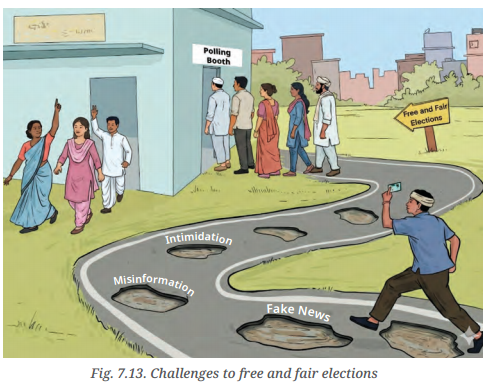
Answer:
Answers may vary:
| Challenges (Potholes) | How can we overcome them? |
| Voter intimidation | Provide adequate security, ensure secret voting and take strict action against those who threaten or influence voters. |
| Fake news and misinformation | Verify information from reliable sources and promote media literacy. |
| Money power in elections | Enforce strict election spending limits and monitor campaign expenses. |
| Voter bribery | Create awareness that accepting money or gifts for votes is illegal and unethical. |
| Low voter turnout | Conduct voter awareness campaigns and encourage every eligible citizen to vote. |
| Misuse of social media | Monitor online content and encourage responsible use of social media. |
| Criminalisation of politics
|
Ensure strict action against candidates with serious criminal records and encourage clean politics. |
| Hate speech and communal politics | Enforce the Model Code of Conduct and take legal action against those spreading hatred. |
| Violence or intimidation during elections | Provide adequate security and ensure peaceful polling. |
Questions and Activities (Page No. 179 & 182)
Question 1.
What reforms have been introduced by the Election Commission of India (ECI) to make voting more inclusive for the following groups?
a. People with Disabilities (PwDs)
Answer:
- The Saksham App helps PwDs register as voters and locate their polling stations.
- Braille-enabled EVMs allow visually impaired voters to vote independently.
- Wheelchairs, ramps, volunteers and other assistance are provided at polling stations.
- Eligible PwDs can also avail the home voting facility.
b. Service Voters
Answer:
The Electronically Transmitted Postal Ballot System (ETPBS) enables service voters to receive and cast their postal ballots electronically from anywhere outside their home constituency.
c. Senior Citizens (60 years and above; and 80 years and above)
Answer:
- Senior citizens are provided with priority and assistance at polling stations.
- Voters aged 85 years and above can opt for the home voting facility.
d. Prisoners
Answer:
- Convicted prisoners and undertrial prisoners lodged in jail are not allowed to vote.
- However, prisoners released on bail may vote if they are eligible.
e. Persons in Preventive Detention
Answer:
Persons under preventive detention are allowed to vote through the postal ballot facility.
Question 2.
What are the various functions of the Election Commission of India? Which of these functions is most important for the conduct of free and fair elections? Explain.
Answer:
Functions of the Election Commission of India (ECI):
- ECI ensures free and fair elections.
- ECI also conducts Special Intensive Revision (SIR) which involves updating, verifying and correcting electoral rolls.
- ECI supervises the preparation and revision of electoral rolls through Electoral Registration Officers.
- ECI Registers political parties and allocates election symbols. Only political parties registered with the ECI can contest elections.
- ECI monitors compliance with the legal provisions applicable to registered political parties and classifies political parties as recognised, national or state/regional parties.
- ECI acts as a quasi-judicial body in addressing disputes regarding the recognition of political parties and the allotment of symbols.
- ECI decides the election schedules and date for the elections. ECI Activates the machinery needed to conduct an election.
Most Important Function:
The most important function is conducting free and fair elections because it ensures that people can vote freely and elect their representatives without fear, pressure, or unfair practices.
Question 3.
Elections are the soul of a democracy. Do you agree? Why or why not?
Answer:
Yes, I agree that elections are the soul of a democracy as they give every citizen an equal voice in the formation of a government. Elections allow citizens to choose their representatives and hold the government accountable.
Question 4.
Explain at least three differences between the national and state/regional political parties.
Answer:
| National Party | State/Regional Party |
| A National Party is recognised by the Election Commission if it fulfils any one of the criteria for national party recognition (such as recognition in at least four states or meeting the required vote and seat share). | A State Party is recognised by the Election Commission if it fulfils any one of the criteria for state party recognition in a particular state (such as the required vote share and seats won in that state). |
| It works across many states and contests elections on national issues. | It mainly works in one state or a few states and focuses on regional or state issues. |
| It can contest elections throughout the country and aims to form the Central Government. | It mainly contests elections within its state and aims to form the State Government or represent regional interests. |
| Examples: National Parties: Bharatiya Janata Party (BJP), Indian National Congress (INC), Aam Aadmi Party (AAP), Communist Party of India (Marxist) [CPI(M)j, Bahujan Samaj Party (BSP), National People’s Party (NPP). | Examples: State/ Regional Parties: Dravida Munnetra Kazhagam (DMK), All India Trinamool Congress (AITC), Biju Janata Dal (BJD), Telangana Rashtra Samithi/Bharat Rashtra Samithi (BRS), Shiv Sena, Jammu & Kashmir National Conference(JKNC). |
Question 5.
Why should you vote? Arrange the following in the descending order of your choice. Discuss the reasons for your choice.
a. Opportunity to choose my representative
b. Makes me a responsible person
c. Opportunity to change the non-performing representative
d. Strengthens democracy
Answer:
Suggested Order:
1. (d) Strengthens democracy
2. (a) Opportunity to choose my representative
3. (c) Opportunity to change the non-performing representative
4. (b) Makes me a responsible person
Reason: Voting strengthens democracy by allowing citizens to choose capable leaders, replace those who do not perform well and fulfil their responsibility as informed citizens.
Question 6.
What is the Special Intensive Revision (SIR) initiative of the ECI? Explain the objectives and the necessity of conducting SIR.
Answer:
The Special Intensive Revision (SIR) is a special exercise conducted by the Election Commission of India (ECI) to update, verify and correct the electoral rolls. It ensures that only eligible citizens are included in the voter list and that no eligible voter is left out.
Objectives of SIR:
- To include the names of all eligible voters, especially those who have recently turned 18 years of age.
- To verify and correct the electoral rolls.
- To remove the names of deceased, shifted, duplicate or permanently untraceable voters.
- To provide citizens with an opportunity to raise claims and objections before the final electoral roll is published.
SIR is necessary because it helps maintain an accurate and updated electoral roll, ensuring that only eligible citizens can vote. This promotes free, fair and transparent elections and strengthens democracy by protecting the voting rights of every eligible citizen.
Question 7.
Match the political party name with its symbol.
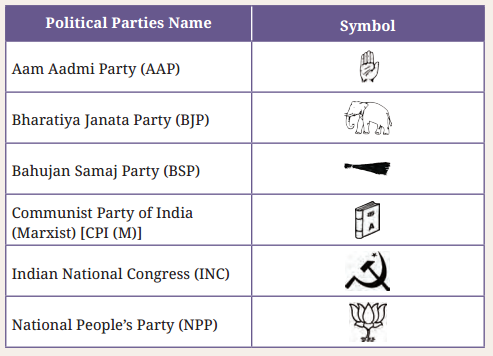
Answer:
Aam Aadmi Party (AAP) – Broom, Bharatiya Janata Party (BJP) – Lotus, Bahujan Samaj Party (BSP) – Elephant, Communist Party of India (Marxist) [CPI(M)j – Hammer, Sickle and Star, Indian National Congress (INC) – Hand, National People’s Party (NPP) – Book
Question 8.
Read the case study below and answer the following questions.
Ishani and her mother were in the local market, day before the state assembly elections. She noticed wall writing and campaign posters pasted everywhere. Large groups of campaigners were distributing pamphlets and raising slogans in support of the respective candidates. Ishani has turned 18 and will be voting for the first time. She had registered to vote through the ECI’s online portal. The next morning, she, along with her mother and her disabled elder brother, went to the polling station, which was well guarded by the police personnel. A wheelchair was made available to them and volunteers guided them to the polling booth. Inside the polling booth, there were only three people who were performing all duties. Ishani had forgotten her voter ID card and Aadhaar card, but she was surprised as no one asked for them. After casting her vote, she was also able to see the VVPAT slip. While leaving, she wondered how the police personnel vote, as they must be on duty from early morning till late evening. When she went home, she narrated her entire experience to her 89-year-old grandmother, who cast her vote from home.
a. What initiatives were taken by the ECI to enable the voters to cast their vote?
Answer:
The ECI introduced several initiatives such as:
- Online voter registration through the ECI portal.
- Wheelchair and volunteer assistance for persons with disabilities.
- Adequate security arrangements at the polling station.
- VVPAT to verify the vote.
- Home voting facility for senior citizens aged 85 years and above.
b. If Ishani was allowed to vote even without carrying her Voter ID card or Aadhaar card, which other document might she be carrying that is valid for voting?
Answer:
She could have carried any other approved identity proof, such as a Passport, Driving Licence, PAN Card, MNREGA Job Card, Passbook with Photograph issued by a Bank/Post Office, or Government-issued Identity Card.
c. Cite the examples of violations of the Model Code of Conduct.
Answer:
The examples are:
- Wall writing on public places.
- Pasting campaign posters without permission.
- Distributing pamphlets in violation of election rules (if done without permission).
d. Give a suitable title to the passage.
Answer:
“A First-Time Voter’s Election Experience”
e. Find out how the police and army personnel cast their votes.
Answer:
Police personnel on election duty cast their votes through the postal ballot or the Electronically Transmitted Postal Ballot System (ETPBS), wherever applicable. Members of the Armed Forces (service voters) also cast their votes through the ETPBS.
Question 9.
A comparative chart of three countries is given below. Based on the information given in the chart, answer the questions.
| Country A | Country B | Country C | |
| Political Dimension | Written constitution, periodic elections, voting rights, party system varies from two-party to multiparty. | Written constitution, periodic elections voting rights, one political party. | Written constitution, monarchy, no voting rights, no political party. |
| Economic Dimension | Average standard of living. | Aboveaverage standard of living. | High standard of living. |
a. What is the difference between having a voting right in a country with a multi-party system and another with a single-party system?
Answer:
In a multi-party system, citizens can choose from different political parties and candidates, giving them a wider choice. In a single-party system, only one political party is allowed to contest elections, so voters have very limited choice.
b. In which of the above countries would you like to stay and why?
Answer:
(Answers may vary): I would like to stay in Country A because it has a written Constitution, regular elections, voting rights and a multi-party system, which provide citizens with greater freedom and democratic participation.
Question 10.
What are the challenges to conducting free and fair elections?
Answer:
Some major challenges are:
- Money power in elections.
- Fake news and misinformation.
- Voter bribery.
- Voter intimidation.
- Criminalisation of politics.
- Hate speech and communal politics.
- Violence during elections.
- Low voter awareness and turnout.
Question 11.
On the Stage.
Elections are to be held in your school for the posts of Head Girl, Head Boy and Sports Captain. Assume the roles of an Election Commissioner, Returning Officer, Polling Agent, Candidate, Campaigner, Polling Officer, Police Personnel and a Journalist and perform their roles while ensuring free, fair and transparent elections.
Answer:
Sample Role Play (Answers may vary):
Election Commissioner
- Announces the election schedule.
- Ensures free and fair elections.
- Monitors the election process.
Returning Officer
- Accepts nomination forms.
- Supervises polling and counting of votes.
- Declares the election results.
Polling Officer
- Verifies voters’ identity.
- Operates the EVM and VVPAT.
- Maintains order inside the polling station.
Polling Agent
- Observes the polling process on behalf of a candidate.
- Ensures voting is conducted fairly.
Candidate
- Explains election promises.
- Campaigns peacefully and follows the Model Code of Conduct.
Campaigner
- Requests voters to support the candidate through speeches and pamphlets.
- Follows election rules during campaigning.
Police Personnel
- Maintains law and order.
- Prevents violence and ensures peaceful voting.
Journalist
- Reports election-related events impartially.
- Provides accurate information about the polling and results.
Question 12.
Try and make videos or audios on topics like: My Vote My Nation; No Voter to be Left Behind; How to Eliminate the 111 of Money Power, etc.
Answer:
Sample Script: Title: “My Vote, My Nation” (1 minute) “Voting is not only our right but also our responsibility. Every vote helps shape the future of our country. By voting honestly and wisely, we elect leaders who work for the welfare of the people. We should never sell our vote or be influenced by money, caste, or religion. Let us encourage every eligible citizen to vote because every vote counts. Together, we can build a stronger and better democracy. My Vote, My Nation!”.
Question 13.
Select one national or state political party. Using authentic and reliable sources such as the Election Commission of India (ECI) website, the official website of the selected political party and newspapers. Prepare a comparative chart of the last two State Legislative Assembly elections. The chart should include the following details for the chosen party:
a. Some promises made in the Election manifesto
b. Percentage of votes polled
c. Number of seats won
d. Number of women who contested
e. Number of women candidates elected
Present the data for both elections in a clear and comparative format, citing all sources used.
Answer:
(Answers may vary): Bharatiya Janata Party (BJP) – Madhya Prades Assembly Elections
| Particulars | 2018 Election | 2023 Election |
| Some Manifesto Promises | Better roads, employment, farmers’ welfare, women’s welfare | Women’s empowerment, welfare schemes, infrastructure development, employment |
| Percentage of Votes Polled | 41.0% | 48.6% |
| Number of Seats Won | 109 | 163 |
| Number of Women Candidates Contested | 24 | 28 |
| Number of Women Candidates Elected | 16 | 22 |
Sources:
- Election Commission of India (ECI)
- Official BJP Website
- Newspaper reports
Note: Students may prepare a similar chart for any national or state political party using authentic sources.
Question 14.
Do you think ‘One Nation, One Election’ can improve the efficiency of the electoral process? Divide the class and discuss into two groups-one to examine its potential advantages and the other to analyse its limitations.
Answer:
(Answers may vary): One Nation, One Election can improve the efficiency of the electoral process by reducing the time and cost involved on conducting frequent elections. It can help the government focus more on development work, as the Model Code of Conduct will not be enforced repeatedly. However, it also has some challenges. If an elected government falls before completing its term, conducting simultaneous elections may become difficult. It ihay also reduce attention to important state issues during elections. Therefore, while One Nation, One Election has several advantages, it requires careful planning and broad agreement to ensure that democracy remains fair and effective.
Elections Class 9 Extra Questions and Answers
Elections Class 9 Very Short Question Answer
Question 1.
Why are elections considered an essential feature of democracy?
Answer:
- Elections allow citizens to choose their representatives, who will make laws for them.
- They ensure accountability and participation in governance.
Question 2.
Name any two countries where the method of proportional representation is used.
Answer:
- Netherlands
- Israel
Question 3.
What is NOTA? Why was it introduced?
Answer:
NOTA stands for “None of the Above.” It is an option on the ballot/EVM that allows voters to reject all contesting candidates without supporting any of them. It was introduced in 2013 following a Supreme Court direction, to give voters a way to express dissatisfaction with all candidates while still participating in the democratic process, and to promote cleaner politics.
Question 4.
What is an electoral roll?
Answer:
- An electoral roll or voters list is the official list of eligible voters.
- Only people whose names appear in this list are eligible to vote.
Question 5.
What is the role of enumerators in the election process?
Answer:
- Enumerators collect, verify and update voter details.
- They help maintain electoral rolls for every election.
Question 6.
What is the purpose of delimitation?
Answer:
- Delimitation redraws constituency boundaries,
- It ensures equal representation of population.
Question 7.
What is EPIC? Why is it important during elections?
Answer:
EPIC stands for Election Photo Identity Card. It is an identity card issued by the Election Commission to voters to prevent impersonation at polling booths. Voters are encouraged to carry their EPIC while voting, though other government-issued identity documents are also accepted. EPIC helps ensure that only genuine, registered voters cast their votes.
Question 5.
How have Electronic Voting Machines (EVMs) improved the Indian electoral process?
Answer:
EVMs make the voting process faster and more accurate by reducing human errors during the counting of votes. They also help in the quick declaration of election results, making the entire electoral process more efficient and transparent.
Question 6.
What is a coalition government?
Answer:
- A coalition government is formed when multiple political parties join hands together to form a government.
- It occurs when no party secures clear majority seats.
Question 7.
What is the purpose of the Anti-Defection Law?
Answer:
- To restrict legislators from switching parties.
- To maintain political stability.
Question 8.
Who looks after the disputes related to the disqualifications that occurs on grounds of defection?
Answer:
All the disputes regarding the disqualification of members due to defection is decided by the presiding officer or speaker of the concerned House.
Question 4.
Differentiate between a one-party system and a multi¬party system, with one example of each.
Answer:
In a one-party system, only one political party is legally allowed to hold power and form the government. This is typically found in authoritarian regimes. Example: North Korea.
In a multi-party system, more than two political parties have the potential to gain control of the government, often leading to coalition governments. Example: India.
Elections Class 9 Short Question Answer
Question 1.
Explain any three ways in which elections empower citizens in a democracy.
Answer:
- Elections give citizens the power to choose who will govern and make laws for them.
- They allow people to actively participate in the decision-making process.
- Citizens can remove inefficient leaders by voting against them in the next election.
Question 2.
Explain the First-Past-The-Post system.
Answer:
- The candidate with the maximum number of votes wins the election.
- It is a simple method, widely used in populous countries like India and the UK.
- The winner does not even need half the share of total votes cast to win.
Question 3.
Why is the First-Past-The-Post (FPTP) system considered simple and practical for countries like India?
Answer:
- It is easy to understand and functional, as the candidate with the highest number of votes automatically wins.
- The process of counting votes and declaring results is quick and straightforward.
- It is suitable for large and diverse countries like India because it clearly identifies one representative for each constituency.
Question 4.
How do elections strengthen a democracy?
Answer:
- Elections encourage the citizens to participate.
- They ensure government accountability, as their power is always restricted by the fear of being removed in the next elections if they do not meet the expectations of the general public.
- They provide legitimacy to the governing authority, as they are selected by people who they will rule.
Question 5.
Distinguish between the First-Past-The-Post (FPTP) system and the Proportional Representation (PR) system used in India. Give one example of where each is used.
Answer:
FPTP is used for direct elections to the Lok Sabha and State Legislative Assemblies. The candidate with the highest number of votes in a constituency wins, even without securing 50% of the votes. Example: Lok Sabha elections.
PR (with STV) is used for indirect elections in India. Voters rank candidates in order of preference, and candidates are elected based on a quota. Example: Election of members to the Rajya Sabha and the offices of the President and Vice-President.
The key difference is that FPTP is a direct, single-member-constituency system with high vote wastage, while PR with STV is an indirect, multi-member system that reduces vote wastage and reflects party strength more proportionally.
Question 6.
How does the preparation of an electoral roll contribute to ‘fair elections?
Answer:
- It ensures that only eligible citizens get to vote.
- It prevents duplicate or fake voting by maintaining accurate records.
- It gives an equal opportunity to all qualified voters to participate in elections.
Question 7.
“Delimitation is necessary in a country like India.” Justify and support the statement.
Answer:
- It ensures that each constituency has a roughly equal population.
- It fairly maintains representation across different sections and regions.
- It adjusts boundaries according to the population changes over time.
Question 8.
Discuss the Representation of the People Acts.
Answer:
- The 1950 Act deals with voter registration, electoral rolls, procedures for delimitation of constituencies and allocation of seats in Parliament and State Assemblies.
- The 1951 Act governs election conduct, administrative machinery for elections, candidate qualifications and regulates election disputes and corrupt practices.
- These laws ensure transparency in elections.
Question 9.
How can an eligible citizen get their name registered in the electoral roll? Describe the process briefly.
Answer:
An eligible citizen can apply for inclusion in the electoral roll in two ways:
Online, through the Voters’ Service Portal or the Voter Helpline App.
Offline, by submitting Form 6 to the local Booth Level Officer (BLO) or Electoral Registration Officer (ERO).
The key steps are:
- submission of Form 6,
- verification through a field visit by the BLO,
- approval and addition of the name to the official electoral roll, and
- issuance of the Election Photo Identity Card (EPIC).
Question 10.
What are the main features of a multi-party system?
Answer:
- More than two political parties contest elections.
- Voters have multiple political choices.
- Coalition governments may be formed.
Question 11.
Why do coalition governments often demand cooperation and compromise among parties?
Answer:
- Different political parties have their own ideologies and agendas.
- They must work together to form a stable government.
- Decisions are made through mutual understanding to keep all the elected representatives together and make the government function smoothly.
Question 12.
How does a multi-party system benefit voters in a democracy?
Answer:
- It provides the voters with more choices among candidates and parties.
- It ensures representation of diverse opinions and interests.
- It encourages a healthy competition among political parties.
Question 13.
What are the grounds of disqualification of an elected legislator under the Anti-Defection Law?
Answer:
According to the Anti-Defection Law any elected legislator can be disqualified if:
- He gives up his party membership voluntarily.
- He votes against or abstains from voting in the House on any direction given by his respective political party.
- Any independently elected member joins any party.
- Any nominated member joins any political party after six months. (Any three points)
Question 14.
What is a Common Minimum Programme (CMP)? Why is it important for coalition governments?
Answer:
A Common Minimum Programme (CMP) is a shared policy agenda agreed upon by all the political parties that come together to form a coalition government. It is important because:
- It helps coalition partners who may have different ideologies agree on a common set of priorities for governance.
- It provides a framework for consensus-based decision¬making, reducing conflicts among coalition partners.
- It gives the public and the legislature clarity about the government’s policy direction despite the presence of multiple parties in power.
Question 15.
List any three criteria for a political party to be recognised as a National Party by the Election Commission of India.
Answer:
A political party is recognised as a National Party if it fulfils any one of the following conditions (any three): It is recognised as a State Party in four or more states. Its candidates secure at least 6% of the total valid votes in any four or more states in the latest Lok Sabha or Assembly elections, along with at least four MPs in the most recent Lok Sabha.
It wins at least 2% of the total seats in the Lok Sabha from not less than three states.
Elections Class 9 Long Question Answer
Question 1.
Explain the importance of elections in a democratic system.
Answer:
Elections are the foundation of democratic governance.
- Every eligible citizen gets an equal chance to choose their own representatives.
- They make governments accountable to the people, because they will always have a fear of being replaced in the next elections if they fail to perform well.
- They ensure the peaceful transfer of political power, as all candidates are free to contest elections and offer real choices to the voters.
- They encourage public participation in political processes and make politics free and fair.
Thus, elections are essential for maintaining democratic governance and public trust.
Question 2.
Differentiate between First-Past-The-Post System (FPTP) and Proportional Representation (PR).
Answer:
The First-Past-The-Post (FPTP) system and Proportional Representation (PR) are two different methods used to convert casted votes into seats in a legislative body.
| First-Past-The-Post System (FPTP) | Proportional Representation (PR) |
| This is a very simple and easy to use system where the candidate who receives the maximum number of votes in a constituency wins the election. | In this system, seats are allocated to parties in proportion to the number of votes they receive. |
| Only one candidate represents a constituency, and the winner does not necessarily need more than half the votes. | Parties or groups get seats according to their share of total votes, ensuring a wider representation. |
| Emphasises individual candidates and local constituencies. | Emphasises political parties and the overall vote share. |
| For example – India and the United Kingdom | For example – Netherlands and Israel |
While the FPTP system is simple and easy to conduct, proportional representation aims to reflect the voters’ preferences more accurately by giving parties seats according to the proportion of votes they receive.
Question 3.
Discuss the role of elections in ensuring a responsive and responsible government.
Answer:
Elections play a key role in making governments responsive and responsible to the people.
- Accountability: Leaders know they must answer to the public, as they can be removed in the next elections if they fail to perform well.
- Public Participation: Elections encourage general public to take part in governance by voting and voicing their concerns.
- Policy Improvement: Political parties focus on better policies and promises to attract voters, which makes them more responsible.
- Trust in Governance: Regular elections build confidence among citizens that their voice actually matters in decision-making.
Thus, elections ensure that governments remain answerable, active, and aligned with the needs of those who elected them.
Question 4.
Explain the role of the Election Commission of India in conducting elections.
Answer:
The Election Commission is an independent body that ensures democratic elections in India.
- EC organises and supervises elections from announcement of election dates till the declaration of* final results.
- It carefully prepares the electoral rolls to ensure that names of all eligible voters are correctly mentioned and updated.
- It further enforces election rules and Model Code of Conduct and even punishes those who violate it.
- Altogether, EC ensures that elections at every level are free and fair.
Thus, the ECI plays a vital role in protecting the integrity of the electoral process.
Question 5.
Describe the step-by-step process followed during elections in India.
Answer:
The electoral process in India follows a systematic and well-organised procedure.
- Formation of Constituencies and Preparing Electoral Roll: The country is divided into different constituencies for representation and a list of eligible voters is prepared and updated regularly for each constituency.
- Announcement of Elections: The Election Commission announces the election schedule.
- Campaigning: Political parties and candidates promote their ideologies and policies.
- Voting and Counting: Citizens cast their votes, which are later counted to declare the final results.
This structured process ensures transparency and fairness in the entire election process.
Question 6.
Explain how different authorities and officials work together to conduct elections smoothly in India.
Answer:
Elections in India are conducted efficiently through the coordinated efforts of various authorities.
- Election Commission of India: It supervises the entire election process and ensures fairness.
- Enumerators: They collect and verify the information of eligible voters to prepare accurate electoral rolls.
- Delimitation Commission: It redraws constituency boundaries to ensure equal representation.
- Government Officials: They assist in organising polling booths and managing logistics.
- Legal Framework: Laws like the Representation of the People Acts guide the entire process.
All these bodies work together to ensure that elections are conducted in a smooth, transparent, and democratic manner.
Question 7.
Describe the composition of the Delimitation Commission and explain why its decisions cannot be challenged in court.
Answer:
The Delimitation Commission is an independent statutory body responsible for redrawing the boundaries of electoral constituencies in India.
Composition:
- It is appointed by the President of India.
- It typically consists of a retired judge of the Supreme Court or a High Court as Chairperson.
- It includes the Chief Election Commissioner or an Election Commissioner.
- State Election Commissioners are included for state- level delimitation.
- It is constituted afresh after each Census to reflect updated population data.
History: Delimitation Commissions have been set up four times in India — in 1952,1963,1973, and 2002.
Why decisions cannot be challenged in court:
- The decisions of the Delimitation Commission are final and binding and have the force of law.
- This provision ensures that the process of delimitation remains free from political interference and prolonged legal delays.
- It helps maintain impartiality and public confidence in the electoral system, since constituency boundaries need to be finalised well before elections are conducted. Thus, the independent composition and legally binding nature of the Delimitation Commission’s decisions together ensure that constituency boundaries remain fair, timely, and free from political manipulation.
Question 8.
Discuss the role of political parties in elections.
Answer:
Political parties are essential for democratic elections.
- They nominate candidates who contest elections and propagate the party ideology.
- They present policies and programmes representing the interest and demands of the general public.
- They mobilise voters and encourage political participation.
- They form governments, implement policies and serve the citizens.
Thus, political parties play a vital role in democratic governance.
Question 9.
Explain the advantages and challenges of coalition governments.
Answer:
Coalition governments have both positive and challenging aspects.
Advantages:
- They represent a wider section of society and diverse viewpoints.
- They prevent concentration of power in a single party.
Challenges:
- Decision-making may become slow due to disagreements among parties.
- There can be political instability if supporting parties withdraw their support.
Thus, while coalition governments encourage inclusiveness, they also require strong coordination.
Question 10.
Discuss how the Anti-Defection Law helps in maintaining stability in the political system.
Answer:
The Anti-Defection Law plays a crucial role in maintaining political stability:
- It restricts elected representatives from switching parties for personal benefits, ensuring that governments do not become unstable because of sudden changes in support.
- It promotes loyalty and discipline among political party members.
- It discourages unethical practices like bribery or political pressure.
- It helps maintain the trust of voters who elected representatives on a specific party basis.
Therefore, the Anti-Defection Law strengthens the democratic system by ensuring consistency and stability in governance.
Elections Class 9 Competency Based Questions
Question 1.
Define the terms “constituency” and “electoral roll.”
Answer:
Constituency: A constituency is a specific geographical area created for election process. Voters of each constituency elect their representative.
Electoral roll: An electoral roll is the official list of all eligible voters in that constituency. Only those whose names are included in this list can cast their vote.
Question 2.
Explain the working of the Proportional Representation (PR) system?
Answer:
The Proportional Representation (PR) system works on the idea that political parties should get seats in proportion to the number of votes they receive.
In this system voters cast their vote not for an individual candidate but a political party. After voting, the total votes secured by each party are counted and then seats in the legislature are distributed according to the percentage of votes each party receives. For example, if a party gets 30% of the votes, it will receive around 30% of the seats.
This ensures that even smaller parties get representation if they receive a reasonable share of votes.
Question 3.
Why is it important for the Election Commission to remain independent?
Answer:
- The Election Commission must remain independent to ensure that elections are conducted without any political pressure.
- This ensures fairness in the election process.
- Its independence helps build trust among citizens and ensures that all parties get an equal opportunity during elections.
Question 4.
What is a coalition government? When is it formed?
Answer:
A coalition government is formed when a single party is unable to win a clear majority in elections on its own and then two or more political parties come together to form a government.
Question 5.
Are there any exceptions under the Anti-Defection Law? If so, elaborate them.
Answer:
There are few exceptions under the Anti-Defection Law where disqualifications do not happen.
- Merger Exception: If two-thirds of legislators of a party decides to merge with another party, then neither the members who leave nor who stay will be disqualified.
- Presiding Officer Exception: If any elected person is appointed as a chairman or speaker, they can resign from their party without disqualification and can even rejoin that party if they resign from that post.
- No Split Provision: Earlier, parties were allowed to split within the party under this law, but now this is not allowed because splits are no longer protected.
These exceptions allow practical political functioning while maintaining party discipline and political stability.
Question 6.
A village in Jharkhand notices that the constituency boundaries were changed before elections. Which institution is responsible for this process?
Answer:
The Delimitation Commission is responsible for redrawing constituency boundaries, ensuring each constituency has a balanced population for fair representation.
Question 7.
Vishal just turned 18 before the general elections in his constituency. He checks whether his name was updated in the voters’ list before voting. Which electoral concept does this represent?
Answer:
This represents the concept of the electoral roll, which is the official list of eligible voters. Only individuals whose names appear on this list are allowed to vote.
Question 8.
Read the Passage given below and answer the following questions:
With barely hours to go before Maharashtra state goes to the polls on November 20, a citizens’ group named Vote For Democracy (VFD) has raised serious concerns over the integrity of the Haryana and Jammu & Kashmir 2024 Vidhan Sabha elections.
VFD has highlighted cases of electoral manipulation, unexplained vote percentage increases, and a lack of transparency in the election process. The matter assumes significance as the states of Maharashtra and Jharkhand while they are preparing to vote in their new assemblies shortly.
“Democracy in India is at a crossroads. We cannot stand by as the integrity of our electoral system is eroded. The time for answers and reforms is now,” said the group.
(i) What concerns were raised by Vote For Democracy (VFD) regarding recent elections?
Answer:
Vote For Democracy (VFD) raised concerns about electoral manipulation, unexplained increases in vote percentages and a lack of transparency in the election process, particularly in the 2024 Vidhan Sabha elections of Haryana and Jammu & Kashmir.
(ii) Why does the issue highlighted by VFD become significant at present?
Answer:
The issue is significant because states like Maharashtra and Jharkhand are about to hold elections, and concerns over electoral integrity may affect public trust and the fairness of upcoming assembly polls.
(iii) What warning did VFD give about democracy in India?
Answer:
VFD warned that democracy in India is at a critical stage, emphasising that electoral integrity is being threatened and urgent reforms and clear answers are necessary to protect the democratic system.
Question 9.
Analyse why a multi-party system is suitable for .a diverse country like India.
Answer:
India is a diverse country with a wide range of cultures, languages, and interests. A multi-party system allows different groups and regions to have their own political representation, ensuring that all opinions and voices are heard to prevent dominance by a single party, making democracy more inclusive.
Question 10.
Evaluate whether coalition governments are always stable. Give reasons.
Answer:
Coalition governments are not always stable. While they represent diverse opinions and promote cooperation, they can face disagreements among parties and candidates. If supporting parties withdraw their support, the government may collapse causing instability. Therefore, stability depends on coordination and mutual understanding.
Question 11.
Read the Passage given below and answer the following questions:
The results of the parliamentary election have ended ten years of one-party rule of the Narendra Modi-led Bharatiya Janata Party (BJP). It has failed to cross the majority mark to form the government at its strength in the parliament.
Though the BJP-led National Democratic Alliance has the numbers to form the next government, the electoral verdict has shown the waning of the so-called ‘Modi magic1 in winning elections.
(a) What type of government is likely to be formed in this case?
Answer:
Coalition government
(b) Why did this situation arise despite one party being dominant earlier?
Answer:
This situation arose because the Bharatiya Janata Party failed to win enough seats to reach the majority mark on its own, possibly due to changing voter preferences or reduced public support.
(c) What does this outcome indicate about voter behaviour in a democracy?
Answer:
This outcome clearly highlights that voters can change their preferences over time according to the performance of the elected leaders and voters are not bound to support one party over years, reflecting the dynamic nature of democracy where public opinion plays a decisive role.