Carrier of Words Class 9 Question Answer
Reflect and Respond
I. Look at the pictures given below of persons engaged in the same profession.
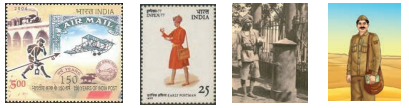
Question 1.
Which profession do they belong to?
Answer:
They all belong to the profession of a postman or postal worker. They are responsible for delivering letters, parcels, and important messages to people.
Question 2.
Do they face any difficulties while doing their duty?
Answer:
Yes, they face many difficulties. They often have to travel long distances in harsh weather conditions such as extreme heat, rain or cold. In remote areas, they may have to walk across deserts, mountains or villages where transport is limited. Their job can also1 be physically tiring.
Question 3.
How does their profession affect the people they meet?
Answer:
Their profession has a very positive impact on people. They deliver letters and messages that bring joy, hope and important information. For many people, especially in remote areas, the postman is a vital link to the outside world.
II. Discuss in Groups
Question 1.
How can ‘words’ be ‘carried’?
Answer:
Words can be carried through different means such as letters, messages, emails, phone calls, and even through people who convey information verbally. In earlier times, postmen carried words through handwritten letters, while today technology also plays an important role.
Question 2.
Who could be a carrier of words?
Answer:
A carrier of words can be anyone who delivers or communicate messages. This includes postmen, couriers, messengers, and even digital platforms like email services or messaging apps. Teachers and journalists can also be considered carriers of words as they share information with others.
Question 3.
What are the means for people to stay Connected?
Answer:
People can stay connected through letters, telephones, mobile phones, emails and social media platforms. In remote areas, traditional methods like postal services are still very important, while in cities, digital communication is more commonly used.
III. Read the words given in the box below and place them in their appropriate context in the following passage.
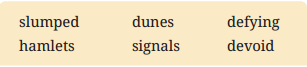
We stepped out of the vehicle at the end of the road. Immediately, our body sent 1. _________ that our decision to visit the sand 2. _________ in the afternoon was insane. We had passed a few 3. _________ on our way to the desert. We could not fid even a single soul outdoors, 4. _________ the blazing sun. Even the camels were 5. _________ in the little shade offred by the khejri trees. In this remote place people relied on Bharat Sanchar Nigam Limited (BSNL) to connect to the world as the area was 6. _________ of any other network service.
Answer:
‘We stepped out of the vehicle at the end of the road. Immediately, our body sent signals that our decision to visit the sand dunes in the afternoon was insane. We had passed a few hamlets on our way to the desert. We could not find even a single soul outdoors, defying the blazing sun. Even the camels were slumped in the little shade offered by the khejri trees. In this remote place, people relied on Bharat Sanchar Nigam Limited (BSNL) to connect to the world as the area was devoid of any other network service.
Class 9 English Kaveri Chapter 7 Question Answer
Check Your Understanding
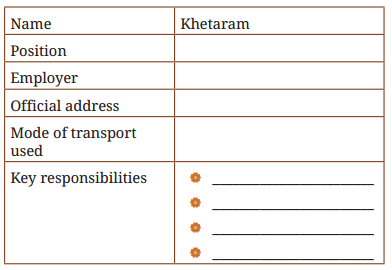
I. Khetaram needs to submit information about himself for getting an identity card. While reading the text, fill up the following information sheet for Khetaram.
Answer:
| Name | Khetaram |
| Position | Gramin Dak Sevak (Postman) |
| Employer | India’Post |
| Official address | Somarad Branch Post Office, Rajasthan |
| Mode of transport used | On foot (across sand dunes) |
| Key responsibilities | • Delivering letters and mail to remote hamlets • Carrying heavy mailbags across long desert distances • Ensuring timely delivery of mail(within 24 hours) • Acting as a link between people and their families • Delivering letters and mail to remote hamlets • Carrying heavy mailbags across long desert distances • Ensuring timely delivery of mail (within 24 hours) • Acting as a link between people and their families |
II. Discuss with your teacher.
Question 1.
Why do you think Khetaram has taken up this challenging job?
Answer:
Khetaram has taken up this job out of a strong sense of duty and commitment. His role is essential in connecting people living in remote areas with their families. Despite the harsh conditions, he continues his work because he understands its importance and takes pride in serving his community.
Question 2.
How do you think Khetaram would feel about taking up this challenging task every day?
Answer:
Khetaram would feel physically exhausted due to the extreme heat and long distances he travels. However, he would also feel proud and satisfied, as his work brings happiness, hope and connection to people. His dedication shows that he finds purpose and meaning in his work.
Check Your Understanding
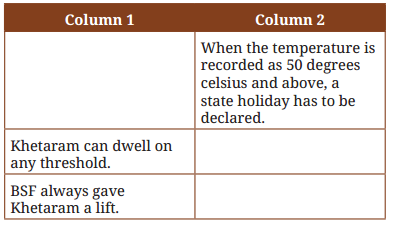
I. Complete the table given below with the situations given in Column 1 and the reasons in Column 2.
Answer:
| Column 1 | Column 2 |
| Khetaram delivers even on days when his body signals that the temperature has crossed 50 degrees, but it is recorded as 49.9 degrees. | When the temperature is recorded as 50 degrees Celsius and above, a state holiday has to be declared. |
| Khetaram can dwell on any threshold. | Villagers feel comfortable asking him to read letters and draft replies, making him a warmly welcomed man amongst the villagers. |
| BSF always gave Khetaram a lift. | The BSF personnel recognised his dedication and the difficulty of his work, so they helped him by offering him transport whenever possible. |
II. Why was a piece of jaggery offered in the village when he brought news of a birth or weddings?
Answer:
A piece of jaggery was offered because it was the only simple gift villagers could afford to express their joy and gratitude when Khetaram brought news of births or weddings.
III. How would phone lines help Khetaram in his job?
Answer:
With the arrival of phone lines, Khetaram could become a Gramin Sanchar Sewak, whose duty would involve carrying both a cell phone and letters from home to home. This would help him combine modem communication with traditional postal services, improving his role in connecting people.
Critical Reflection
I. Read the extracts given below and answer the questions that follow.
1. “Akaal or famine is a way of life here. In a good year, I get one crop ofbajra. That cannot feed my family of five. We would starve without this job,” he says. And for each family which resides ittihis arid land, survival is partly dependent on money orders remitted by a relative.
i. Complete the sentence given below with an appropriate reason.
One crop of bajra makes a little difference for people like Khetaram because _______.
Answer:
it is not sufficient to feed his family for the entire year
ii. Why did Khetaram term famine as ‘a way of life’?
Answer:
Khetaram termed famine as m. way of life’ because drought and scarcity are frequent and recurring in the arid region, making shortage of food a regular and accepted part of life.
iii. Give one reason why Khetaram had to take up a job to help his family to survive.
Answer:
Khetaram had to take up a job because his single crop of bajra was insufficient to support his family, and without his job, they would starve.
iv. Complete the analogy given below with a word from the extract.
Answer:
Other families: Money orders :: Khetaram:. this job
v. What would ‘a good year’ signify?
Answer:
A ‘good year’ would signify a year with sufficient rainfall, allowing at least one crop of bajra to grow successfully.
2. There is one letter delivery he dreads. The envelope with the right corner torn off, which signifies that the missive bears news of death. “Ashubh Samachar cannot be carried into the house,” says- Khetaram. So, he stands outside, reads out the letter twice, then tears it to bits. “Bad news must be destroyed,” he mutters philosophically.
i. Choose the correct option for the following question.
Who could have tom the right comer of the envelope?
(A) Khetaram
(B) Sender of the letter
(C) Receiver of the letter
(D) The postmaster
Answer:
(B) Sender of the letter
ii. Complete the sentence with an appropriate reason.
The most likely reason for Khetaram reading the letter twice is because _________ .
Answer:
he wants to ensure that the message is clearly understood by the family
iii. What was Khetaram’s philosophy regarding bad news, and how did he act j upon it?
Answer:
Khetaram believed that ‘bad news must be destroyed’. He followed this by reading the letter twice outside the house and then tearing it to bits after conveying the message.
iv. State whether the following sentence is true or false.
Khetaram’s action of tearing the letter differed from his beliefs.
Answer:
False
v. Mention any one aspect of Khetaram’s temperament which is revealed through this extract.
Answer:
Khetaram is compassionate, as he handles bad news sensitively to reduce the family’s distress.
II. Answer the following questions.
Question 1.
Justify the statement made by the Postmaster-General, Rajasthan Western Region stating that the role of GDS is ‘invaluable’.
Answer:
The role of the Gramin Dak Sewak (GDS) is truly “invaluable” because they reach areas beyond the last railhead and even where the road crumbles into sand, delivering mail where no other service can. They act as the only link between isolated villages and the outside world, especially for families dependent on money orders for survival. Their work goes beyond delivery—they read letters aloud, write replies for the illiterate, and handle even ‘ashubh samachar’ with sensitivity. This combination of physical endurance, social responsibility and emotional support makes them irreplaceable. Hence, their service is not merely postal but deeply human and essential to mral life.
Question 2.
How was the purpose of India Post different from that of the British postal system?
Answer:
The British postal system was designed mainly to carry official “dak” between administrative centres, serving colonial governance rather than the common people. In contrast, after Independence, India Post aimed to include the entire population in its network, regardless of remoteness. Its purpose became people-oriented, ensuring communication, financial support and connection for rural communities. This is evident in how families in remote areas depend on money orders and letters delivered by GDS workers. Thus, while the British system focused on administration and control, India Post functions as a socia*l lifeline, bridging distances and sustaining relationships across even the most inaccessible regions.
Question 3.
People trusted Gramin Dak Sewaks. Support this statement with any two instances from the text.
Answer:
People placed immense trust in Gramin Dak Sewaks as they handled both personal arid financial responsibilities with great care.
Firstly, villagers freely shared their private matters with Khetaram, asking him to read their letters aloud and write replies on their behalf. This willingness to involve him in personal correspondence reflects a level of trust that goes well beyond a professional relationship. Secondly, families in the desert depended on him to deliver money sent by relatives working elsewhere, money that was often their only means of survival in a region where farming alone could not sustain them. The fact that the community strongly opposed any attempt to replace the GDS with revenue officers-further confirms that this trust was not accidental but earned steadily over years of reliable and sensitive service.
Question 4.
Infer the most likely reason that Khetaram was grateful to continue as GDS, even after the age of 60.
Answer:
Khetaram’s gratitude stems from both economic necessity and a deep sense of belonging. Living in a region where drought is a recurring reality, a single harvest is never enough to feed his family of five, making his GDS salary the most dependable source of income he has. The provision that allows him to serve beyond sixty and up to the age of sixty-five offers him financial stability that farming in such an unforgiving land simply cannot provide. Beyond the economic benefit, over fifteen years of service have woven him into the daily life of the community. People welcome him at their doorsteps, rely on him for reading and writing, and trust him with their most personal news. This sense of being needed and valued gives his work a dignity and purpose that no retirement could easily replace. It is this combination of security and belonging that makes him genuinely grateful to continue.
Question 5.
Explain why the author payis tribute to people like Khetaram.
Answer:
The author pays tribute to people like Khetaram because they embody dedication, resilience, and selfless service in extremely harsh conditions. Walking nearly 20 km daily in intense heat and braving sandstorms, he ensures that communication reaches remote villages. His duties extend beyond delivery—he reads and writes letters for the illiterate and conveys even news of death with cultural sensitivity. Acting as a vital human link between isolated communities and the outside world, he performs his role with commitment despite minimal recognition. The author rightly calls such individuals “part and parcel of our social fabric”, as they quietly sustain and connect society.
Vocabulary and Structures in Context
I. Study the phrases given in Column 1 and match them with their meanings in Column 2.
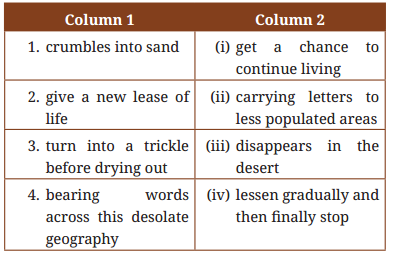
Answer:
(1 – iii), (2 – i), (3 – iv), (4 – ii)
Now, use the phrases from Column 1 in sentences of your own.
Answer:
Sentences:
i. The ancient mud house slowly crumbled into sand after years ofneglect.
ii. The timely medical treatment helped give a new lease of life to the patient.
iii. During summer, the once-flowing river turns into a trickle before drying out completely.
iv. The postman continued his duty of bearing words across this desolate geography, connecting remote villages to the outside, world.
II. Identify examples of alliteration and metaphor in the extract given below.
Khetaram’s khaki turban and uniform are his only protection against the desert’s furies, the scorching summer winds and swirling sandstorms which turn him into a walking sandman.
Answer:
Alliteration:
- “Khetaram’s khaki” (repetition of the ‘k’ sound)
- “scorching summer” (repetition of the ‘s’ sound)
- “swirling sandstorms” (repetition of the ‘s’ sound)
Metaphor:
- “the desert’s furies” — the desert is described as fierce and powerful like an angry force.
- “a walking sandman” — Khetaram is compared to a sand-covered figure due to constant exposure to sandstorms.
III. Match the words in Column 1 to what they suggest in Column 2 in the context of the chapter.
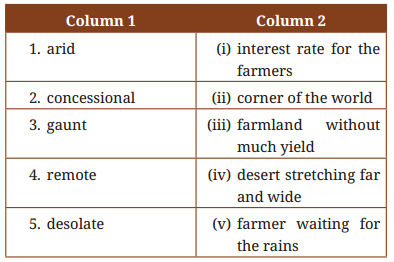
Answer:
(1 – iii), (2 – i), (3 – v), (4 -ii), (5 – iv)
Now use the words from Column 1 in sentences of your own.
Answer:
Sentences:
- The arid land made farming extremely difficult for the villagers.
- The government provided loans at a concessional rate to support farmers.
- The farmer looked gaunt after months of drought and hardship.
- The village is so remote that it has very little access to basic facilities.
- The desolate landscape stretched endlessly under the scorching sun.
IV. Now, fill in the blanks by using the present perfect form of the verbs given in the brackets to complete the following paragraph.
Answer:
I have just got a collection of postage stamps from my grandfather. He has collected these stamps over a period of 20 years. I have studied most of the stamps in his collection and loved all of them. I have begun my own collection of postage stamps. Grandfather has truly inspired me.
V. Khetaram’s nephew wants to join the GDS. He asks Khetaram how to prepare for it. Khetaram gives him the following advice.
[Note: Refer to the advice given by Khetaram in the textbook]
Now, complete the following paragraph about the advice given by Khetaram. One example has been done for you.
Answer:
To begin with, a lot of stamina will be needed for this job. Next, reading clearly A. should be practised, as you B. will be expected to read out the letters by some of the villagers. Words C. should be written neatly as you D. may be asked to draft replies by some villagers. Full-sleeved shirts and trousers E. should be worn to protect yourself from the heat.
Listen and Respond
I. You will listen to a girl talking about an
event. As you listen, fill in the blank with the suitable word from the brackets. (Transcript for teacher on Textbook page 272)
The speaker concluded her talk with a ________.
Answer:
request
II. You will listen to the girl talking about the event again. As you listen, choose the correct option for the following questions.
Question 1.
What was the occasion that the speaker was talking about?
Answer:
(iii) Indian Postal Day
Question 2.
India Post is famous for having the most extensive network _______.
Answer:
(ii) in the world
Question 3.
Letter writing is being revived as this art form has been ______.
Answer:
(iii) forgotten
Question 4.
Which of the following will be a part of the letter writing carnival?
Answer:
(i) calligraphy and graphology
Question 5.
What will the postal department add to the event?
Answer:
(i) interactive demonstratioiis
Speaking Activity
I. The postcard, inland letter, envelope, and money order form were engaged in a discussion on who the most important one was. In groups of four, select one each and reason with each other logically. You may use the points for discussion given in Column 1 and the cues given in Column 2 to express your opinion.

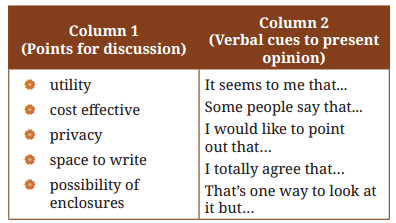
Answer:
Student 1 (Postcard): It seems to me that the postcard is the most useful for short and quick communication. It is very cost effective and easy to send. Some people say that it lacks privacy, and I totally agree that anyone can read it, but for simple messages, it works well.
Student 2 (Inland Letter): I agree that postcards are cost effective, but I would like to point out that inland letters offer more privacy and more space to write. They are also quite affordable.
Student 3 (Envelope): That’s one way to look at it, but I think envelopes are the most useful. They provide complete privacy and enough space to write. I would like to point out that they also allow enclosures like documents and photographs. Some people say they are not cost effective, and I totally agree, but their utility is greater.
Student 4 (Money Order): I would like to point out that all of you are focusing oncommunication, but the money order serves a different and important purpose. It is very useful for sending money safely. Some people say it has limited space to write, and I totally agree, but its main utility is secure money transfer, especially where digital services are not available.
[Note: The above answer is given for reference. Students are expected to do this activity in groups.]
Writing Task
On behalf of your parents draft an imaginary condolence message for your aunt on the recent passing away of her father.
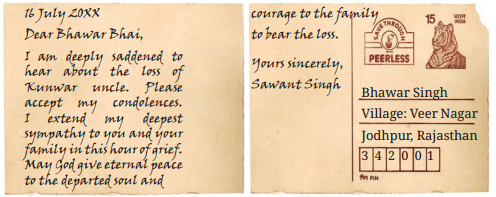
Answer:
16 August 20XX
Dear Aunt,
We are deeply saddened to hear about the passing away of your father. Please accept our heartfelt condolences. We can only imagine the pain and grief you and your family must be going through at this difficult time.
I We would like to extend our deepest sympathy to you and your family. May God give you the i strength and courage to bear this great loss. We I pray that the departed soul rests in eternal peace.
Please take care of yourself and remember that we are always there for you in this time of sorrow.
Yours sincerely,
Raghav & Family
Learning Beyond the Text
I. Study the postage stamps given below and discuss who or what they depict.

Answer:
Stamp 1 – This stamp depicts: Sarojini Naidu, a poet, freedom fighter, and the first woman Governor of an Indian state, she is fondly remembered as the “Nightingale of India”.
Stamp 2 – This stamp depicts: the legendary Indian playback singer, composer and actor Kishore Kumar.
Stamp 3 – This stamp depicts: Teej Festival, a vibrant Hindu festival celebrated by women across North India, marking the reunion of Goddess Parvati with Lord Shiva.
Stamp 4 – This stamp depicts: Painted Stork, a large wading bird (Mycteria leucocephala) native to the Indian subcontinent.
Stamp 5 – This stamp depicts: Sun Temple, Konark, a 13th-century UNESCO World Heritage Site in Odisha, built by King Narasimhadeva I.
II. Work in groups of five. Find information about stamps on the following categories and note details as directed in textbook.
- personalities: name and the fild they belong to
- celebrations: festivals/national events—name and signifiance
- centenaries: name of person/occasion and signifiance
- nature: name and signifiance
- our heritage: monuments/music/dance—name and signifiance
Now, prepare a class board on ‘Philately–Upholding Our Heritage’ with your fidings.
Answer:
| Personalities — Name and the Field They Belong To | |
| Homi J. Bhabha | Nuclear Science |
| Celebrations: Festivals/national events – Name and significance | |
| Independence Day | Commemorates India’s freedom from British rule on 15 August 1947 |
| Centenaries: Name of person/occasion and significance | |
| Birth Centenary of Jawaharlal Nehru | Honoured India’s first Prime Minister and his vision for a modem, democratic India |
| Nature: Name and significance | |
| Mangrove Forests | Highlight the ecological importance of coastal ecosystems |
| Our heritage: Monuments/music/dance – name and significance | |
| Sanchi Stupa | A UNESCO World Heritage Site; one of the oldest stone structures in India, representing Buddhist heritage |
Carrier of Words Class 9 Extra Questions and Answers
Carrier of Words Short Question Answer
Question 1.
Why is Khetaram described as the ‘sole link’ for the villagers?
Answer:
Khetaram is the only postman serving scattered hamlets in the Thar Desert where no modem communication exists. Carrying letters and money orders, he connects villagers to the outside world. His role as the ‘sole link’ highlights their isolation and complete dependence on his daily efforts.
Question 2.
What challenges does Khetaram face due to the geographical conditions of the Thar Desert?
Answer:
Khetaram walks across shifting sands where roads disappear, facing extreme heat above 50°C and frequent sandstorms. These severe conditions sometimes compel him to postpone deliveries till sunset. The harsh terrain makes travel exhausting as he carries a heavy mailbag over long distances, reflecting the severe physical challenges of desert life.
Question 3.
Why does Khetaram sometimes postpone deliveries until after sundown?
Answer:
Khetaram occasionally delays deliveries until after sundown due to extreme daytime heat in the desert, often exceeding 50°C. Cooler evening temperatures make travel safer. This shows his practical adaptation to harsh conditions while ensuring that his duties are still fulfilled.
Question 4.
What role do Gramin Dak Sewaks play beyond delivering letters?
Answer:
Gramin Dak Sewaks connect remote communities to essential services like communication, savings and financial, services. In isolated areas, they act as representatives of the state, ensuring inclusion. Khetaram’s work shows Gramin Dak Sewaks go beyond delivery to support both social and economic needs.
Question 5.
Why are money orders important families living in remote areas?
Answer:
In drought-prone desert regions, agriculture is unreliable and local income is often limited. Families depend on money orders sent by relatives working elsewhere. These payments help them survive, making the postal system essential for their financial stability and daily needs.
Question 6.
Why was the proposal to replace GDS with patwaris rejected?
Answer:
Villagers opposed replacing Gramin Dak Sewaks with patwaris begapse they trusted Khetaram’s dedication acnd reliability. His consistent service and personal connection made him irreplaceable. They believed others would not perform these duties with the same sincerity and commitment.
Question 7.
What does Khetaram’s reaction, to letters carrying bad news tell us about him?
Answer:
Khetaram reads letters bearing bad news outside the house and tears them up afterwards, believing bad news must be destroyed. This reflects his deep compassion, emotional sensitivity, and respect for people’s feelings. He genuinely understands the pain such news brings and tries to shield families from sudden shock.
Question 8.
What does the phrase “oases of humanity” suggest about the setting?
Answer:
The phrase suggests that while the vast desert is harsh, barren and largely lifeless, small villages scattered within it provide warmth, hope and emotional connection. These settlements stand out like oases, representing human life, relationships and mutual support amidst an otherwise desolate and unforgiving environment.
Question 9.
How does the story reflect the dignity of labour?
Answer:
Khetaram’s work, though physically demanding, is shown as essential and respectable. Walking across “shifting sands” in extreme heat, he performs his duty with dedication. His role as the only link between state and villagers earns him respect, highlighting the dignity of honest labour.
Carrier of Words Long Question Answer
Question 1.
Describe how the author uses contrast to emphasise the importance of Khetaram’s work.
Answer:
The author places two very different worlds side by side to show why Khetaram niatters. On one side is the connected, technology- driven urban wo’rld where a message travels in seconds. On the other is a strefch of desert so remote that roads dissolve into soft sand and bicycles are useless. It is here that Khetaram walks daily, bent under the weight of his mailbag, in heat that pushes past fifty degrees. This sharp difference between the ease of city communication -and the physical struggle of desert postal work forces the reader to appreciate what is often taken for granted. The author uses this gap to argue that progress has been uneven — and that where modem systems have failed to arrive, one man’s feet have not. Khetaram’s continued presence in such conditions makes his work not a matter of choice but of necessity.
Question 2.
Discuss how the theme of trust is developed in the story.
Answer:
The author builds the theme of trust gradually, through small but telling details. Villagers do not simply receive their letters from Khetaram, they invite him into their private lives, asking him to read 1 correspondence aloud and put their thoughts into written words. This level of closeness requires a trust that goes well beyond professional duty. The community’s fierce resistance to any official attempt to hand the GDS work over to revenue officers shows that for them, the relationship with their postman is personal and irreplaceable. Even in delivering the’ heaviest kind of news such as a death in the family, Khetaram follows an unwritten code of sensitivity, ensuring that grief is handled with dignity. The story suggests that trust of this depth is not built through systems or policies but through years of quiet, consistent, and humane service.
Question 3.
How does the story highlight the social and economic challenges of life in desert regions?
Answer:
The story treats the landscape as a force that shapes every aspect of daily existence. The heat makes washing a luxury that water cannot afford, the sand buries everything by evening, and the roads simply give out long before the villages begin. For the people who live in these conditions, farming offers no certainty; one poor season means hunger, not just hardship. Families are therefore dependent on money sent from relatives who have moved elsewhere, and that money arrives through Khetaram. The absence of schools, health centres and reliable communication in the same area shows that the desert’s difficulties are not only physical but also deeply structural. The story quietly argues that geographical isolation and poverty do not exist separately, each makes the other worse.
Question 4.
Analyse how the author blends human emotion with geographical description in the story.
Answer:
What makes the story unusual is that its geography and its humanity are inseparable. The author does not describe the desert’s heat and sand as mere background detail — they become part of the emotional weight of Khetaram’s work. The further he walks from any road or phone line, the heavier his bag feels, and the more significant each letter inside it becomes. A wedding announcement or a money order, carried across kilometres of sunbaked earth, arrives with far more meaning than the same message sent by a click. The moment where—Khetaram stands outside a door and reads a letter bearing news of death twice before destroying it—captures this blend most powerfully. The barrenness outside and the grief inside meet at the threshold, and it is Khetaram who stands between them. The author uses this interplay to show that emotion gives the landscape its weight, and the landscape gives emotion its depth.
Question 5.
“Khetaram’s work is both visible and invisible.” Explain this statement. ’
Answer:
At first glance, Khetaram’s work seems I entirely visible — a man walking across a desert with a bag on his shoulder, his footprints pressed deep into the sand by the weight he carries. The physical effort is plain to see, and even regulated, with rules limiting how much he can carry. But the more meaningful part of his work cannot be seen or measured. When he reads a letter to someone who cannot read, he is offering comprehension. When he writes a reply for someone who cannot write, he is giving a voice. When he handles a death notice with care, standing outside the home and destroying the letter afterwards, he is managing grief. None of these acts appear in any official record, yet they are what make him indispensable. The visible work keeps the postal system running; the invisible work keeps the community together.
Question 6.
Critically examine the relevance of Khetaram’s role in today’s digital age.
Answer:
It is easy to assume that a man walking through a desert with letters belongs to a past that technology has already replaced. But the story resists this assumption carefully. The phone lines that could change Khetaram’s work are still fifty kilometres away, a distance that says more about the pace of development in remote areas than any statistics could. For the families of the Thar, money orders are not a quaint old habit but the main channel through which financial support reaches them. The personal dimension of Khetaram’s work, which includes reading, writing, and comforting, is something that no app or algorithm has yet found a way to replicate in communities where literacy and connectivity are both limited. Rather than being made irrelevant by the digital age, his work exposes its limits, reminding us that progress has geography, and some places have been left outside it.
Question 7.
Evaluate Khetaram’s role as more than just a postman.
Answer:
To call Khetaram simply a postman is to describe only the surface of what he does. His official duty is to carry and deliver mail, but the community he serves has quietly expanded that role over fifteen years. He functions as a reader for those who have never learnt to read, a writer for those who cannot hold a pen confidently, and a financial courier for families whose survival depends on the money orders he brings. He is welcomed at every doorstep not out of courtesy but out of genuine reliance. His handling of distressing news with great care, reading it outside and then destroying it, shows a kind of emotional intelligence that communities in difficult circumstances develop and come to depend upon. He is, in every practical sense, a thread that holds together the social fabric of a region the outside world has largely forgotten.
Question 8.
Discuss the significance of the Gramin Dak Sewak system in promoting social and economic inclusion.
Answer:
What the CDS system achieves is something straightforward but profound. It refuses to accept that remoteness should mean disconnection. In a country where post offices grew from around 25,000 at independence to well over a lakh and a half today, much of that expansion into rural and inaccessible areas has been made possible by workers like Khetaram. For families in the desert, the money order is not a convenience but often the only economic lifeline connecting them to a relative earning wages elsewhere. The fact that an attempt to transfer this work to village record keepers was rejected, not just officially but by the community itself, shows how much the system is valued where it matters most. Inclusion, the story argues, is not achieved by policy alone. It requires people willing to walk where there are no roads, and a system that supports them in doing so.
Question 9.
Imagine you live in a remote area with limited access to communication and basic services. Reflect on how the absence of essential communication services would affect your daily life, relationships, and access to resources such as money, information, and support.
Answer:
Living in a remote area without communication services would make me feel isolated and uncertain. I would constantly worry about my family, as I wouldn’t be able to contact them or know if they were safe. Simple tasks like receiving news or asking for help in emergencies would become stressful and delayed. Managing money would also be difficult without a reliable way to receive support from others. I would deeply miss staying connected with friends and loved ones, and over time, this distance might weaken our relationships. Even small problems could feel overwhelming without proper guidance or information. Overall, life would feel slower, harder, and more lonely making me truly realise how essential communication is.